
These early mushrooms, with similar-sounding names, are often confused because they look similar. Both are spring mushrooms, and the hunt for them begins in late April, when other mushrooms are nowhere to be seen.
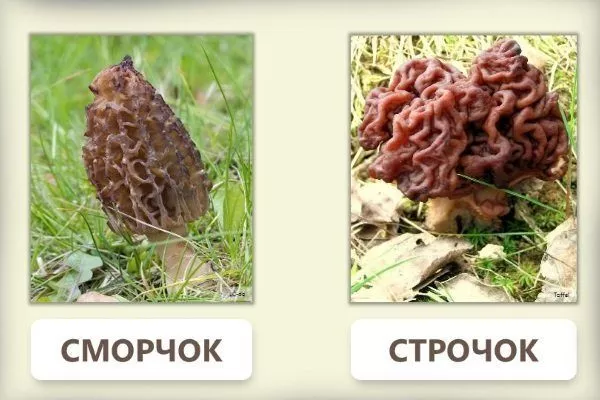
Relatives or not?
Despite the similarity of names and appearance, these mushrooms do not even belong to the same family:
- Morels are from the Discinaceae family.
- Morels are from the Morchellaceae family.
Mushroom pickers may not know which families certain mushrooms belong to, but it's much more important to remember what they eat—morels—and it's best to avoid gyromitra, as it's responsible for too many poisonings.
Which of them is poisonous?
Morels are suitable for a variety of dishes. Some are considered edible, while others are considered conditionally edible. Gyromitra are strictly prohibited from being eaten raw—they are poisonous. Some varieties are permitted for culinary use, but only after special preparation.
The poison content of morels is variable—it changes depending on the growing location and the weather. They are especially toxic during dry springs.
- ✓ Always check the mushrooms to make sure they match the description
- ✓ Avoid picking mushrooms in dry conditions
Morels are full of gyromitrin, a poison that persists even after prolonged boiling. In some countries, morels—in their entirety—are considered poisonous mushrooms.
Comparison of external features
Confusion between mushrooms with funny names can end in disaster – morels are deadly without special treatment, which not all mushroom pickers are aware of. Table 1 provides a comparative analysis of morels and morels by appearance:
Table 1
| Comparative features | Morels | Lines |
| Hat - what does it look like? | Elongated, cone-shaped. Shaped like an egg. Less commonly, it's spherical or flattened. | Shapeless and lumpy, worn on a leg like a turban. |
| Hat size | In diameter – 3-7 cm, in height – 3-8. | Spherical caps are 2-10 cm in diameter, sometimes reaching 13 cm. |
| Fruiting body | Hollow | Filled with convoluted pulp, with separate cavities. |
| Pulp | When cut, it is whitish. It is tender and crumbles easily. | Delicate, fragile. |
| Leg | Fine-grained, white. Height – up to 10 cm. Diameter – 3 cm. Not buried in the ground, but protruding from the soil, moss, and pine needles, it is clearly visible from afar. | The stem is short and swollen, completely buried in the ground, mossy, or pine litter. |
| Hat drawing | The surface is covered with cells of varying sizes. | Covered with wavy stripes, the hat resembles a brain or a walnut. |
| Cap color | Can vary from ochre-yellow to grey and brown. | The color is dark - brown, brownish, brownish-red. |
| Smell | Bright mushroom flavor - pleasant. | Barely noticeable.
Associated with dampness |
What types of morels are there?
It would be simpler if gyromitra and morels existed in the same species, but these mushrooms have several varieties with distinct appearances. By learning the characteristics of the most common gyromitra and morels, you can easily identify the mushrooms found in our forests.
Morel mushroom
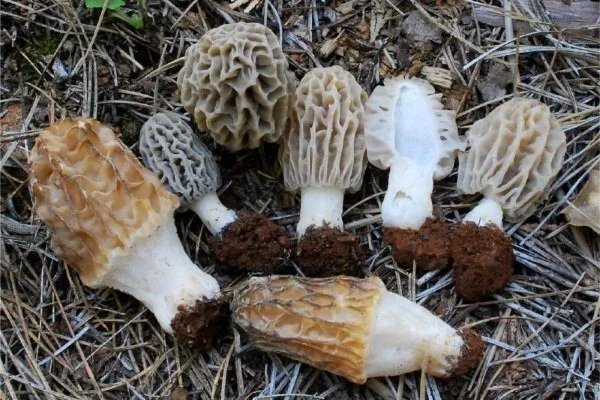
Morchella esculenta. Its cap and stem merge into a single mushroom body. Distinguishing features of the common morel:
- Hat. Cellular, ovoid. Hollow inside.
- Leg. Long, whitish in color, reaching up to 10 cm. The cap color ranges from yellowish to brown.
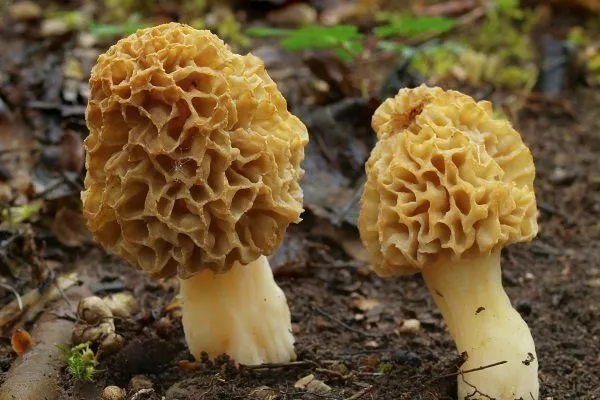
Slugs and snails hide in morel caps, so morels are thoroughly washed before consumption.
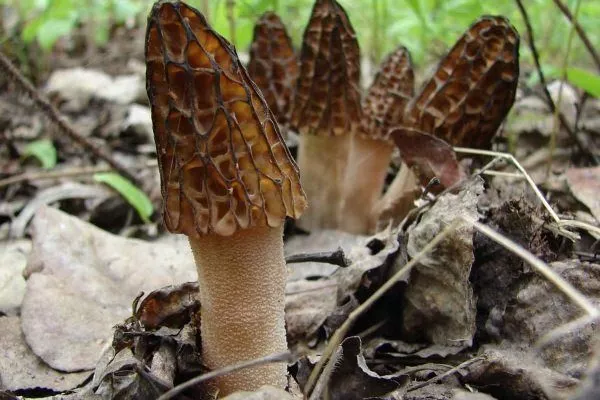
Conical morel
Morchella conica. The stem and cap are fused into a single fruiting body. Conical morels can be distinguished by the following characteristics:
- Hat. Hollow and honeycombed. It differs from the common morel by its pointed cap. Its height is 3-9 cm, or two-thirds of the morel's total length. Its color ranges from yellow-brown to black-brown.
- LegCylindrical, hollow inside. Height – 2-4.5 cm, thickness – 1.5-3 cm. The surface of the stem is velvety due to longitudinal grooves. Color – white to yellowish.
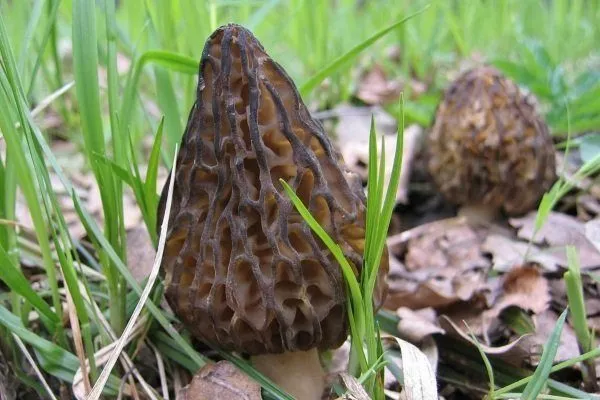
Morel mushroom
Morchella elata. It is very similar to the conical morel. However, its cap is darker and the fruiting body is larger. The mushroom grows up to 25-30 cm in height.
- Hat. A long mushroom with a conical cap – 4-10 cm tall and 3-5 cm wide. The cap is covered with triangular, olive-brown cells. As the mushroom matures, the cells turn brown or blackish-brown. The partitions are olive-ochre.
- Leg. It reaches a height of 15 cm, it is initially white, and over time it acquires ocher shades.
Morel
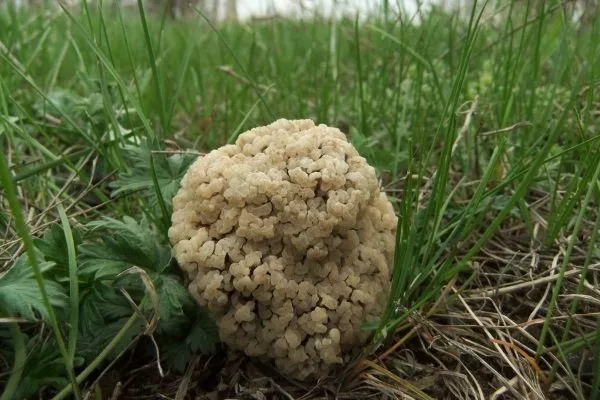
Morchella steppicola. This is the largest morel found in Russia. Its cap has a very pronounced convolution.
- Hat. Spherical. This is the main difference; the caps of other species are elongated. The color is gray-brown. The cap diameter is 2-10 cm, the height is 2-10 cm. The maximum diameter is 15 cm.
- Leg. Color: white. Distinguished by its short length—only 1–2 cm. Inside, there are hollow spaces.
With such external characteristics - a short stem and a spherical cap, the steppe morel can easily be confused with a gyromitra - be vigilant!
The mushroom reaches a height of 25 cm and grows up to 2 kg.
What types of lines are there?
Lines come in a variety of forms, each with distinct appearance. Let's look at some common types.
Common morel
Gyromitra esculenta. Rarely grows in forests. Prefers sandy, unsodden soil. Fruiting occurs from March to May.
- Hat. 2-13 cm in diameter. Shape – irregularly round. Chestnut-brown.
- Leg. Height: 3-9 cm. Diameter: 2-4 cm. Whitish, grayish, or yellowish. Often flattened. Hollow inside.
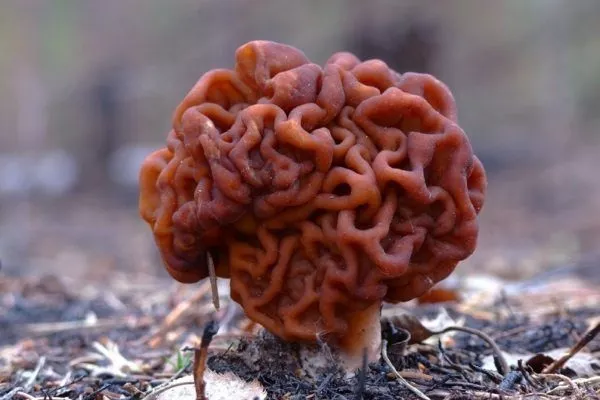
The pulp is waxy, and the smell cannot be called unpleasant – it can deceive an inexperienced mushroom picker.
Giant morel
Gyromitra gigas. The fruiting body, as expected of a morel, resembles the sinuous kernel of a walnut.
- Hat. In sinuous stripes. Inside are cavities. The shape is irregularly spherical. It has a folded structure. The color is yellowish. The cap diameter of mature giants is 7-30 cm.
- Leg. Short, only 2-3 cm tall, sometimes completely invisible. Hollow inside, whitish in color.
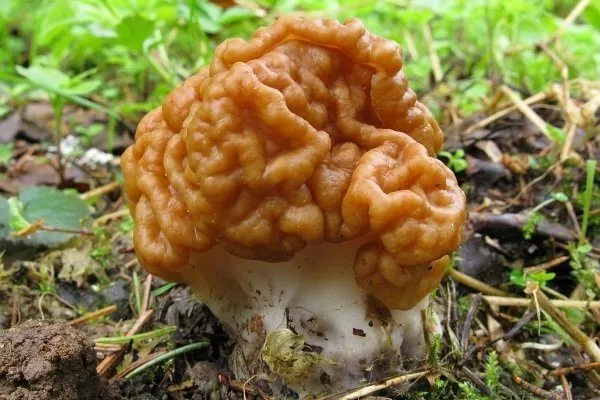
Giant morels are edible, as they contain less gyromitrin than other species. However, they must be thoroughly boiled before consumption. Another theory is that morels are poisonous and should not be eaten.
The giant morel, unlike the common morel, has a larger and lighter cap. It grows most often under birch trees. The flesh, thin and crisp, has a pleasant mushroomy aroma, although morels usually have an unpleasant odor.
Autumn morel
Gyromitra infula. This bizarre mushroom is often called the "horned" mushroom due to its unusual cap shape. Its appearance:
- HatIt reaches 10 cm in width. Its shape is folded. Initially, it is brown in color, becoming darker—brown-black—with age. It has a horn-saddle shape. The mushroom usually has three fused "horns." The surface is velvety.
- Leg. Length: 3-10 cm. Width: 1.5 cm. Hollow inside, sometimes flattened. Color: from white to brownish and gray. Cylindrical shape, the stem is thicker at the bottom.
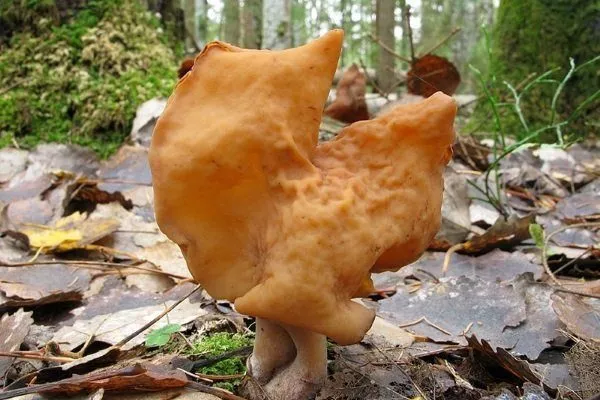
The mushroom's flesh is brittle, crumbly, and waxy. It has no distinct aroma. It can't be confused with a morel—unlike other gyromitra, this mushroom grows in July and August. It's extremely dangerous.
Where do morels grow?
They grow in any forest. However, different species prefer certain trees, for example:
- Conical morel, most often found in pine forests, less often in deciduous forests. It prefers clearings, shrubs, and willow thickets, but can also grow in gardens and fields.
- Gray giant morel It's not particularly picky about soil and terrain—it even thrives in clayey wastelands. It can be found in poplar groves and shelterbelts.
- Morel capAvoids shade. In early May, it grows in burnt-out areas, clearings, and near roads.
Growing conditions:
- They love moisture. In high humidity, they grow even in treeless deserts.
- In early spring, while the soil is moist, the mushroom grows in almost any conditions – it can even be found in your own garden or vineyard.
- If you're looking for a large harvest of morels, it's best to look for them in well-lit clearings and burnt areas.
Morels, unlike other mushrooms that bear fruit for two to three months, appear for a very short time. As soon as the spring moisture drains from the soil, morels disappear. They appear only once a year – for a couple of weeks.
In good weather—when it's warm and damp—harvests can be enormous. But few people go mushroom picking in the spring. So morel mushrooms often go untouched. Why aren't they picked? Perhaps because they're unattractive, because they grow out of season, and, most importantly, because many fear poisoning. But if you understand their external characteristics, it's virtually impossible to confuse edible morels with dangerous gyromitra.
A "silent hunter" explains the difference between morels and gyromitra, how they grow, and how to find them:
Where do morels grow?
They grow in the same places as morels. Gyromitra emerge in late April, in pine forests, choosing sunny spots. These mushrooms, like morels, come in different varieties, and each has its own preferences, for example:
- The giant morel grows in pine forests and in plantings for the cultural cultivation of butter mushrooms.
- The autumn morel grows in any forests – coniferous and deciduous, and loves rotting wood.
Is there a difference in taste?
Gyromitra and morels are similar in many ways, but their main common denominator is their superb, rich mushroom flavor. Connoisseurs will never trade these crisp-fleshed spring mushrooms for champignons and oyster mushrooms grown on a substrate. About the flavor:
- Morels. They have a wonderful taste, especially delicious when fried or stewed.
- LinesThey are just as tasty as morels. It's easy to see that if you eat a conditionally edible mushroom, it tastes excellent. Morels are used to make soups, sauces, and stuffings; they're also fried and baked. Importantly, long simmering doesn't detract from the flavor of these unusual mushrooms.
Is there a difference in cooking morels and gyromitra?
Morels are conditionally edible mushrooms. They can only be eaten after cooking. They contain a small amount of a toxic substance called hydrazine. The cooking methods for morels and gyromitra are similar:
- MorelsThey can only be cooked after boiling. Cooking time is 15-20 minutes. The mushroom's fruiting body also loses its toxin during drying, so morels can be dried. Boil them in salted water. Discard the broth, and rinse the mushrooms under running water. After this, the mushrooms are ready for further cooking—they can be fried, stewed, pickled, or frozen.
The procedure of boiling morels is mandatory for any form of mushroom preparation; they are not boiled only before drying.
Morels are not recommended for use in soups or entrees, as they lose their flavor and aroma. Morels are also used to make a powdered seasoning! - Lines. They are always boiled. Whether to eat morels or not is a personal choice. Scientists have found strong toxins in morels, but many people still pick and eat these spring mushrooms. Processing instructions for the mushroom:
- For 1 kg of mushrooms, use 6 liters of water. For 100 g, use 2 liters.
- Add a pinch of baking soda to the boiling water. Only then add the mushrooms.
- After boiling the mushrooms for 20 minutes, drain the water. Rinse the boiled morels.
- Unlike morels, gyromitra are boiled twice.
Gyromitra, like morels, can be dried. Both mushrooms shouldn't be eaten immediately after drying—you need to wait at least a month. Gyromitra takes a very long time to dry in the oven, setting the temperature to 55 degrees Celsius (123 degrees Fahrenheit). Air-dried gyromitra can take up to six months.
- Call an ambulance immediately.
- Save a sample of the mushroom for identification.
Morels and gyromitra have a lot in common, but knowing their distinctive features will help you easily tell them apart. If "silent hunting" is your hobby, you should be armed with knowledge that will help you recognize danger.
We were in the forest in May and collected a lot of morel mushrooms and morel caps: https://www.youtube.com/watch?v=kio1ymL4VeI