
The catfish is a unique fish in every way. It's completely unlike any other freshwater fish—it has no scales or a normal tail. However, it does have long, fleshy whiskers—two pairs in total. But what makes the catfish unique is its weight. Specimens weighing 300 kg have been recorded.
Description of catfish
The catfish is the largest freshwater inhabitant. True, the beluga is just as heavy. However, it is an anadromous fish, entering rivers only to spawn. Among permanent river dwellers, the catfish is unmatched in weight and size. The meat of this wonderfish is unusual – it is exceptionally fatty and tender. It is used in various dishes, canned, salted, and dried.
The Latin name for the catfish is silurus glanis. Classification of the common catfish:
- Class – Pisces.
- Order – Catfish (Siluriformes).
- Family – Catfishes (Siluroidea).
- Genus – Soma (Siluridae).
- Species: Common catfish (Silurus glanis).
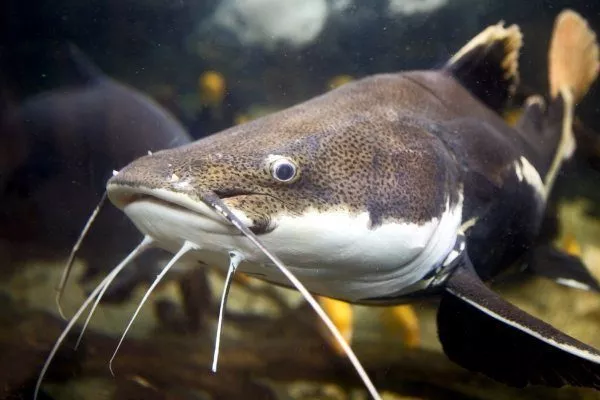
The common or European catfish is found in Russian waters. It belongs to the catfish family.
External signs:
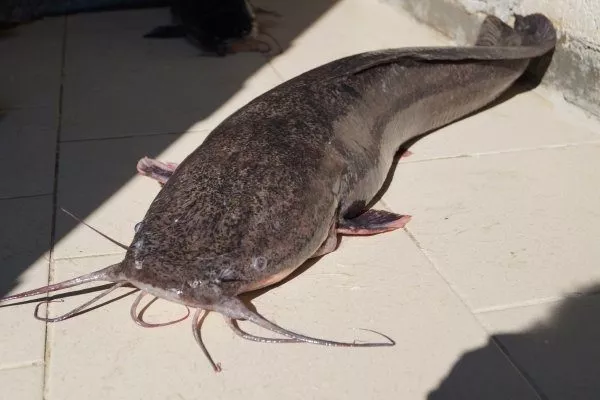
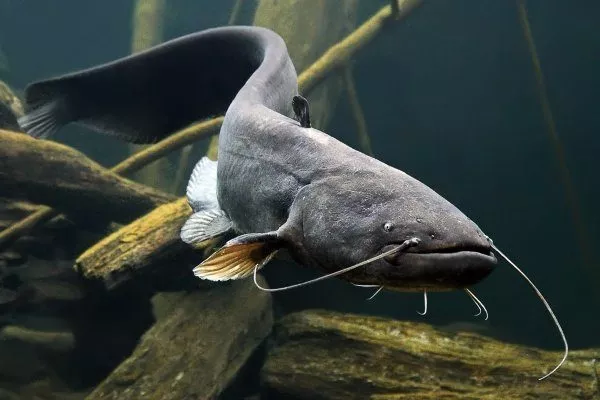
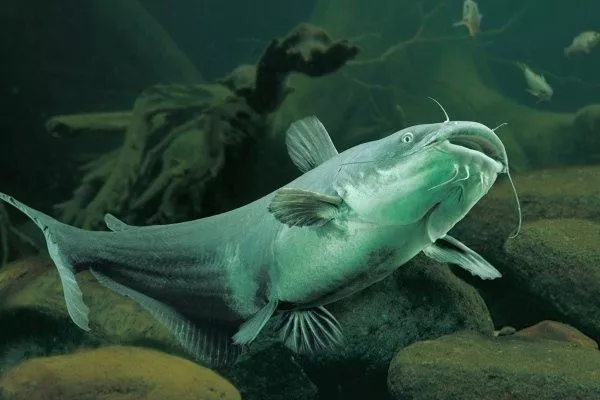
- The coloration is brown, with predominantly brownish-green hues. The belly is white. The coloration depends on the habitat and can vary from light yellow to black. Albinos are very rare among catfish.
- There is no adipose fin. The caudal fin is very short. The anal fin is long.
- The body is covered with mucus. There are no scales.
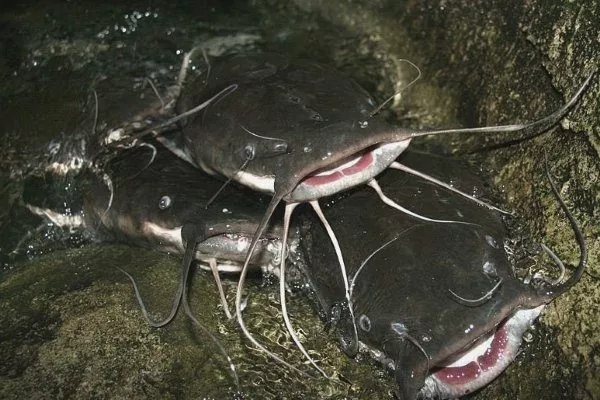
- The head is broad and flattened. The mouth is enormous. Two large whiskers extend from it, and on the chin are two more pairs of smaller whiskers.
- The tail is unlike that of a fish; it is very long and flattened on the sides. The tail is more than half the length of the body.
- The eyes are set wide apart and close to the upper lip.
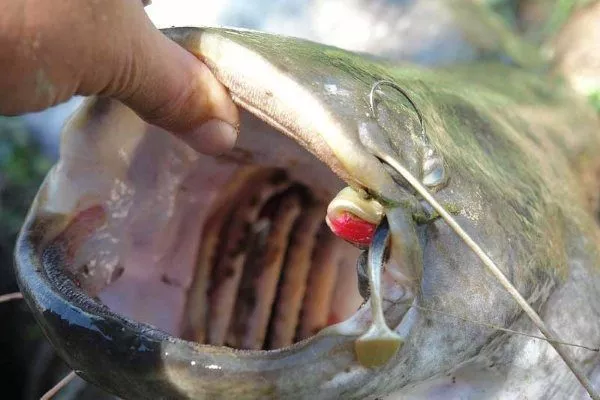
- The lower jaw protrudes forward. The mouth contains numerous small, sharp teeth, which catfish use to grind up coarse food.
The sizes and weight of catfish are in Table 1.
Table 1
| Maximum length | Weight Limit | ||
| historical | modern | historical | modern |
| 5 | 2.5 | more than 300 | 150 |
Such large catfish are rare today; fishermen usually catch fish weighing 10-20 kg.
The largest catfish, weighing over 300 kg, were caught in the 19th century in the Dniester and Oder rivers. The officially recorded catch weighed 306 kg. It was 3 m long and approximately 80 years old.
The European catfish is a sedentary fish. Once it chooses a hole, it remains faithful to it for its entire life, never changing its location.
Habitat
Catfish inhabit rivers and lakes throughout the European part of Russia. They are absent only from the Arctic Ocean basin. This freshwater giant is a heat-loving species, so it is most often found in bodies of water belonging to the basins of warm seas – the Aral, Black, Caspian, and Azov. It is rarely found in the Baltic Sea, and when encountered, it is usually of small size.
Amur catfish inhabit Siberian rivers. They differ from the European species in appearance, including coloration and size. Amur catfish are not as large as the European catfish.
Most catfish are found in rivers of southern latitudes—the Volga, Kuban, Don, Dnieper, and Ural Rivers. This fish tolerates slightly brackish water, so it can be found in river estuaries and in slightly saline seas.
Where do they live?
Catfish wisely stay in deep water. Their large size and caution force them to stick to the bottom. They feel uncomfortable in shallow water. They are afraid of light. Catfish are predators that hunt at night. For rest, they choose the darkest and deepest places in bodies of water.
Catfish live in pits where sunken logs, trees, and snags accumulate. If the river is shallow, these giants hide in beaver pits. They seek out any depressions where they can hide. While it's daylight outside, the catfish lie in their shelter, resting and digesting their food. As soon as darkness falls, the barbel goes hunting—surely something will fall into their enormous jaws.
Types of catfish
There are approximately 30 families in the order Siluridae. However, only the common and ictalurid catfishes have the characteristic "catfish" appearance. Besides the common (European) catfish, several other interesting representatives of the Siluridae family can be found in waters across Russia and around the world.
Soldatov's catfish
Soldatov's catfish (Silurus soldatovi) is a large scaleless fish. Characteristics and life history facts about this species:
- Length – up to 3 m, weight – 80 kg or more.
- Similar in size and coloring to the European catfish. The back and sides are gray-brown, with streaks. The belly is light.
- It feeds on fish, but can also swallow waterfowl.
- Usually hunts at night.
- In autumn it goes into deeper waters, where it mainly lies dormant.
- Doesn't eat in winter.
- Matures in the 4th year of life. Lives 30 years or more.
Soldatov's catfish is a rare fish listed in the Russian Federation's Red Book. Its population is constantly declining. Its fishing is prohibited by law.
The fish's habitat is the Amur River basin, the Ussuri River, and Lake Khanka. It spawns in June and July, entering coastal thickets. It lays its eggs on plants, among which it constructs a kind of nest.
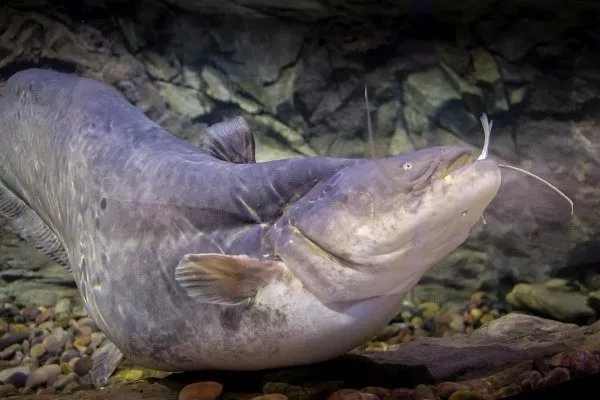
Amur catfish
The Amur catfish (Parasilurus asotus) is not afraid of brackish water. It is also known as the Far Eastern catfish.
External signs:
- It reaches 1 m in length and weighs 6-8 kg.
- The head is large, wide, flattened.
- The body tapers toward the tail. There is a small fin on the tail.
- Body color: dark green. Belly: light.
- The anal fin is large, almost reaching the caudal fin.
- The lower jaw protrudes forward. There are two pairs of whiskers on the muzzle.
Behavioral features and habitat:
- Loves warm waters.
- Prefers still or slowly flowing water.
- In summer, it goes into channels, floodplains and coastal areas.
- In autumn it goes deeper.
- Does not build a nest.
- It hunts from ambush in the evenings and at night. Its diet consists primarily of small fish, mollusks, frogs, and crayfish.
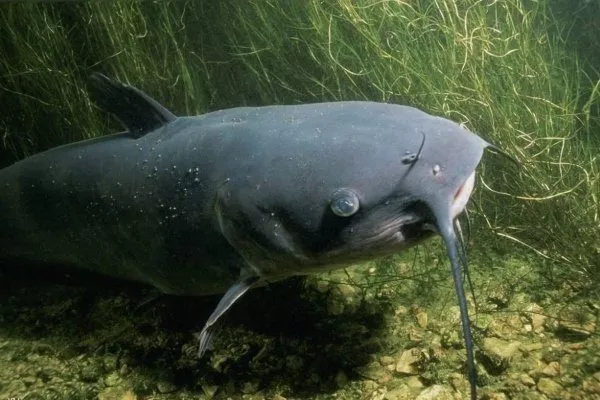
Sexual maturity occurs in the fourth year of life. Spawning season is from late May to the first half of July. Males do not guard the eggs, which are laid on aquatic plants.
Commercial fishermen catch approximately 10 tons of Amur catfish annually. The fish is a popular target for both sport and recreational fishing.
The catfish is native to the waters of Japan, China, and Korea. In 1933, 22 spawners were released into the waters of Primorye. The catfish reached Lake Baikal and spread throughout Primorye. It is considered a valuable commercial fish. The meat is tasty, medium-fat, and has few bones.
Channel catfish
The channel catfish (Ictalurus punctatus) is a fish of the Ictaluridae family. It is a representative of the North American catfish family and is commercially harvested.
External signs:
- Body length – up to 132 cm. Usually – no more than 57 cm.
- Maximum weight: 4.5-9 kg. Throughout the history of the fishery, the largest channel catfish was a specimen weighing 26 kg.
- The body is dark in color—blue-olive, gray, black. The belly is light. There are spots on the sides.
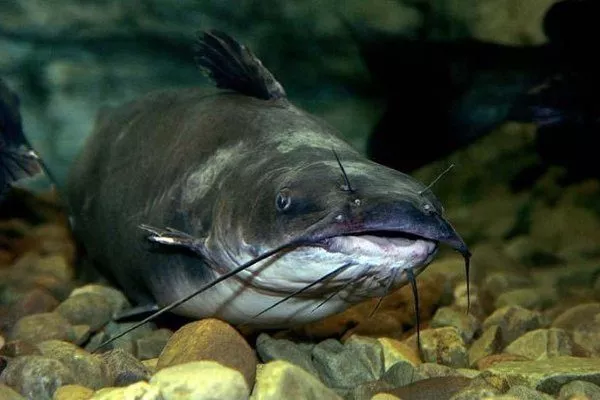
Omnivorous, it feeds on fish, mollusks, insects, and small mammals. It is found in the United States, southern Canada, and northern Mexico. Since 1972, channel catfish have been bred in Russia, particularly in the Kuban region. From ponds, they have migrated to the Don and Kuban rivers. They are also bred in the Moscow region and the Urals.
African catfish
A heat-loving fish native to the Jordan River and waters of South and Southeast Asia. It resembles the common catfish in appearance. It has an elongated body, slightly flattened laterally. It is also known as the Sharmut. It is capable of breathing atmospheric air. In addition to gills, it has African catfish There is an organ permeated with blood vessels - this is the prototype of the lung, which allows the fish to survive in the air for 15-45 hours.
The lifestyle of the common catfish
Catfish are homebodies. They rarely travel far. These giants don't leave their nests for decades. They remain in their dens, emerging only to hunt. Due to their intimidating appearance and size, catfish are incapable of pursuing fish for long periods, so they catch fish by suddenly attacking from ambush.
Spring-summer
With the arrival of spring, when the flood begins, the catfish leaves its nesting hole. It moves upstream, enters floodplains and floodplain lakes, where it spawns.
About a month passes from the moment they awaken from hibernation until spawning. During this time, the catfish eats a lot, making up for the hungry winter months by eating fish and other creatures they can find. All summer long, the catfish actively hunts, preparing for winter.
Hunting strategy:
- Swiftly rush into a school of fish swimming past, or pounce on a single fish that has come close enough for a throw.
- The powerful flexible tail is used to stun several fish at once if an attack is made on a school.
- Large catfish are clumsy and rarely manage to catch fish. These giants have to make do with amphibians and mollusks.
- Large catfish prey on young fish. They lie with their mouths half-open, and when a school approaches, they inhale the water along with their prey.
Other behavioral characteristics of catfish:
- It's not that catfish are entirely nocturnal. They often "wander" at dawn. Sometimes, however, they appear on the surface during the day, revealing their dark, slippery sides.
- Catfish can be seen—and not only during spawning season, basking in the sun. They surface and lie belly-up. There's a saying that the appearance of catfish during the day is a harbinger of inclement weather.
- If there are prolonged rains and floods, and the water becomes muddy, the catfish is forced to leave its hole - it looks for a quiet backwater, goes to places where there is no turbidity.
- Catfish hunt nightly. Specimens weighing 16 and 32 kg emerge from their hiding places at sunset. First, the catfish circles its "nest," then swims upstream in search of prey. Hungry fish can sometimes travel very far from their nest in search of food. But regardless of the distance, the catfish always returns home in the morning.
Autumn-Winter
Catfish love warmth—almost all species of the catfish family are native to tropical zones. Therefore, they cease their active lifestyle early. As early as September, they head to their wintering grounds. From October to November, depending on climate conditions and water temperature, the catfish, having fattened up over the summer, stop hunting.
It settles into hibernation in pits, and does so earlier than other fish. The giant burrows its flat head into the mud. The sleeping predator becomes completely harmless to the small fish and other creatures that make up the barbel's daily diet.
Sexual maturity and spawning period
As soon as spring arrives, catfish set out to find a secluded spawning site. Spawning begins during the spring floods. If spring arrives early, spawning begins in May. Favorable spawning temperatures are 14-16°C.
Catfish reach sexual maturity in their third year. They can reproduce when they reach a weight of approximately 3 kg and a length of 60 cm. Fish of the same age group gather in groups. Females seek out males of a similar age and size for mating.
Small males risk being swallowed by females during mating season, as the number of contenders dwindles.
Catching catfish is prohibited by law during the spawning season. Fines include dozens of minimum wages and confiscation of fishing gear. The ban is imposed for 20 days. The ban is categorical: fishing is prohibited even from the shore, even with a single line.
Catfish carefully select a spot to spawn. The female lays her eggs on aquatic plants growing in the coastal zone. Ideal conditions for spawning are a weak current, or even better, a complete lack of one.
To lay eggs in shallow waters, catfish go:
- in the reeds;
- to flooded meadows;
- into the thickets of grass and algae.
In deep bodies of water, catfish look for pools or flooded ravines.
Once the female has chosen a male to her liking, the pair retreat to a secluded spot to spawn. The catfish, using its powerful fins, prepares a nesting hole, using tree roots and straw. Spawning occurs at night, before dawn. The eggs are large and few in number. The number of eggs depends on the size of the female.
After fertilization, the eggs are coated with mucus, which holds them together and allows them to adhere to the surface of plants or driftwood. The parents watch over the nest for about a week, driving away dangerous and curious inhabitants of the water. When the fry hatch, the parents swim away to their favorite holes. After spawning, the couple rests in deep water, not even rising for food. Only after 1-2 weeks do they venture out in search of food.
What does catfish eat?
A catfish's diet depends on its age. Young catfish feed on:
- planktonic crustaceans;
- leeches;
- mosquito larvae;
- tadpoles;
- small water beetles.
| Age of catfish | Basic diet | Additional nutrition |
|---|---|---|
| Fry (up to 4 cm) | Plankton, mosquito larvae | Microscopic crustaceans |
| Juveniles (4-15 cm) | Small aquatic insects | Tadpoles, leeches |
| Teenagers (15-60 cm) | Small fish | Crayfish, mollusks |
| Adults (1-3 m) | Large fish | Birds, rodents, frogs |
| Old individuals (3+ m) | Carrion | Organic waste |
Growing catfish quickly develop predatory tendencies. Upon reaching 4 cm in length, the young predators begin hunting the fry of other fish. As they mature, the catfish begins to feed primarily on fish. Their diet is supplemented by:
- frogs;
- crayfish;
- mollusks.
Catfish become fully developed predators by the age of three. Once sexually mature, they continue to grow. An adult catfish's diet includes a variety of protein-rich foods:
- fish;
- crustaceans;
- mollusks;
- birds;
- rodents;
- frogs;
- small mammals;
- large insects.
If the prey is large, the catfish can't eat it immediately. Instead, it waits for the dead creature to rot and decompose. For this reason, catfish are often called scavengers.
The catfish won't starve—if the pond is short on fish and other large prey, it will devour any organic matter. If regular food is unavailable, the giant can eat ordinary bread.
Catfish fishing
The best time to fish for catfish is summer. Catching this fish is every angler's dream. Numerous methods have been devised for catching these giants. Catfish are the most coveted trophy in fishing.
What you need to know when preparing for fishing:
- The rod and reel must be ten times more powerful than the tackle for catching pike.
- The braided cord should have a diameter of at least 0.3-0.5 mm.
- It is almost impossible to pull the giant ashore, so a boat is needed.
- After "riding" the fisherman in the boat, the catfish weakens over time. Inexperienced fishermen should remember that a fight with a catfish is life-threatening.
When fishing, the rod should be tied to a stake driven into the ground or to sturdy branches. Even fish weighing 4 kg bite very quickly, instantly tearing the rod from its place.
Silicone baits
Catfish, like any predator, bite on any attractive bait, but the best results are shown by rigs with jig baits (silicone).
Catfish bite on any silicone bait:
- twisters;
- vibrotails;
- reapers.
The sinker is selected proportionally to the hole's depth. If the depth is greater, a sinker weighing 30-40 g is used. The optimal bait size is 15-20 cm. If the catfish swallows the bait, a strong hookset is required. The angler should be prepared for strong resistance.
Spoon
Catfish respond particularly well to large spoons. Spoons have a wide surface area, which prevents slow retrieves in currents. Spoons are recommended for fishing in pits—where the water is still and stagnant.
Examples of suitable lures:
- Storling 25 g. The classic option. For catfish, use a palm-sized spoon. A spoon with a noticeable concavity near the hook.
- Atom 20 g. It is similar to a curtain rod, but has a tapered end near the winding ring.
- Kuusamo Rasanen 20 y. The spoon is decorated with a red ball and moves smoothly through the water.
Kwok
A kwok is a device that, when its cup-shaped end hits the water, produces a sound that entices catfish. Hearing the kwok hit the surface, the hungry catfish rise from the depths. Kwoks are made of wood or composite material.
Donka
Bottom fishing is the most common rod for catching catfish. Fish are always more willing to eat natural baits. Another advantage is that anglers can rig up an unlimited number of rods. The rig typically consists of a large hook and a 100g weight. The bait is then placed on the hook.
The best baits for catfish
Catfish readily attack any living creature. For a giant to be interested in bait, it must be of animal origin and fairly large. The bait must be securely attached to the hook, otherwise it may fly off when it hits the water. You can secure the bait to the hook with regular thread. Suitable baits:
- Crawlers. These are large worms—they stay alive for a long time and move around on the hook, attracting the fish's attention. Two or three worms are threaded onto the hook at a time. Smaller specimens are uninterested in worms, but larger predators will be attracted to them. Wormtails are found after rains, in the dark. They appear in parks and garden plots, crawling out of the ground onto the surface.
- Mole cricket. A large insect and garden pest. To attract a mole cricket, bury a bottle of beer in the garden—just a little bit. Cover the neck with gauze. This is one of the best baits.
- Frog. A favorite delicacy of catfish, frogs stay alive for a long time and move, which attracts predators.
- Live bait. Small fish are the mainstay of the catfish's diet. They need fish they're familiar with, so they're taken from the same body of water they'll be fishing in. Gobies, bleak, and roach are all suitable.
- Leeches. They are strung together in a bunch, like worms. Three or four are placed on the hook. The leeches' suckers are cut off to prevent them from attaching to the hook or the bottom.
- Pearl barley. This bivalve mollusk can be found in any body of water.
- Chicken liver. Before stringing it, it is dried in the sun.
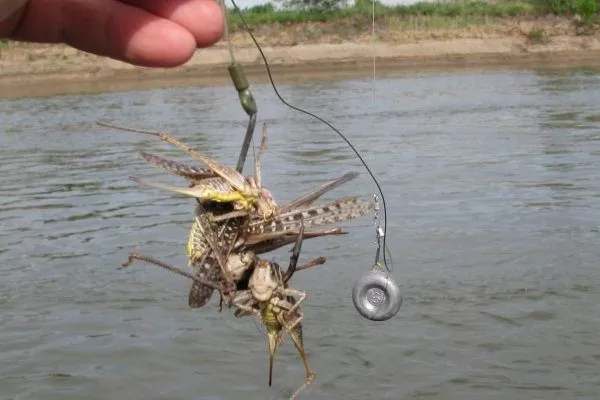
- Locusts. Several insects are left on the hook.
It's impossible to guess which bait a catfish will prefer—live or dead. Catfish are gourmets. You have to find the right approach to them. To achieve your goal, you have to try a variety of options.
Proper complementary feeding
Most anglers, while spending a lot of time preparing bait, neglect groundbaiting altogether. And that's a shame. Catfish readily respond to tasty food. Experienced anglers claim that good groundbait can significantly increase the number of bites.
Unlike other predatory fish, the whiskered giant eats all kinds of protein-rich food besides fish. To attract catfish, you can use:
- Offal. Ground skin—pork or beef—is suitable. Catfish will also enjoy intestines, lard, meat, chicken gizzards, and other offal. To make meat or offal more attractive to catfish, it's recommended to dry or fry them.
- Bird feathers. It's a cheap bait that needs to be fried over a fire for a bit.
- Fish oilIt's sold in pharmacies and stores. Fat is added to any bait. However, adding vegetable fats is strictly prohibited, as other fish will swim up and the predator will start hunting for the small fish. This will distract the catfish from both the bait and the hookbait.
Catfish, having discovered that a tasty food source is available in a certain area, will return again and again. But leaving bait where catfish don't show up is pointless.
Lures don't work:
- on fast rolls;
- in shallow waters;
- in coastal areas.
You need to leave treats:
- at the entrances and exits of pits;
- near sunken snags;
- on a deep-sea reach.
Breeding and growing catfish
Catfish are a promising fish species for artificial breeding. Compared to other predatory fish such as pike or zander, they offer several important advantages:
- Large bodies of water aren't necessary. Pits or canals filled with water are sufficient for feeding. The main thing is to ensure the appropriate hydrochemical conditions.
- Catfish hibernate during winter, making them easier to care for. There's no need to keep or feed them in wintering ponds.
- Spawning can be carried out in wintering ponds vacated by carp.
- Catfish taken for breeding can be released into water bodies to exterminate low-value fish.
- Ponds located near fish processing plants or slaughterhouses can be used for breeding in order to utilize the waste from these industries.
- Due to their wide range of food, catfish eat not only fish, but also all kinds of pond creatures.
Catfish are bred in ponds and reservoirs where other fish are also raised. Thanks to this predator, fish productivity in artificial reservoirs can be increased to 110 kg/ha.
| Indicator | African catfish | Channel catfish | Common catfish |
|---|---|---|---|
| Optimal water temperature | 25-30°C | 22-28°C | 20-25°C |
| Growth rate (to market weight) | 6-8 months | 12-18 months | 18-24 months |
| Feed conversion | 1:1 | 1.2:1 | 1.5:1 |
| Planting density (per m³) | 100-150 pcs | 50-80 pcs | 20-30 pcs |
| Oxygen requirements (mg/L) | 4-5 | 5-6 | 6-7 |
The predator clears the pond of trash fish, frogs, and tadpoles.
How does a catfish farm work?
An industrial catfish farm typically produces 50 tons of fish per year. Farms with annual production capacity of 20 and 100 tons are also available. Such a farm can be operated by one person, working 25 hours per week. African catfish are the most common species bred on such farms.
The production cycle of such farms begins with the introduction of fry weighing 0.1-5 g. On the farm, catfish can grow up to 1 kg in just six months. Since the fish grow at different rates, the "harvest" is collected weekly, and the caught fish are sorted by weight. Feed consumption on a catfish farm is 1 kg per 1 kg of live weight of the fish.
Harvesting of producers
The spawners are hunted in natural waters. Harvesting takes place in the fall and winter. Straining gear is used to catch common catfish. Catching takes place a year before spawning in an artificial pond.
Features of harvesting breeding catfish:
- Before transporting the fish, they must be kept in a cage. Catfish "regurgitate" the food they ate the day before, which contaminates the water and makes transportation difficult.
- The most promising breeding opportunities are found in individuals aged 5-9 years. They weigh lightly—up to 10 kg—and are easy to handle.
Spawning in artificial conditions
Wintering carp ponds with an area of 500-700 square meters are best. Spawning carp ponds are ineffective – the catfish eggs, scattered across the vegetation, are poorly fertilized and sink into the silt, making it difficult to subsequently catch the larvae and young fish.
Catfish eat a lot before spawning. Before breeding, males and females are placed in a wintering pond with nests made of willow roots. The spawning substrate—the nests—are attached to wire circles 60-70 cm in diameter.
What you need to know about preparing for spawning:
- The nests are secured with pegs, 30 cm from the bottom and 3 m from the shore.
- The optimal depth of the pond is 1 m.
- The optimal water temperature is 20-22°C.
- The catfish are transferred to the pond using a net. It's best to do this in the evening.
- There should be equal numbers of females and males.
- Before spawning, females should be given an injection of carp fish pituitary gland – 3 mg (in 3-4 ml of saline solution) per 1 kg of weight.
- Selection of producers (ratio 1:1)
- Keeping in quarantine ponds for 14 days
- Injection of pituitary suspension
- Placement in spawning ponds with nests
- Water temperature control (20-22°C)
- Removing nests 24 hours after spawning
- Spawning will begin within 24 hours of placement in the pond. Spawning lasts for 4 hours. The female lays her eggs in various nests. It's important to keep the spawning area quiet.
A step-by-step plan for preparing for spawning
Growing young animals
After spawning is complete, the nests are removed from the water and placed in special devices called Chalikov apparatuses.
Performance indicators of the device:
- fertilization rate – 80-90%;
- larval hatch rate – up to 80%;
- incubation duration: 1760-1800 degree-hours.
The larvae are kept in the cages where they were incubated. They are transferred to a mixed diet on the fourth day of hatching. They are reared in fry ponds. The stocking rate is 300,000 fry per hectare.
Larval growth rates:
- weight gain of fry per month – 2-3 g;
- survival rate – 80%.
Yearlings gain 25-30 g in weight. About 70% of the specimens survive. The yearlings are transferred to a wintering pond for the winter. The norm is 2-3 tons per hectare. Yearlings are released into a carp fattening pond. The norm is 100-200 specimens per hectare.
What species are grown?
The following are grown in artificial ponds:
- Common catfishThey are fed fresh fish—crucian carp, rudd, and granulated salmon feed. The number of catfish weighing 0.1-2 kg should not exceed 50-100 per hectare of the farmed pond.
- African catfishA tasty and easy-to-grow fish. It grows quickly. Expensive feed and water heating account for about 30% of the cost – this is the only drawback to raising African catfish. They require favorable conditions – warm water, high oxygen levels, and a suitable pH level. If done correctly, fish can grow up to 2 kg in a year.
- Channel catfish. An unfussy but warm-loving fish, it is successfully grown in southern regions where the water temperature remains at 22°C for at least four months of the year.
Amur catfish is recommended as an additional species for warm-water cage culture. Two-year-olds weigh 550-650 g. Cage productivity is 94 kg per square meter.
Economic importance and protection status of fish
Catfish is a valuable commercial fish. Its meat is prized—it's fatty, tasty, and tender. In the old days, its swim bladders and skin were also used. Glue was made from the bladders, and the skin was used to make "glass" for windows. At the beginning of the last century, catfish catches from a single body of water amounted to thousands of tons. Today, catches are much lower.
Uncontrolled fishing and poaching have led to a widespread decline in the catfish population. Today, in many bodies of water where catfish were once abundant, they have become a rarity. In many regions, catfish are listed in the Red Book and are protected by the state.
Interesting facts about catfish
The catfish is also known for its unusual habits and characteristics. Below are some interesting facts that will surprise the reader:
- The catfish is not only the largest, but also the most cunning. It uses its barbels as bait, which fish mistake for thick worms. Upon spotting prey, the barbel quickly sucks the water in, along with the gullible fish.
- Catfish are unrivaled greedy and gluttonous creatures. They are eager for any prey. If a catfish spots a nest above the water, it will invariably try to knock it down with its tail. Even if it's not hungry, it will never miss a gaping duck—it will swallow it whole. Young ones will even attack spoons and animals like calves and dogs.
- Catfish are dangerous. Stories of cannibalism are true—these huge fish can attack humans.
- Before spawning, these giants engage in boisterous displays. Males strive to show off their best form, competing in swimming speed and jumping height. These displays can sometimes attract up to a hundred fish. The noise of the mating competition can be heard for kilometers. The female chooses a worthy mate, and the pair chases away all the unwanted fish.
Catfish are a striking example of freshwater fish fauna. A worthy target for fishing and an interesting species for breeding, everyone can find something of interest in this wonder fish.