
The Sante potato is a variety that has gained popularity among many farmers who grow root vegetables for profit. Its distinctive features include its uniform shape, low maintenance, and potential for high yields. This article describes the description, cultivation, and care of this variety.
Description of potatoes
Sante is a mid-early potato variety. It takes 80-90 days from planting to harvest. It is characterized by good yields and long shelf life of harvested roots.
The Sante variety has increased resistance to diseases such as potato cancer, golden nematode, and various viruses. It is moderately susceptible to late blight of foliage and tubers. Under unfavorable conditions, it can be affected by rhizoctonia or blackleg.
A distinctive feature of this variety is its excellent taste. The potatoes have a pleasant, rich flavor, without being excessively dry or watery. Due to their low starch content, the tubers do not overcook, maintaining their shape.
Processing and cooking the potato do not affect the color of the flesh—it does not darken. This variety is considered ideal for making chips, soup dressings, deep-frying, stuffing, and baking. It is also used for vegetable mixtures. This variety is popular in restaurant cooking—it cooks quickly and has an attractive appearance. However, Sante potatoes are not recommended for mashed potatoes.
Characteristics
Potato yield depends directly on soil fertility, weather, and the variety's growing location. However, farmers report high yields: 275-500 centners of potatoes are harvested per hectare.
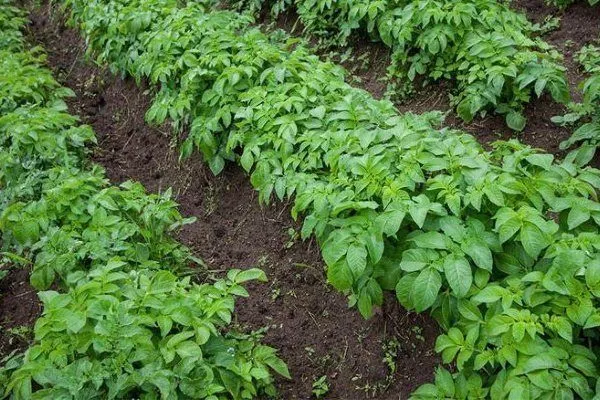
The bushes are compact, small, and medium-height. The root system is well developed, allowing the tubers to develop abundantly. The plant has minimal green mass. Gardeners harvest up to 20 potatoes, each weighing 150 grams, from a single bush.
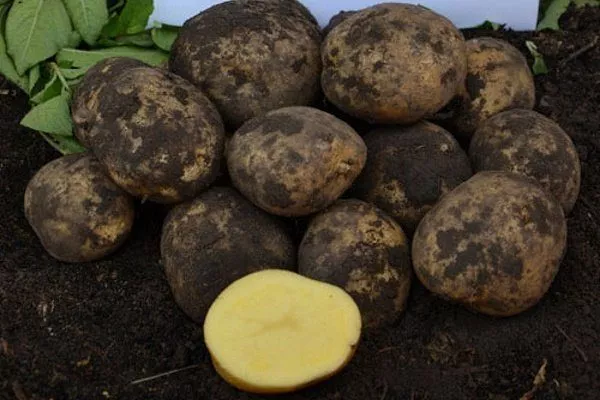
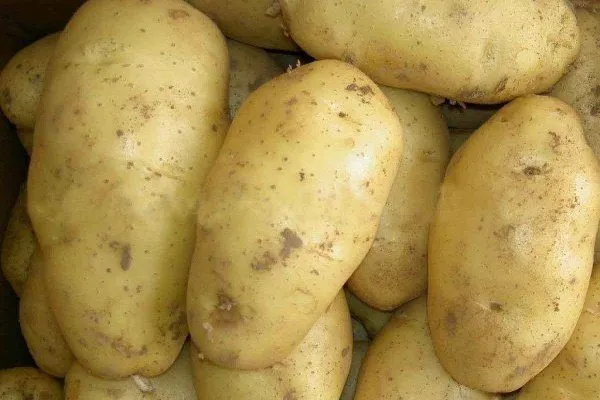
The tubers are uniform in size and have a yellowish, thin, yet dense skin that is reliably protected from mechanical damage. This ensures trouble-free transportation of the potatoes, maintaining their attractive appearance.
The tubers have numerous shallow, superficial eyes. The potatoes peel easily and remain smooth. When cut, they have a pleasant yellow hue. A distinctive feature of this variety is its minimal starch content—12-15%. It is rich in vitamin C, trace elements, B vitamins, and amino acids.
| Detailed characteristics of potatoes | |
| Potato variety | Santa |
| Ripening period | 80-90 days |
| General characteristics | a mid-season variety with good yield and excellent taste |
| Productivity | 275-500 c/ha |
| Number of tubers in a bush | up to 20 |
| Weight of commercial tubers | up to 150 g |
| Starch content | 12-15% |
| Shelf life | 92% |
| Pulp color | light yellow |
| Peel color | yellow |
| Disease resistance | moderately susceptible to late blight, susceptible to scab |
| Preferred growing regions | central and southern Russia |
Origin
The Sante potato was developed by Dutch breeders. It was added to the State Register in 1993. It is suitable for planting in the Central, Far Eastern, Lower Volga, Volga-Vyatka, Ural, West Siberian, Northern, and Northwestern regions.
It is used for industrial-scale cultivation, as well as in private and private farms. The harvested crop stores well and withstands long-distance transportation. Its marketable qualities are maintained for several months after harvest.
Advantages and disadvantages of the variety
Before planting potatoes, carefully consider their advantages and disadvantages to understand what difficulties may await during planting and caring for the plants:
| Pros | Cons |
| At low temperatures the variety may be damaged, which will result in a decrease in yield.
The variety quickly responds to soil nutrition, showing good or slow development. |
How to grow correctly?
To reap a bountiful harvest, gardeners need to follow simple agricultural practices. Choose level, flat areas for planting. The soil is prepared in the fall by digging and fertilizing. Adding fresh manure in the spring can cause disease.
Potatoes require potassium and phosphorus fertilizers, but an excess of potassium, on the contrary, affects the reduction of yield.
In the fall, seed is prepared. For the future harvest, it's important to select the right tubers: they should be medium-sized, no larger than a chicken egg. Very small potatoes, unfit for consumption, are often left for seed. This leads to the degeneration of the Sante variety and a decline in yield.
In the fall, after harvesting, the seeds are exposed to light for a few hours to allow the tubers to green up. This will help them preserve better and prevent rodents from attacking them. For an earlier harvest, it's recommended to germinate strong, uniform seedlings before planting.
Three to four weeks before planting, the seed potatoes are removed from the cellar and placed in a well-lit room where the temperature remains at least 15 degrees Celsius. The tubers are placed in boxes or perforated bags and scattered on the floor.
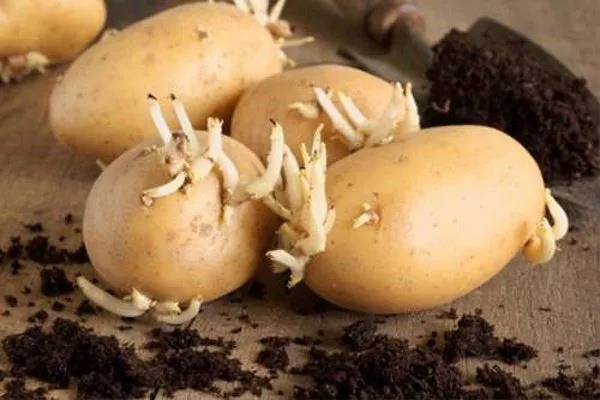
Before planting, the sprouts should be no more than 5 centimeters tall. It's important to ensure sufficient light during germination, otherwise the sprouts will stretch, turn white, and lose viability.
High temperatures can accelerate sprouting, but they can also weaken the tuber itself. When planting the Sante variety, it's important to follow a certain sequence. Because the variety has a developed root system, tubers are planted 35-40 cm apart. The distance between rows should be at least 50-60 cm.
By maintaining the recommended distances between plants, you will be able to conserve soil when hilling, and the potato plants will thrive, as the variety thrives on light penetration.
A depth of 5 cm is used when planting potatoes in clayey, dense soils, and a depth of 13-15 cm is used when placing tubers in sandy soils.
| Soil temperature | +9 degrees |
| Distance between tubers | 35-40 cm |
| Distance between rows | 50-60 cm |
| Planting depth in clay soils | 5 cm |
| Planting depth in sandy soils | 13-15 cm |
Sante potatoes are planted when frosts have passed and the soil warms to 9°C (49°F). At lower temperatures, plant growth slows, making it difficult to expect a good harvest from underdeveloped plants. Optimal conditions for the growth and development of Sante potatoes include temperatures no higher than 28°C (82°F) and moderate humidity.
How to care for it properly?
The Sante potato variety requires a constant supply of oxygen to its roots, so regular soil loosening is essential. Five to six days after planting, gardeners loosen the soil, which not only provides air but also removes weeds. After each watering or rain, the process is repeated, but only after the moisture has been absorbed.
When the first shoots reach 8-10 cm in height, they are hilled for the first time. The process is repeated 20 days later. Hilling is done in dry weather, early in the morning or after sunset. Water the soil moderately before and after hilling. Water thoroughly three times per season: after the shoots emerge, after buds appear, and after flowering.
You can find more information about the correct hilling of potatoeshere.
During dry and hot summers, potatoes should be watered more frequently, paying attention to the condition of the tops: if the leaves begin to wilt, the plant needs watering. Fertilizing is required one month after planting.
For 10 square meters of area you will need the following number of components:
- 100 g urea;
- 100 potassium sulfate or chloride;
- 200 g superphosphate.
The ingredients are dissolved in water and the potatoes are watered with the solution. The Sante variety responds well to bird droppings: for 10 square meters of area, 2 kg of dry droppings diluted in 20 liters of water is required.
Diseases and pests: control and prevention
The Sante variety boasts increased resistance to many serious diseases. It is resistant to tobacco mosaic virus, leaf wrinkle or leaf curl, potato cancer, and golden cyst nematode. Gardeners also note moderate resistance to late blight. For prevention, plantings are treated with copper-containing preparations.
You can avoid infestations by periodically rotating planting sites. It's best to plant potatoes in soil previously occupied by legumes, cabbage, and meadow grasses.
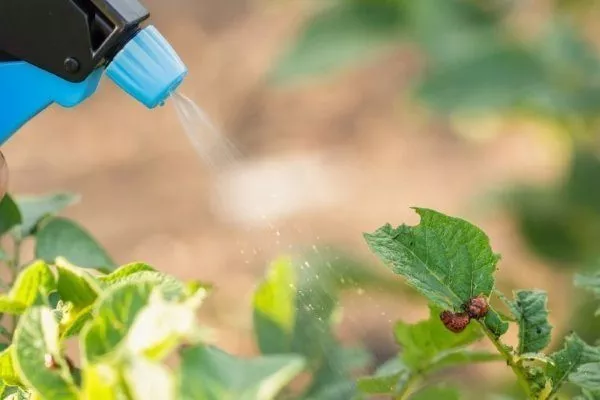
Potatoes are also vulnerable to attacks by the Colorado potato beetle and aphids. These pests are controlled by spraying with chemicals. Potatoes can also be damaged by wireworms, potato moths, and mole crickets. Modern weeding and hilling techniques help prevent these insects. Wireworms can be eliminated by treating the tubers before planting.
How to harvest and where to store the crop?
After harvesting, the harvested potatoes are left on the ground for several hours to dry. They are then transferred to storage areas such as basements, cellars, and other storage areas. The storage area should be kept at no more than 2-5°C. Relative humidity should be 70%.
By following simple rules, gardeners can reap a bountiful harvest of large, healthy tubers with excellent flavor. Potatoes are stored in nets, wooden boxes, or on the floor, after digging a hole in the ground and lining it with straw.
The variety's unpretentiousness, good yield, and long-term storage stability are the main advantages that make private gardeners and professional farmers prefer the Sante potato.
Advice from the pros
Experienced gardeners who have been growing Sante potatoes for many years share simple tips for achieving excellent results and a bountiful harvest:
- The Sante variety prefers full sun, so it is important to choose well-lit, rather than shaded, areas for planting.
- Preference is given to soil enriched with oxygen - it should be light and fertile.
- It is best to plant potatoes in a plot where cabbage, legumes, phacelia, and radishes were previously grown.
- Before planting in the fall, the soil must be dug over. Digging is also done before planting. The application of mineral fertilizers is recommended.
- Potatoes are planted only after the last frost has passed. Planting begins in late April or early May, but the optimal time to plant is after the May holidays, as the soil has already warmed up to a depth of 10 cm by then.
- Weeds must be removed. Harrow the soil twice a season. Don't forget to water the plants, especially during flowering. Just be careful not to overwater to prevent the tubers from rotting.
- Eliminate pests promptly, including the Colorado potato beetle. If necessary, treat with insecticides.
- Begin harvesting within 80 days of the first sprouts appearing. It's best to harvest potatoes quickly, as this can cause insect damage to the tubers.
Reviews
Reviews of the Sante potato variety are positive. Many gardeners note its low maintenance, lack of need for regular watering, high yield, and resistance to mechanical damage.
The Sante potato is considered one of the best varieties of the crop. It has numerous advantages and few disadvantages, yields are high, and the taste is excellent. The key is to follow the planting, growing, and care guidelines, and the results will exceed all expectations.