
A good harvest is the primary goal for every gardener, so most homeowners are constantly searching for new and profitable varieties. Potatoes, the primary strategic winter food source, are a particular focus. Recently, an unusual and rare variety—the "kiwi" potato—has made a splash on the market. While it's not available in regular stores, it's quite possible to order.
Appearance and spread
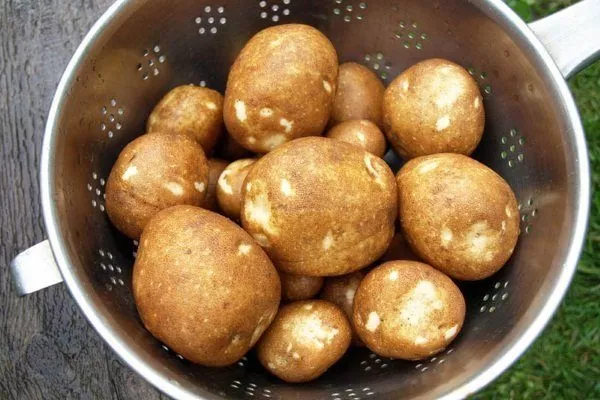
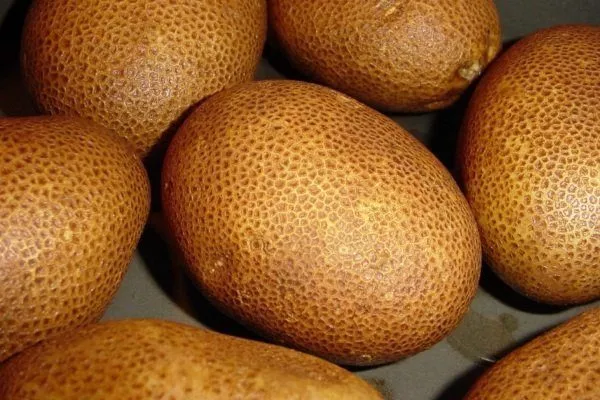
The kiwi potato got its name for its resemblance to the well-known fruit. It's considered a product of genetic engineering and genetically modified, but this is a misconception. It poses no danger to the body. In fact, it's quite beneficial.
This variety has already been tested in Belarus, Lithuania, Kazakhstan, Ukraine, and is actively grown in the Krasnodar region, Kaluga, Moscow, Nizhny Novgorod, Yaroslavl, Perm, Volgograd, and Ivanovo regions, as well as in the Krasnodar region.
Some farmers believe that the kiwi potato originated in Belarus. However, this is a mistake; the kiwi was created by Russian breeders from the Kaluga region.
Description and characteristics
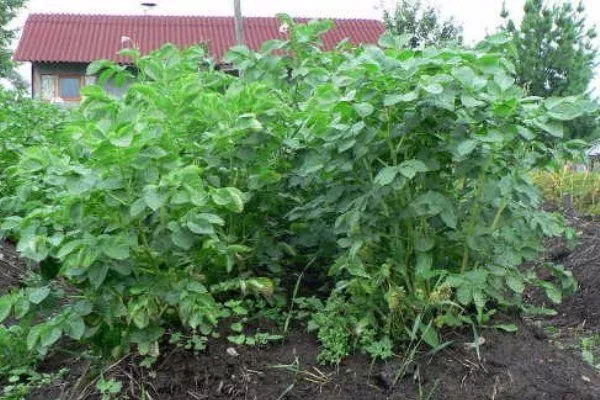
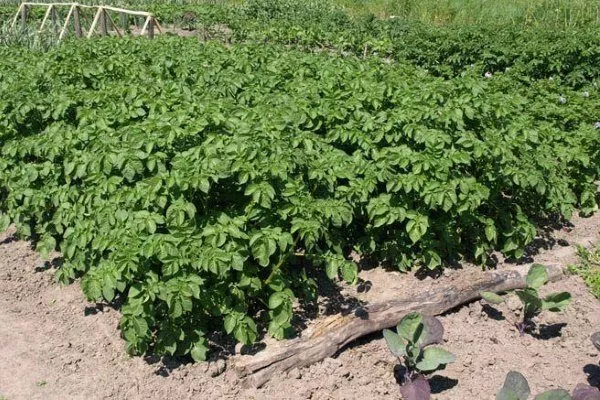
Kiwi potatoes grow very tall, up to 80 cm tall, depending on the soil. The stems are straight, with emerald leaves with serrated edges and lilac-colored inflorescences. The flowers are often attractive to bees.
Characteristic:
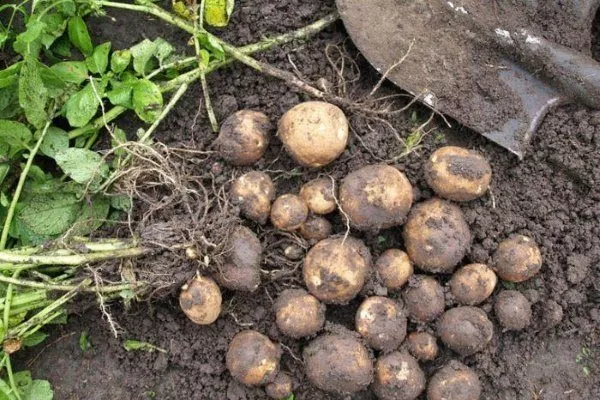
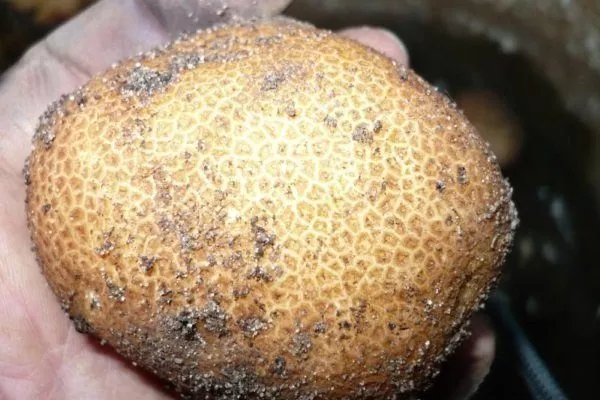
- To the touch, the fruits are elongated, with round edges, and rough due to small hairs.
- Mesh peel.
- The flesh is snow-white and yellow and cooks beautifully. The only drawback is that it takes much longer to cook than regular vegetables, at least 40 minutes. It can be used in purees and soups.
- Stores well. If you create the right conditions, it will easily last for at least a year without losing its flavor.
- Lush lilac-colored inflorescences.
Features of kiwi potatoes:
- Grows in all types of soil, best in sandy loam.
- The taste is soft.
- Very resistant to plant diseases and pests.
- Loves lots of sun and systematic watering.
- Accepts all fertilizers well.
- It has a rich harvest; you can actually harvest up to 20 kg from a kilogram of potatoes.
- Grows in all regions.
A very rare variety, the price per kilogram reaches 100 rubles.
Selection of seed material
Experts recommend selecting potatoes for planting in the summer, when they're flowering. This makes it easy to identify the most lush and healthy plants. This ensures good seedlings, and the tubers from these plants are more resilient.
Selection rules:
- Tubers are taken from bushes where at least 7-8 pieces have grown.
- The weight of the potato should be at least 100 g, since they dry out a little over the winter.
- The selected material must be left in the sun for a couple of hours to dry and clear of soil.
Storage of seed potatoes
Basic rules:
- In order for the peel to ripen, it needs to lie for 2 weeks at 18-20 degrees Celsius in a well-ventilated room.
- The potatoes are laid in a 10 cm layer and turned over from time to time to make them green.
- After two weeks, remove the bad tubers and store them. This can be in a cellar with at least 70% humidity, or in an apartment. Indoors, it's convenient to store seed potatoes on the balcony in a special heated box. If there are no severe frosts, they can be stored in canvas bags or nets. Optimal conditions for storing seed material
Condition Parameter Temperature 2-4°C Humidity 70-80% Lighting Absent Ventilation Moderate - Potatoes need to be sorted at least 3 times during the winter.
Preparation of seed material
To get a good harvest, you need to carefully select the planting material.
Important points:
- The potatoes should be of good quality and not too large.
- The optimal tuber size is 5 cm in diameter and weighs up to 50 g.
- eyes - no more than 5 pieces.
- Germinate for about a month on a thin sheet of paper, temperature no more than 18 degrees.
- You can plant when the sprouts have grown to 5 mm; for a summer cottage, 2.5 cm will be enough.
- The tubers retain their taste during storage, so they can be stored in vegetable storage facilities for several years.
Planting time: In temperate climates, the best time is late April to early May, when the soil warms up to 9°C (41°F) to a depth of 10 cm. Then there's no need to worry about frost.
Soil preparation
The soil for planting kiwis is prepared at the end of September, with the top layer dug or plowed. The recommended depth is 15 to 20 cm in sod and podzolic soils, while 8 cm is sufficient for loam.
- Conduct a soil analysis for acidity and nutrient content.
- Add organic fertilizers (manure, compost) at a rate of 5-10 kg per 1 m².
- Add mineral fertilizers according to the soil analysis results.
- Carry out deep digging of the area to a depth of 20-25 cm.
Important tips:
- It's essential to add manure; phosphorus and potassium can be substituted. To make the vegetable more nutritious, nitrogen is sometimes added in the spring. But it's important not to overdo it, otherwise it will be harmful.
- You can prepare the plot when the soil warms up to 10 degrees Celsius. Rows should be laid out parallel, north-south. The distance should be at least 60 cm, as the bushes are very spreading.
- ✓ The area must be well lit.
- ✓ The soil should be loose and well-drained.
- ✓ Sandy loam or loamy soils are preferred.
Preparing potatoes
Important tips:
- A month before planting, the potatoes should be heated at a temperature of about 20 degrees Celsius for about two days. Then, they should be spread in two rows in containers and left to germinate. Keep the containers in the light to promote strong sprouts.
- Once the eyes reach 3 cm, potatoes can be planted, but only if no frost is forecast. You can treat them with growth stimulants.
Do not store in several layers, as air will not reach the lower tubers well and they will spoil.
Planting and care requirements
Kiwi potatoes are not demanding in terms of care, but they do require adherence to certain rules.
- The digging depth should be from 15 to 20 cm in sod and podzolic soil; in loam, 8 cm will be enough.
- The first application is made in the fall, and the second in May.
- Only sprouted tubers should be planted; seeds should not be used.
- Before planting, the soil must be cleared of weeds and dug over again.
- This variety can be planted in soil where zucchini, cucumbers, squash, cabbage, beets, peas, and pumpkins previously grew.
- Does not take root after tomatoes, strawberries, peppers and eggplants.
- Kiwifruit should also be avoided in areas where strawberries were grown, as they are susceptible to the same pests as the vegetables listed above. Harmful spores tend to persist even after the soil has been turned over.
- A couple of days before digging up the potatoes, trim the tops to a distance of 15 cm from the surface. This will give the tubers a thicker skin and a longer shelf life.
The Dutch method is recommended for sowing kiwifruit. This is the best option, yielding a bountiful harvest. However, much depends on the diligence of the owners. This method yields up to 2 buckets per bush. However, gardeners also praise the traditional method: a standard layout of 40 by 70 and 45 by 90 cm. Choose a sunny location to ensure a good harvest. The area must be cleared of weeds and loosened again.
Principles of the Dutch method:
- Row pattern: 2 adjacent rows, a gap, and then 2 adjacent rows again with a gap.
- The distance between the beds should be 70-75 cm, and between the tubers – 30 cm.
- Potatoes aren't hilled; they're covered with soil on both sides, forming small mounds. These protect the roots and provide oxygen. While the sprouts are small, they need to be completely covered.
It is not advisable to overfeed with fertilizers!
Fertilization and watering
When caring for kiwi, you need to take into account some of the characteristics of potatoes:
- It is not advisable to water frequently; three times during the summer is sufficient.
- Fertilize for the first time in late summer, when the weather warms up, then repeat twice more, 10 days apart. Fertilize potatoes by applying the solution into the depressions between the plants. If you're planting kiwi for the first time, there's no need to over-fertilize.
- Water generously, ensuring the water reaches a depth of 0.5 meters. Loosen the soil before watering. Avoid getting water on the plant! Only at the roots; this will help protect the harvest.
- If there's a lot of rain, kiwi doesn't require additional watering. Only when the soil dries out to a depth of 24 cm.
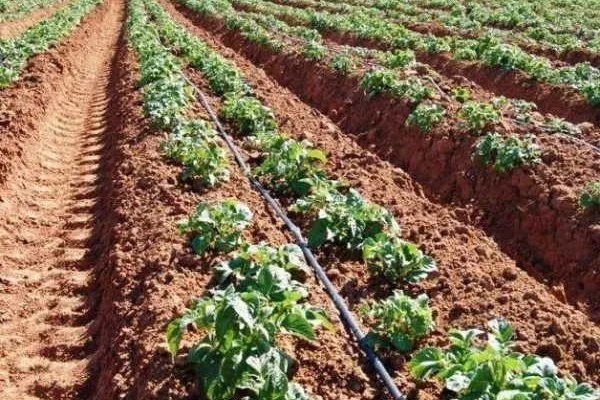
Don't get carried away with fertilizers; they are applied no more than 3 times, and strictly according to the instructions.
Organic fertilizers
You can prepare such fertilizer yourself, the main thing is to get hold of manure and not be too squeamish, since the smell is very strong and pungent.
- Method 1. Dilute water and manure 50/50 and let it ferment for two weeks. Then dilute the solution 1:10 and water the potatoes.
- Method 2Sow into the soil when digging up the plants; winter rye, mustard, legumes, alfalfa, and peas are suitable for this purpose.
Organic matter contains all the nutrients needed for potato growth, allowing tubers to form easily. Humus also increases soil fertility. As the fertilizer decomposes in the soil, carbon dioxide is released, which helps the plants grow lush and the ovaries large.
The best organic fertilizers for kiwi:
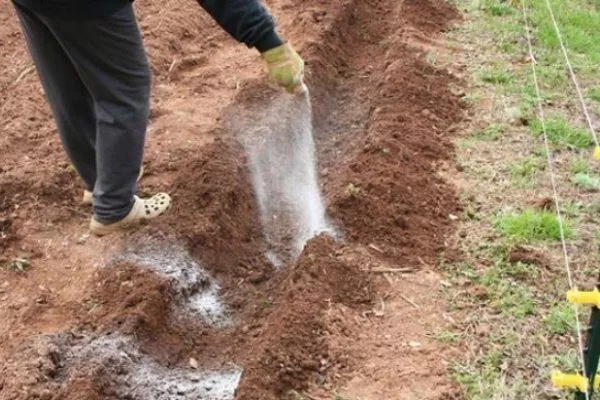
- Wood ashIt can be added to the holes or scattered over the plot in the fall. It prevents the soil from becoming soggy. If the soil contains a lot of sand or peat, it's worth scattering the ash in the spring. The method is simple: add a matchbox of ash to one hole and mix it with the soil.
- Chicken manureMix with chopped straw or peat. This fertilizer is applied in the fall, but can also be applied a month or a month and a half before planting. It begins to actively release nitrogen, but it's important not to overdo it. If you add too much, the bushes will be tall, but with fewer tubers.
- Foliar feedingMagnesium, nitrogen, and sulfur are easily absorbed through the foliage. It's best to spray in the morning and evening, as the fertilizer will evaporate in the heat. Avoid overwatering the foliage.
- Organo-mineral fertilizersThey help potatoes absorb all the added additives, as well as nutrients from the soil. Gardeners recommend "Ispolin"—a mixture of organic matter and various micro- and macronutrients. It's added to the seed potato hole when planting, mixing it with the soil. Then, water thoroughly to activate the fertilizer and begin distributing essential nutrients to the plant. In the fall, scatter the granules throughout the garden and dig them in. You can also dilute the mixture in water at a rate of 60 g per 12 liters of water, let it sit for several hours, and then water the tubers.
Mineral fertilizers
These are highly concentrated additives that are applied before or during potato planting. They can be mixed with organic fertilizers or supplemented with peat and straw. The advantage of mineral fertilizers is that they not only nourish but also protect against diseases. Although kiwi is resistant to them, it still doesn't hurt to be extra cautious.
The most popular supplements:
- Ammonium nitrateCalculation: 1 kg per hundred square meters, applied in spring.
- Potassium sulfateTake 1.5-2 kg per hundred square meters.
- Double superphosphateAt the rate of 1 kg per hundred square meters.
- Other methods. Some gardeners cover the plot with rotted manure, at a rate of 45 buckets per 100 square meters. They then dig it in. You can also add ammonium nitrate and potassium fertilizers: 20 grams of each.
If the soil is not depleted, there is no need to fertilize it, otherwise the high concentration of minerals will harm the crop!
Growing without hilling
Kiwi potatoes aren't hilled; they're raised in small mounds, which is much more convenient. But experienced gardeners have devised another, equally effective method: using additional coverings.
You can use:
- A special black film that allows moisture to pass through. It's also called agrofibre.
- Pieces of cardboard.
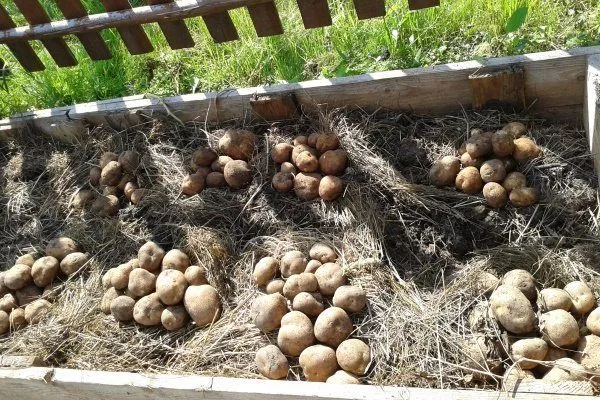
- Hay or straw.
Small nests are made on the surface of the soil using the materials listed above. This is very convenient for those planting potatoes in boxes or barrels. Straw is best.
Pros:
- The coating creates the necessary microclimate.
- The soil is well protected from overheating in hot weather.
- Straw retains moisture well and creates additional humus, which attracts worms that promote tuber growth.
- Blocks weeds, eliminating the need for weeding.
- After harvesting, the straw can be dug into the ground, thus preserving beneficial bacteria for the next planting.
But along with the advantages, there are also disadvantages to this method that are also worth considering:
- Rodents. The straw always leaves ears of corn, which attract mice. They are quite capable of ruining the harvest. But they can be repelled by planting elderberry, mint, wild rosemary, wormwood, tansy, or chamomile.
- Slugs. The only way to control them is with special traps. Because of these creatures, experienced gardeners recommend against planting potatoes next to cabbage.
Harvesting
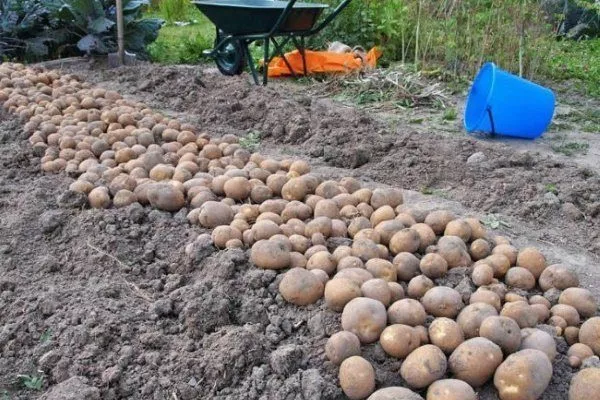
A bountiful harvest is the hallmark of the kiwi potato, which is why it has gained such popularity. It is harvested in the fall. Key distinguishing features:
- Kiwi is a late-ripening variety, with tubers taking 120 days to ripen. In northern regions, this can extend to 130 days. The harvest is in late September – early October. The dug-up tubers are dried, sorted, spoiled ones removed, and only then stored.
- You can tell if the tubers are ripe by the dried tops. To be sure, dig up one plant to make sure.
- If the tops turn yellow, they need to be mown down, and after 10-12 days, dig up the potatoes.
- The harvest should be done in sunny and dry weather.
- The tubers need to be left in the sun for a couple of days to disinfect and dry.
- It is better to use a pitchfork for harvesting potatoes; they will damage the potatoes less.
Kiwifruit is prized for its easy transport and storage, thanks to its thick skin, and for not drying out or sprouting. Some farmers feed it to livestock and poultry in winter; experience shows that animals tolerate cold better with this diet.
How to properly store potatoes is described here.
Advantages and disadvantages
Like any food, even artificially grown, kiwi has its pros and cons. These, too, must be taken into account when growing.
Advantages:
- The tubers are always large, there are practically no small ones.
- High-yielding variety.
- It has good resistance to rot, late blight, alternaria, scab, and phoma.
- Not damaged by the Colorado potato beetle.
Flaws:
- It takes a long time to cook, and the middle is almost tasteless.
- Not suitable for frying because it often burns.
Diseases and pests
Since kiwis are pest-resistant, there's no need for chemical treatment. It's believed that pests dislike kiwis because of their rough skin, which makes it difficult for larvae to lay eggs on. The vegetable also contains biofiber, which insects cannot digest.
Does it contain GMO?
There has been some debate about whether the "kiwi" potato is harmful, as a genetically modified product. Agronomists have suggested that pests will certainly try harmless potatoes, and if they don't, it means the tubers are laced with bacteria that target Colorado potato beetles.
Versions about the variety's appearance in Russia:
- Smuggled in from abroad.
- Developed by scientists from Bryansk.
- Developed by breeders from the Kaluga region.
The kiwi potato isn't listed in the state register of breeding achievements, but it's also not on the list of banned varieties. So, theoretically, it's safe to eat.
But scientists have proven that it is possible to create such a variety through simple selection. The first attempts to grow such fruits took place in Russia as early as the mid-20th century, when common potatoes were crossed with wild potatoes. This attempt was unsuccessful, as the vegetable's flavor deteriorated significantly. But over time, breeders learned to minimize the harm caused by crossbreeding.
Only two varieties are officially recognized as genetically modified in the country:
- "Elizabeth Plus".
- "Lugovskoy plus".
They are said to be developed by the Russian Academy of Sciences' Center for Bioengineering. Although certified, they are prohibited for human consumption because they have been modified. Pests avoid them, a trait they share with kiwifruit, although the latter is not listed as a GMO.
There are two more pieces of evidence that support the idea that kiwi is not a GMO product:
- Numerous small hairs on the shoots. Scientists believe this confirms that the gene structure has not been tampered with.
- Other varieties also resistant to the Colorado potato beetle, developed through conventional selection, include 'Lasunok,' 'Kamenskiy,' 'Bryanskiy,' and 'Utro.'
Reviews
Kiwi potatoes are highly prized by gardeners for their bountiful harvest and excellent storage properties. Some complain about their lack of flavor, but most consumers are quite satisfied with the taste as is. The pros clearly outweigh the cons. They are pest-resistant, retain their flavor even in less-than-ideal weather conditions, and can survive long periods without water—every gardener's dream. They also produce large harvests. Growing kiwis is very profitable, but it's important to follow planting and care guidelines to ensure your efforts are not wasted.