
The Aladdin potato is characterized by its mid-late ripening, long shelf life (at least 6 months), and ease of cultivation. For these reasons, this root vegetable is in high demand and is often grown commercially.
| Characteristic | Aladdin | Other varieties |
|---|---|---|
| Ripening period | 90-110 days | 70-120 days |
| Yield (c/ha) | 400-500 | 200-600 |
| Shelf life | 6 months | 3-8 months |
| Disease resistance | High susceptibility to late blight, average susceptibility to alternaria | Depends on the variety |
| Soil requirements | Unpretentious | Depends on the variety |
General characteristics of the variety
Aladdin was first developed by Dutch breeders, but was registered in Russia and the CIS in 2011. It is a high-yielding table variety with many distinctive features:
- Root crops easily withstand long-distance transportation, therefore they are widespread not only in the Russian Federation, but also in other countries;
- tubers are not subject to mechanical stress;
- the amount of starchy substances is 21%;
- potato class – high;
- planted on various soils;
- cooks quickly;
- has a pleasant taste.
What's unique about Aladdin is that it's approved for use at home, in restaurants, in childcare facilities, and even while on a diet. It can be boiled, baked, fried, or steamed.
Appearance of bushes, tubers
Characteristics of tubers:
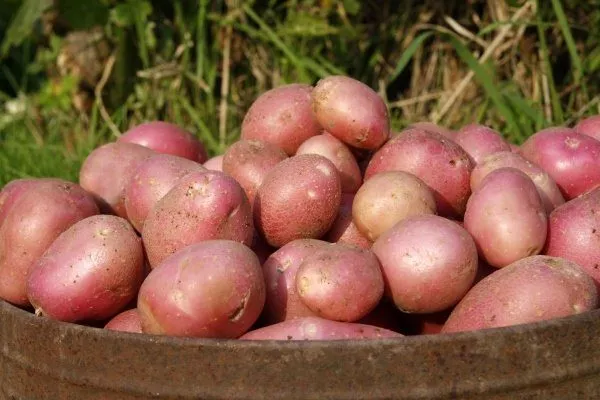
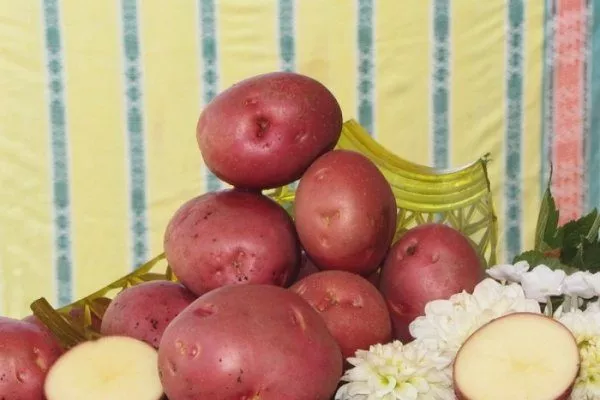
- the weight of one root vegetable is from 100 to 180 grams;
- round-oval shape;
- the surface is smooth;
- eyes - not clearly defined, not deeply located;
- peel color - red;
- pulp color – white;
- 10-12 fruits are collected from one bush.
Characteristics of the bushes:
- the height reaches half a meter;
- leaf shape – elongated;
- emerald leaf color;
- corolla size – from small to medium.
Ripening time
The ripening period varies by region—the further south you go, the shorter it is. On average, the tubers are ready for consumption in a minimum of 3 months and a maximum of 110 days.
Productivity and shelf life
Aladdin is a high-yielding variety, yielding 400-500 centners per hectare. However, to achieve this yield, nitrogen fertilization, proper planting, and proper care are necessary.
If you store potatoes in a cool place, the minimum shelf life is six months.
How to harvest and store Aladdin potatoes?
To ensure long-term storage of potatoes, it's important to harvest them correctly. Here are some guidelines:
- Collection takes place during the Indian summer period (September 10-24).
- The air temperature should be at least +10, maximum +17 degrees.
- Digging should be done in clear weather, without high humidity or rain.
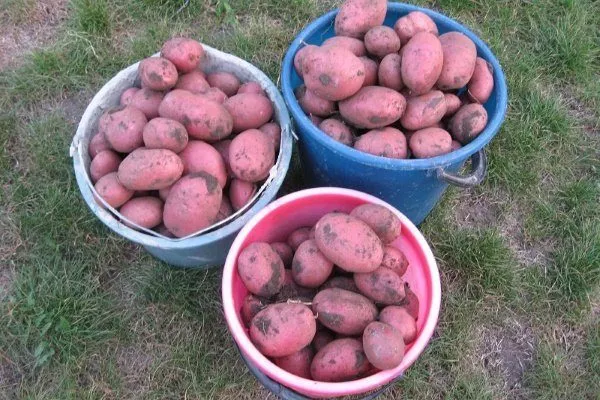
- Immediately after digging, the potatoes are laid out outside to dry – a couple of hours is enough.
- Then dry it under a suspended structure for ten days. There should be no more than two layers.
It is strictly forbidden to harvest during frosts, as the Aladdin variety becomes unfit for consumption.
How to store correctly:
- Dried potatoes are placed in a cellar or other room where the temperature will not be below +2 degrees and above +4.
- Maximum humidity level is 90%.
- To preserve the tubers, they are placed in wooden boxes, which are raised 20 cm above the floor surface.
- If nets or bags are used for storage, they are placed on shelves.
- If it's a pile, the hole should be 17-20 cm deep, measuring 2 x 5 meters. In this case, the tubers should be laid in a cone shape, covered with dry straw. Cover the top with a layer of soil.
- If storing potatoes indoors, place them on a glazed balcony (loggia) and place them in wooden crates. Insulate them with foam, sawdust, or fabric.
- It's best not to expose the root vegetables to sunlight, otherwise they will turn green.
Features of planting, growing and care
Aladdin grows in any soil—floodplain soil, black soil, loam, and sandy loam. However, the most important requirement is an open, sunny location. Features:
- Shrubs should be planted on the north and northeast sides for protection, and the slope should be on the south and southwest.
- It is not advisable to water the tubers immediately after planting.
- Potatoes do not like water in large quantities, so they are not planted in low places with clay soil, as water stagnation occurs there in the spring.
- For the same reason, groundwater should not be allowed to be within a meter of the surface where Aladdin is planted.
- It's forbidden to select the same sites for this potato every year. Otherwise, the soil will become overrun with pests, which will then cause diseases and depletion. Therefore, it's best to return Aladdin to its previous location only after at least three years.
- To increase crop yields, potatoes should be planted after beans, cucumbers, grains, pumpkins, and cabbage have grown in the field.
- It is forbidden to plant Aladdin after tomatoes, nightshades and sunflowers have been grown on the site.
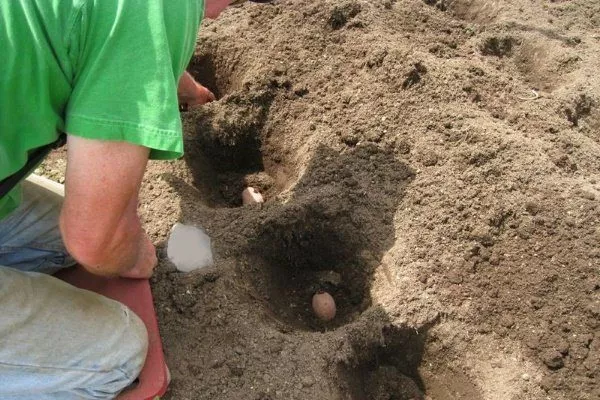
- The depth of the bookmark is from 10 to 12 cm.
- For 1 hectare you will need 35-40 tubers.
- The shoots are broken off only once, since frequent breaking leads to improper formation of the potato.
- The distance between fractions should be from 32 to 36 cm.
Planting dates and regions
As mentioned above, in southern regions, potatoes mature in 90 days and should be harvested in September. Accordingly, planting is planned for mid-June.
In northern areas of the country, Aladdin should be planted in May. Soil temperature must be maintained at 7-8 degrees Celsius. Air temperature should not fall below 8 degrees Celsius.
Aladdin's climate doesn't depend on local conditions, as it's drought-tolerant. It thrives equally well in the north, west, south, and east.
Preparing soil and planting material
Before planting, tubers must be germinated, especially in northern regions. This should be done approximately a month before the planting date. To do this, the tubers are placed in a room with a temperature of 7 degrees Celsius.
This approach allows us to determine which potatoes will sprout. If any tubers have buds that haven't sprouted, they shouldn't be planted. Each potato is cut into pieces weighing up to 50 grams.
The soil, as with any crop, should be moistened, but avoid overwatering. Otherwise, the potatoes will take too long to germinate.
Hilling
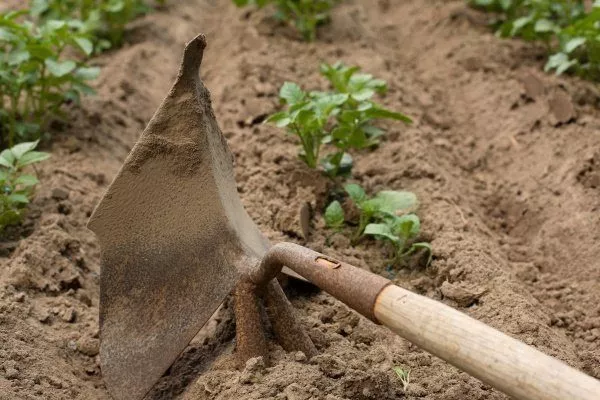
Hilling potatoes It accelerates the growth and development of the tops, promotes the formation of new tubers, and improves flowering. To do this, use a hoe to rake a small amount of soil toward the bush. However, before doing this, it's important to lightly moisten the soil. This creates a mound.
Hilling is carried out three times:
- for the first time the height of the bush should be 11-12 cm;
- the second hilling is carried out 10 days after the first time;
- the third time - if necessary.
Weeding and loosening
You need to constantly weed your garden, as weeds absorb nutrients from the soil and prevent tubers from developing normally.
It's important to loosen the potatoes periodically, but do so carefully. Garden tools should be pushed no deeper than 3 cm. Otherwise, the tubers and sprouts will be damaged.
Loosening is carried out 7-8 days after planting, and then after each moisture event (rain, watering). This prevents the formation of a dry crust and eliminates weeds.
Watering and fertilizing
Watering Aladdin frequently isn't recommended—only in very dry weather. There are some watering considerations:
- It is forbidden to pour water under the bush, only into the lateral furrows (this will eliminate the risk of diseases);
- Watering is carried out mainly in the morning, since the scorching sun is harmful.
Fertilizing is carried out to increase yields three times during the growing season. It is carried out as follows:
- The first time, apply a urea solution (1 tablespoon per 10 liters of water) during the plant's growth period. This is especially important when the foliage is poorly developed, the stems are weak, and the leaves appear pale. Half a liter of solution is needed per plant.
- A second feeding is needed when buds are forming. This will speed up the flowering process. Use a solution of potassium sulfate (1 tablespoon), wood ash (3 tablespoons), and water (10 liters). Pour 0.5 liters of the mixture under each plant.
- The third time, the soil is fertilized during active flowering. For every 10 liters of water, add 200 ml of mullein and 2 tablespoons of superphosphate. Watering is carried out in the same way as before.
Diseases and pests
Aladdin is not susceptible to late blight, but can be affected by Alternaria wilt. It attacks shoots and foliage, occurring in 25 out of 100 cases. Distinguishing features include brown spots at first, turning yellow later. After drying, the leaves fall off. If you dig up the tubers, you'll notice indented spots. This leads to tubers becoming deformed.
Among pestsThe insects that attack Aladdin include the Colorado potato beetle, mole cricket, wireworm, and potato moth.
Preventive treatment
To prevent potato diseases and insect attacks, preventive measures are taken:
- To protect against Alternaria blight, spray the plants with specialized products. The first time, the bush should be no taller than 20 cm and there should be no signs of the disease. The second time, spray a week later. If it rains after spraying, repeat the spraying process 3-4 days later. Recommended products: Abiga-Peak, Profit, Acrobat MC, Poliram.
- To combat the Colorado potato beetle, spray with preparations such as Tanrek, Confidor, Commander, Napoval, Prestige, Regent, Lightning, TabooYou can use a mixture of vinegar and mustard. Beetle larvae hatch in three stages, so you need to spray the bushes three times. The first time is when they appear on the leaves, and the remaining two times are every 10 days.
- You can kill mole crickets with Boverin and Nemabact. These are biological agents that infect the larvae with bacteria that kill them. Other options include Maxim and Prestige. These solutions are applied to the tubers before planting. There are also folk remedies. You can boil porridge, add Regent, and make small balls to scatter into the burrows. Mole crickets are wary of the smell of fish, marigolds, beer, and pine.
- To get rid of wireworms, the following medications are suitable: Zemlin, Provotoks, Pochin, Barguzin, Medvetoks.
- Potato moth does not tolerate Dendrobacillin, Lepidocide, Enterobacterin, Bitoxibacillin, etc.
Pros and cons of Aladdin potatoes
Advantages:
- unpretentiousness;
- storage duration;
- wide range of applications;
- high yield;
- ease of care;
- pleasant taste.
Flaws:
- Potatoes of this variety should not be over-fertilized with nitrogen, so you will need to strictly follow the fertilizer application instructions.
- Aladdin is not sensitive to tuber growth regulators.
Reviews
If you decide to plant Aladdin potatoes, rest assured you'll reap a bountiful harvest of delicious tubers. However, be sure to follow all planting, harvesting, and storage guidelines.