
Grafting is an agronomic technique used in horticulture to address a wide range of issues. This selection method allows for increasing the yield of fruit trees, rejuvenating them, strengthening their crowns, and developing new varieties.
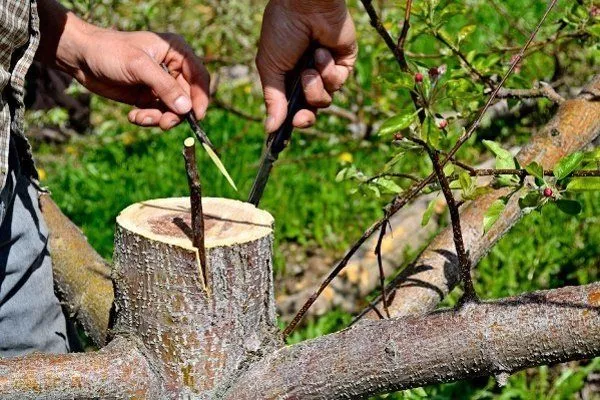
Features of apple tree grafting in spring
Grafting cuttings can be done at any time of year, but spring is considered the most favorable time for this agricultural procedure. Grafting begins when frosts subside and the sap begins to flow.
Why is vaccination necessary?
Grafting involves grafting cuttings from one tree onto another. Grafting apple trees achieves several agronomic benefits:
- Old trees are rejuvenated.
- Fertility increases.
- Apples of different varieties grow on one trunk.
- Frost resistance is increased. A scion of a more heat-tolerant variety is grafted onto a local rootstock that is frost-resistant.
- Garden space is saved. If a gardener doesn't need many apples of one variety, they can grow fruits of different varieties on the same trunk.
- On the same tree, apples of different tastes ripen at different times, so the harvest is spread out over a long period of time.
- The tree's appearance changes, making it more accessible for fruit picking.
Grafted cuttings bear fruit 2-4 years after grafting.
Grafting is practiced by both large fruit nurseries and ordinary hobby gardeners. This agricultural technique allows a dying tree to be revived by grafting its scion onto the rootstock.
Optimal timing
Only cuttings without swollen buds are used for spring grafting. If you miss the time, you'll have to postpone the grafting until summer.
Before manipulation, the tree is watered generously and the soil around it is loosened to increase air circulation and moisture absorption.
Spring is the time of sap flow, and at this time, scions and rootstocks are more resilient to injury. In Russia, spring is considered the best time for grafting. However, timing varies by region. When choosing the right time for grafting, consider the following:
- Kidney condition – you need to do it before the sap starts to flow.
- Position of the moon. It is believed that the best time to graft trees is during the waxing moon.
- Weather. Preferably warm and cloudy, without rain or wind.
- Times of Day - morning or evening.
The ideal time for vaccination according to the lunar calendar is when the Moon is in Scorpio, Cancer or Pisces.
The difference in the implementation of vaccination work in different regions is due to timing:
- In the south of Russia, the growing season is longest, and grafting begins in early March. However, the risk of frost is greater in the south. High humidity here makes frosts more dangerous than in the north.
- In the middle zone, spring grafting begins at the end of April or the beginning of May, depending on the weather.
- In Siberia and the Urals, the timing of spring grafting is determined by soil conditions. When the soil can be dug to a depth of two spade-widths, the work can begin.
The timing of vaccination also depends on its type:
- Grafting by cuttings It's best to perform the procedure in late March or early April, after temperatures reach above zero. The earlier the procedure is performed, the greater the chance of survival.
- Eye grafting It's best to do this later—in late April or early May. This period is characterized by active sap flow, which will ensure good fusion of the bud with the tree.
Benefits of spring grafting
In addition to the above-mentioned advantages of this agricultural technique, spring grafting has special benefits:
- A higher percentage of survival is due to sap movement.
- An opportunity to save a tree damaged by cold.
- You can make a double graft in the summer or fall if for some reason the cutting does not fuse with the rootstock.
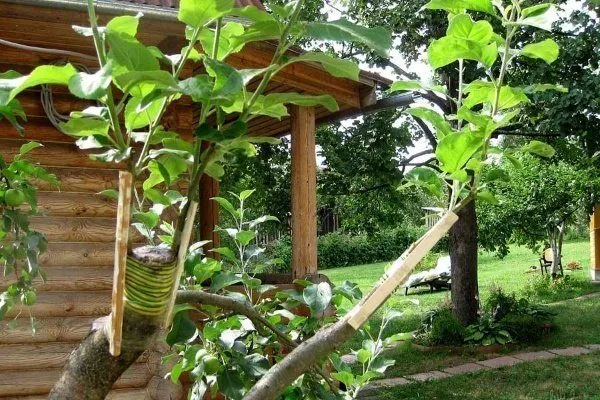
Preparation of tools and materials
To perform grafting, you'll need a set of tools whose composition hasn't changed since the beginning of breeding. These are:
- A sharp knife and a hacksaw – They make cuts. A hacksaw is used to cut down thick branches, if necessary. Before use, be sure to sharpen and treat the blade with an antiseptic – this will reduce injury and the risk of infection.
- Garden var. The grafted cutting is treated with this composition to increase the chances of survival.
- Electrical tape or polyethylene – are used to tie and secure the cutting. They also protect the drive from bacterial infections and environmental aggressors.
- Drying oil or paint, suitable for woodworking. The handle is painted at the very end of the work.
The market offers gardeners a new tool: grafting shears. Used by both professionals and novice gardeners, these shears reduce the risk of damaging plants. Thanks to the special blade shape, grafting shears can make curved cuts that improve the attachment of the scion to the rootstock. The tool is designed for three different operations:
- making a cut with a groove for installing the cutting;
- cutting the handle to ensure its precise fit into the groove;
- performing budding.
To wrap the graft, gardeners use electrical tape, plastic strips, twine, and grafting tape. However, the best material is cotton fabric soaked in garden pitch. This type of wrapping is recommended for the inner layer, with an old bandage wrapped around the outside.
Spring grafting rules
Grafting a cutting onto a rootstock doesn't always produce the desired result. To ensure a satisfying result, gardeners should follow these guidelines:
- Use sharp and disinfected instruments.
- Select the part of the trunk for grafting, taking into account the purpose of the procedure:
- when completely replacing the rootstock variety, the graft is made at a distance of 30 cm from the ground;
- If only 1-2 apple tree branches need to be replaced, all branches that prevent the sun from reaching the cutting should be shortened.
- During the grafting period, the rootstock should be in the active phase of development, and the scion should be in a cool place, in a dormant state.
- Immediately before grafting, the cutting is transferred to a warm, dry place – the branch should “wake up”.
- All cuts are made so that they have clear outlines, no curvature or indentations are allowed.
- When working, you must maintain sanitation and wear gloves only.
- The scion is quickly inserted into the rootstock - into the grafting site, without touching the cuts with your hands and under no circumstances dropping the cutting on the ground.
- If you use electrical tape for strapping, apply it with the sticky side facing out.
What trees can an apple tree be grafted onto?
| Object | Yield (kg per tree) | Ripening period | Frost resistance |
|---|---|---|---|
| Antonovka | 100 | Average | High |
| Wild | 50 | Early | Very high |
| Zoned varieties | 80 | Different | High |
It is recommended to graft apple trees onto similar species. Suitable trees include:
- low-culture analogues of local origin;
- Antonovka seedlings;
- zoned varieties.
Grafting on wild stock
This is the best option, its advantages lie in the properties transferred to the scion:
- frost resistance;
- durability;
- high yields;
- disease resistance.
Wild seedlings no older than 4 years are suitable for grafting.
What else can you graft an apple tree onto?
| Object | Yield (kg per tree) | Ripening period | Frost resistance |
|---|---|---|---|
| Pear | 70 | Average | Average |
| Plum | 60 | Early | High |
| Cherry | 40 | Early | Average |
| Rowan | 30 | Late | Very high |
| Hawthorn | 20 | Average | Very high |
| Irga | 25 | Early | High |
| Quince | 50 | Average | Low |
In addition to wild and localized apple varieties, the following can be used as rootstock:
- Pear. It's well known that pears graft well onto apples, but the same can't be said for apples grafted onto pears. Several pear varieties and an apple tree can be grafted onto a single tree. Sometimes, the tree produces quite acceptable yields.
- Plum. It is frequently and extensively grafted onto plum. However, encountering an apple tree on a plum tree is rare. However, the plum-leaved apple (Chinese apple), distinguished by its developed root system and frost resistance, is often used as an apple rootstock. Both trees are members of the rose family, so they can survive grafting. However, plum is not specifically used as a rootstock. Plum trees have a shorter lifespan than apple trees, and their shoots are thinner than those of apple trees, which results in graft breakage. There are no yield data from such experiments.
- Cherry. Another member of the Rosaceae family. Grafting an apple tree is entirely possible, but, as with plums, problems arise during scion development. The risk of rejection is too high. Cherry trees simply cannot support the heavy branches of apple trees.
- Rowan. Red rowan is preferable to black chokeberry. It has higher frost resistance. It causes apples to become smaller.
- Hawthorn. It's attractive due to its low growth. Apple trees can be grafted onto hawthorn using 50-cm-long cuttings. The graft height is 50-60 cm above the ground. Crossbreeding accelerates fruiting by at least a year. The rootstock and scion grow together quite strongly. Hawthorn's advantage is its root system, which is located close to the ground surface. This quality is advantageous in areas with high groundwater levels.
- Irga. This is a dwarf rootstock often used for grafting apple trees. The graft height is 15-20 cm. Serviceberry has long, thin branches, so this should be taken into account when choosing a grafting site.
- Quince. Grafting an apple tree onto it should only be done experimentally. The chances of success are slim. The scion dies after a few years.
Plum, cherry, and other unusual rootstocks look unique—a source of pride for any gardener. However, apple scions on them don't last as long as those on their own trunks or wildings.
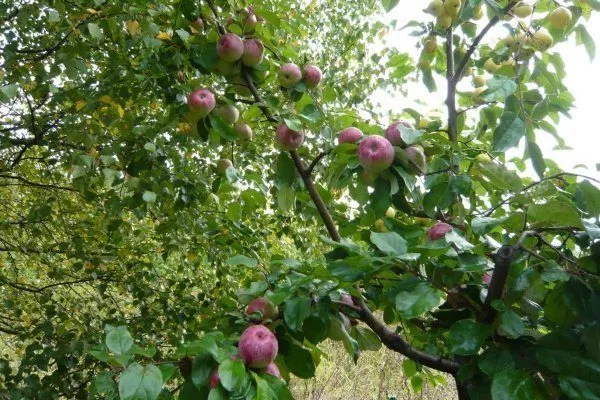
How to choose scion and rootstock for spring grafting?
A novice gardener should preferably select a rootstock under the guidance of an experienced team. The first step is to select the rootstock—the seedling onto which the scion will be grafted.
- ✓ Resistance to diseases typical for the region.
- ✓ Compatibility with the scion in terms of growth rate and lifespan.
Rules for choosing rootstock:
- A healthy tree with undamaged bark and no dry branches.
- High frost resistance.
- If the purpose of grafting is to change the appearance of the tree, a young seedling – up to 3 years old – is taken.
- Each region has its own list of the best rootstock apple trees.
Rules for choosing a scion:
- The cutting is taken from a mature tree that has yielded at least two harvests. This allows you to assess the variety's hardiness and get a feel for its fruit's flavor.
- The best option for increasing compatibility is when the scion and rootstock are closely related varieties. This isn't a requirement—an apple tree can be successfully grafted onto a wild apple tree.
How to prepare cuttings?
Cuttings for grafting are usually purchased, but if desired and possible, they can be prepared independently. Guidelines for preparing cuttings are provided in Table 1.
Table 1
| Indicator | Characteristic |
| Age of donor branches | over 1 year old |
| Optimal preparation time | at the beginning of winter, at a temperature of -10°C |
| Storage temperature | -2°C |
| Storage location |
|
Donor branches should show no signs of disease or bark damage. After the snow has fallen, grafting cuttings should be buried in snow, after being placed in a container filled with sawdust or peat.
Methods of grafting
There are many ways to graft trees. Firstly, the methods differ in the grafting material used. You can graft:
- cuttings;
- kidney.
Secondly, there are several different grafting techniques:
- into the cleft;
- bridge;
- in the side cut;
- on a stump;
- under the bark.
Let's take a closer look at different methods of grafting apple trees.
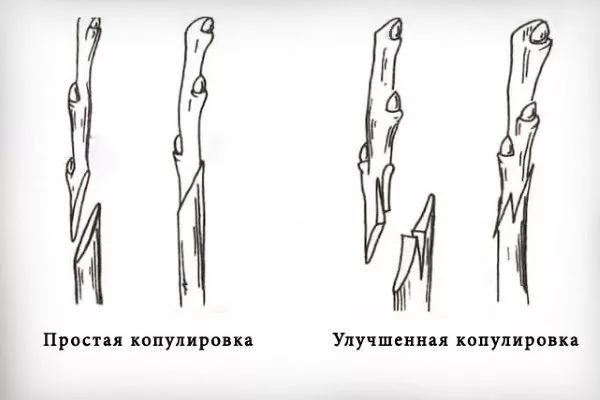
Classic copulation
Copulation is a word of Latin origin. Copulo means "to join." In horticulture, it refers to the fusion of a scion and rootstock of equal thickness.
There are 2 types of copulation:
- Simple. Used on young trees. Use a 1-2 year-old rootstock. Maximum thickness is 1.5 cm. The scion is selected based on its thickness. The cut on the scion and rootstock is made at the same angle. The cut is made in one motion.
- Improved. It differs from simple copulation by the addition of an additional cut—a tongue—made on both the scion and the rootstock.
Technique for performing improved copulation:
- On the cutting and rootstock, oblique cuts of the same length are made – 2-4 cm.
- They make incisions called tongues. The longer the incision, the stronger the fusion will be.
- The handle is inserted into the tongues, pressing firmly with the fingers.
- The scion is wrapped in plastic film. The grafting site is treated with garden pitch.
Fig. 1. Standard and improved copulation
Cleft grafting
The optimal grafting option is for 3-5 year-old seedlings. If the grafting is too long, it will rot. The grafting site is 20-25 cm above the ground. The graft is made onto a skeletal branch.
Procedure:
- The rootstock is split with an axe. The depth is 8-10 cm.
- A cut is made at an angle at the lower end of the scion, matching its length to the depth of the cleft. Using a sharp knife, make the cut—one-sided or two-sided.
- After inserting a spacer into the cut, it is widened to accommodate the rootstock. Up to four scions can be placed in a single cleft; then the cleft is made crosswise.
- After removing the spacer, wrap the grafting site. Twine can be used; in this case, plastic wrap is unnecessary.
- After treating the grafting site with garden pitch, plasticine or clay is stuck onto the gap.
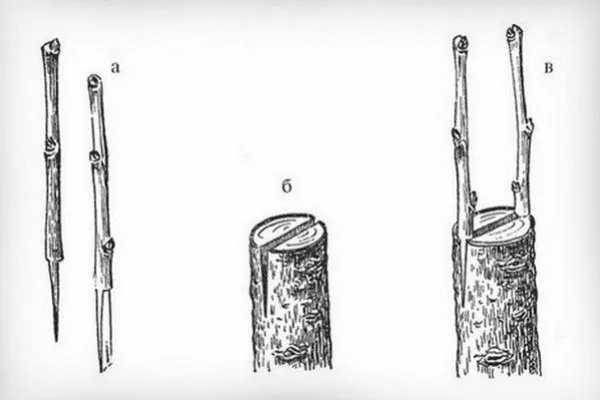
Cleft grafting
In the side slit
This grafting method is considered the simplest. All you need is a garden knife. Here's how:
- The lower end of the cutting is cut at an angle of 45 degrees.
- On the rootstock, select a branch where the cutting will be grafted, and step back from its base by approximately 20 cm.
- With the knife at an angle of 20 degrees, cut the bark to cut into the wood a few millimetres deep.
- The lower edge of the cutting is placed into the cut made on the rootstock, achieving a perfect fit.
- The grafting site is tied with polyethylene and coated with pitch.
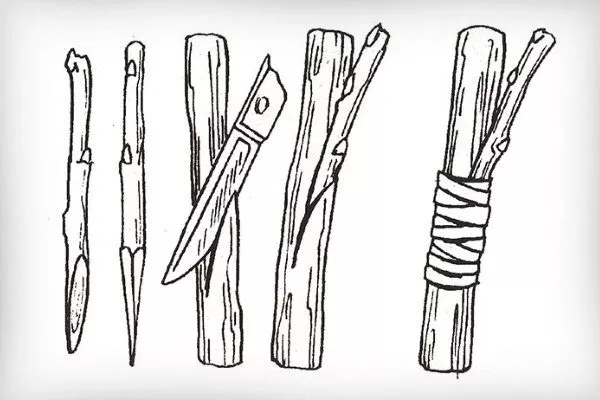
Lateral incision grafting
With grafting shears
Suitable for cuttings 4-16 mm. The procedure for copulating with pruning shears:
- Using pruning shears, cut the bark on the scion so that the cut is shaped like the letter U.
- A similar shaped notch is made on the rootstock using pruning shears.
- After inserting the scion into the rootstock, secure the structure with polyethylene or electrical tape.
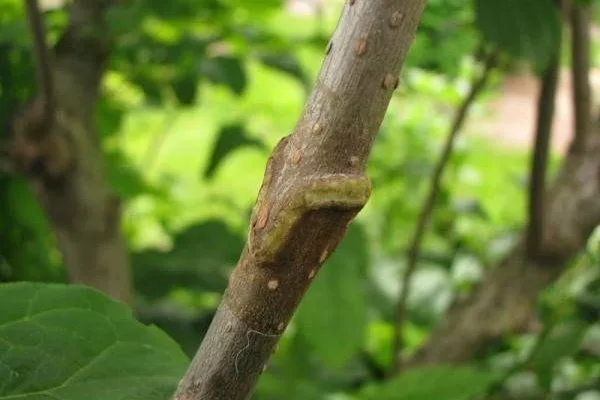
Grafting with grafting shears
For the bark
This option is best for mature trees that need to be made more robust and frost-resistant. It's also suitable for acclimating the variety. The procedure is quite complex, requiring precise movements. The task is further complicated by the difficulty in achieving a good rootstock connection. This method is only used in the spring, during sap flow, when it's easier to separate the bark from the wood. Procedure:
- Four scions can be grafted onto the rootstock at once. Three are then removed, leaving the strongest one.
- The height of the cut is 100 cm from the ground.
- Using a sharp knife, make a 4-5 cm long cut.
- By moving the bark, the wood is slightly exposed.
- A diagonal cut is made at the base of the scion—its length should be equal to three times the scion's diameter. The cut should be smooth, with the buds facing upward.
- Having placed the cutting behind the bark, press it tightly.
- After tying the grafting site with electrical tape or polyethylene, coat it with garden pitch.
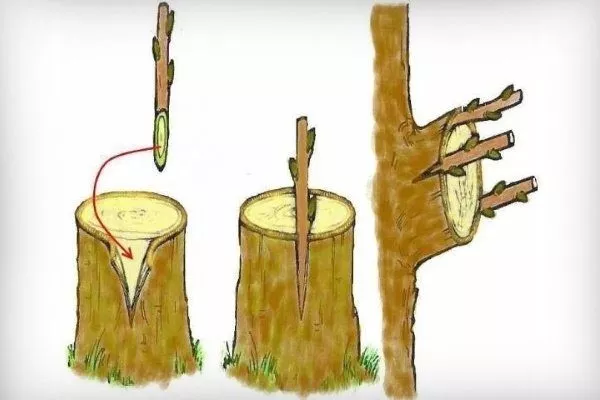
Grafting an apple tree by the bark
By bridge
Used to save trees gnawed by mice or hares over the winter. Bridge copulation procedure:
- The damaged area is cleaned.
- Longitudinal incisions are made above and below the damage.
- Small cuttings are cut and the buds are trimmed off.
- On the rootstocks, cuts are made in one plane.
- The cuttings are inserted with the lower part into the lower cut, and the upper part into the upper cut.
- The grafting site is wrapped with film.
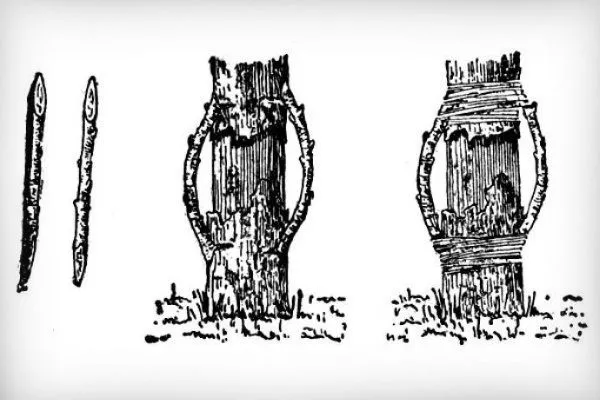
Bridge grafting
On the stump
A stump can be either a part of a skeletal branch or the lower part of a sapling or young tree. Procedure:
- Stump preparation – a new cut or resurfacing of an old cut. Cleanup with a knife.
- Choice of method - in a cleft or behind the bark.
- The prepared cutting is inserted into the gap or cut.
- Film wrapping.
To the trunk of the apple tree
The apple tree has many large gaps along the trunk, making it seem as if branches are missing. The trunk grafting procedure is:
- A T-shaped incision is made.
- A diagonal cut is made on the cutting.
- The cutting is inserted into the cut.
- The grafting site is wrapped with film and coated with garden pitch.
An experienced gardener demonstrates how to graft apple and pear trees in the spring. The specialist explains the technical nuances of the process:
T-budding
A single bud (eye) from a cutting of the desired variety is used as a scion. The rootstock is a branch or trunk of an apple tree or a wild apple.
Advantages of budding:
- small grafting area – minimal trauma;
- the possibility of reusing the rootstock if the bud does not take root;
- from one cutting of a valuable variety, several grafts can be made at once - according to the number of buds present on it;
- high percentage of scion survival;
- quick completion of work.
Stages of T-budding:
- On a flat area of the rootstock, make a T-shaped cut in the bark with confident and precise movements. The transverse cut is 2 cm, and the longitudinal cut is 3-4 cm.
- A bud is cut out from the cutting, capturing the tissues adjacent to it at the top and bottom.
- After parting the bark on the rootstock with a knife, place a bud inside the T-shaped cut. The bud is placed in the very center of the cut.
- Pressing the bark against the bud, wrap the budding site with bandaging material. The bud is not wrapped—it should remain free.
If all goes well, the bud will swell and begin to grow within a couple of weeks. Budding is typically used to graft several apple varieties onto a single trunk.
It is not recommended to graft varieties with different ripening times onto the same rootstock. Otherwise, the tree will lose its frost resistance and become susceptible to disease.
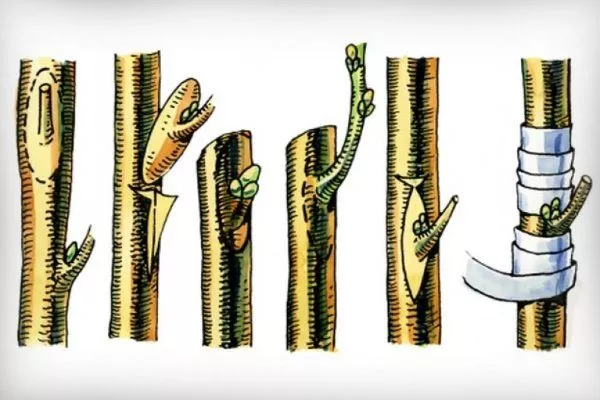
Apple tree budding
Budding in the butt
The method doesn't depend on whether the bark is removed easily or with difficulty. Here's the procedure:
- The bark of the rootstock is trimmed from top to bottom, capturing a small amount of wood. The strip is 2.5-3 cm long and 0.4-0.7 cm wide.
- The knife is positioned at a 30-degree angle. The cut depth is 4-5 mm. A wedge-shaped incision is made into which the scutellum with the bud will be inserted.
- The cutting of the shield is carried out in the same way as in the first case - with T-shaped budding.
- Place the shield under the bark. It must be aligned with the rootstock to achieve maximum contact.
- The grafted area is covered with film. The grafting must not be allowed to shift. If there are any exposed cut areas, seal them with garden pitch.
A gardener talks about grafting mature apple trees using the "cleft" and "behind the bark" methods:
How to care for an apple tree after grafting?
To ensure that the scion takes root and the injured tree is not harmed, it must be provided with appropriate care:
- For the first few days after copulation or budding, you need to water the grafting site with garden pitch or another protective agent.
- Protect the tree from pests, birds, and rodents. Inspect the graft site daily; if you notice any insects, remove them immediately.
- Provide a grafted tree top dressing and timely watering.
- Loosen the fixing winding in time.
- Tie up the shoots.
- ✓ Optimal humidity at the grafting site.
- ✓ Avoid direct sunlight in the first weeks after vaccination.
Post-graft care involves pruning root shoots:
- All shoots that appear below the grafting site are completely removed.
- The shoots are carefully cut off at the very base, and not broken off.
- By breaking off the shoots, you stimulate their growth.
Pruning of a grafted apple tree for the following spring is carried out as follows:
- Only one shoot is left on each graft – the strongest one is chosen.
- All other shoots are removed.
- All shoots that have grown below the grafting site are cut off.
- When growth is good, branches are shortened by 1/3 of their length.
When to remove the harness?
The plastic film or electrical tape should first be loosened and then completely removed. This should be done gradually:
- Ten to fifteen days after grafting, the bandage is loosened or renewed. To do this, make a cut along the film with a knife.
- The bandage is removed 2-3 months after vaccination.
If you don't loosen the winding in time, you can crush the branch.
Questions about apple tree grafting
1Is it possible to do spring grafting if the tree was planted in the fall?
Answer: One-year-old seedlings grafted with a new variety need to be established—bud budding is recommended. If using specially prepared rootstocks, grafting is safe. Grafting is most successful on 3-4-year-old apple trees.
2How to graft an apple tree onto an old tree?
Answer: Every garden has an old apple tree—some 20 years old. They need to be grafted to create new varieties and for rejuvenation. The latter makes sense if the tree produces high-quality fruit. Considerations for grafting an old apple tree:
- Skeletal branches are selected for grafting.
- The graft is made at a distance of 30 cm from the trunk.
- 2-4 cuttings are grafted onto branches with a diameter of less than 3 cm, and 4-5 cuttings onto branches with a diameter of 3 cm or more.
- If the apple tree is more than 25 years old, it is not grafted.
3Is it possible to graft dwarf apple trees onto wild apple trees?
Answer: Yes, you can, but there's a specific procedure. It's quite simple:
- First, a dwarf tree is grafted onto a wild tree;
- A year later, a valuable variety is grafted onto the dwarf tree – a grafting with an insert is done.
After the work is done, you receive:
- a tree with a root system of vigorous seedlings;
- insertion of dwarf rootstock – about 20 cm;
- At the top is a cultivated variety.
Common mistakes of novice gardeners
Inexperienced gardeners often make the following mistakes:
- The wrong bud is being selected for budding. An open bud is not suitable for grafting. A better choice is buds formed in the previous season.
- Violation of sanitation – using dirty instruments.
- When making a copulation on a side cut, beginners often take a cutting with an insufficient number of buds - 3-4 pieces are needed.
- Budding is carried out from the south side - the sun can interfere with engraftment.
- The cuttings are grafted during the rain.
- They take fresh scions, but what is needed are cuttings cut during the dormant period.
- They forget to loosen and remove the harness in time.
- The shoots that grow below the grafting site are left.
If you've never grafted before, you should try this effective gardening technique. If done correctly, you can rejuvenate your garden, clone varieties, and engage in breeding—your garden will become much more interesting!