
Feeding ostriches is a labor-intensive process that requires precision and discipline. This is especially true for young ostriches, who lack the ability to control their own feeding. Ostriches, compared to other birds, digest fiber well, allowing them to produce delicious red meat with virtually no cholesterol.
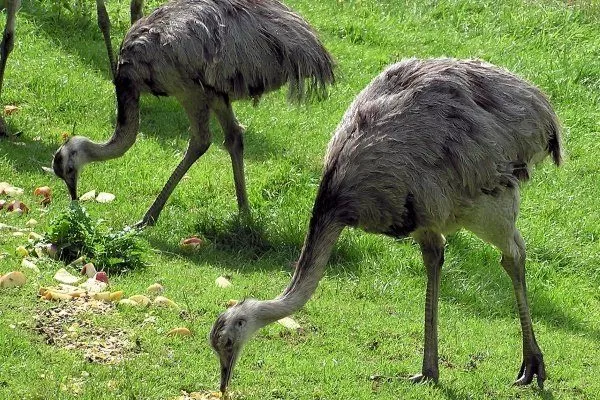
What do ostriches eat?
Ostriches are accustomed to living in the wild, and naturally, they feed on whatever food they find themselves, making them omnivores. Their diet is quite varied, as they can consume both plant foods:
- alfalfa;
- various herbs;
- leaves from the trees.
And so are the living creatures:
- small insects;
- bugs;
- snails.
The diet is supplemented with compound feed, crayfish, shells, proteins, vegetables and grains.
In nature
Ostriches, large feathered birds, inhabit the long, flat African savannah. These areas are rich in greenery and young leaves, which are their primary food source. The African savannah is home to many herbivorous animals. In the wild, ostriches feed on foraging.
Birds can survive for quite a long time without water, so they often nest in dry desert areas, where they eat seeds, roots, and branches that grow on bushes.
For variety, in addition to greenery, they eat small insects, rodents, and reptiles. To burn enough energy and run far, an ostrich needs about 4 kg of food per day.
In the wild, ostriches interact with antelopes and zebras. These animals have excellent eyesight, so they can spot wild animals first and alert their friends. Antelopes and zebras help ostriches find food, using their sharp feet to pluck insects from the grass.
On the farm
Birds living on farms or private farms don't have much different diets than free-ranging birds. Ostriches eat the same food they eat in the wild, whether they're kept at home or on a farm. The only difference is that on a farm, they're confined to a limited space, so they move less, expend less energy, and eat little. Their primary diet consists of fresh grass, greens, and leaves.
The table below shows the costs of concentrated feed per individual of different ages:
| Periods | Bird's age in months | How much feed is needed for a year? |
| Newborn | from 0 to 2 | 16 kg |
| Start | from 2 to 4 | 84 kg |
| Fattening | from 4 to 6 | 100 kg |
| Finish | from 6 to 10 | 300 kg |
| Slaughter | from 10 to 12 | 150 kg |
When birds are fed correctly, they should weigh as follows:
- at 1 month up to 3 kg;
- at 2 months up to 10 kg;
- from 2 to 6 months up to 60 kg;
- from 6 to 11 months up to 100 kg;
- from 11 to 14 months up to 120 kg.
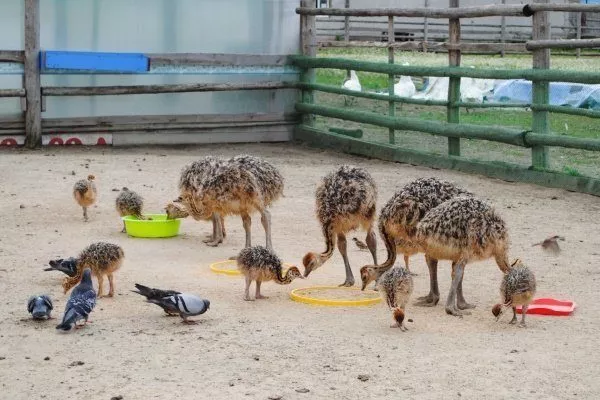
The influence of the digestive system of ostriches on their diet
The birds' digestive tracts are suited to the arid conditions of savannas and prairies. These birds lack a crop, unlike other domesticated birds. Food passes into the forestomach, where it is softened by fluid secreted from the forestomach walls.
The soft mixture then passes into the stomach, which has thick, hard walls. Ostriches lack teeth, so they often swallow small stones. The food, which consists of coarse fibers, is digested along with the stones.
At the end of the process, nutrients are absorbed in the small intestine, which is 5 meters long. The remaining fiber is broken down only in the appendages of the cecum.
Thanks to this, the birds can go for quite a long time without water, since it is replenished from food.
Feeding methods
The feeding diet needs to be given a lot of attention when ostrich breedingWith proper, nutritious, and balanced feeding, ostriches will enjoy good weight gain, good development, and high productivity. In winter, alfalfa, sold as hay, is preferred, while in summer, fresh alfalfa mixed with compound feed is given. One and a half kilograms is sufficient per ostrich.
There are 3 types of feeding, the choice is up to the bird's owner:
- Intensive method.
- Semi-intensive.
- Extensive.
Intensive method
This method involves feeding ostriches either compound feed or homemade grain mixtures (crushed corn, wheat, oilcake, premixes). Silage, hay, and perennial grass are also added to the diet.
Semi-intensive
If the grazing area is small, a semi-intensive feeding method is chosen. In this case, the ostriches are left to roam freely, moving around a lot, and foraging for food. At the same time, the owner feeds them specialized feed in the form of pellets mixed with chopped vegetables and greens. This method is considered the best, as the birds are fed both naturally and artificially, receiving everything they need.
Extensive feeding
The extensive method involves foraging independently for food, roaming in a pasture. This option is very economical, as there's no need to constantly buy feed from stores. The diet is supplemented with compound feed. Ostriches have long been bred in Africa, and they've noticed that they achieve the best weight gains when kept in pasture, especially in meadows dotted with alfalfa. The range area should be 1 hectare per 10 birds.
In addition, it was found that from two weeks to four months, it is better to keep chicks on pasture, after which they are transferred to fenced pens and given alfalfa in pellets or simply chopped.
Experienced farmers let their ostriches graze on a variety of grasses, such as serradella, clover, and vetch. They also graze happily in fields after the wheat harvest. During droughts, when natural food is scarce, feeding is carried out as with the intensive method.
How to choose compound feed?
Every ostrich farmer wants to purchase the best feed for their animals. There are many types of compound feed with various additives. The choice of compound feed should be based on the weight and age of the birds. Typically, there are several types of feed based on age:
- from 0 to one month;
- from 1 to 2 months;
- from 2 to 4 months;
- from 4 to 6 months;
- from 180 to 330 days;
- from 330 to 420 days;
- compound feed for feeding during rest periods;
- compound feed during the egg-laying period.
It's important to purchase feed from specialized stores or trusted sources. When purchasing, pay attention to the ingredients and expiration date. Don't feed adult food to young ostriches, and vice versa.
The table shows the names of the feeds and their approximate cost:
| Name of the feed | Price in rubles, wholesale price per 1 kg |
| KS-30 | 19 |
| KS-60 | 18 |
| KS-120 | 16 |
| KS-180 | 16 |
| KS-330 | 15 |
| KS-420 | 12 |
| KS0 | 17 |
| KSN | 16 |
You can see current prices on the website. strausferma.ru
Preparing your own food
The compound feed can be fed to ostriches from the first days of life, as its composition allows it to replace complementary foods. The compound feed was formulated to ensure the animals receive the necessary nutrients in the right quantities.
It contains:
- wheat;
- cake;
- corn;
- fish meal;
- calcium phosphate;
- chalk;
- soybeans;
- sodium chloride;
- premixes;
- lysine;
- methionine;
- threonine.
You can always make your own food by following the table:
| Component | Growth period from 2 months to a year, % | Productivity period, % | Productivity period, % | Productivity period, % | Unproductive period, % |
| Barley | 15 | 20 | 5 | 27 | 25 |
| Wheat | 12 | 11 | 10 | 11 | 18 |
| Corn | 30 | 15 | 20 | 15 | 20 |
| Oats | 3 | 12 | 20 | 12 | 5 |
| Fish meal | 5 | 10 | 7 | — | 5 |
| Bran | 5 | 5 | — | 7 | 10 |
| Sunflower meal | 7 | 10 | 5 | — | 2 |
| Soybean meal | 10 | 5 | 15 | — | 5 |
| Yeast | 5 | 3 | 5 | — | 2 |
| Bone meal | 2 | 2 | — | — | 2 |
| Vegetable oil | 1 | 1 | 3 | 3 | 1 |
| Chalk | 1.2 | 3 | — | — | 1.4 |
| Monocalcium | 3 | 2.5 | — | — | 3 |
| Salt | 0.1 | 0.01 | — | — | 0.01 |
| Premix PKK P 8 569 | 0.5 | — | — | — | — |
| Premix PKK P 9 570 | — | 0.5 | — | — | — |
| Premix PKK P 9 571 | — | — | — | — | 0.05 |
| UVMKK "Felucen" 1175 | — | — | 10 | — | — |
| UVMKK "Felucen" 654 | — | — | — | 25 | — |
Nutritional characteristics of ostriches
If ostriches are not fed properly, they may grow up with uneven legs, which will prevent them from living a normal life. Newborn ostriches can survive for several days without food, making feeding and long-distance transport easier. This is because their bodies contain a lot of protein, which is not fully absorbed until they are 10 days old.
During their first outing, the chicks are introduced to clean water and food consisting of chopped alfalfa or clover leaves and mixed feed. Every 1-2 days, they are offered low-fat cottage cheese with chopped hard-boiled eggs.
In the following video, a farmer shares his experience feeding ostriches:
Starting in their second week of life, ostrich chicks gain 300 grams per day, growing by 1 cm daily. At three months of age, they weigh 15 kg. The chicks need to be fed gravel; otherwise, their stomachs simply won't be able to digest the food, causing indigestion and constant hunger.
At three months of age, fiber and protein are added to the main feed. Succulent grass should also be included in the chicks' diet, as should flour and silage. Crushed stones are needed to improve the digestive tract; they are essential to prevent the chick from dying while chewing solid food.
For some reasons, young birds are fed with the droppings of adult birds, which helps colonize their intestines with beneficial microflora. However, before doing this, it's important to ensure that the adult ostrich is completely healthy and free of worms.
| Period | Number of feedings per day |
| Up to 6 months | 5 |
| From 6 months to a year | 4 |
| Adults | 2-3 |
Until the chicks are six months old, they are fed five times a day; from six months to one year old, the number of feedings decreases to four. Adults are fed two or three times a day.
Feeding during the egg-laying period
During the egg-laying period, both males and females experience changes in their nutritional needs. Females experience an increased need for calcium, as the eggshell is forming during this period.
In males, too much calcium interferes with the absorption of zinc, which plays a key role in sperm production. High levels of this substance are necessary for females to egg formed correctly, and if the male overeats, this will lead to obesity, and fertility will be low.
During the egg-laying period, feeding should be different for males and females. Males and females are kept separate, and only allowed near each other for a few hours every other day. This feeding should only occur after the female has eaten.
You can feed ostriches during the egg-laying period with the following products:
- wheat;
- crushed corn;
- juicy leaves;
- compound feed;
- foods containing calcium;
- chalk;
- grass.
Drinking regimen
Although ostriches are accustomed to drought, they still need to be provided with clean water. At home and on the farm, a water bowl is provided alongside their food so they can drink to their heart's content. Clean water is essential, as the birds' health depends on it.
For every 1 kg of dry food, there should be 2.5 liters of water, with constant access to water. The drinking bowl should be 70 cm above the ground or floor.
How does diet change in winter, spring, summer and fall?
Like any animal, its diet changes depending on the season, and ostriches are no exception.
Summer. During the summer, ostriches spend most of their time outdoors, searching for their own food. They also need to be fed 1.5 kg of compound feed daily, which they must consume daily. To replenish their body with all the necessary nutrients, especially protein, lupine, beans, fruits, and oilcake are added to the main feed. These components are easily digestible, especially when combined with amino acids found in chalk, shells, eggshells, and bran.
Autumn and spring. During the spring and fall, ostriches should eat greens or grass meal, along with gravel, oilcake, and grain. It is recommended to supplement the diet with bone meal, table salt, and chalk. Vegetables are also essential in the diet of both adults and chicks.
Winter. During the winter, ostriches are fed pre-prepared hay, which is mixed with concentrated feed and grains. Between feedings, the birds are allowed to be given:
- cabbage leaves;
- beet tops;
- fodder beet;
- carrot;
- zucchini;
- apples;
- waste.
- ✓ Use alfalfa hay as the basis of the diet.
- ✓ Add vegetables and fruits to add variety to your diet.
The main food in winter remains hay, preferably alfalfa.
The following report describes the feeding and maintenance of ostriches in Siberia:
What should not be fed?
Although ostriches are omnivores, there are still a certain set of foods that should not be fed to the birds, and there are those that should be given in limited quantities.
The following foods should not be fed:
- potato;
- parsley and dill;
- rye.
Can be given in limited quantities:
- cabbage;
- flour;
- bran.
Frequently asked questions and answers
Beginning farmers have many questions about keeping and breeding ostriches. Before acquiring the birds, it's important to gather as much information as possible about keeping and feeding them.
1Question: Should ostriches and adult birds be fed together or separately?
Ostriches should be fed separately from adult birds, as babies are restricted from many foods that older birds can. The same applies to the number of feedings per day: newborns eat five times a day, while adults eat only two or three times.
2Question: How long can ostriches live without water?
Ostriches can go without water for several days, but if it's available, they drink large quantities. However, clean water should always be available. Drinking bowls should be cleaned daily.
3Question: Should ostriches be given shell rock?
Limestone and shell rock should be readily available to birds at all times, as they help their skeletons develop properly. They are especially important in the first days of life.
4Question: When should I start feeding ostriches?
Newborn chicks don't require supplemental feeding, as the yolk sac remains in their umbilical cord for several days, providing them with nourishment. Adult birds are fed 2-3 times a day, while babies should have food constantly. When weaning begins, chicks should be given a variety of mash, concentrated feed, and crushed leaves without stems.
Feeding ostriches is a labor-intensive process, as the ratio of grain, grass, compound feed, and other ingredients must be considered. The bird's health and lifespan depend on proper feeding. The diet must include all the nutrients and beneficial substances necessary for proper body development.