
Ostrich farming is not an exotic or whimsical endeavor, but a highly profitable business. Today, these gigantic birds, which generate real profits, are successfully bred in the southern and central regions of Russia.
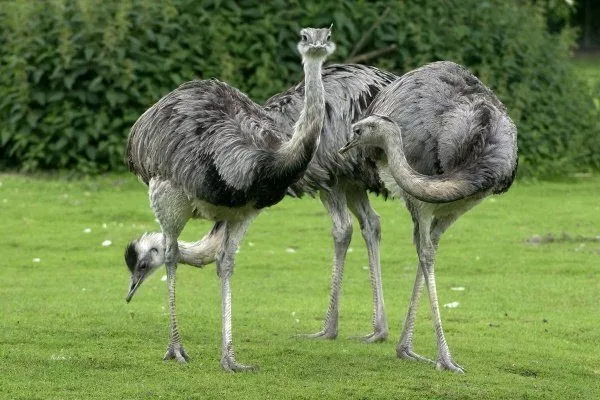
Why are ostriches bred?
Ostriches were once popular zoo visitors—this enormous bird always aroused interest. Powerful legs, massive bodies, and magnificent feathers—they were truly a sight to behold. But beyond their decorative appeal, these birds also garner commercial interest. Ostriches are a lucrative breeding opportunity for farmers. Breeding them is a profitable business, offering several sources of income. Besides meat and eggs, skin, fat, feathers, claws, and beaks also bring in profit.
Meat
The main advantage of ostrich meat is its low cholesterol content. It contains only 34 mg per 100 g. For comparison, chicken contains approximately 80 g, and rabbit and turkey contain 40-60 g.
Other benefits of ostrich meat:
- high protein content – up to 22%;
- a large set of microelements;
- low fat content;
- Well soaked in spices, it is an excellent culinary object.
Ostrich meat has long been a favorite among Mexicans, and it has many fans in the US, Europe, and Asia. Europeans, for example, have significantly reduced their beef consumption due to rising ostrich sales. And the popularity of this unique meat continues to grow.
The meat yield per bird is approximately 30 kg, representing 40% of the bird's live weight. The cost of a carcass in European markets is approximately $500. In Russia, the cost of a carcass is 250 rubles, and a fillet is 700-800 rubles.
Eggs
Ostrich eggs, like the hens they lay, are true giants. One egg weighs an average of 1,500 g. This is equivalent in weight to 30 chicken eggs. So, it's enough to feed one ostrich egg 10 people can eat it. Like meat, ostrich eggs are low in cholesterol.
Interesting and useful facts:
- It takes 1 hour 15 minutes to hard-boil an ostrich egg.
- The price of one egg is 800-1000 rubles.
- Very long shelf life – can be safely stored in the refrigerator for a whole year.
- Egg shells are incredibly hard. Breaking them is a challenge in itself. Artists value them for engraving and painting. They are also prized by jewelry makers.
- Fertilized eggs are especially valuable, fetching significantly more than unfertilized ones.
- A female lays up to 70 eggs per year.
In southern African countries, ostrich eggs are added to baked goods, and in Europe they are served in restaurants.
Leather
Ostrich leather is of luxurious quality. It has become an excellent alternative to the hides of wild animals, whose numbers have declined or been reduced to zero due to barbaric hunting.
Advantages of ostrich leather:
- moisture resistance;
- elasticity;
- durability – service life more than 30 years;
- wear resistance.
Ostrich skin is used to make luxury haberdashery and footwear. It's used to make bags, wallets, belts, gloves, shoes, and purses. Ostrich skin is comparable in quality to crocodile and snakeskin.
The most popular skins are those from the back and chest, where they have a beautiful pattern resembling air bubbles. Leg skins are primarily used to make boots. Even selling ostrich skins alone can cover the entire cost of raising the birds.
Feathers
A couple of centuries ago, the fashion for ostrich feathers led to the mass extermination of ostriches. The white feathers of males, found on the wings and tail, are considered the most valuable. They are used primarily for decorative purposes.
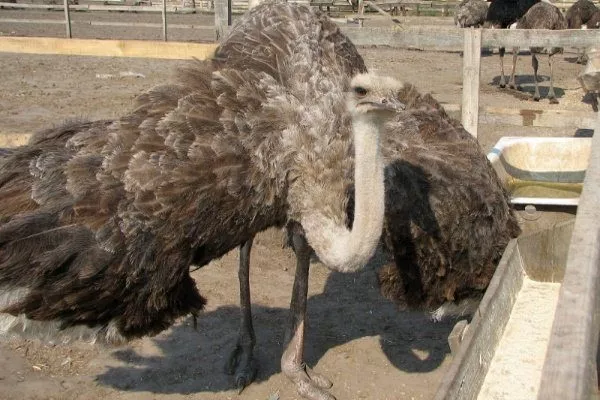
Ostrich feathers have an antistatic effect, so they are used to clean dust from electrical appliances.
Uses of ostrich feathers:
- used by designers and fashion designers to create original works;
- feathers are often bought by visitors to ostrich farms as souvenirs;
- are in demand among artists and home art enthusiasts;
- The remaining feathers, which are less valuable, are used for stuffing pillows.
Feather sales generate up to 10% of ostrich farm profits. Each bird yields approximately 1 kg of short feathers and 0.5 kg of long and medium feathers (from 22 cm).
Claws and beak
It seems as if ostrich farms are a waste-free operation. Literally everything is used. Even the beaks and claws of these enormous birds find practical use:
- Claws are used to make fasteners and buttons. They are also used to make a powder used to polish diamonds. A ton of claws sells for $80,000 in Europe.
- The beak is primarily used to make jewelry—necklaces and amulets. Even flash drive casings are made from claws and beak.
Fat
One bird yields 7-15 kg of fat. Ostrich fat is used as a raw material for cosmetics and medicines. It is used to make creams, ointments, soaps, and balms. Emu fat is prized above all other fats for its antibacterial, anti-inflammatory, and hypoallergenic properties. Ostrich fat is also used to treat joint problems—it warms and relieves pain.
Ostrich farming as a business in Russia
This southern bird adapts perfectly to our climate, and ostrich farming has rapidly gained momentum. If you're going to breed ostriches, you should choose the most profitable option—the African Black breed. Breeding these giants promises considerable profits across all categories—meat, eggs, feathers, fat, and so on.
Here are the parameters of the average black ostrich:
- male height – 2700 cm;
- live weight of male – up to 150 kg;
- female height – 2 m;
- The live weight of the female is 120 kg.
There's no need to fear ostriches—these giants are calm and docile, and there are no particular problems with their care. The only time they might become agitated is during mating season, when the males can be a bit noisy.
Productivity of ostriches
Ostriches are enormous, but that doesn't mean they take a long time to grow to their full 100-150 kg weight. They reach slaughter weight in just 10 months. In the wild, female ostriches begin laying eggs at four years of age, while farmed ostriches begin laying eggs at two years of age. In Russia, ostriches can be successfully bred in the temperate continental climate found in the European part of the country.
Performance characteristics:
- Egg production ranges from 40 to 80 eggs, sometimes reaching 100.
- The weight of one egg is 1400-1900 g.
- The egg diameter is 15 cm.
- Egg length: 15-21 cm.
- The shell thickness is 0.6 cm.
- The incubation period is 42-45 days.
- Productivity of females/males 30/40 years.
- Egg fertilization rate is 90%.
Females become sexually mature at two years of age, while males mature one year later. Eggs are laid twice a year, in autumn and winter. The clutch duration is 60 days. The frequency of laying eggs is one every two days. During the first season, females lay 10-30 eggs, then egg production increases. Fertility depends on the period of the clutch during which they are laid. Eggs laid first and last have a lower fertility rate.
Although ostriches originate from warm climates, they are very tolerant of temperature fluctuations. Therefore, they can be bred not only in the European part of Russia but even in Siberia.
Market value
Farmers choose the ostrich business because of the demand for their products and the high profits. The market value of products obtained on ostrich farms is shown in Table 1.
Table 1
| Name | Cost, thousand rubles |
| One-day-old chick | 7 |
| Chick up to a month old | 10 |
| Two-month-old bird | 12 |
| A six-month-old bird | 18 |
| Bird 10-12 months | 25 |
| Sexually mature ostriches of two years old | 45 |
| Adult birds aged 3 years | 60 |
| Ostrich family 4-5 years old | 200 |
| Hatching egg | 3 |
| Table egg | 1-2 |
| Souvenir egg | 0.5 |
| Rendered fat, per 1 kg | 1 |
| Meat (fillet), per 1 kg | 1.1-2.2 |
| Wet-salted leather 1.2-1.4 sq. m | 3 |
| Tanned leather 1.2-1.4 sq. m | 7 |
| Ostrich feather, 60 cm | 0.4 |
The video below explains how to breed ostriches for profit:
Expense items
To generate a stable profit from ostrich farming, you need to invest in your future business. This includes:
- Building a poultry house. You'll also need an incubator and an aviary for the birds to roam.
- Interior work in the poultry house and construction of outdoor canopies.
- Rent or purchase of a land plot.
- Equipment – shovels, rakes, special tools – for example, scissors used to trim feathers.
- Equipment used to crush grain and grass.
- An incubator for hatching eggs.
- Feeders and drinking bowls – they can be purchased ready-made or made independently.
- Young animals or eggs. Transportation and insurance.
- Registration of documents.
- Payment for the work of farm staff, livestock specialists.
It is also necessary to take into account the costs of feed, water, electricity, lawn grass (seeds), heating, and the services of a visiting veterinarian.
One of the main expenses is purchasing livestock. The cost of ostriches:
- newborns – 7,000 rubles;
- monthly – 10,000 rubles;
- one-year-old female – 40,000 rubles;
- two-year-old male – 60,000 rubles.
It's more cost-effective to purchase entire families—females, males, and their chicks. A family costs 200,000 rubles. The total cost is approximately half a million rubles.
Required documents
To open an ostrich farm legally, you need to register it as a legal entity—for example, an LLC, or, even better, a farm. In the latter case, farm owners receive the following benefits:
- they pay a single tax under the simplified taxation scheme;
- receive subsidies from the state;
- receive financial assistance – free food, vaccines, etc.
To register a farm, you will need the following documents:
- General civil passport.
- Application (form No. Р21002).
- Receipt for payment of state duty.
- Agreement on the establishment of a farming enterprise. There may be one or more founders.
The prepared package of documents is submitted to the tax office.
Payback period – what kind of profit can you expect and when?
Before calculating the potential profit, we need to estimate the investment. An ostrich farm requires capital and ongoing funding. We previously calculated that starting a farm would require approximately 500,000 rubles. Now we'll find out how much money can be earned from a single ostrich. An ostrich produces meat, fat, feathers, and skin. The total cost is approximately 70,000 rubles.
If an ostrich lays 60 eggs per season, they could earn an additional 40,000 rubles. Five ostriches are enough to cover the cost in one year. Taking into account ongoing expenses, the farm's payback period is approximately eighteen months.
Once you've made your first profit, you can expand your business and increase your herd. With proper management, profitability can reach 95%. Let's try calculating the profitability of a small ostrich farm using an example:
- The cost of a one-month ostrich is 10,000 rubles.
- Let's say 15 female ostriches and 2 males are purchased for a mini-farm - the purchase of the livestock will cost approximately 170,000 rubles.
- The cost of keeping one ostrich is only 4,000 rubles per year.
- Costs for the entire livestock: 17 x 4 = 68,000 rubles.
- The female will lay 60 eggs per year.
- Total egg production: 15 females x 60 eggs = 900 eggs.
- 50% of the eggs will be used for breeding, the rest will be sold.
- Let the cost of one egg be 1,500 rubles. The cost of all eggs: 450 x 1,500 = 675,000 rubles.
Selling eggs alone helps recoup the cost of purchasing and raising ostriches. A farm typically achieves a good profit in the second year of operation. During this period, the flock size has been established. It is recommended to divide it into two parts (1:3):
- to replenish livestock;
- for slaughter.
If all 450 eggs left for breeding hatch successfully, the farm will receive 450 new ostriches. 150 ostriches will be kept for breeding and sale, and 300 birds will be slaughtered once they reach 100 kg. This process takes approximately 10-12 months.
One ostrich yields 55 kg of meat. Selling it at 500 rubles per kg brings in 27,500 rubles. Another 3,000 rubles comes from the fat, feathers, and skin. Selling 300 ostriches would net you 9 million rubles.
Points of sale
Today, the main consumers of ostrich meat are large cities. Here, ostrich meat and eggs are sold by supermarkets, restaurants, and gourmet private sellers. The product can also be sold directly to farmers and private sellers. If you sell meat without documentation certifying its quality, you'll be paid less.
Live birds are sold to farmers and businesses. Advertising is essential to establish sales channels. The most effective methods for advertising ostrich farm products are:
- mailings to the client base;
- distribution of leaflets;
- organizing excursions to the farm;
- advertisements in print media.
What breeds of ostrich are there?
All ostriches, regardless of breed, have large, bulging eyes with long eyelashes. There are three breeds of ostriches:
- African. These birds have black and white plumage. The breed is a result of crossing South African and North African ostriches. They are considered to be undemanding in terms of climate and living conditions. They tolerate a wide range of temperatures, and can tolerate freezing temperatures.
The optimal temperature for keeping them is 15-25°C. Once accustomed to their owner, they become friendly, and some individuals are fully domesticated. This is the largest breed. Egg production ranges from 40-80 eggs per season, depending on the variety.
There are several subspecies of African ostriches:- Black. They got their name from their dark plumage. Males are black, females are brown. They live for about 70 years and remain productive for up to 35 years. Sexual maturity occurs at 3 years. One egg weighs 1500-2000 g.
- Namibian. Smaller than black ostriches, they reach a height of about 2 m. Their distinctive coloration is a blue neck. They are distinguished by their sparse plumage. They can regulate their body temperature and tolerate temperatures up to +50°C. Their eggs weigh 1100-1500 g.
- Zimbabwean. It is comparable in size to the black ostrich. Its neck is blue, and its beak and legs are dark gray. Eggs weigh 1,500–2,100 g. They lay 40–45 eggs per season.
- Maasai. They are characterized by low productivity. They are used only for breeding purposes—to produce birds with improved performance characteristics.
- Australian Emus. Emus are the second largest and heaviest after the African breed. Their plumage is gray or light brown. Their wings are underdeveloped, lacking flight or tail feathers. Wing length is up to 25 cm, but they have a claw-like growth. They can reach speeds of up to 50 km/h. A clutch contains 7-8 eggs weighing 700-800 g each.
- Nandu. They resemble African scaly-sided ...
Characteristics of ostrich breeds (height and weight) are in Table 2.
Table 2
| Breed | Height, cm | Weight, kg |
| American Rheas | 150 | 40 |
| Australian Emus | 190 | 70 |
| African | 270 | 150 |
| Breed | Minimum temperature, °C | Maximum temperature, °C |
|---|---|---|
| African | -29 | +40 |
| Australian Emus | -10 | +35 |
| Nandu | -5 | +30 |
What is the best breed to breed?
The choice of breed for breeding depends on the main goal set by the farm owner:
- Meat. If ostriches are bred for meat, the hybrid between a Zimbabwean male and a Black African female is the most suitable. These hybrids are most often bred on ostrich farms.
Their advantages:- fertility;
- unpretentiousness in maintenance;
- easily tolerate high temperatures – up to +40°C;
- are able to withstand low temperatures down to -29°C without harm to health.
Breeding ostriches for meat requires large birds. In addition to the African ostrich hybrid, the Australian emu is also suitable for this purpose – they are large, and their meat has excellent dietary qualities.
- Eggs. For egg production, the rhea is more suitable than other breeds - they are unpretentious and are distinguished by their abundant laying.
The African ostrich, however, is a versatile breed, equally suited to any purpose. These giants produce abundant meat, eggs, and feathers, are long-lived, and have a good temperament.
The most aggressive breed is the Masai ostrich. It is not recommended to breed them on private farms. They should only be used for breeding purposes.
Care and keeping conditions of ostriches
Ostrich farms can use different housing systems, which differ in the rate of maturation of individuals.
There are different options for keeping birds:
- Intensive. Incubators are used for breeding. The resulting eggs are used for breeding ostriches. The birds are kept in a confined area. Ostriches get along well with their caregivers. Mandatory measures:
- daily – cleaning;
- disinfection of drinking bowls and feeders;
- Regular – veterinary examination;
- vaccination.
- Extensive. The ostriches are provided with conditions as close to natural as possible. The birds are given a large area to roam, and they rarely interact with the workers.
- Hybrid. This method of maintenance combines the features of the two previous ones.
A farmer shares his experience of keeping and breeding ostriches in the video below:
Territory
Ostriches require a lot of open space, especially when kept extensively. Characteristics of a suitable area for ostriches:
- there must be a forest belt to provide protection from the winds;
- distance from the city and highways;
- supply of communications – electricity and water;
- land - with grass cover;
- the area is dry – the groundwater level is 1 m or more;
- It is desirable that the site has a slight slope to the south so that it is better illuminated by the sun;
- marshy and damp lands are contraindicated;
- length of the pen – from 40 m;
- walking area – 0.4 hectares;
- The area is enclosed by a high 2-meter fence.
- ✓ The site must be protected from winds by a forest belt or natural elevations.
- ✓ The groundwater level should not exceed 1 meter to avoid waterlogging.
- ✓ Sites with a slight slope to the south are preferred for better insolation.
To enclose the area, a metal mesh with small mesh holes is typically used to prevent birds from sticking their heads through. The approximate mesh size is 30x30 cm.
Premises
The former pigsty will be used as the ostrich house. A new stall will need to be installed. The ostrich house will feature:
- A family consisting of a male and two females should have an area of 12x16 m at their disposal.
- Door width – 120 cm.
- The recommended height of the stall is at least 3 m.
- High quality lighting.
- If the stall floor is concrete, bedding—hay or dry shavings—is needed. Otherwise, the birds will freeze.
- The area of the enclosure adjacent to the room is sprinkled with sand - birds love sand baths.
Male ostriches are polygamous, with families consisting of up to four females. It's best to keep families separate, with partitions installed in the pen allowing the birds to see their neighbors.
Features of nest and feeder arrangement:
- Ostrich nests should be lightly covered with fine gravel to ensure drainage. Clean sand is added after the gravel.
- Feeders and waterers are installed near the enclosure so that staff can fill and clean them without entering the enclosure.
- The dimensions of the feeder for one family are: length 120 cm, depth from 15 cm.
- The dimensions of the drinking bowl are length 75 cm, depth 20 cm.
Conditions of detention
To ensure ostriches are comfortable and don't get sick, you need to follow these rules:
- Clean stalls daily.
- Systematically disinfect the premises.
- Change the water in the drinking bowls daily.
- It is necessary to provide a special microclimate in the room:
- Ventilation. The room should be regularly ventilated. The minimum air exchange rate for a room housing 100 ostriches weighing 5 kg is 750 cubic meters per hour.
- Temperature. The optimal temperature is 15°C.
- Humidity. High humidity promotes the growth of microorganisms and fungi, and leads to respiratory diseases. Humidity in the ostrich enclosure should not exceed 60%.
- Gas contamination. Determined by ammonia content:
- 0.001-0.002% – odor is felt;
- 0.003-0.0035% – the risk of respiratory diseases increases;
- 0.0035-0.004% – decreases the bird’s appetite
- from 0.005% – ostriches’ eyes become inflamed and watery, and they grow poorly.
Ostriches don't like noise. They can be startled even by a fan. A loud noise can trigger them to run. While running, the bird can fall, injure itself, hit a fence, etc.
Inventory
The basic equipment required to equip an ostrich farm are waterers and feeders. Options include:
- Hanging – these are hung on fence posts or trees. The hanging height is 1-2 m.
- Car tires cut in half. Holes are drilled in the bottom to drain water.
- Plastic containers with legs are a more expensive option.
A concrete feeder isn't the best option. Ground feeders are not recommended, as crowding can occur during feeding. Birds jostling around can hit the feeder and injure their legs. Metal feeders, such as troughs and drums, are prohibited.
Feeding
Ostriches are omnivores and eat everything they find in nature. This primarily includes grass, fruits, seeds, roots, and leaves. They can also eat small animals, lizards, or birds, and they also feed on insects.
Feeding systems
The diet of ostriches depends on the rearing system:
- Semi-intensive. Additional feeding with nutrient mixtures and hay.
- Extensive. The bird obtains its primary food supply from its vast territory. During dry or rainy summers, supplementary feeding is provided.
Types of feed
A wide variety of feeds are used to feed adult ostriches; more details are available in Table 3.
Table 3
| Types of feed | What's included? |
| Greens |
|
| Rough |
|
| Juicy |
|
| Cereals and seeds |
|
| Minerals |
|
| Of animal origin |
|
Diet of an adult bird
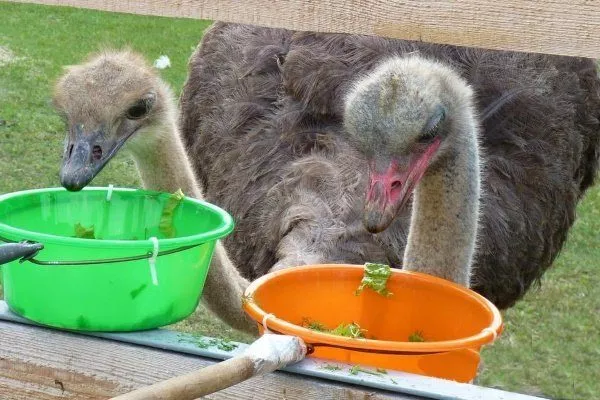
An ostrich's diet should consist of 50% green fodder, 30% mixed fodder, and 20% other feed. An adult ostrich consumes 1.5-2.5 kg of feed per day. Feeding requirements for ostriches in different seasons (over a three-month period) are shown in Table 5.
Table 5
| Stern
| winter | spring | summer | autumn |
| weight, kg | ||||
| fresh herbs | 0 | 20 | 30 | 20 |
| herbal flour | 5 | 3 | 9 | 3 |
| gravel | 1 | 1 | 1 | 1 |
| yeast | 3 | 4 | 3 | 3 |
| cake, meal | 12 | 13 | 12 | 12 |
| crushed grain | 50 | 55 | 60 | 55 |
| whole grain | 50 | 45 | 40 | 45 |
| bone meal | 1 | 1.5 | 1.5 | 1 |
| carrot | 40 | 20 | 0 | 20 |
| meat and bone meal | 5 | 7 | 5 | 5 |
| reverse | 20 | 30 | 30 | 20 |
| salt | 0.7 | 0.7 | 0.7 | 0.5 |
| wheat bran | 10 | 10 | 10 | 10 |
| chalk, shell | 4 | 5 | 4 | 4 |
The annual feed requirement of an adult ostrich (African) is shown in Table 6.
Table 6
| Feed | Feed requirement, kg/year |
| From 0 to 6 weeks (starter) | 12-18 |
| Fattening concentrate (from 6 to 16 weeks) | 100 |
| Crushed corn or corn silage | 120 |
| Hay (alfalfa) | 125-120 |
| The main food is green | 200 |
What and how to drink?
In the wild, ostriches are accustomed to going long periods without water. But on a farm, there's no reason to be thirsty—the birds readily drink water. If it's hot outside and there's a shortage of succulent feed, the recommended daily water intake per bird is 10 liters.
Experienced breeders recommend giving ostriches water at every feeding. Ideally, they should have constant access to water. Water bowls should be placed at least 70 cm above the floor.
What should not be fed?
Ostriches are omnivores in the wild, but on a farm they can't be fed just anything. Some foods are restricted, and some are completely prohibited. It's forbidden to feed the bird:
- rye;
- potato;
- parsley.
Ostriches are given flour, bran and cabbage in limited quantities.
Nutrition in winter
In winter, the basis of the ostrich diet consists of the following foods:
- cereals – wheat, corn, millet, oats, barley;
- beets and carrots;
- apples;
- herbal flour;
- silage;
- mineral and vitamin supplements;
- bread, crackers;
- meal and cake;
- compound feed.
Breeding Features
If you own your own ostrich farm, it's much more profitable to hatch your own chicks than to buy them from other breeders. All you need are mature birds and an incubator.
Mating season
During mating season, males become aggressive. Caution should be exercised when interacting with the birds. To calm the male, use a 2-meter hook to pin him to the ground to disorient him. If this doesn't work, place a bag over his head with a slit for his beak.
Oviposition
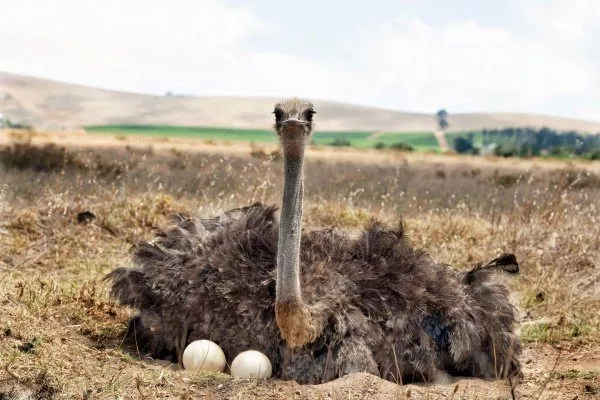
There are 2-4 females per male. The mating season begins in May and continues until autumn. Female ostriches lay one egg every 2-4 days. The quality of the eggs is higher if the male is older than the female, resulting in higher hatchability.
Hatching times
In the wild, ostriches incubate their eggs for 41-46 days. Both parents take turns incubating them. On farms, incubation is entrusted to incubators. African ostriches hatch in 39-41 days, while emus hatch in 52-56 days. A female can hatch 15-20 chicks per season. However, farmers typically use incubators to introduce the young.
Is incubation necessary?
Ostrich eggs are expensive, and each successfully hatched egg will yield a new ostrich to the farm. To speed up the hatching process and minimize their pathologies, incubation is used. Chicks hatched using incubation methods are strong, healthy, and grow well.
What kind of care do ostrich chicks require?
The viability of ostrich chicks depends on the correct incubation and compliance with the rules for raising young.
The chicks are not fed for two to three days after hatching—they receive nutrition from the yolk sac. A week later, they begin to be fed starter food.
It is forbidden to give fiber to chicks under 4 months of age.
The chicks' quarters should be dry and warm. They are kept separate from their parents. The room temperature should be between 30 and 33°C. Chicks can be released into the pasture when there is no dew; otherwise, they will become ill.
When feeding ostrich chicks, it's important to maintain adequate calcium, manganese, zinc, and phosphorus levels. Chicks can be fed the following on the fourth day:
- finely chopped clover leaves mixed with compound feed;
- a mixture of cottage cheese, ground corn and boiled egg.
Plant stems should be given finely ground, otherwise, if they remain in the gastrointestinal tract, they can lead to the death of birds.
The chicks are fed a compound feed containing 19 to 24% protein. They are walked for half an hour twice a day. Pebbles are placed in a separate feeder. It's important not to let the chicks out to pasture hungry—if they overeat alfalfa stalks, they could die.
Poultry health
The biggest danger to an ostrich farm is infection. A single disease can lead to the loss of an entire flock. Most commonly, ostriches suffer from respiratory diseases and digestive disorders. To maintain the health of your ostrich flock, you need to:
- Maintain sanitary and hygienic standards. Cleaning is daily. Staff wear gloves.
- Check the droppings for worms and intestinal infections.
- Follow the vaccination schedule recommended by your veterinarian.
- Set up a quarantine pen for purchased ostriches.
Breeding ostriches requires investment and a certain amount of courage. But experience shows that these birds not only adapt to our climate but also generate significant profits. Mastering ostrich farming techniques can lead to a successful business.