
Rheas are amazing ostriches, captivating in their appearance and behavior. These birds are prized for their low-calorie, delicious eggs. Rheas are also bred for their lean, tender meat. Their feathers and skins are used to make incredibly beautiful products.
Historical information
The Rhea ostrich, according to archaeological excavations, was the first bird of its kind to appear on Earth. Scientists have long debated the animal's family of zoology, and they still haven't reached a consensus. Some believe the South American ostrich is the basal member of the ostrich family, others believe its ostrich-like features were acquired through evolution, and still others classify it as a rhea.
The breed became known in the 16th century. Initially, these birds were domesticated by Native Americans and used for their feathers and meat. In 1884, the rhea was described, and in 1894, a family of ostriches was established, consisting of two species: the lesser rhea and the northern ostrich. Both are critically endangered due to overhunting.
The rhea got its name from its distinctive call: it roars like a large predator, like a lion. The bird's voice doesn't resemble the sounds that birds make. Furthermore, when the animal begins to "howl," the distinct "nan-doo" sound is heard. This is why ostriches have this name.
Ornithologists note that such sounds are more often produced by males during the mating season. However, birds are capable of "speaking" differently, producing slightly hoarse sounds that serve as a danger signal and a warning to their fellows. If the rhea is angry, it begins to hiss.
Bird feathers are popularly used to make jewelry, headdresses, fans, and vanes. Rather than plucking them, they are carefully cut off close to the skin twice a year. This does not harm the birds. Ostrich skin is as valuable as crocodile skin. It is used to make luxury accessories and expensive women's handbags.
Description of the animal
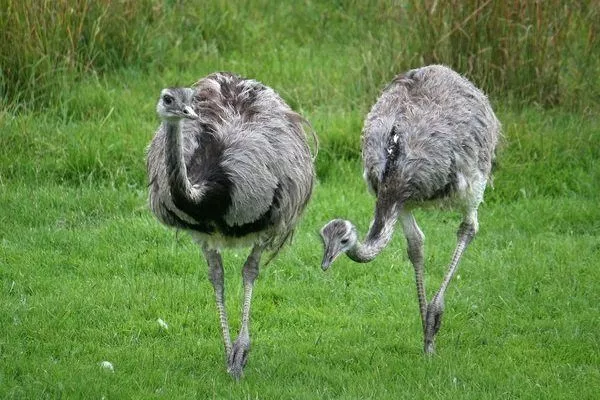
The Rhea ostrich is a flat-chested or ratite-less bird with an elongated, oval-shaped body. It stands on large, sturdy legs. The bird has a long neck and a small head. Its plumage is brownish-gray, grayish-brown, or pure gray. White spots appear on its back. Albinos with white plumage and blue eyes are common among Rheas.
Unlike African ostriches, South American birds are half the size. They weigh around 40 kilograms, and the largest individuals reach a height of 140-150 centimeters. They have short neck feathers, something African ostriches lack.
Their feet have three toes, while African ostriches have two. The toes are connected by a short web, which makes them slower runners than their African counterparts. Rheas rarely reach speeds exceeding 60 kilometers per hour. When running, their stride length is 1.5-2 meters.
But this is compensated for by excellent swimming abilities—ostriches can easily cross rivers. When running, the rhea spreads its wings like a sail, which helps it maneuver better. The tips of its wings are equipped with claws—keratinous appendages that allow the bird to defend itself if attacked.
The video shows a close-up view of a common rhea ostrich. Here's a look at the tall and fast bird:
Spreading
The rhea is common in South America. These large common ostriches are found in Argentina, Paraguay, Bolivia, Brazil, and Uruguay. They prefer open savannas and inhabit lowland areas with milder, warmer climates.
Ostriches are found in the southern regions of Bolivia, Chile, Argentina, southern Peru, and Tierra del Fuego. They can live at altitudes of up to 4,500 kilometers.
Lifestyle and behavior
The rhea's preferred time of day is usually daytime. Only extreme drought and extreme heat can prevent the bird from being active during the day. During this time, the rhea is most active in the evening or at night.
The birds live in flocks of 10 to 35 individuals. Such a family consists of several males, a couple of females, and young.
Status of the species and relations with humans
Native American tribes used rheas for their feathers and meat. They were hunted using bolas, a type of throwing weapon made from a belt with round stones tied to the end. Later, rhea feathers were exported for jewelry, and the birds' skins were used for various products.
Due to hunting and habitat destruction, the bird population has declined significantly. Farmers note that rheas feed on the grasses their livestock need to eat, and flightless individuals are prone to eating grain from fields. For these reasons, the birds are often shot if they appear near agricultural fields. Wire fences also pose a significant threat to the birds, causing them to die after sustaining severe injuries.
Rhea eggs
Rheas build their nests in the ground, digging depressions that they then line with grass. The male is the primary guardian of the nest. A characteristic feature of the laid egg is its initial sterility, but after cooling, bacteria can penetrate it. The surface of the egg should not be washed, even if it is very dirty.
To stimulate high egg production, remove eggs from the nest at least twice a day. The average egg weighs approximately 620 grams. The yolk is located in the center, where it is layered in light and dark layers. A brightly colored yolk indicates that the female's diet is rich in vitamin A.
A distinctive feature of egg products is their incredible health benefits and nutritional value. One ostrich egg can replace 10-12 chicken eggs. It's a dietary product that promotes satiety.
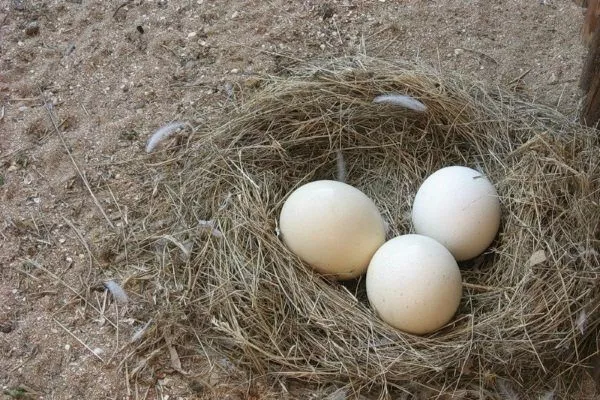
Rhea eggs are sometimes used in folk crafts. The shells are dense, allowing creative individuals to craft souvenirs from them. Beautiful vases and canvases are also made from the eggshells.
Nutrition
Rheas enjoy feeding not only on grains but also on various insects and even small reptiles. They don't require water; they can survive perfectly well without it, simply by foraging for food.
At home, ostriches feed on succulent grasses and root vegetables, preferring beets, boiled potatoes, and carrots. Ostriches require a lot of protein and are fed eggs, fish, cottage cheese, and yogurt. Experienced farmers do not recommend giving fresh milk to chicks.
Birds love to feast on locusts—they consume them in unlimited quantities. Sometimes, overeating can even cause them to lose their ability to run quickly.
Reproduction
Rhea ostriches attract attention with their breeding process, which begins with the disintegration of the flock. The males begin their courtship dance, dropping to their knees, howling protractedly, and spreading their wings.
Flightless birds are considered polygamous, meaning that during the mating season, one male can mate with several females at once, sometimes with up to 5-7 individuals. Females lay their eggs in a communal nest. The incubation period lasts approximately 1.5-2 months, after which the chicks hatch. The males incubate the chicks. If the eggs are laid outside the nest, the caring male will always return them. During incubation, the female becomes the head of the family, bringing food.
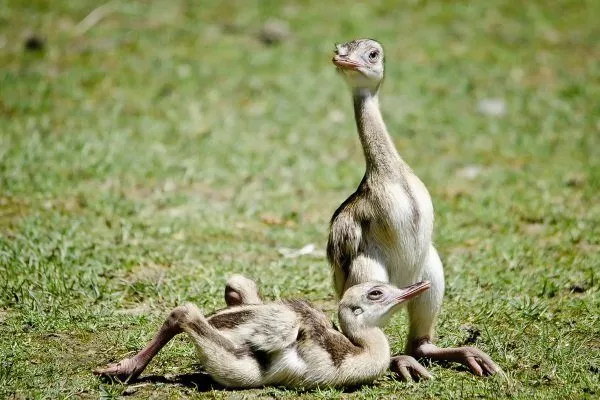
A litter of 25-30 ostrich chicks, weighing around 500 grams, can be born at a time. The babies grow quickly and are born with strong eyesight and excellent hearing, enabling them to move independently. Due to poaching, the young often don't even survive to the age of one year.
Caring for offspring
Although the rhea is a polygamous bird, it is prone to protective care of its own offspring. As early as early spring, the male begins intense courtship of his mate. During this time, the female experiences increased egg production. The male prepares a nest for his chosen mate in advance, lining the hole he dug with grass or hay, which adds softness and warmth. The bird carefully guards its mate and the nest, and if anyone approaches, it begins to hiss.
Females lay eggs in a single nest. Nests kept at home require careful cleaning, as bacteria can enter the eggs through the shell. After laying the eggs, females immediately seek other partners, while male rheas incubate the chicks, never leaving the eggs for a minute.
Breeding of Rhea
Ostriches thrive in captivity. They are raised on specialized farms for their feathers, skins, eggs, and meat. Egg production is particularly popular, as eggs are known to contain many beneficial nutrients and trace elements.
Breeding rhea ostriches is no longer considered exotic. With a competent and responsible approach, you can reap a good profit and build a successful business. Rhea ostriches can be bred at home in several ways:
- Adult rheas are kept in enclosed enclosures but are given regular walks. The male is allowed to incubate the eggs, but he is also responsible for caring for the young and protecting them from predators. In captivity, a male can incubate over 20 eggs.
- Keeping the parents in open pens or insulated rooms ensures excellent egg production. All eggs are removed from the hen and transferred to an incubator. It is believed that removing eggs more frequently will ensure consistent egg production. Ideally, remove eggs from the hen at least twice a day.
When choosing any option, it is permissible to give some of the eggs to the bird for incubation, and collect the other half for the incubator.
Raising chicks
Newborn ostriches reach a height of about 20 centimeters. They grow very quickly, about 1 centimeter per day. Overall, the birds reach a height of about 1.5 meters. For the first three days, the chicks are not fed or given water—this promotes rapid resorption of the gall sac. Ostriches should be kept at a temperature of no more than 32-33 degrees Celsius.
- ✓ The protein ratio in the diet should be at least 20% in the first weeks of life.
- ✓ Mandatory inclusion of vitamin supplements to support immunity.
On the fourth day, the babies are fed a formula containing chopped clover leaves or alfalfa mixed with mixed feed. They are also given a small amount of water. Along with this diet, boiled eggs and cottage cheese should be added to the menu.
When the ostrich chicks are 40 days old and continue to feed them on compound feed for up to three months. Be sure to provide separate feeders for them, filled with small stones or gravel. Young birds begin to eat grass in the summer, root vegetables in the fall, and silage in the winter.
The rhea is an American species of large, flightless bird that can move faster than a car. This animal has distinctive appearance, diet, and breeding practices. Breeding ostriches for eggs and meat is a profitable business.
Hello, I'm from Bulgaria, can you give me detailed information about incubating rhea eggs? Parviyat mi experience is beshe unsuccessful.
Hello!
I also talked the Russian language into Russian. You can translate my excuse into online translation - translate.yandex.ua/translator/
Ostrich eggs are more difficult to hatch in an incubator than any other eggs:
1. Since ostrich eggs are not covered with a cuticle, which protects against infection, handle them only with disinfected/new sterile gloves.
2. Eggs have a short shelf life (maximum 6-7 days). Therefore, they should be placed in an incubator as soon as possible after being removed from the female (recommended between days 2-4).
3. During incubation, the eggs are positioned vertically, with the air chamber facing up (to do this, you need to illuminate the eggs with an ovoscope).
4. At the beginning of incubation, the temperature is maintained at 37.5 degrees Celsius. In the second half, the temperature is lowered to 37.2 degrees Celsius.
5. Relative air humidity should be 35-40%.
6. Ideally, eggs should be turned every 1-2 hours for the first 3 weeks, and at least 4 times a day for the next 2 weeks, with a 5-7 minute cooling period (ventilation) during each turning. Turning the eggs should be done very carefully, alternating between 45 degrees from the vertical axis.
7. Incubation for rheas lasts 36-41 days. On the 35th day of incubation, it is recommended to transfer the eggs to the hatcher. The eggs are laid horizontally! After this, no more turning is required! Humidity is increased to 40-50%.
8. At the first sign of internal peck (a squeaking sound is heard), the air humidity increases to 60-70%. Two to three hours after hatching, the chicks are removed and transferred to a large drying cabinet.