
A mother ostrich can't always hatch her eggs fully. In such cases, incubation is used, but it requires a special approach. The process itself is complex, as it requires choosing the right incubator, maintaining the optimal temperature, misting regularly, and providing adequate lighting to ensure well-developed ostriches.
Choosing an incubator
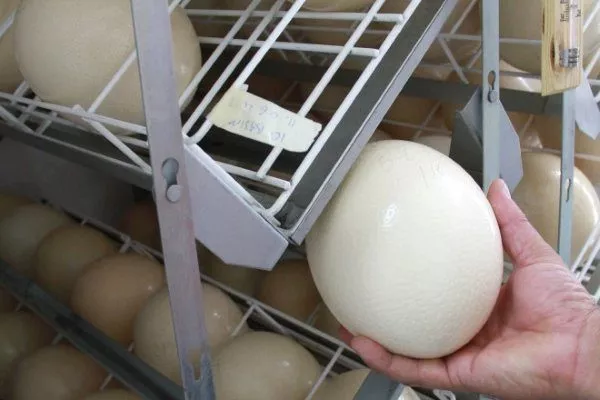
Choosing an incubator should be taken seriously, as the health and survival of the young depends on it. Here are some things to consider when choosing an incubator:
- Country of origin.Many models are produced in China, but domestic models will be of higher quality.
- Guarantee. Even the best and most expensive models can break down. If the incubator is still under warranty and breaks down, it will be repaired free of charge.
- Heating elements. The most durable element is the thermal film; it heats the eggs evenly while consuming little energy.
- Size and turning of eggs. Ostrich egg incubators are larger than those for chicken or goose eggs, so it's important to pay attention to the internal dimensions. An ostrich egg incubator should be at least 100 x 70 x 70 cm. It's best to buy an incubator with automatic egg turning.
- Thermostat.To ensure healthy and viable chicks, maintaining the correct temperature is essential. Sensors must be selected with a high degree of accuracy, as this can have a detrimental effect on incubation. There are two types of sensors: manual and automatic. The former is inexpensive, but the latter is more accurate.
- Humidity regulator.It's best to buy a model with a psychrometer and automatic humidity control. To save money, you can opt for a manual adjustment.
- Body material.The best material is considered to be high-strength steel or plastic with additional insulation from foam. This ensures even heat distribution throughout the incubator, reducing energy consumption.
- ✓ The minimum power of the heating elements must be at least 500 W for uniform heating.
- ✓ It is mandatory to have a backup power source in case of power outage.
A sample model of an ostrich egg incubator can be seen in the following video:
Selecting eggs for further incubation
Fertilized eggs must be selected for incubation, which requires a flock with both a female and a male. However, even in such flocks, 25% of all eggs are spoiled, meaning they are unfertilized.
Ostriches begin laying eggs in April and end in October, with a female capable of laying up to 20 eggs in a single cycle. Eggs should be collected immediately after laying to avoid deteriorating their hatchability.
Ostrich eggs They are also divided into two classes: first and second, depending on size. The first class includes large eggs, while the second class includes small ones. An African merganser's egg weighs 1126-1800 grams, while an emu's weighs 350-750 grams. The shell of the former is white, while the shell of the latter is dark green.
Below is a table of hatching egg class:
| Name of the bird | Weight of a first-grade egg in grams | Egg weight in grams of the second class |
| Ostrich | from 1500 to 1800 | from 1126 to 1520 |
| Emu | from 550 to 750 | from 350 to 570 |
Load eggs of approximately equal weight into the incubator. The best hatching results will be achieved if the load is incomplete.
Features of bookmarking and storage
Before setting eggs in the incubator, make sure the trays are large enough to accommodate both upright and lying eggs. Eggs are set either flat-end up or lying down. The best time to set eggs is 6 p.m.
It's almost impossible to tell the blunt end from the sharp end of an ostrich egg. In this case, an electron tube or an ovoscope will come in handy.
The eggs of these animals are delicate and sensitive because they lack a protective membrane. Therefore, they can quickly and easily become contaminated with pathogens. Their pores are open, so before handling them, wash your hands with soap and water, and it's even better to wear gloves.
Initially, first-class eggs are placed in the incubator, and then only second-class eggs.
Store eggs with the blunt end facing up, but if it's difficult to tell which is the blunt end, it's preferable to store them lying down. They can be stored for up to a week before incubation. To prevent spoilage, store them at a cool temperature of around 15 degrees Celsius and at a humidity level of 75%. While the eggs are stored outside the incubator, they should be turned up to three times a day.
Disinfection of eggs and incubators
Before placing the egg in the incubator, it must be disinfected and washed to remove any dirt. Scraping the shell with a hard brush is unacceptable, as this directly leads to the death of the embryo, as the pores become clogged during the process, preventing the embryo from receiving air.
- Check the temperature of the disinfection solution (it should be 5°C higher than the temperature of the egg).
- Prepare a soft brush and clean gloves for work.
The egg needs to be washed with a special solution. To prepare it, purchase Virkon powder from the store and dissolve 3 grams of the substance in a liter of warm water. Cold water is not suitable, as it will reduce the air supply to the embryo, allowing pathogens to enter the egg.
Recommendations for washing ostrich eggs:
- when cleaning dirt you will need a soft brush;
- the resulting solution should have a temperature such that it is 5 degrees warmer than the egg itself (the temperature of the egg can be checked with a tonometer, and if you don’t have one, then simply heat the water until it is warm);
- After all the dirt has been removed, the egg is thoroughly dried on all sides, that is, first it should lie on one side until completely dry, then turn it over to the other side and wait until the egg is completely dry.
It's also important to disinfect the incubator itself before setting the eggs for incubation, as traces of blood and other dirt may remain from the previous hatching. There are many disinfection methods, but let's look at the most common ones:
- Chloramine solution. This product is readily available at any pharmacy. Dissolve 10 tablets in a liter of water and shake well. Pour the solution into a spray bottle and spray throughout the car. After a few hours, rinse with plain water and air out the solution for 24 hours.
- Formaldehyde vapors.This method uses combustion inside the incubator, resulting in smoke disinfection.
- Formaldehyde vapor.First, the room is rinsed with plain warm water, then a solution of 50 ml of 40% formalin and 35 mg of potassium permanganate is prepared. The incubator is heated to 38 degrees Celsius, and the prepared solution is placed in a bowl inside for 40 minutes. After the procedure, the incubator is ventilated.
- Ultraviolet radiation.This procedure is also carried out after preliminary cleaning of the device, after which one or more ultraviolet lamps are placed inside and left for 40 minutes to destroy pathogenic microorganisms.
Turning and spraying
During the entire incubation period, the eggs should be turned over seven times a day, either manually or using a special device purchased at the store. On the 39th day, the eggs are no longer turned, but are transferred to the hatcher and laid flat.
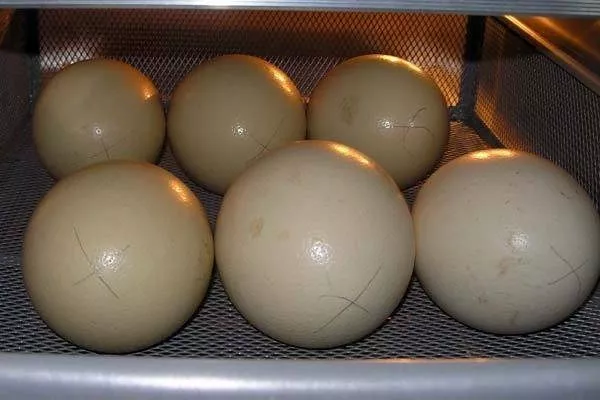
If the required humidity drops, the eggs should be sprinkled with warm water. All objects around the eggs should also be sprinkled with water.
Incubation mode tables
Incubation varies depending on the materials used, the time of the process, and the species (African ostrich or emu). Modern incubators are equipped with many features, allowing for automatic control of the entire process. They can be set to the optimal temperature, humidity, and even automatic egg turning. The table describes the necessary conditions for different periods of ostrich incubation:
| Incubation period in days | Temperature in the incubator | Humidity in percent | What is the position of the egg? | How many times is the egg turned during the entire period? |
| from 1 to 14 | 36.3-36.5 | from 20 to 25 | vertical-horizontal | 23-25 |
| from 15 to 21 | 36.3-36.5 | from 20 to 25 | vertical | 23-25 |
| from 22 to 31 | 36.3-36.5 | from 20 to 25 | vertical | 4 |
| from 32 to 38 | 35.8-36.2 | from 20 to 25 | vertical | 2 |
| from 39 to 40 | 35.8-36.2 | from 40 to 45 | vertical-horizontal | are not fulfilled |
| from 41 to 43 | 35.8-36.2 | from 60 to 70 | vertical | are not fulfilled |
The following table describes the criteria for obtaining a healthy emu chick:
| Incubation period in days | Temperature range in degrees | Humidity in percent |
| from 1 to 27 | 36-36.2 | from 24 to 30 |
| from 28 to 39 | 35.6-32.6 | from 24 to 30 |
| from 40 to 46 | 35.6-32.6 | from 24 to 40 |
| from 47 to 55 | 36-35.3 | from 58 to 61 |
When eggs are in an incubator, they definitely need ventilation, because the embryo will need oxygen during development.
| Incubation period (days) | Oxygen demand (m³/hour) |
|---|---|
| 1-14 | 0.1 |
| 15-21 | 0.2 |
| 22-31 | 0.3 |
| 32-43 | 0.4 |
Stages of development and transillumination
When candling an ostrich egg in an incubator, you can see several stages of its development:
- After a week (from the day the material was placed in the incubator), the shadow of the allantois, which covers 20 percent of the surface of the eggshell, is visible in the egg.
- By the second week, the shadow is easily discernible, as it's larger than before and now occupies half the shell's surface. As the egg ages, the shadow becomes larger.
- On the 24th day from the moment of the process, one sixth of the material is occupied by the air cell, and one second part by the embryo itself.
- After 35 days, practically nothing is visible, because the embryo is located in the entire egg.
Weighing eggs daily is recommended to monitor their weight loss. In one day, an egg can lose 0.3% of its total weight, meaning it will only lose 2% over 7 days. If the egg loses more weight than expected, the humidity level should be increased. If, on the contrary, the loss is small, the humidity level should be reduced.
Hatching times
African ostrich chicks are born 40 days after the egg is placed in the incubator, while emu chicks hatch at 56 days. Newborn African ostrich chicks stand 20 cm tall and weigh between 500 and 900 grams, while emu chicks weigh between 200 and 400 grams. If all the rules are followed, you can have many healthy and strong chicks.
What to do after the chicks are born?
When the eggs first hatch, increase the humidity in the incubator to 30%. If there are only a few eggs, increase the temperature by half a degree, and if there are many, decrease it. Once the chicks are breaking through their shells, increase the humidity to 60%; this will help the chicks hatch more easily.
Humans should not interfere with the natural birth process unless absolutely necessary, especially while the chick is still in the protective membrane. Assistance is only possible if the chick is lying in an abnormal position or is unable to hatch on its own. In this case, the caregiver should lengthen the hatching line.
As soon as the ostrich chick hatches, it is placed in a brooder, a cage with a tray. The cage has metal bars (grids) and heating trays. The chicks are kept there for three hours to warm up and dry out. The chick must be weighed immediately to monitor its weight gain. The umbilical cord is then disinfected daily until the chicks are three days old.
The first days of life of ostriches
From the first days of life, ostrich chicks grow at a rate of 1 cm per day until they reach 150-180 cm. During the first day, a chick can lose 20% of its total body weight, and this is normal. This is because they do not eat any supplementary food for several days, but live off the accumulated yolk mass. From the seventh day on, ostrich chicks can be fed.
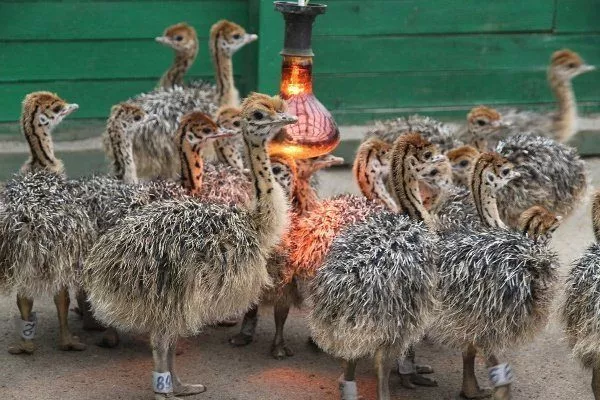
During the first weeks of life, chicks should be kept in a warm place, whether in winter or summer. The barn should have a controlled light and heating lamp, and any drafts should be avoided. When the birds are ready to eat proper food, they initially feed on their mother's manure to colonize their intestines with beneficial microflora.
Starting at one week of age, ostrich chicks are given crushed alfalfa leaves and a crushed boiled egg, which is sprinkled on the ground about eight times a day and tapped with a pencil so they can see where it is. The chicks' feeders and waterers should be kept full at all times so they can approach and enjoy food and water at any time.
Common mistakes beginners make
Hatching eggs using the incubation method requires caution and skill, so beginners often make mistakes, the main ones being:
- The shell was improperly made, as the strength of the shell wasn't tested before the egg was placed. If the shell is weak, the embryo may die in the first few days. A weak and poor-quality shell could have resulted from improper feeding of the ostrich, as the diet lacked sufficient minerals. Read more about proper ostrich feeding in this article.
- Incorrect position of the air sac.
- If the egg is underheated or even slightly overheated, the embryo may die. If the egg is underheated, the baby may be born, but it will still not survive for long.
- If the humidity is below normal, the ostrich chicks will hatch prematurely and die almost immediately.
- Increased humidity is dangerous for the health of babies.
- If there is insufficient ventilation, babies may be born with abnormalities that are incompatible with life.
Possible problems of embryo death
Often the death of future ostrich chicks occurs for the following reasons:
- InfectionsWhen the egg is infected by fungus or bacteria, the white becomes cloudy and develops a putrid odor. Nodules (raw) form, which are essentially dead tissue.
- GenesThis category includes underdevelopment of the nose, organs, and fusion of embryos.
- DystrophyThis pathology occurs when the parents have poor nutrition. Embryos lag in development and growth, and they also have difficulty absorbing nutrients. The yolk becomes thick, and newborn ostriches suffer from paralysis.
Incubation of ostrich eggs is becoming popular worldwide, as the birds can continue to lay eggs, and the number of live chicks increases thanks to proper care in the incubator. It's important to follow all the rules, setting the correct temperature, humidity, and airflow. It's important to be prepared for the fact that not all chicks will hatch alive and healthy, as there are a number of issues that can cause embryo death.