
The naked-neck chicken breed often intimidates farmers due to its distinctive appearance. However, the excellent meat taste, good productivity, and ease of maintenance may allow this breed to quickly gain popularity. We'll discuss its characteristics, advantages, care, breeding, and disease prevention in more detail later in the article.
| Breed | Egg production (pieces/year) | Egg weight (g) | Weight of an adult chicken (kg) | Weight of an adult rooster (kg) | Disease resistance | Feeding requirements |
|---|---|---|---|---|---|---|
| Naked neck | 150-180 | 55-60 | 2-2.5 | 2.5-3 | High | Average |
| Leghorn | 200-250 | 55-65 | 1.5-2 | 2-2.5 | Average | Tall |
| Rhode Island | 160-180 | 55-60 | 2.5-3 | 3-3.5 | High | Average |
The history of the naked-neck chicken breed
To date, there is no consensus regarding the country of origin of the naked-neck chicken breed. Experts consider several theories. Some believe that naked-neck chickens originated in medieval Transylvania (present-day Romania). This is where their names "Transylvanian" and "Semigrad" come from.
According to another theory, this breed only became widespread in Romania, while the true homeland of the naked neck is considered to be Andalusia, an autonomous community in Spain. This is why they are also called "Spanish."
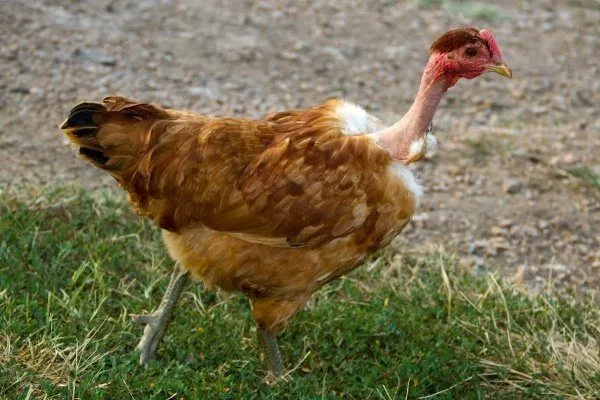
The first mention of this unusual breed of bird was made in 1875 in Austria. Semigrad chickens became known in the CIS countries in 1930. Currently, Naked Neck chickens are particularly popular in Germany and France. In the UK, the Naked Neck chicken breed is quite rare, and is completely absent from the US.
From a genetic standpoint, there's no debate. It's been scientifically proven that this is a purebred breed, belonging to the Red Junglefowl species.
Description and characteristics of the breed
This breed is considered an ornamental bird. The bare-necked trait is dominant and inherited. They are known for their calm and even temperament.
External characteristics
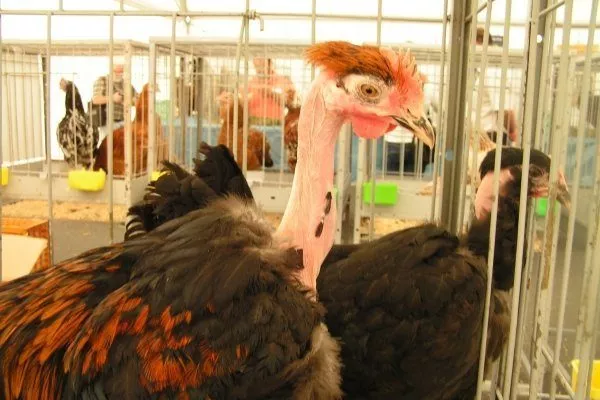
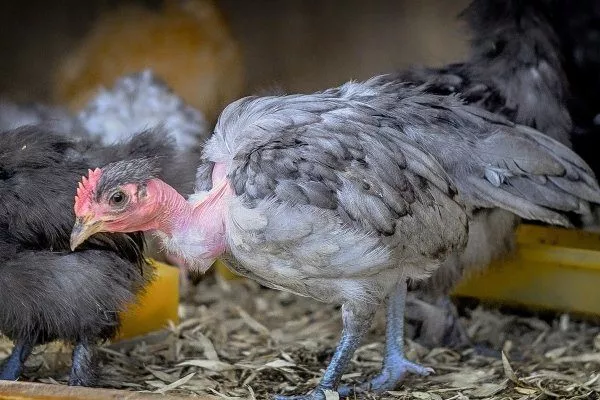
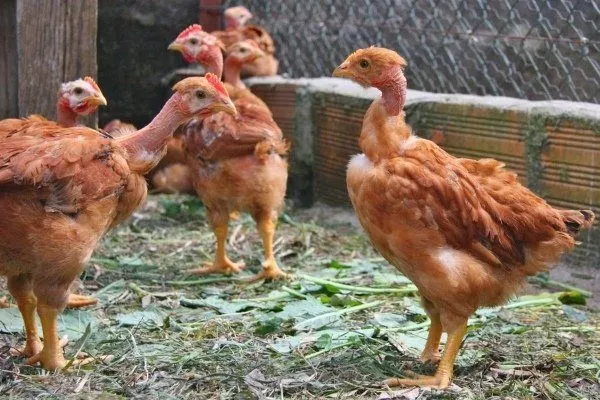
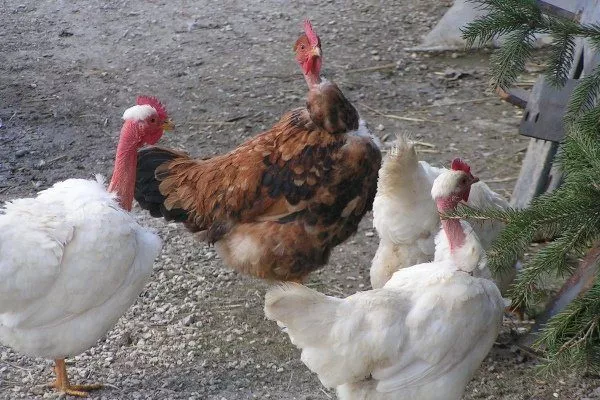
The naked-neck chicken breed is distinguished from other varieties by its rather unique appearance. These birds are completely featherless on their neck and crop. The feathers are distributed unevenly across the body, in stripes, but the bare patches up to the crop are completely covered by adjacent feathers and are therefore visually unnoticeable. A small triangle of skin on the inside of the legs is also featherless.
Birds of this species are characterized by a rounded chest with well-developed pectoral muscles. The body is elongated, slightly raised, and cylindrical. The body is rectangular with a depth-to-length ratio of 1:2. Naked Neck chickens are medium in size and weight.
Chickens also have a full belly and a long back. Their wings are fairly well developed, lying loosely against their body and slightly drooping. Their legs are strong but short, with four toes, and are yellow-orange or gray in color.
If the body is white, the hocks may, exceptionally, also be white. During the molting process, the top layer of skin is completely renewed. The head is wide and small. The comb can be either rose-shaped or leaf-shaped. The feathers on the head form a small cap.
The plumage on the front of the neck resembles a bow. The earlobes are close-fitting and red. The neck is red, rough, and wrinkled. The eyes are orange-red. The wattles are thin and rounded. The bill is yellow and slightly curved. The small, bushy tail is slightly raised. The pigtails are wide but short.
Purpose and performance characteristics
The naked neck chicken belongs to the mixed breeds, meat and egg direction of productivity.
Egg production reaches 150-180 eggs per year. The eggshells are cream-colored. Egg weight ranges from 55-60 g. Despite the partial lack of feathers on their bodies, the hens tolerate cold well, and therefore maintain good egg production even in December and January.
Naked neck hens begin laying eggs at six months of age. The chicks are hardy, easy to care for, and grow quickly. An adult rooster weighs on average 2.5 kg to 3 kg, while a hen weighs 2 to 2.5 kg. The taste of this breed's meat is similar to that of turkey.
Color variations
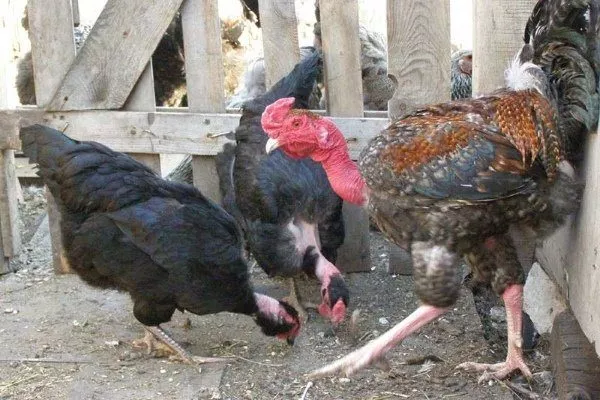
The plumage of Spanish Naked Necks can vary widely, so the color range isn't limited by the standard. In most cases, the feathers are represented by the following colors:
- brown;
- black;
- cuckoo;
- motley;
- Colombian.
Advantages and disadvantages of the breed
The positive qualities of the naked neck chicken breed include:
- unpretentiousness in care and feeding;
- due to the natural features of the plumage, plucking is easier and faster;
- calm nature, which allows them to live peacefully with other chickens;
- the taste of the meat is very similar to dietary turkey meat;
- early onset of egg laying;
- good marketable appearance of eggs;
- high hatchability rates (about 95%);
- resistance to low and high temperatures;
- The naked neck gene is used in the development of other breeds, particularly broiler chickens (it leads to a decrease in body temperature, promotes an increase in the weight of chickens, improves the quality of the carcass compared to well-feathered broilers, and increases feed conversion).
Flaws:
- unattractive appearance, which is why some farmers refuse to breed this breed;
- poorly developed maternal instinct (it is recommended to either hatch chickens using an incubator or to lay eggs with hens of other breeds);
- productivity values are at an average level.
How to choose the right one?
When choosing chickens for breeding, it's important to know what signs to look for and what indicates a defect in the breed. A naked-neck chicken can be identified as impure if the bird:
- pale earrings;
- black face;
- dark eyes;
- in areas without feathers the skin has a yellow tint;
- thin and weak body;
- steep tail;
- The neck and inner part of the legs are covered with feathers.
- ✓ Activity and mobility
- ✓ Clean and clear eyes
- ✓ Uniform plumage without bald spots
- ✓ No discharge from the nose or eyes
- ✓ Good appetite
A crossbred bird (for example, a cross between a naked-necked chicken and a standard chicken) will also have a bare neck due to the dominance of the Na gene. However, at least one of the other traits will be present, indicating non-compliance with the breed standard.
Keeping naked-necked chickens
To keep birds comfortably and increase their productivity, it is necessary to create optimal living conditions for them.
Chicken coop design
Choose a dry, warm location for the chicken coop, preferably protected from cold winds. Brick, adobe, planks, stone, insulated blocks, or panels are acceptable building materials. If you choose a loose material (shell rock or adobe), protect the walls from below with mesh up to 80 cm high to prevent chickens from pecking.
The roof can be made of any waterproof material and pitched, which will protect the ceiling from overheating. It is typically used to store bedding and vitamin-rich grass meal. Wood is best for the ceiling. Clay mixed with sawdust and straw serves as insulation. Windows should be easy to open and remove. The floor should be raised at least 20 cm above the ground and can be made of planks, concrete, adobe, or asphalt.
When floor-raising chickens, use permanent litter, which retains heat well. Deep litter is laid on the floor as follows:
- add slaked lime, which serves to absorb excess moisture and disinfect the floor (at the rate of 0.5 kg per 1 sq. m);
- A 5 cm high layer of bedding is placed on top, which is added during use and as it gets dirty so that after a year its height reaches 20 cm.
On average, one hen requires about 7-8 kg of bedding per year. Sawdust, peat, shavings, chopped straw, chaff, crushed corn cobs, sunflower husks, and other loose materials can be used. To prevent the bedding from compacting and becoming damp, it should be loosened once a week. Sprinkling grain on top of it can also be helpful. Chickens will peck at it and simultaneously loosen it. If the bedding becomes excessively wet, sprinkle it with slaked lime or superphosphate (200-300 g per square meter of floor area).
Keeping naked-necked chickens also requires waterers, feeders, perches, and nest boxes. Feeders and waterers should be positioned so they can be moved anywhere in the coop or run. Feeders should have 2-cm-wide internal edges, which will reduce the risk of feed spillage during feeding by 35%.
Trough drinkers are widely popular and can be made from galvanized iron, wood, or plastic pipes cut in half lengthwise. The standard length for these drinkers is 2 cm per bird.
Nests are placed 50-60 cm above the floor. This will prevent the eggs from becoming dirty and will reduce the breakage rate, unlike if the hens laid eggs on the floor.
Nests should be built in shaded areas that are easily accessible for cleaning and egg collection. In the shade, hens feel safe and lay eggs well. The coop should also be equipped with perches, which serve as a place for the birds to rest at night.
The perches are planed wooden blocks with rounded edges and have a cross-sectional diameter of 4 x 7 cm. This size allows the bird to grasp them comfortably with its toes and promotes comfortable sleep. The perches are designed to be 20 cm per head, with a minimum distance of 35 cm between them.
It is not recommended to place perches like ladders or slides, as the birds' desire to reach the top positions can lead to fights, resulting in injuries and peritonitis. Perches should be installed 50-60 cm above the floor, near the wall opposite the coop window.
The run area should be fenced with a 2-meter-high mesh fence. To provide an exit, holes should be made in the wall of the coop, 10 cm above the floor. The hole dimensions are 30 x 35 cm.
Read more in the article, How to build a chicken coop yourself.
Microclimate
Maintaining a proper microclimate in the room is crucial. The health of the chickens, their productivity, and feed utilization largely depend on temperature, lighting, and relative humidity.
Despite their resilience, naked-necked hens will spend their energy on maintaining heat at temperatures below comfortable levels, rather than on gaining weight or producing eggs. To replenish their energy reserves, the birds will consume more feed, which incurs additional costs.
At temperatures of 1-4°C, hens will continue to lay eggs, but their productivity will drop by 15-20%. At temperatures dropping to -5°C, egg production will cease completely. The most comfortable temperature in the chicken coop is +5 to +15°C. Therefore, many poultry farms heat their houses during the cold season, which helps maintain high productivity even in winter.
At elevated room temperatures, chickens lose their appetite, drink a lot of water, breathe rapidly, and sit with their beaks open and wings spread. At 38-40°C (100-104°F) for two hours, the birds can die from overheating. If the temperature is lower than normal, the birds huddle together, which can lead to death by suffocation.
Relative humidity should be 60-70%. The gas composition of the air and air exchange have a significant impact on chickens. Adult birds produce approximately four liters of carbon dioxide per day. Ammonia and hydrogen sulfide are released from droppings and litter. These gases reduce the birds' vitality, affect their well-being, and impair productivity. To avoid these consequences, ridge ventilation is installed. This system will supply fresh air and remove harmful gases, moist air, and excess heat.
The length of daylight also significantly influences the egg production of naked neck hens. Various lighting regimens are used in poultry farming. The simplest regimen is as follows: regardless of the bird's age or the time of year, the total duration of daylight (natural and artificial) should be 15-16 hours per day.
This lighting regime can significantly increase egg production in hens. Electric or fluorescent lamps with a power of 40-60 watts are used for this purpose. A light level of 20 lux (lx) is considered normal. Lighting below 5 lx is insufficient. Chickens eat and drink little, which leads to decreased productivity and weight gain.
Excessive illumination (more than 25 lux) is dangerous because birds become aggressive and may resort to cannibalism.
Cleaning the poultry house
Disinfecting the chicken coop is an important part of poultry care. It prevents the proliferation of pathogenic microorganisms. This can lead to chickens getting sick, their productivity declining, and eggs becoming contaminated with dangerous microbes (such as Salmonella or Proteus). Sanitation is performed every two months in a strict sequence, after removing the birds from the coop:
- Cleaning. Using a stiff brush, remove droppings, feathers, feed scraps, and bedding material from the floor, perches, and other surfaces. Next, remove debris from the coop. Wear personal protective equipment (gloves and a mask) during these procedures to prevent bacteria and dust from entering the body.
- WashingThe walls, floor, perches, and nests must be thoroughly washed, after which the room must be thoroughly dried. Specialized cleaning products should be used, as household chemicals are toxic and irritating to the respiratory system, which can negatively impact chicken productivity. Furthermore, they lack sufficient disinfectant properties. A 3:2 solution of apple cider vinegar is acceptable.
- Disinfection. Chemical and organic agents with sanitizing properties are used. Among specialized products, Monclavite, Bakteritsid, and Virotsid are particularly popular. Folk remedies are also available, for example:
- Pour hydrochloric acid and potassium permanganate (5:1) into a wide-mouthed container. Leave this mixture in the chicken coop for 30 minutes.
- Place crystalline iodine (20 g per 20 cubic meters of poultry house), aluminum powder (1 g rubbed with a file), and 1.5 ml of water in a ceramic bowl. The aluminum chloride will rise as a brown vapor. Let the mixture sit for half an hour. This procedure can be performed in the presence of hens.
After disinfection, the poultry house must be well ventilated.
It is necessary to remember about personal protective equipment, such as gloves, mask, glasses, and clothing that covers the skin.
Aviary
Naked-neck chickens thrive in a yard for running, as they require sunlight. The run is a spacious room made of a wooden frame covered with fine wire mesh. It should be located adjacent to the coop, but away from frequented paths.
The area around the enclosure should be free of dense vegetation, as it will block the birds from sunlight—the source of vitamin D, essential for their health. To protect against sudden rain, the roof is constructed using sheets of transparent plastic. It's a good idea to have grass growing around the enclosure, which is essential for a balanced diet for naked-necked hens.
The size of the enclosure should be calculated based on the rule: each hen should have 1-2 square meters of space. The minimum acceptable size is 2 x 7 meters. If the hens are kept in close quarters, they may constantly crowd around the feeders, causing stress, which will lead to a decrease in egg production.
How and what to feed?
Naked-neck chickens are known for their low maintenance, and feeding them won't pose any additional problems. However, to maximize their productivity, a balanced diet is crucial. Constantly feeding them only compound feed and grain mixtures will reduce the egg-laying potential of this breed of chicken.
The daily diet of naked necks should include:
- sprouted grain;
- boiled vegetables (zucchini, beets, potatoes, pumpkin);
- wet mashes;
- dairy products and vitamin and mineral supplements.
Just like broilers, in order to quickly gain weight, these chickens should be given a little yeast in their feed.
To replenish the bird's body with calcium, which is significantly consumed during egg production, it is necessary to enrich its diet with crushed eggshells, corn kernels, salt and shell rock.
It is essential to have water in the drinking bowls at all times.
Adult hens should be fed twice a day. The first feeding (in the morning before lights out) can include vegetables and wet mash, and the second feeding in the evening (an hour to an hour and a half before lights out) can include compound feed. The daily ration is 130 g of feed per adult 2 kg hen, with 10 g of grain added for every 250 g of body weight thereafter.
Breeding
Naked neck chickens are typically raised only in private farms. They don't require any special care, unlike other breeds. Naked neck chickens thrive both indoors and outdoors.
When purchasing birds for breeding, it's important to consider that one rooster can fertilize up to 10 hens. The incubation method is preferable for raising young. This involves placing the eggs in an incubator and hatching them artificially. This method is preferred because Spanish naked necks can abandon the nest with eggs midway through the incubation period. However, as mothers, they are caring and attentive.
The requirements for incubation material for growing young animals are as follows:
- freshness of eggs (not older than 5 days);
- cleanliness and absence of visible defects (cracks, rough or folded, with limescale deposits);
- correct form;
- the same average size (weak chicks hatch from small eggs).
It's advisable to candling the eggs to check for defects. Eggs should only be washed if more than 50% of their surface is contaminated. This should be done very carefully to avoid damaging the outer membrane covering the shell. The best solution for cleaning eggs is a 1-1.5% hydrogen peroxide solution.
The optimal temperature in the incubator room is 20-22°C, but not below 15°C. It is recommended to place the eggs in the evening so that hatching begins in the morning rather than at night.
The conditions in the incubator depend on the stage of incubation, presented in the table:
| Initial stage (1-11 days) | Intermediate stage
(12-19 days) | The final stage (19-21 days) |
| The temperature in the incubator is 38-39°C. Humidity is 30%.
The incubation material must be turned every 2-3 hours. Starting on the 4th day, the eggs are ventilated. | The temperature is reduced by 0.5°C. Humidity is 28%. During ventilation, the temperature should not drop below the permissible level for more than half an hour. | Temperature 37-38°C. Humidity 31%.
The ventilation ducts are left completely open. Turning and ventilating the eggs is no longer necessary. |
Raising chickens
To minimize the mortality of young animals and accelerate their growth and development, it is important to know the basics of proper care and feeding of chickens.
Necessary conditions
To raise incubator-hatched naked-neck chicks, prepare a heated, enclosed area. A wooden, insulated box with 40-60 cm high walls can be used. Place the box on bedding, with thick paper on the bottom. The stocking density should be 30-35 day-old chicks per square meter.
To warm the chicks, it's best to use 100-150W bulbs or a metal mesh reflector. The following temperature regime should be maintained:
- from day 1 to day 5 – 29-30°C;
- from day 6 to day 10 – 26°C;
- then every three days the temperature decreases by 3°C until it reaches 16-18°C.
The thermometer is installed at a height of 50 cm from the floor.
For the first 10 days of rearing, chicks are kept under 24-hour lighting. Daylight hours are then gradually reduced, reaching 9-10 hours by two months of age and until egg production begins. Light bulbs should provide 3-4 watts of light per square meter of floor space.
On days 4-7, remove the paper from the box and replace it with bedding. After 2-3 weeks, gradually expand the nesting area.
From the age of five days, it's beneficial to let chicks outside, provided the weather is sunny and windless. In adverse weather conditions, chicks should not be allowed outside until they are two months old. If kept indoors, vitamins D2 and D3 should be added to their diet to prevent rickets.
How to feed correctly?
The more varied the feed, the better the chicks survive and grow. In the first days of life, hard-boiled eggs, cottage cheese, millet, oatmeal, and finely ground yellow corn and wheat are considered good feed for naked necks. Cottage cheese and eggs are ground with crushed grain before feeding.
It is recommended to strictly adhere to a feeding schedule. For the first 10 days, naked-necked chicks are fed 5-6 times a day, and after one month, 3 times a day. Starting on the third day, fresh greens (nettles, alfalfa, clover, etc.) should be introduced, and on the fifth day, shellfish, chalk, fish meal, and meat and bone meal should be added. Starting on the 11th day, oilcakes and meal, as well as boiled vegetables (potatoes, beets, carrots), are added to the diet. Oatmeal and wheat flour should be sifted through a sieve until the chicks reach one month of age. Provide chicks with constant access to clean, fresh water.
From one week to 1.5 months of age, it is recommended to fill the drinking bowls with a solution of potassium permanganate (0.1%) twice a week for half an hour.
It is not possible to raise young birds of different ages in the same sections; older individuals may eat the feed of earlier-aged chickens.
During the first month of rearing, chicks are fed wet mash (a crushed mixture of corn, wheat, oats, peas, and barley) 3-4 times a day, then 2-3 times a day. Crushed grain is fed morning and evening. Sour milk is given in separate clay or wooden drinkers. For chicks over 60 days old, nutrient intake is limited by introducing bulky feeds such as greens and root vegetables (up to 25-30 g per chick per day). Spanish chickens also grow well on broiler feed until they are four months old.
The feeding process for naked-neck chicks must be closely supervised. Care must be taken to ensure that weaker chicks are not pushed away from the feeder, and the crop fullness of all chicks must be manually checked after feeding. If any chicks remain hungry, they are fed individually. All uneaten wet feed must be removed from the feeder immediately after feeding.
Diseases of naked-necked chickens, prevention
Naked neck chickens are extremely rarely subjected to diseasesThe mortality rate of young birds, as well as adult birds, is less than 5%.
The main diseases affecting chickens:
- pullorosis;
- coccidiosis;
- pasteurellosis;
- salmonellosis;
- helminthiasis.
To detect the disease early and take the necessary measures, pay attention to the behavior and appearance of naked necks. Sick chickens have a poor appetite or refuse to eat altogether. They sit motionless in corners with their eyes closed, tucking their heads under their wings, making no sounds, and barely moving.
Their combs become pale, wrinkled, and take on a bluish or yellowish tint. The plumage is ruffled and dirty. Infectious diseases caused by bacteria and viruses cause the temperature of the naked neck to rise to 43-44°C. The mucous membranes of the respiratory tract become red. The bird makes wheezing sounds, and mucus accumulates in the nasal and oral cavities.
Many illnesses are accompanied by digestive disorders. The fluff around the vent becomes dirty, making it difficult to eliminate feces.
There are also cases of nervous disorders: paralysis, convulsions, increased excitability, head tilt.
If these signs appear in naked-necked chickens, they must be immediately evacuated from the coop and a veterinarian must be notified.
The following preventative measures will help reduce the risk of contracting the main possible diseases:
- It is necessary to constantly maintain cleanliness in the chicken coops;
- periodically carry out deratization (destruction of rodents - the main carriers of infections and fleas);
- get preventive vaccinations;
- provide the birds with balanced, nutritious food and proper care.
Reviews
A brief overview of the main characteristics and advantages of the naked neck chicken breed can be found in the following video:
The Naked Neck chicken breed hasn't gained widespread popularity due to its unsightly appearance. However, it has a number of undeniable advantages over other common breeds. Naked Necks are quite hardy and easy to care for and feed. These chickens boast good egg production, tasty meat, and a relatively calm disposition.