
In a poultry yard, various breeds of pheasants look exotic, with their beautiful plumage and graceful forms. Besides their decorative value, pheasants can also serve as a source of valuable dietary meat and eggs. Below, we'll take a closer look at the main breeds and their subspecies.
| Name | Male weight (kg) | Female weight (kg) | Body length (cm) | Egg production (pcs/season) |
|---|---|---|---|---|
| Common pheasant | 1.8-2 | up to 1.5 | 80 | 50 |
| Hunting pheasant | 2 | 1.5 | 80 | 60 |
| Green pheasant | 1.9-1.2 | 1.2 | 75-89 | 7-9 |
| Diamond Pheasant | 0.9-1.3 | 0.8 | 75 | 7-10 |
| Golden Pheasant | 1.3 | 0.9 | 100 | 7-10 |
| Royal Pheasant | 1.3 | 1.3 | 200 | 7-14 |
| Long-eared pheasant | 1.7-2.1 | 1.5-1.75 | 100 | 6-12 |
| Himalayan pheasant | 1.3-2 | 1 | 100 | 6-8 |
| Silver Pheasant | up to 5 | 2-2.5 | 125 | 50 |
| Taiwanese pheasant | 0.9-1.3 | 0.9-1.3 | 80 | 6-15 |
| Argus | 1.4-1.6 | 1.4-1.6 | 200 | 6-10 |
| Horned pheasant | 1.6-2.1 | 1.3-1.5 | 100 | 3-6 |
| Peacock pheasant | 1.6-2 | 1.3-1.4 | 100 | up to 45 |
| Wedge-tailed Pheasant | 1.1 | 1.1 | 58-63 | up to 25 |
| Romanian pheasant | up to 2.5 | up to 2.5 | 100 | 20-60 |
| Yellow Pheasant | 0.9 | 0.6 | 100 | 5-12 |
| Lofurs | 1.1-1.6 | 1.1-1.6 | 100 | 4-6 |
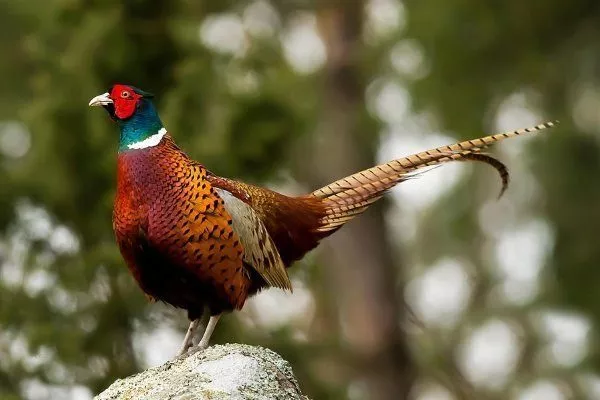
Common pheasant
The common pheasant is the bird once hunted in the forests. Later, it was domesticated to adorn royal courts and provide valuable meat. This breed originated in the Caucasus, and was also found in Turkmenistan and Kyrgyzstan. Today, it is a popular choice for meat production.
Description. In appearance, the bird resembles a common chicken. However, there are some striking differences: firstly, the long tail feathers tapering towards the tips. Secondly, the presence of red skin around the eyes – a facial "mask." Male pheasants always appear more vibrant than females. The silvery-gray plumage of males has a variety of eye-catching shades – yellow, orange, purple, piercing green. Turquoise feathers appear on the neck and head. Females have only three primary colors in their plumage: gray, black, and light brown. The legs of males are equipped with spurs. The tail of males reaches 55 cm in length, while that of females reaches 30 cm.
Productivity. Males weigh 1.8-2 kg, while females weigh up to 1.5 kg. Their body lengths are 80 and 60 cm, respectively. During the mating season, the female lays approximately 50 eggs, 1-2 per day. Egg-laying typically lasts from April to mid-June.
Other features. In the wild, they inhabit areas with shrubs, tall grass, bodies of water, and fields of corn or wheat. Males are aggressive towards rivals, engaging in fights that can be fatal. Females lay 8-15 eggs. The clutch is laid in a hole dug in the ground. The female incubates the eggs herself for 3-4 weeks. The chicks mature at approximately 5 months.
Maintenance and care. This breed is the most common on hunting farms. In the wild, these birds eat berries and insects. When kept captive, they are undemanding. The main requirement for keeping them, as with any pheasant breed, is a large, covered enclosure. Pheasants tolerate frost well, but avoid drafts. Birds are kept in pairs. The floor is covered with sawdust or straw bedding.
Hunting
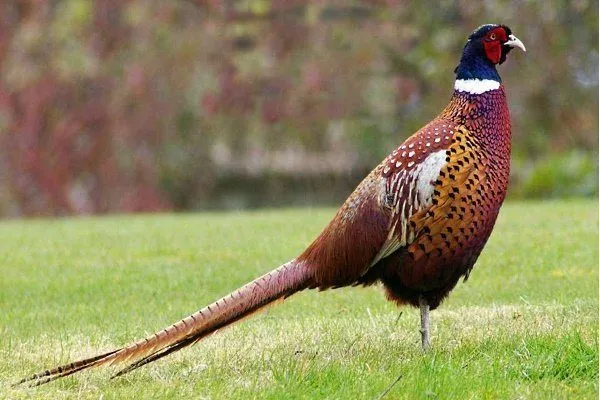
This hunting breed was created by crossing green and common pheasants. The population is small. Crossbreeding of the hybrid produces a wide variety of subspecies. Today, the hunting pheasant is found in the United States and Europe.
Description. Coloration varies from pure white to black. Males are traditionally more luxurious than females. Their plumage has a green or lilac sheen. Brown, orange, burgundy, and bronze shades predominate. Males have a red "mask," a black cap, and a snow-white ruff. Their legs are powerful and adorned with spurs.
Productivity. The average weight of a female is 1.5 kg, while that of a male is 2 kg. Their body length is 80 cm, of which 50 cm is the tail. Females are prolific egg layers, laying up to 60 eggs in three months.
Other features. It is distinguished by its fertility and excellent health. It is often used in selective breeding to develop unique subspecies. Its meat is tasty and dietary, with a low cholesterol content.
Male pheasants are polygamous, living with up to three or four females at a time. They may clash with other males, seeking the attention of a particular "lady."
Maintenance and care. Pheasants are responsive to nutritional intake—increasing their feed intake immediately increases their weight gain. They reproduce well and gain weight in captivity. They are bred for slaughter and also for resale to hunting farms. Pheasants are kept in a similar manner to hens. However, during mating season, it's best to separate males from each other to avoid conflict. Ideal conditions are a family of one male and six females. A single pheasant requires 75 grams of feed daily, and 80 grams during nesting.
Pheasants eating Colorado beetles in potato fields improves the taste of their meat.
Green
The green pheasant, or Japanese pheasant, has been Japan's national bird since 1947. Their habitat was previously limited to the islands of Honshu, Kyushu, and Shikoku. The green pheasant has several subspecies in its lineage, both common and game, and therefore produces a wide variety of color variations when bred.
Description. The male's back and chest are covered in emerald feathers. His neck is covered in violet feathers. The tail is purple-green. Females lack bright plumage, instead being a dun-brown color with black speckles.
Productivity. The average male weighs 1.9-1.2 kg. The body length is 75-89 cm, of which 25-45 cm is the tail. Females reach 50-53 cm in length, with a tail length of 21-27 cm. A clutch contains 7-9 eggs.
Other features. Males are not particularly aggressive. Green pheasants live for about 15 years. They prefer hilly terrain, tall grass, thickets, and shrubs. They live in monogamous and polygamous families.
Maintenance and care. These birds are hardy and cold-resistant. They can be kept like regular chickens. They can be easily kept on farms and in zoos. The main requirement is a large, covered enclosure with grass and shrubs. Their diet in the wild includes grains, young shoots, berries, fruits, worms, mice, snakes, and lizards. In captivity, they require a balanced diet. This includes grain feed, mixed feed, finely chopped vegetables, cottage cheese, greens, and insects.
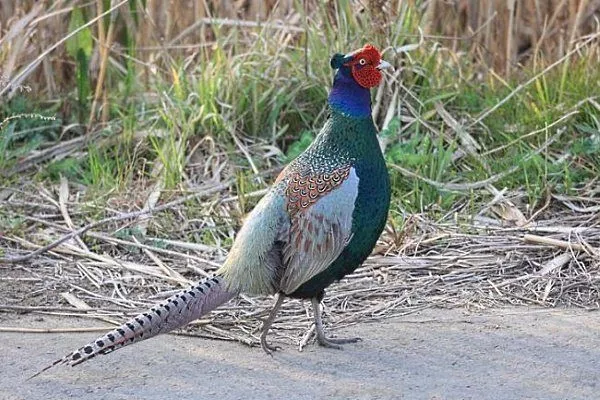
The green pheasant has several subspecies, which, while similar, have slight differences in the coloration of their mantle, belly, ruffs, heads, feet, and bills. The varieties and their habitats are listed in Table 1.
Table 1
| Subspecies of green pheasant | Habitats |
| Northern |
|
| Southern |
|
| Pacific |
|
Diamond
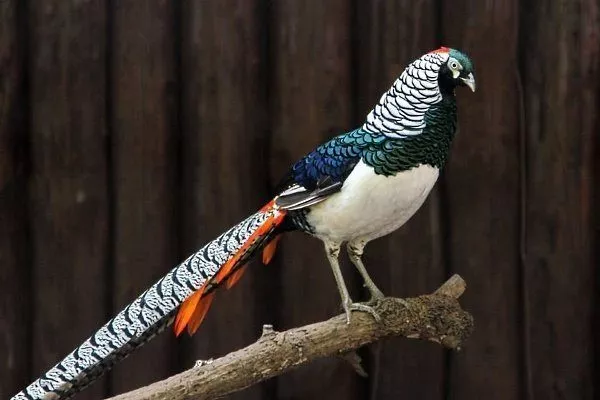
This is one of the most beautiful birds in the world. The diamond pheasant's second name, Lady Amherst, is named after the wife of the Governor-General who sent the bird to London from India. From there, the diamond pheasant spread throughout Europe.
Description. The Diamond Pheasant is not called the Diamond Pheasant for nothing; its plumage shimmers like a precious stone. Its head is covered in broad white feathers, reminiscent of an antique wig. The chest is olive or emerald, blending into a white belly. The crop is a combination of white and black feathers. The back is a bluish-black plumage. The bird's tail is particularly luxurious. Females have a traditionally modest appearance, with brownish-mottled plumage and bluish skin around the eyes.
Productivity. The average male weighs 0.9-1.3 kg. The female weighs 0.8 kg. A clutch contains 7-10 or more eggs. A female can lay up to 30 eggs per season.
Other features. These birds are highly adaptable. They can coexist with other birds, such as chickens, pigeons, and others. They have a calm, peaceful disposition, are not shy, and readily interact with people. Diamond pheasant meat is nutritious, very tender, and pleasant to the taste. Their eggs are high in protein.
Maintenance and care. Despite its exotic appearance, this bird tolerates cold well and is undemanding in terms of housing conditions. It is easy to breed in private backyards. They are housed in spacious aviaries in families, with one male per two females. The aviary should be divided into zones for pairs. To speed up weight gain, the birds are given fish oil. The rest of the diet is similar to that of chickens. They eat greens, grain, worms, vegetables, and fruits. They are bred for hunting and ornamental purposes.
Gold
This breed is distinguished by its particularly majestic and beautiful plumage. It is bred for meat and ornamental purposes. The bird is native to Eastern Europe. It can be found in nature reserves, but is a rare visitor elsewhere. However, the Golden Pheasant's homeland is not Europe, but southwest China and eastern Tibet.
Description. The breed's main distinguishing feature is its golden crest, edged with black. The belly is dark burgundy. Females lack a crest. The males' plumage combines yellow, orange, black, ocher, and blue hues. The neck is adorned with an orange "ruff" with a dark edge. The tail is long and luxurious. Females are smaller and more subdued in plumage.
Productivity. The average weight is 1.3 kg. A clutch contains 7-10 or more eggs. A female can lay up to 45 eggs per season, and young can lay up to 20. A characteristic of the golden pheasant is that egg production increases if the eggs are collected immediately.
Other features. The meat has excellent taste. The downside is a weak immune system.
Maintenance and care. Breeding is not particularly difficult. Since the bird is prone to disease, it is recommended to administer antibiotics along with its feed. Although golden pheasants have a weak immune system, they tolerate cold very well – they can withstand temperatures down to -35 degrees Celsius without harm. This bird can be kept in unheated rooms. For more information on golden pheasants and their breeding, see here.
The golden pheasant has several interesting subspecies. They are found in the wild and are also kept by breeders:
- Red pheasant. This is a wild variety of Golden Pheasant, introduced to breeders after the work of breeders.
- Bordeaux. It has a coloration similar to the Golden Pheasant, but has burgundy feathers instead of red. This species was the first to be bred from the domesticated red pheasant.
- Golden Gigi. It was named after the Italian Ghigi, who bred it. The species' distinctive feature is its entire body covered in yellow-green plumage.
- Cinnamon. This species was developed in the United States. Instead of blue and green plumage, it has gray feathers on its back.
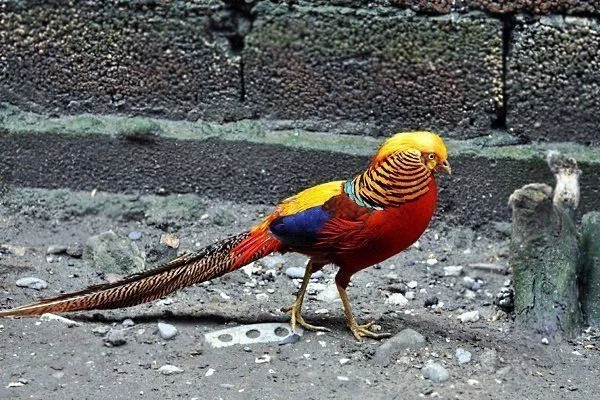
Golden Pheasant (Chrysolophus pictus)
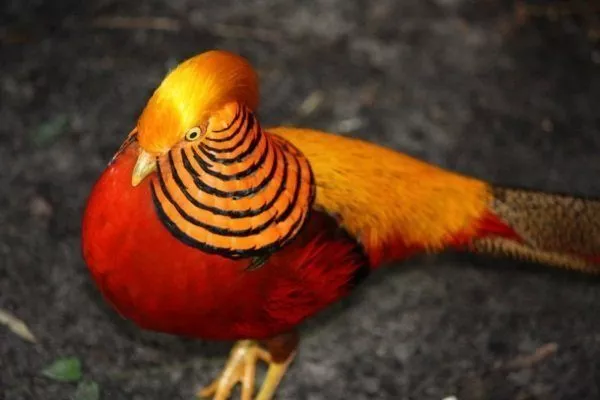
Golden pheasant red
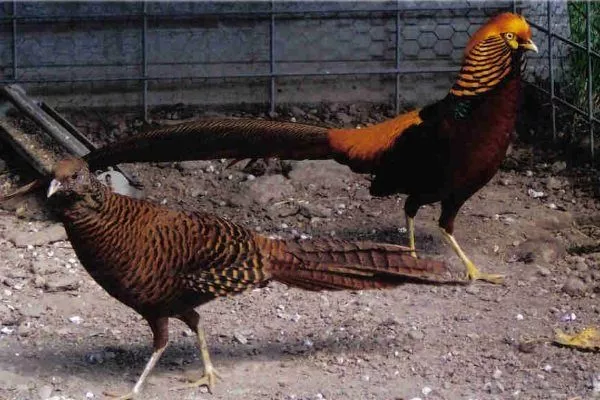
Golden Pheasant of Bordeaux
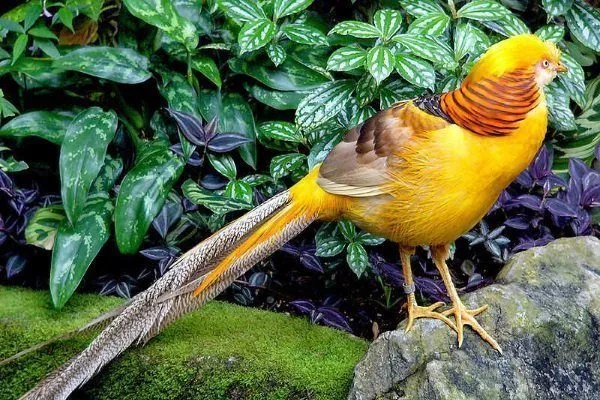
Golden Gigi
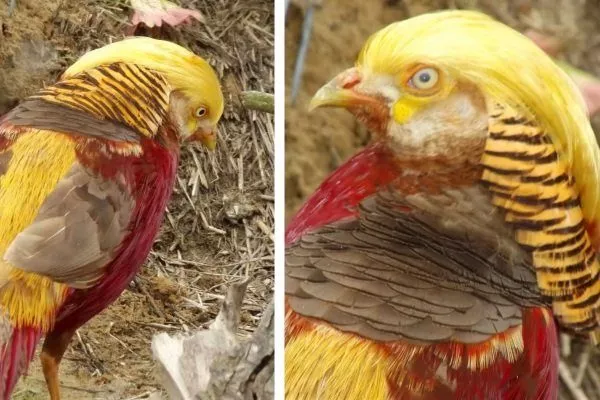
Golden Cinnamon
Royal
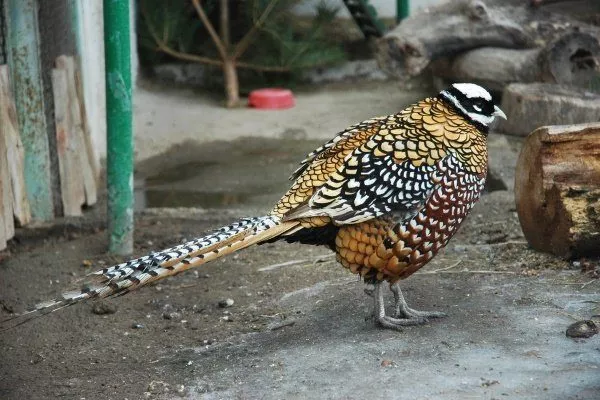
This is the largest pheasant, bred primarily for ornamental purposes. The bird's native land is the mountainous regions of northern and central China. In Europe, this breed is bred in hunting grounds, and in Russia, it can be seen in zoological gardens. The royal pheasant is often called the motley or Chinese pheasant.
Description. The plumage is yellowish-brown, reminiscent of scales. Each feather is edged with a dark border. A black border surrounds the neck. The crown has light feathers. The female is more subdued in coloration—her plumage is golden-yellow, with visible dark speckles. The tail is white, luxurious, edged with brown, and reaches a length of up to 2 meters. The chest and nape of the male are orange or almond-colored. The bill and feet are gray. The head is white, with a black "mask."
Productivity. Average weight: 1.3 kg. Clutch size: 7-14 eggs.
Other features. They prefer to move on the ground, rarely using their wings. They live up to 14 years and are extremely shy. This bird is not only beautiful, but also has delicious and tender meat.
Maintenance and care. They tolerate cold well and rarely get sick. However, they dislike dampness. It's important to keep their enclosures dry. Perches are essential for them. Coniferous trees are used for these. Pheasants need perches for observing—it's their favorite pastime. Sitting on perches often helps them heal the skin on their paws, which is very delicate.
The enclosure is stocked at a density of one pheasant per square meter. They are fed 75 grams of compound feed per day, consisting of corn, wheat, yeast, and fish and bone meal. In the spring, pheasants are additionally fed sunflower oil, berries, and calcium—this will promote faster growth and more tender meat.
Eared
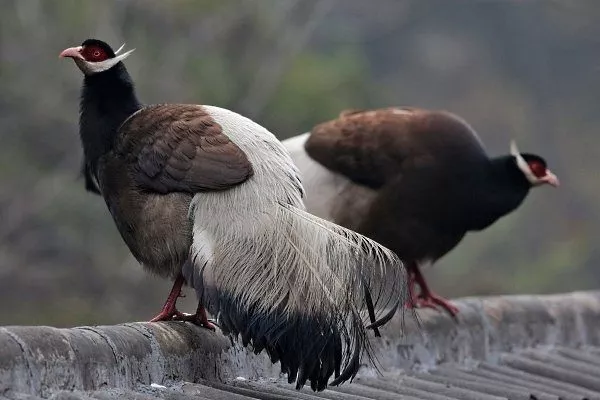
Eared pheasants are among the most massive birds of their kind. There are three subspecies of eared pheasants: white, blue, and brown. In the wild, they are found in the highlands of East Asia. There is no difference in plumage between males and females.
They have an elongated body with short, powerful legs. Their feet have spurs. Their main distinguishing feature is the long white feathers near their ears. These feathers, called "ears," are raised slightly upward. Their head is black and glossy. There are red circles near the eyes. They have a very long tail—it makes up half the bird's total length.
Blue-eared
The bird can be found in the mountainous and forested areas of western and central China. It was introduced to France from China in 1929.
Description. The bird is a smoky blue. Its "mask" is red, and it has white ear feathers. Because of these, the bird is also called the Blue-eared Pheasant—the feathers resemble pointed ears or whiskers. The legs are long and pink. Males have spurs. The tail is luxurious, blue or black. Males reach 100 cm in length, of which the tail makes up more than half.
Productivity. Blue-eared pheasants are quite heavy compared to their relatives. Males average 1.7-2.1 kg, while females weigh 1.5-1.75 kg. A clutch contains 6-12 eggs. The eggs are large, gray or gray-brown in color.
Other features. They are easily tamed, sociable, and friendly. Males can become aggressive during breeding season. They prefer monogamy.
Maintenance and care. They are frost-resistant and very hardy. They love to romp in the snow and don't suffer from the cold at all. In the wild, they feed on plant matter; in captivity, blue pheasants are fed a mixture of compound feed and grain. Some breeders even feed them dog food. They require spacious enclosures with grass and shrubs. Logs should be provided for perching. They dislike humidity, so drainage is essential.
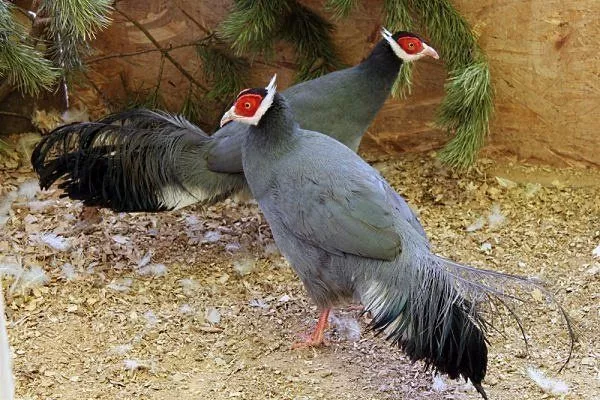
White eared
This is a very rare species of pheasant. In the wild, it can only be found in the mountains of Tibet. This rare bird is usually kept in zoos and for ornamental purposes.
Description. The plumage is snow-white. The head is red, with a black cap on the crown. The wings and tail have gray feathers, along with white, tipped with jet-black feathers. The legs are bright red, adorned with spurs.
Productivity. The average bird weight is 1.35-1.5 kg. Egg production per season is 30 eggs.
Other features. The females lay eggs, but rarely sit on them; they need to be placed under other hens.
Maintenance and care. Adapts well to captivity.
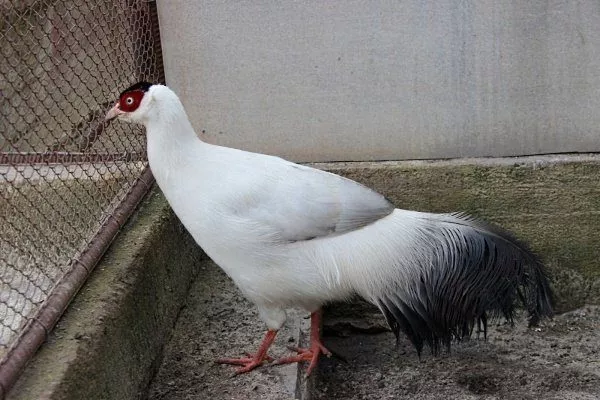
Brown eared
Description. They are distinguished by the brown plumage of their body and wings. The neck and tip of the tail have a black-blue border. The back is cream-colored. The head is adorned with a black "cap." The eyes are yellow, and the beak is yellow-brown.
Productivity. Males weigh 2.7 kg, females – 2.5 kg.
Other features. When searching for food, the bird may turn over large stones with its beak to find plant roots. This is important to consider when creating aviaries; they should be planted with non-poisonous plants. The bird is non-confrontational and easily adapts to humans.
Maintenance and care. The cat eats plant-based foods, which make up 70% of its diet. Peanuts are recommended.
Himalayan
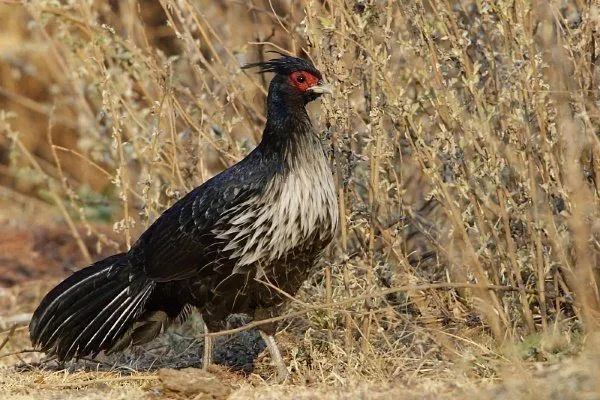
The Himalayan, or Nepalese, pheasant inhabits the mountainous regions of southwestern China, Indochina, and the Himalayas. Another name for the Himalayan pheasant is the black lophura. There are several subspecies, of which the purple-black, white-crested, and white-backed varieties are most commonly kept in captivity. White pheasants were introduced to Europe in the 18th century.
Description. The plumage is black with a purple-metallic hue. A wide white border flaps the lower back. The head is adorned with a long black crest. The legs are dark gray and have spurs. The bill is light green. The female's plumage is olive-brown with a light brown border.
Productivity. Males weigh 1.3-2 kg, females – about 1 kg. The number of eggs laid per season is from 15. The clutch size is 6-8 light cream or reddish-yellow eggs.
Other features. Many females incubate and raise their chicks independently. It is not recommended to house them with other bird species, as this breed can be aggressive, especially during the breeding season. They are also known to be shy.
Maintenance and care. In captivity, they are fed a grain mixture of millet, wheat, corn, and other seeds. They are also given chopped vegetables and fruits. This bird requires plenty of shelter—made from logs, slate, stones, and shrubs. They are hardy and can withstand extreme temperatures. Tropical subspecies require the construction of coops for the winter.
Silver
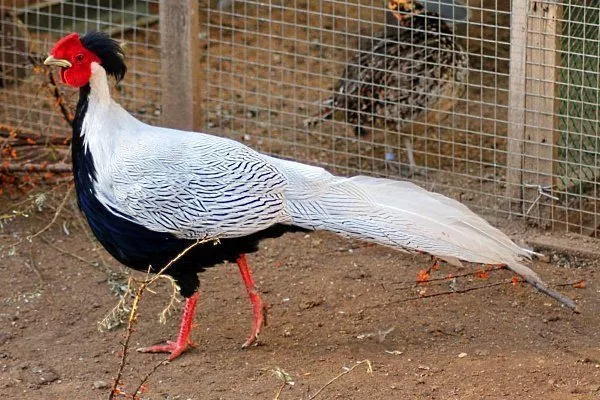
A common breed native to China, the Silver Pheasant is a profitable breed for meat production due to its high egg production and heavy weight.
Description. The body is covered in light gray or white plumage with dark stripes. It has a greenish tint. A red "mask" covers the face. The head is adorned with a blue-black crest. A white hood covers the back. The underparts are black, with black-edged feathers on the back and wings. The bird appears "silvered." The upper tail feathers are snow-white. The legs are coral-pink. The male is 125 cm long, of which the tail accounts for 70 cm. The female is significantly smaller, standing 75 cm with a tail of 30 cm.
Productivity. Males weigh up to 5 kg, females – about 2-2.5 kg. The egg-laying size per season is 50 eggs. A clutch contains 7-15 eggs.
Other features. It gains weight quickly. The Silver Pheasant has a strong immune system, so it rarely gets sick. Males are known to be combative during breeding season.
Maintenance and care. This breed is well adapted to Russian conditions. It tolerates temperatures down to -30°C, thanks to its dense plumage. It dislikes drafts. It readily eats chicken and goose food. The bird is unpretentious and easy to keep in breeders.
Taiwanese
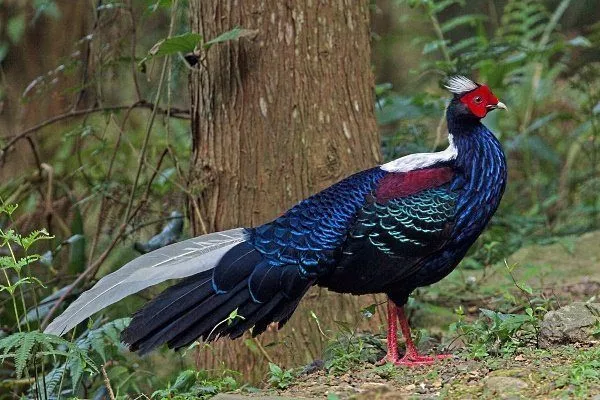
A very rare bird. Also known as Swaine's pheasant, it is listed in the Red Book. It is named after the ornithologist Swaine, who discovered it in the highlands of Taiwan in 1862. This species is found nowhere else.
Description. A small bird with violet-blue feathers on the chest and neck. The lower back is edged in black. The tail feathers are white. A white spot runs from the neck to the lower back. Orange spots are at the base of the wings. The face is featherless and coral-red. The feet are bright pink. Males have spurs. Males are 80 cm long and have a 48 cm tail. Females are 50 cm long and have a 25 cm tail.
Productivity. Average weight: 0.9-1.3 kg. Clutch size: 6-15 eggs. They lay up to 20 eggs per season.
Other features. This bird is known for its shyness and caution. In the wild, it hides in bushes all day and spends the night in trees. It is active between dusk and dawn. It lives for about 15 years.
Maintenance and care. It feeds like all Galliformes – seeds, fruits, insects, and greenery.
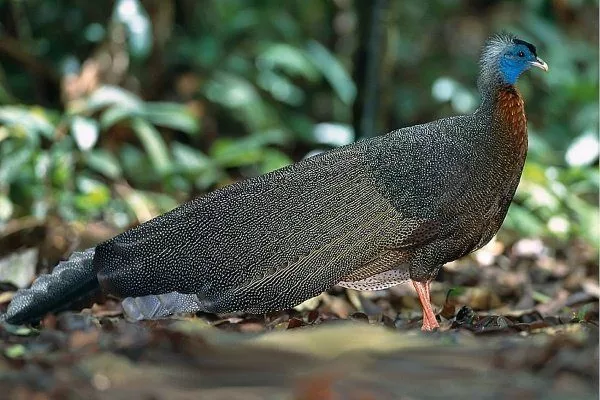
Argus
The Greater Argus is native to the Malay Islands. This rare bird can be found in specialized nurseries and from hobby breeders who sell breeding birds.
Description. The plumage resembles that of a peacock. The bird is large, but not as brightly colored as most pheasants. It has gray-green speckled plumage, a rufous neck, and a blue head. However, during courtship, the male spreads his tail, revealing oval golden "eyes." This is where the bird got its name—Argus, named after the many-eyed deity. The legs are red and spursless. It can reach 2 meters in length, of which the tail accounts for 1.5 meters.
Productivity. Average weight: 1.4-1.6 kg. Clutch size: 6-10 eggs. They lay up to 20 eggs per season.
Other features. Females lay a fair number of eggs, but aren't always ready to hatch them. Argus meat has a unique flavor.
Maintenance and care. They adapt well to life in an enclosure. They are friendly and get used to their owners. Young animals are fed minced meat, carrots, worms, etc.
Horned
Horned pheasants, or Tragopans, are divided into five subspecies, and they all have common characteristics: females and males are not similar.
Description. Males are quite large. They have bright colors and cone-shaped growths near their eyes. Red and brown shades predominate. Their throats are covered with growths called "wattles." Females are dull brown, without "horns" or "wattles." Their legs are short; males have spurs.
Productivity. Males weigh 1.6-2.1 kg, females 1.3-1.5 kg. The female lays 3-6 eggs for incubation.
Other features. Males are aggressive and fight with each other.
Maintenance and care. Adapts well to captivity. Its diet consists primarily of berries, fruits, greens, and wheat.
Types of tragopans:
- Black-headed or Western tragopan. The male has a black cap and a crest with a red tip. The cheeks are featherless and bright red. The male weighs 1.8-2 kg, the female 1.4 kg.
- Brown-bellied. Also known as Cabot's tragopan, it also has a black cap and an orange crest. Males weigh 1.2-1.4 kg, while females weigh up to 0.9 kg.
- Grey-bellied. Also known as Blyth's tragopan, it is the largest representative of the tragopan family. Males weigh 2.1 kg, while females weigh up to 1.5 kg. The male's head is adorned with an orange crest with a black stripe.
- Ocellated. Another name is Temminck's tragopan. One of the most beautiful pheasant species. The male's head is adorned with a black and orange crest and blue "horns." The throat has blue-turquoise projections resembling lapels. The featherless face is blue. Males weigh 1.2-1.4 kg, while females weigh up to 1.0 kg.
- Tragopan satyr. Another name is the Indian scaly-tailed ...
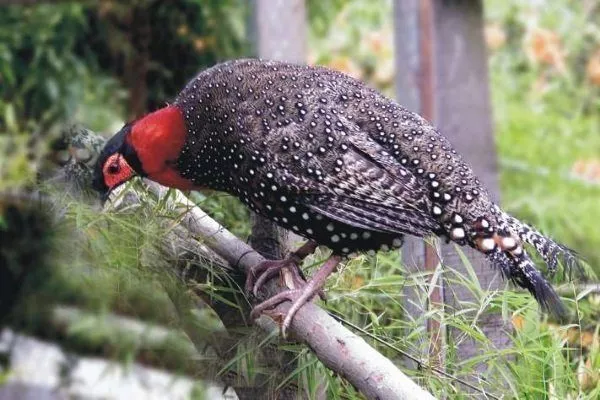
Black-headed tragopan
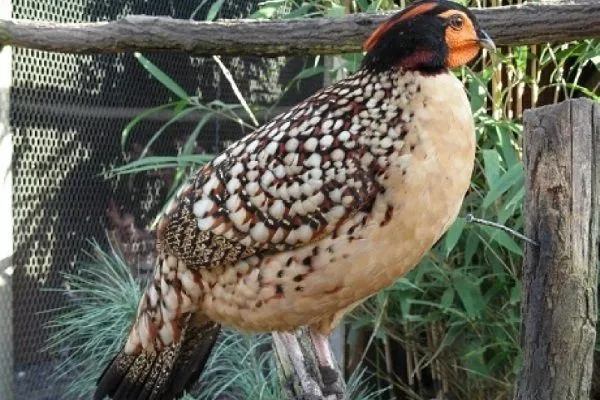
Brown-bellied tragopan (Tragopan caboti)
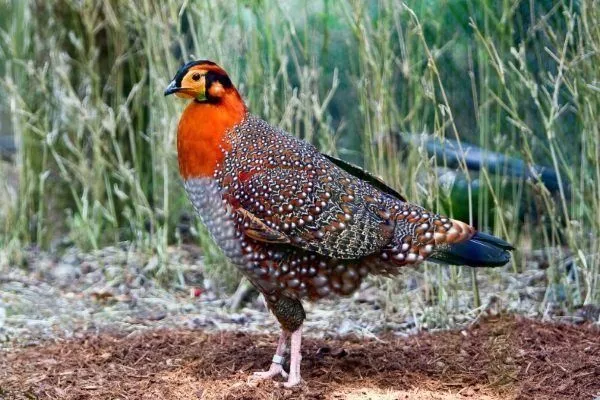
Grey-bellied Tragopan (Tragopan blythii)
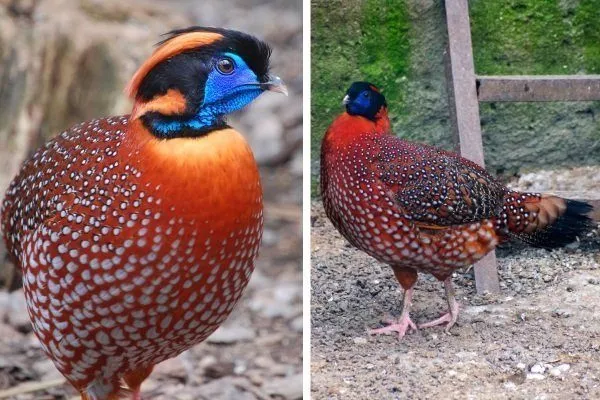
Ocellated tragopan
Peacock
This is not a specific species, but a whole group of subspecies united by a common characteristic: they all resemble a peacock in their feather patterns and lush tail. Peacock pheasants are also known as mirror pheasants or mountain pheasants. This pheasant species is not widely distributed in our country; it is mainly raised by Indian farmers. The purpose of raising it is ornamental.
Description. The back, wings, and tail are covered in a peacock pattern. The tail contains 16 feathers, which are used for directional control during flight. The plumage is silvery, with some feathers having a pearly hue.
Productivity. Males weigh 1.6-2.0 kg, females 1.3-1.4 kg. A female lays up to 45 eggs per season, and the young lay up to 20. The eggs are tasty and nutritious. A clutch contains up to 15 eggs.
Other features. They are friendly and quickly get used to people.
Maintenance and care. They are prone to disease, so it is recommended to add antibiotics to their feed. They can withstand temperatures down to -35 degrees Celsius. They adapt well to captivity.
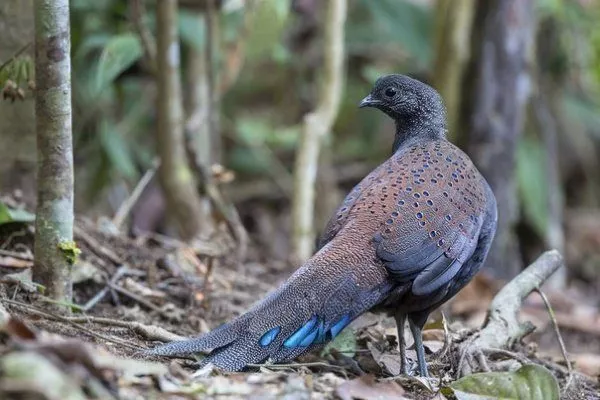
Wedge-tailed
This small bird is native to China. It is also known as the Koklas. It inhabits mountain forests and shrublands. Its natural habitat is northern China, Nepal, and Afghanistan. This very small and elusive bird is difficult to catch.
Description. The male's head is adorned with a crest divided in two. The belly and chest are brown, and the wings are white or gray, decorated with a striped pattern. The male's length is 58-63 cm, of which the tail accounts for 23-24 cm. The female is similar in size. Unlike other pheasants, there are no bare spots on the face. The bill is black, and the feet have spurs.
Productivity. Males weigh about 1.1 kg. Females lay up to 25 eggs per season.
Other features. Females can incubate eggs and care for chicks.
Maintenance and care. In the wild, they feed primarily on plant matter. Avoid overfeeding them with compound feed, as they can die from obesity. Their diet should be primarily green, such as lettuce, nettle, yarrow, wheat sprouts, and so on. Grains or chicken feed can be added to their food. They prefer a dry, cool climate. They do not acclimate well to Europe, as they are sensitive to dampness. They are kept in pairs in enclosures.
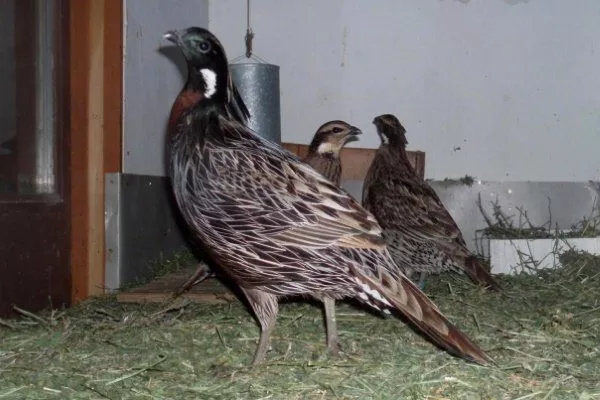
Romanian
This breed is a subspecies of the common pheasant. It was created by crossing the wild Japanese pheasant and the European common pheasant. This bird is often called the Green or Emerald Pheasant due to its characteristic green tint on its wings. Some individuals have feathers with a yellow or blue tint. This is a large bird raised for its meat.
Description. The plumage is grayish-brown. Part of the male's head is covered with greenish-blue plumage. The entire body is emerald-green. A crest is found on the head. Females are dull in color—they have brown plumage, without a green sheen.
Productivity. Weight: up to 2.5 kg. On poultry farms, these birds are raised for only 1.5 months, slaughtered when they reach 1 kg. A female lays 20 to 60 eggs per season.
Other features. A female's egg production is determined by her age. Romanian pheasant meat is prized for its nutritional value and excellent taste.
Maintenance and care. Maintenance and feeding are the same as for the common pheasant.
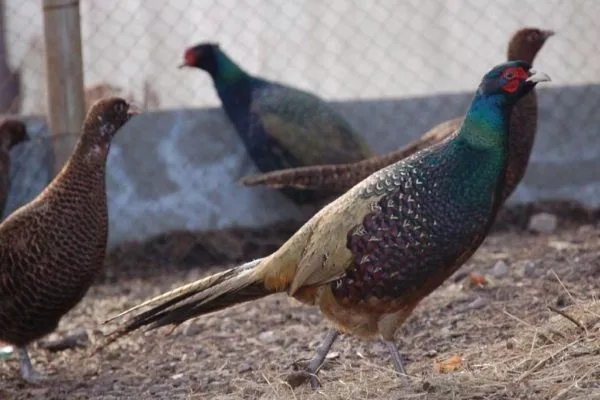
Yellow
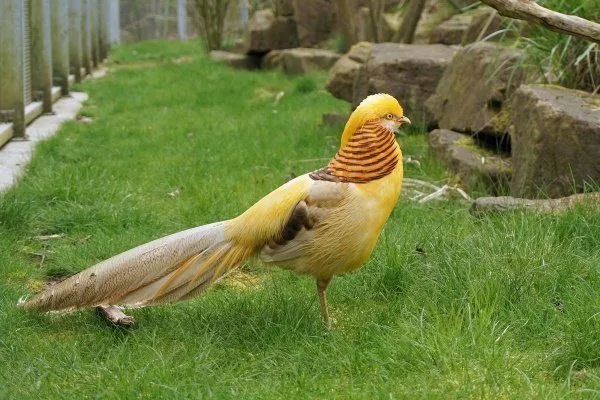
This variety of golden pheasant was bred artificially.
Description. The plumage is bright yellow. The head is adorned with a long, lemon-colored crest. There is a yellow-orange hood. Females are more subdued; they are also yellow, but a lighter shade. The male is 1 m long.
Productivity. The male weighs 0.9 kg, the female – 0.6 kg. The clutch contains 5-12 eggs.
Other features. Females lay eggs in holes they dig in the ground. They live for about 10 years.
Maintenance and care. They are fed a mixture of wheat, millet, ground corn, and other seeds. Finely chopped vegetables and fruits are also provided. During the non-breeding period, they are kept in a communal aviary. During the breeding season, the birds are separated into families to avoid violent fights. A family consists of one male and 6-10 females. Food can be given every 2-3 days to avoid disturbing the skittish birds. The aviary should have a "winter garden" of shrubs and dead trees.
Lofurs
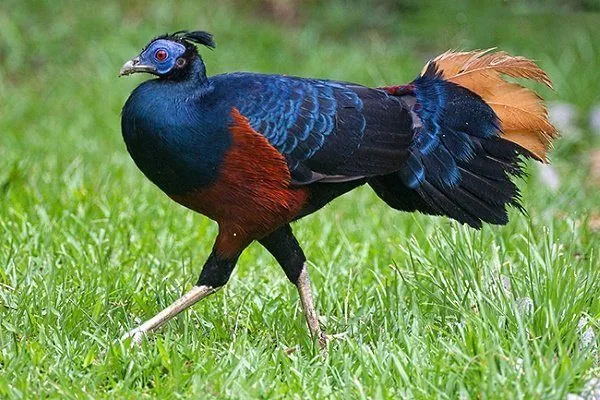
The Lophius pheasant is a genus within the pheasant family. All birds in this genus share a common characteristic: male Lophius pheasants have a reddish back. These birds are native to southern and central Asia. Many species live in isolation, on islands. The Lophius pheasant species include the Siamese, Bulwer's, Sumatran, Black, and others.
Description. The lower back color varies from orange-red to dark copper, as seen in the Edwards's lophura. All male lophuras have spurs. The face has unusually large, cavernous bodies, colored red or blue. In the Bulwer's lophura, for example, the cavernous bodies are so enlarged that they reach the ground during mating.
All female lophiurs have more subdued plumage, with brownish hues. Males are predominantly dark blue and black, and many lophiurs have a tuft on their heads. The tail is usually white or yellow.
Productivity. Weight: 1.1-1.6 kg. Clutch size: 4-6 eggs. Sumatran laphura lays 2 eggs per clutch.
Other features. Lophuras are usually polygamous. Only the Sumatran lophura is a monogamous species. Females are capable of brooding chicks.
Maintenance and care. All but the Sumatran scaly-sided ...
Pedigree characteristics of pheasants
All breeds of pheasants intended for home breeding are divided into 2 groups:
- Common or Caucasian pheasants.
- Green or Japanese pheasants.
The first category contains many more species—these are typically bred for their valuable meat. The second category, with only five species, is kept for ornamental purposes and is a common sight in pet zoos.
- ✓ Disease Resistance: Some breeds, such as the Silver Pheasant, have a strong immune system, while others, such as the Golden Pheasant, are prone to disease.
- ✓ Aggression: Breeds such as the Himalayan Pheasant can be aggressive, requiring special care.
Characteristics of all pheasant breeds:
- They are smaller than chickens. Pheasants are comparable in size to small breeds of egg-laying chickens.
- Pheasant meat is considered a dietary food, prized for its unique flavor and low fat content. It's a true delicacy.
- Pheasant eggs are low in cholesterol. Pheasant eggs are typically used for breeding, as they are too expensive to eat.
- If there are insects in the garden beds, pheasants can clear them out in a couple of days. Moreover, these birds even eat insects that other birds dislike, such as Colorado potato beetles.
- Pheasant feathers are used to make jewelry.
The Greeks were the first to domesticate and tame pheasants. They were named after the Phasis River, near which a settlement was located where these birds were kept and bred.
Most pheasants breed successfully in captivity and are usually polygamous. However, some prefer monogamy. When rehoming birds, consider their personalities and behavior. If two aggressive females and one male are housed in the same enclosure, the stronger female may kill the weaker competitor.
Anyone considering pheasant breeding has a wealth of options—nature and breeders have ensured a wide variety of species. Most existing breeds are raised for meat and feathers, while others are bred for ornamental value. However, before raising pheasants for meat, it's important to consider the costs—given the small size of the birds, making a profit is quite difficult.