
Golden pheasants are bred not only for their delicious meat but also for ornamental purposes, as they are incredibly beautiful and captivating. These birds are extremely easy to care for, so raising and caring for them is straightforward. We'll cover the basic breeding guidelines in this article.
Description of the breed
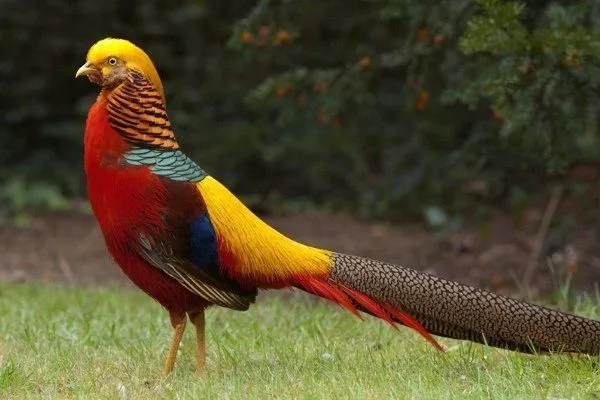
The golden pheasant is an ornamental bird, belongs to the genus Collared, and has characteristic differences.
Males:
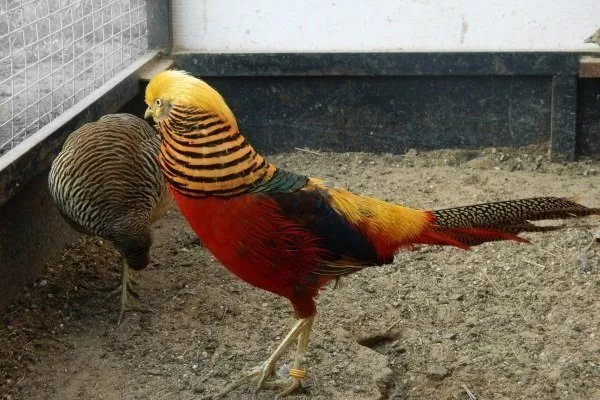
- Unusual plumage. The birds' backs are bright yellow with a golden shimmer, the underparts are bright red, and the shoulders are dark blue with purple spots.
- A thick golden crest and an orange collar with a black border.
- The long, wedge-shaped tail is gray. The area above the tail is purple.
- Spurs on the feet.
- Weight is 1-3 kg.
- Body length – up to 85 cm.
Females:
- They are not distinguished by their bright coloration. Their feathers are a tawny brown with black spots and stripes.
- Weight – less than a kilogram.
- Body length – up to 50 cm.
- During the season they lay about 50 eggs weighing 25-35 g.
The characteristic coloring appears in chicks after molting at the age of 2 months, and even then the sex can be clearly distinguished.
You can learn about the appearance of a male and female golden pheasant and their behavior in captivity from the video:
Breeding and caring for chickens
Female pheasants rarely hatch eggs outside the wild, so an incubator is required for breeding.
- ✓ Automatic egg turning for even heating.
- ✓ Temperature maintenance accuracy of ±0.1°C.
- ✓ Adjustable humidity in the range of 50-80%.
To hatch healthy chicks, follow these rules:
- First, collect the eggs as quickly as possible before the birds peck at them. This will require searching throughout the enclosure, as pheasants don't lay their eggs in one place.
- Select only good eggs for incubation – large, regular-shaped, smooth, and without damage.
Also, pay attention to the coloring: chicks most often hatch from light gray eggs. Avoid those with shells that are too light or too dark.
- The incubation material must be fresh—no more than 3 days after collection. If this is not possible, store the eggs in a cool place for up to 15 days, do not wash them, and turn them daily.
- Let them warm to room temperature before storing.
- Turn on the incubator and set the temperature to 37.8°C.
- After 24 hours, you can place the material for breeding.
Further incubation is divided into 4 stages:
- From day 1 to day 7Maintain the initial temperature and humidity at 60-65%. Turn the eggs 4 times a day.
- From day 8 to day 14. The temperature and humidity do not change, the eggs should be turned 6 times a day.
- From 15 to 21 days. Everything remains the same as in the previous period, but now you need to open the incubator for 15 minutes twice a day to cool it down.
- Day 22-24 – the hatching period. Humidity is 80%, temperature is 37.5 degrees. There is no need to turn or cool the eggs.
It is very convenient to use an automatic incubator, it changes the position of the eggs itself.
We invite you to watch a video to see how golden pheasant chicks hatch from eggs in an incubator:
After hatching, chicks are weakened and require special care:
- Place a thick layer of hay and sawdust on the floor, and ensure the room is warm and free of drafts.
- During the first week, the temperature should be 28°C, then gradually increase to 34°C. This temperature should be maintained in the enclosure for the entire first month of the chicks' lives.
- It is worth choosing vacuum drinkers, they are safer for chickens.
- To prevent diseases, give young animals antibiotics: Erythromycin or Biovit in the dosage indicated in the instructions for the drug.
Food in the first days of life of chickens is very varied:
- Day 1 – finely chopped chicken egg white and yogurt;
- 2-3 days – nettle, green onions, ant eggs;
- 4-5 days – powdered eggshells, clover, spinach, wheat porridge;
- Day 6-7 – to everything described above, add 0.02 grams of salt and chalk for each chicken;
- Days 8-11 – add 0.05 grams of bone meal and 0.3 grams of wheat bran to your diet;
- from day 12 – add millet to everything you gave earlier;
- From the age of 1 month, the chicks begin to be fed oatmeal and ground wheat, and are transferred to adult food.
For the first two weeks, pheasants are fed 10 times a day, then 7 times a day until they are two months old, and 4 times a day until they are three months old. After they reach three months of age, they eat three times a day.
Maintenance of adults
To keep and breed pheasants on a farm or at home, you need an aviary (at least 2 square meters per family, also at least 2 meters high), a walking yard and a warm poultry house for the winter.
- ✓ Minimum area per family is 2 square meters.
- ✓ The height of the enclosure is at least 2 meters to prevent injuries when attempting to take off.
- ✓ Availability of shelters and perches at different heights.
The territory must be developed following these rules:
- It is best to cover the walls and floor of the enclosure with metal mesh to prevent other birds and rats from getting inside.
- Place a layer of sand or clay on the floor.
- Build perches at different heights, but not less than a meter from the floor.
- Make the roof out of nylon material, as pheasants may try to fly out of the enclosure, which can lead to injury.
- If the floor is not sandy, install sand and ash trays for the birds to clean their feathers in.
- Install feeders and waterers, be sure to clean them regularly.
- Pheasants need a yard to roam – about 10 square meters. If space allows, plant a couple of bushes or trees there and sow grass.
- Build a hole from the aviary into the yard and keep it open all day. In warmer weather, you can leave it open at night, as birds sometimes like to sleep in trees.
- In harsh winter conditions, the poultry house is insulated with foam. Supplemental heating is unlikely to be necessary, but additional lighting should be installed.
- Before wintering, give the birds a course of antibiotic therapy.
- On frosty, sunny days, organize a walk in the yard.
Diet
Pheasants eat a lot and often, so they will need a large amount of food.
Basic rules of nutrition:
- In winter, the diet is structured like this:
- 50% – grain mixtures and dry food mixed with broth;
- 20% – grated vegetables (carrots and cabbage);
- 16% – cottage cheese, minced meat, bone meal.
Additionally, they give vitamins to boost immunity.
- In addition, in winter, 2 grams of fish oil are added to the drink and 5 grams of ascorbic acid to the feed, thus replenishing the lack of fruit.
- The summer diet must include:
- 45% of grain crops (corn, barley and wheat);
- 20% vegetables and fruits.
- Any new foods should be introduced gradually, as even adult birds may experience digestive problems.
Susceptibility to diseases
In captivity, golden pheasants, especially chicks, often suffer from viral infections and colds. If detected early, these can be easily and quickly treated with antibiotics.
The following serious diseases are encountered:
- laryngotracheitis;
- smallpox;
- marble disease - affects the spleen;
- Marek's disease - paralyzes the legs of birds;
- mycoplasmosis;
- pasteurellosis;
- tuberculosis.
To avoid health problems in pheasants, follow these recommendations:
- Keep newly acquired birds in quarantine for a month, separately from others;
- take care to protect from drafts, cold and excessive humidity;
- If even one individual becomes ill, immediately separate it from the others until it fully recovers.
The golden pheasant can be a true gem in any poultry yard. These ornamental birds grow well and are highly productive. They are easy to care for—they are undemanding in terms of housing conditions and food. To prevent disease, keep pheasants away from drafts and stress, and administer antibiotics prophylactically.