
Not all beginning poultry farmers are able to distinguish between male and female guinea fowl. This is essential for establishing a breeding stock for future poultry production. This article discusses many ways to distinguish between male and female guinea fowl. Some of these are complex, but with practice, a breeder will become accustomed to them and will be able to easily identify a male or female within seconds.
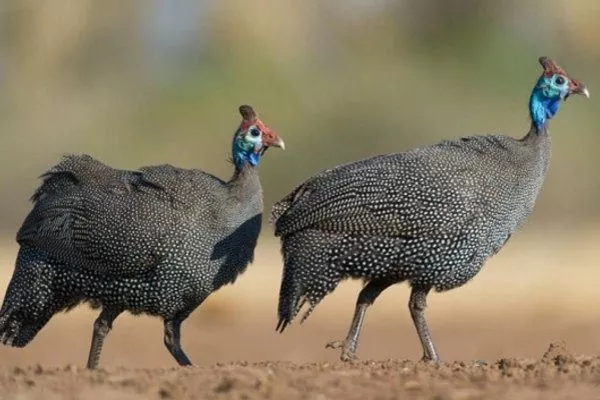
Size and weight of the bird
Many farmers debate whether sex is determined by the birds' body weight and size. However, opinions differ significantly. Some believe that guinea fowl are the only domesticated birds in which the females are larger than the males, while other breeders disagree.
Comparison table of sizes and weights
Age Female Male Up to 4 months Smaller in size Larger in size After 4 months 20% larger Smaller than the female In fact, up until four months of age, the female is much smaller than the male. But after reaching this age, especially during the egg-laying period, the guinea fowl begins to rapidly gain weight. At this point, she becomes larger than the male, increasing her body weight by 20%.
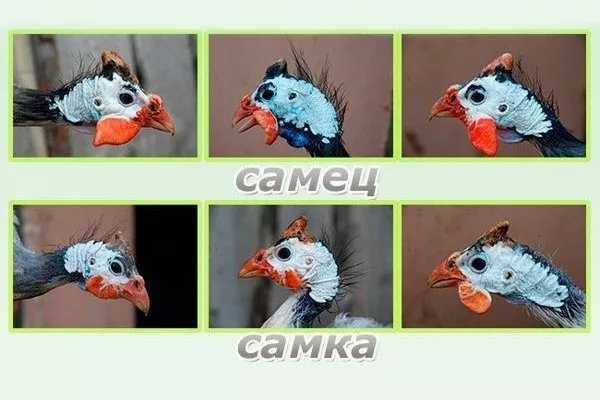
Beak shape
It's quite possible to distinguish between males and females by looking at the beak shape. Females have small, graceful, and neat beaks with non-protruding nostrils. Their beaks are reddish-orange in color. The front portion of the beak is smooth and blends smoothly into the head.
Males are a little different. As they age, the beak of the "boys" becomes larger and especially prominent. The base of the beak is bright red, almost blood-red. The nostrils are quite large and noticeable.
Below is a table comparing the appearance of the beak and head of birds:
| Female | Male |
|
|
These distinctive features in the appearance of the beak and nostrils in males and females become noticeable when the young are 4-5 months old.
Head position
Guinea fowl and guinea hens have another difference in appearance—their head position. Hens are proud birds, with a proud gait, a straight neck, and a head that looks extremely straight. They walk in an upright, erect posture, as if on a podium.
Males walk somewhat differently—they always lean forward, their chests raised. Their torso is slightly tilted toward the floor, and their heads begin to tilt downwards.
Color and length of feathers
Until a bird is six weeks old, determining its sex by its feathers is quite difficult, as both birds look identical. However, adult birds vary in coloration, making it possible to determine the bird's sex. For example, white Siberian guinea fowl and cream-colored females have predominantly darker plumage, while males have slightly lighter plumage. Sometimes, it's much easier to spot a male simply by looking—his plumage is entirely white.
To determine the sex of guinea fowl, many farmers use a method based on the inheritance of plumage color. According to this method, females tend to inherit the coloring of their males, and vice versa, males tend to have the same coloring as their female mothers. This sometimes allows them to distinguish guinea fowl chicks by their cross-coloring. However, this method is considered rather complex and is best suited for experienced farmers.
It has also been noted that females develop feathers faster than males. This means that birds that develop feathers earlier are crossed with males that develop feathers later. The result is guinea fowl breeds where females have longer flight feathers than all other breeds. Meanwhile, males have feathers of exactly the same length.
Location of the ridge
The comb, or more precisely its placement, can help the farmer determine whether the guinea fowl is a male or a female. This method requires particular attention. How to identify males by the comb:
- it is slightly raised from the base of the head;
- does not stand straight, but in a slightly curved position;
- has a larger size.
In this video, Ivan Serba, a guinea fowl breeder, will share his experience in telling a male from a female. He'll also show a visual example of comb placement and wattle shape:
Earrings
The birds have wattles beneath their beaks, which farmers can use to determine the bird's sex. Females have delicate, neat growths, while males have thicker, more conspicuous wattles. Older females are sometimes mistaken for guinea fowls, as their wattles grow larger and resemble those of males at this age.
You can distinguish males from females by the shape of their wattles during the first year. Later, they will begin to harden, making this much more difficult.
Voice
Birds have a rather melodic, loud voice. Because of this characteristic, not every farmer wants to keep guinea fowlMales tend to "crack" and "trill." Females can be identified by their softer voice; females do not crackle.
If you have trouble understanding the call of a female guinea fowl, you can clearly hear the bird's voice in the video, as well as understand how it behaves during the "conversation":
Belly shape
Farmers should also pay attention to the shape of the birds' abdomens. Males have firm, full abdomens, while females have softer abdomens. You can distinguish the sex of the birds by touch—the pubic bones are separated.
Habits
Males and females behave differently, and their behavioral patterns can vary significantly. Females are shy, with their tails held low and their heads held in a natural position. Male guinea fowl are somewhat restless, constantly searching for food. They like to hide in secluded corners.
Males always present themselves as powerful individuals. Their tails are curled high. Their heads are raised, and they constantly glance around. Their every movement exudes pride and superiority. They are the "masters of the situation," looking down on the females with condescension.
Primary sexual characteristics
A bird's genital structure can be used to 100% reliably identify males and females. By examining the genitals, a farmer can determine the sex of the animal. The advantage of this method is that it can be used to determine the sex of a bird as young as one day old.
Experienced poultry farmers know that from the day of birth until 1.5-2 months, the birds are practically no different in appearance and behavior.
- ✓ Make sure the bird is calm before examination.
- ✓ Use gloves for safety and hygiene.
- ✓ Gently stretch the cloaca to examine the genitals.
In this case, sexual characteristics are determined by the structure of the genitals: a girl has a loop, a boy has a penis.
Follow these instructions:
- Gently lure the bird toward you and pick it up. Gently stroke its back to calm it down. Guinea fowl are considered extremely timid birds, and human contact can be very frightening. A frightened guinea fowl will begin to contract its entire body, which can make it difficult to stretch its vent. The bird will experience severe pain or even be injured.
- Just a few minutes of gentle stroking can calm the animal. If it's a male, such touching will cause blood to rush to the cloaca, exposing the penis, making it impossible to miss.
- Once the bird has calmed down, turn it on its back for better visibility of the anus. Hold the guinea fowl with one hand, and with the other, gently push back any interfering feathers and stretch the vent. Be sure to wear gloves when performing this procedure.
- A thorough examination begins: the "boy" has a pink penis, somewhat resembling a tubercle; the "girl" has no differences inside the passage, she has a pink loop.
The sex of chicks should be determined before purchase so that the farmer knows how many females to purchase per male. This is crucial in poultry breeding and, consequently, affects future profits.
Don't trust the seller when buying—they may claim to be selling females, but in reality, they may be males. You won't get your money back, but worse, your entire business will be ruined due to the lack of females in the herd. Therefore, it's important to learn to distinguish between females and males to avoid falling victim to unscrupulous sellers.
It is recommended to use all the methods described above in combination. Over time, a poultry farmer will gain experience and learn to distinguish guinea fowl from male guinea fowl quickly and easily.
Other distinctive characteristics
There are several other ways to determine a bird's sex. These include the following:
- Males are not capable of laying eggs; only hens do this.
- If there are many males in the flock (more than one for every four females), the guinea fowl suffer from constant trampling, which is indicated by a balding back.
- Males are extremely sexually active and constantly seek to mate even with other bird species.
- Females are prone to constant fighting in the struggle for their place on the roost and territory.
Sexing domesticated guinea fowl requires a serious approach from poultry farmers. Gaining knowledge and experience will help in future flock formation, business development, and profit from the sale of eggs and meat.