
A bee larva is completely unlike an adult bee. Unlike the aggressive and industrious honey bee, it is completely inert and defenseless. Situated at different levels of the food chain, adults and larvae consume different resources, so they are not rivals for food.
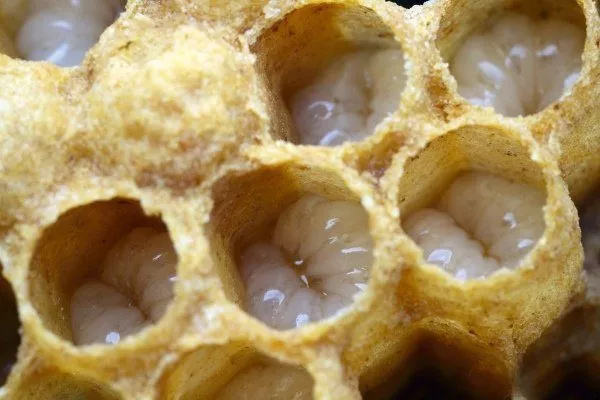
The structure of a bee larva
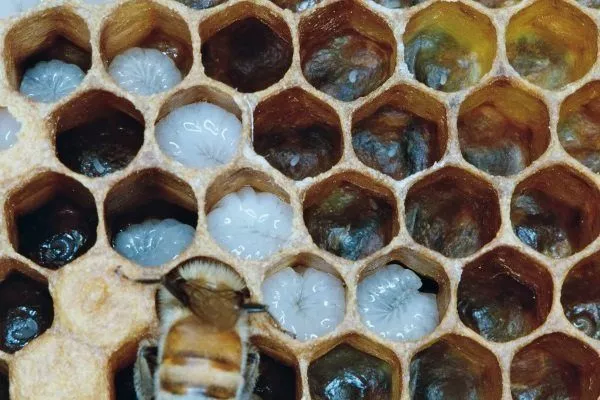
The bee larva has a simple structure. Its distinctive features are:
- small head;
- color – white or light yellow;
- body shape - worm-shaped;
- the body consists of several segments - thoracic and abdominal;
- The outer shell has a chitinous armor.
The larva has the same internal organs as the adult, but they are not fully developed.
Bee larvae have very small heads—they consist almost entirely of jaws. They eat a lot, thoroughly chewing their food—both animal and plant.
Internal organs:
- Intestines – this is the most important internal organ of the larvae. Its structure:
- Foregut – a short tube with well-developed muscles. Through contractions of the intestine, the larva absorbs liquid food.
- Midgut – occupies the main part of the body. Along it stretch the excretory organs – the four Malpighian tubules.
- hindgut – has a curved shape. At the end is the anal opening.
While the larva feeds and grows, it does not excrete feces—the bees don't have to remove them. Initially, food remains do not enter the anus because the hindgut does not communicate with the midgut. They join later.
The rest of the structure:
- Heart. It has 12 chambers and is located on the back. Adult insects have only 5 chambers.
- Respiratory organs. These are tracheal trunks, which have many branches and are located throughout the body.
- Fat layerIt makes up to 65% of the total mass. Plastic substances accumulate in the fat layer.
- Nervous systemTwo nodes of elementary structure - supraesophageal and subesophageal.
- GenitalsThey are underdeveloped and in their embryonic stage. Throughout their life, the larvae develop rudiments of ovaries. Drone larvae have rudiments of testes.
- Rudiments of organsThe larvae have legs, wings, and other organs similar to those of the adult insect, which are formed during the embryonic stage.
The larva has no eyes or olfactory organs. Using spinnerets located on the lower lip, the future bees spin cocoons.
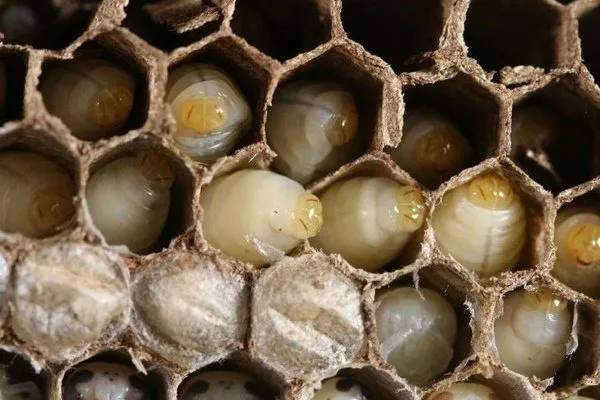
Stages of development
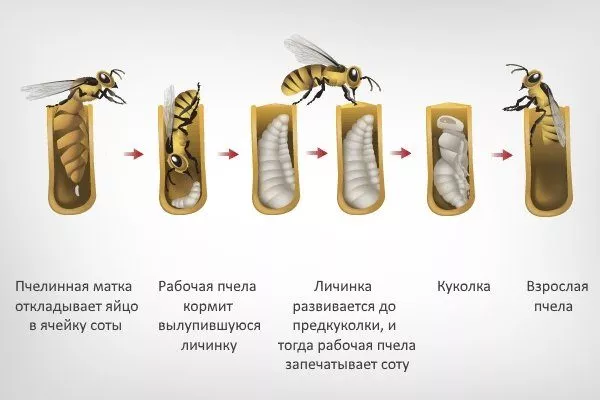
Bees are insects that undergo complete metamorphosis. Before the worms that will become bees begin spinning, their skin will change four times! Each stage of development is characterized by a specific body structure, feeding habits, and behavior. The entire period of larval development is divided into four stages:
- eggs;
- larvae;
- dolls;
- adults.
Active growth
| Object | Adult weight (mg) | Duration of development (days) | Life expectancy (days) |
|---|---|---|---|
| worker bee | 130-150 | 21 | 30-60 |
| Uterus | 340 | 16 | 1460-1825 |
| Drone | 360 | 24 | 75 |
Each adult bee grows from an egg "laid" by the queen. The queen bee attaches the eggs to the bottom of the honeycomb. After a day, the eggs tilt, and after three, they assume a horizontal position, settling on the bottom of the cell. The egg develops into a small white larva.
First, the larva receives royal jelly from the queen, who deposits it directly into the cell. It is fed royal jelly for three days. On the fourth day, the young are fed bee bread and honey. The first stage of development lasts three days and is completely identical for all categories of bee species—queens, workers, and drones.
Queens are produced from fertile eggs, drones from infertile ones.
Active development occurs over the course of six days. This stage is characterized by rapid growth. Weight increases from 0.1 mg to 150 mg. A moment comes when the well-fed creature becomes overcrowded—it stretches along the cell, moving head first toward the exit. By this time, feeding has ceased. During this first stage, the rudiments of legs and antennae, as well as all internal organs, are formed.
To raise 10,000 larvae, 0.5 kg of pollen and 1 kg of honey are used. To feed one embryo, a whole cell of bee bread is needed.
After six days, the queen seals the cells containing the young. A special mixture of wax and pollen is used for sealing. The queen leaves an opening to allow air to enter. Within the sealed cells, the larvae begin to create cocoons around themselves, transforming into prepupae.
Prepupa
Once in the sealed cell, the larva straightens up and spins a cocoon—pupation. This is the prepupal stage. A prepupa develops inside the spun cocoon. The process is complete within a day. A few hours later, molting occurs. It's time to shed its skin once again. The old shell is deposited at the end of the cell, where it mixes with feces.
Doll
This stage can be called the adult bee stage. The pupa's skeleton hardens and darkens. After a few days, the young bees emerge. As soon as the fourth and final skin shed occurs, the bees begin gnawing at the cell cap. Once the passage is clear, the young bee emerges.
When an individual emerges from a cell, it leaves its cocoon behind. Since each cell serves many generations over the years, the white combs eventually turn yellow, then light brown, and finally completely dark. The bottom and walls thicken, causing older combs to appear narrower and shorter—they harbor weaker individuals with small wings and short proboscises.
Unlike older bees, young bees have a chitinous skeleton and a soft body covered in fine hairs. Over time, the shell hardens, the hairs wear away against the walls, and the bee's body becomes shiny and hairless. The development of a worker bee lasts approximately 21 days.
Molting
The larva grows, but its skin retains its original size. It must shed the old skin so that its plump body can receive a new, more comfortable "shirt." Let's reiterate: the larva molts four times before the honeycomb is sealed.
Before molting begins, feeding ceases. The shell loses its shine and becomes matte. The old skin, splitting at the head, tears along the back. A larva emerges from the resulting opening, carrying a new skin. The skin shedding process lasts 1 hour and 20 minutes.
Immediately after molting, the bee remains motionless and consumes minimal food. The discarded shell is not discarded but remains in the comb. Six days after hatching, the larva receives its final portion of food and is sealed in the comb, where it begins spinning a cocoon. The bee completes this task within 24 hours. The future bee then undergoes its fifth molt, which occurs four hours after the cocoon is completed. The creature that emerges after the fifth molt is no longer a larva. It has all the characteristics of an adult bee.
The pupa is a precursor stage, separated from the adult by one final molt. Once the final skin shedding is complete, the insect emerges, gnawing through the lid of the honeycomb.
Care
For a bee colony to thrive and develop, it requires a specific microclimate. Bees are sensitive to any changes in conditions—temperature, humidity, and carbon dioxide concentration. The optimal temperature in the brood zone is +35°C, with humidity of 80-85%. If the temperature drops, the bees become passive—they conserve their energy reserves.
- ✓ The temperature in the hive should be maintained in the range of +32…+35°C to ensure normal development of the larvae.
- ✓ The air humidity in the hive should be 80-85% to prevent the larvae and their food from drying out.
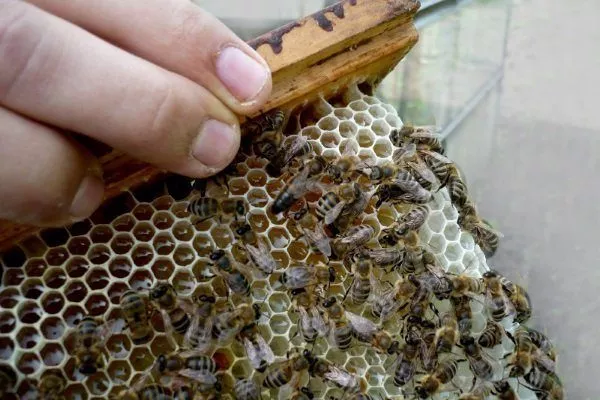
Carbon dioxide content
The concentration of oxygen and carbon dioxide in a hive depends on the characteristics of a particular bee colony—its strength and development. Bees respond to changes in carbon dioxide levels through their heat receptors. Its concentration varies from the periphery to the center and depends on the season.
When transporting bees by road, carbon dioxide levels in hives can reach 4%. The insects become stressed and tend to retreat to the space above the frames, which impairs gas exchange. If ventilation is inadequate, the bees may die before they survive the journey.
As the season draws to a close, the gas concentration increases from the periphery to the center. In early autumn and spring, the carbon dioxide concentration in the center is 1.1%, while at the periphery it's 0.6%. As cold weather sets in, these values drop to 3% and 1%, respectively.
Nutrition
The amount of food added is 2-4 times greater than the egg's volume. If there isn't enough food, the larva will die from malnutrition. Upon contact with royal jelly, the egg cracks, revealing the larva's body. If there is no food, the egg will dry out without cracking, and the larva will die.
During the first few days, the young are fed royal jelly produced by the young bees. Subsequent feeding depends on the hierarchy:
- future queen - diet does not change;
- worker bees and drones receive honey and bee bread.
Rapid weight gain occurs. After 5 days, the larvae weigh:
- queen bees – 340 mg;
- drones – 360 mg;
- worker bees – 130-150 mg.
| Larva type | Number of feedings | Feed volume (mg) |
|---|---|---|
| Uterus | 1600 | 340 |
| Drone | 140-150 | 360 |
| worker bee | 140-150 | 130-150 |
The future queen will receive food 1600 times, worker bees – 140-150 times.
Temperature
During the first stage of development, the larva is extremely vulnerable—it requires a specific ambient temperature. If the temperature is below normal for at least 15 minutes—during the first 8-14 hours of development—the egg will develop into an individual combining the characteristics of a bee and a drone.
If the temperature fluctuates in any direction for a long time, the insects will die.
Temperature affects the development time of queen bee larvae, drones, and worker bees. The optimal temperature is 32 to 35°C. If the temperature drops to 30°C, the development time will increase; if it rises to 38°C, it will decrease.
Humidity
It's important to ensure good air exchange in the hive. For this purpose, hives have top entrances and ventilation slots. If ventilation is insufficient, condensation occurs, which can cause mold to form on the hive walls, and the wood reaches its maximum moisture content—30%.
A bee colony requires 30 liters of water throughout its lifespan. Bees make up to 100 flights daily, each time bringing 30-50 mg of water back to the nest.
Honey can affect nest humidity, not only moistening but also drying out the space inside the hive. What you need to know about humidity:
- If the air humidity reaches 60-65%, and honey contains 17-18% water, then moisture is neither released nor absorbed.
- If humidity rises to 70%, honey absorbs water vapor – it contains up to 30% water.
During winter, bees consume food with a water content of 30%. Winter reserves do not contain this amount of moisture. Therefore, food moisture is increased either by the bees themselves or by the hive's humidity. As insect activity decreases, regardless of the time of year, the carbon dioxide concentration in the hive increases. Before cold weather sets in—in the pre-winter period—oxygen levels decrease and humidity increases.
How does the development of worker bee, queen and drone larvae differ?
The formation of larvae lasts:
- queens – 16 days;
- worker bee – 21 days;
- drone – 24 days.
Worker bees are the foundation of the hive. They feed the entire colony, from birth to reproduction. They also:
- build housing for a bee colony;
- act as security guards;
- prepare food and cook it;
- They clean up in honeycombs and much more.
The worker bee is significantly smaller than the drone and queen. They do not mate with the drones because they lack proper reproductive organs.
Life expectancy drones – 2.5 months.
Drones are male bees needed to fertilize the queen. After mating with the queen, a drone dies, losing part of its reproductive organ. Born in the spring, males survive until autumn, where they retain the ability to reproduce. Drones mature 10-14 days after leaving the cell.
| Stages of development | Development timeframes | ||
| bee | uterus | drone | |
| egg | 3 | 3 | 3 |
| larva | 6 | 5 | 7 |
| prepupa | 3 | 2 | 4 |
| doll | 9 | 6 | 10 |
| duration of development | 21 | 16 | 24 |
The development of drones and worker bees is virtually identical, except for the duration of development. Queen bee, female bee, and drone larvae go through the same stages: egg, larva, pupa, and prepupa. The larvae of the first two hatch from fertilized eggs, while drone larvae hatch from unfertilized ones.
What is a homogenate?
Homogenate is the contents of a cell, including the larva itself and bee products. There are different types of homogenate:
- Drone - milk from squeezed drone larvae.
- Uterine – the most valuable product. It is distinguished by its high content of royal jelly.
- Worker bees – it contains practically nothing but larvae. This product is in low demand.
Drone homogenate is obtained from cells containing 6-7-day-old larvae. They are removed from the honeycombs and then ground into a homogeneous mass. The product rapidly loses its properties when exposed to sunlight. It is stored at -5°C to -8°C. The shelf life is 1 month. It has a broad spectrum of effects, from boosting immunity to increasing libido.
Queen bee homogenate is obtained from three-day-old queen bee larvae. This unique product essentially consists of stem cells. It stores bioactive substances and promotes regeneration in the aging body.
Drone and queen bee homogenates contain the same vitamins. The former contains more decenoic acids, while the latter contains more proteins. They also contain natural hormones—testosterone, estradiol, and progesterone. Bee homogenate does not contain hormones, but it does contain decenoic acids.
Artificial breeding of queen bees
There are several cases when it is necessary to raise a new queen bee:
- To replace an aging queen bee.
- To form a colony-nucleus.
- If the active queen bee has died.
- To obtain large volumes of hemogenate and royal jelly.
The problem resolves itself only in the third case—if there is brood in the frames. The larvae should be transferred to queen cells and fed with royal jelly. In all other cases, human intervention is necessary.
A beekeeper explains how to raise queen bees. A beekeeping specialist explains and demonstrates how to set up combs to produce one-day-old larvae:
There are two ways to breed queens artificially:
- A frame containing eggs and brood is removed from a large, robust bee colony. A 3x4 cm hole is cut at the top. The lower walls of the cut are removed, leaving two larvae. The frame is placed in a hive with a queenless colony. This method allows for the production of high-quality material.
- This method is used when several queens need to be bred at once. A queen is placed in a good colony, isolated between two frames. After four days, she is transferred to a nuc (a special hive) with honey, bees, and brood. The frame containing brood produced over four days should be returned to the "native" hive. It needs some work, removing any cells without larvae.
For more information on queen breeding, please look for Here.
Bee larvae, being potential adults, can not only replenish the bee colony with a queen, drones or worker bees, but also provide a valuable product used in medicine.