
Ascospherosis is bee disease, which also has another name—chalkbrood. The peculiarity of this pathology is that adult bees carry the pathogen while remaining healthy. Additionally, the apiary gradually becomes contaminated with the fungus, which can lead to its demise.
What is ascospherosis in bees?
Ascospherosis refers to a contagious disease of bees caused by a mold fungus belonging to the genus Ascospheridae. This pathogen is quite resilient and resistant to environmental factors.
The fungal growth causes swelling of the larvae, gradually leading to their death. The infection spreads to the honeycombs and hive houses. In severe cases, a third of the brood dies, and productivity declines. The pathogen is found in the insects' intestines, which allows the bacteria to enter the honey.
Ascospherosis spreads throughout the apiary. A veterinarian considers an apiary unfit for use after the disease has been cured.
The main causes of the disease
Ascospherosis most often occurs in the spring, when the insects hatch their first brood. A long, cold winter weakens bees' immune systems, creating a favorable environment for the disease to develop.
The main provoking factors influencing the occurrence of ascospherosis:
- transfer of the fungus into the apiary by infected bees, drones or parasites;
- penetration of the pathogen through honey, bee bread, nectar, pollen;
- the presence of high humidity and lack of heat;
- improper processing of equipment (frames, hives);
- poor nutrition of insects;
- spread of fungus between healthy bees;
- using bees to pollinate necessary crops in a greenhouse, since the high temperature and humidity there provoke the development of ascospherosis;
- excessive use of antibiotics, which disrupt the natural pathogenic microflora of insects.
Before setting up an apiary, it is necessary to thoroughly clean all equipment and create the most favorable conditions for insect reproduction and subsequent honey production.
Stages of the disease
The course of ascospherosis is classified into the following stages, which determine the number of dead insects:
- The latent progression of the disease implies the death of a small number of individuals, which may go unnoticed.
- The mild stage is characterized by a small number of dead individuals (10-15 insects).
- In severe stages, the death of a large number of insects (more than 100 individuals) is observed.
In mild cases of ascospherosis, you can prevent further infection yourself, but a severe form requires the necessary treatment measures under the supervision of a veterinarian.
Characteristic symptoms of ascospherosis
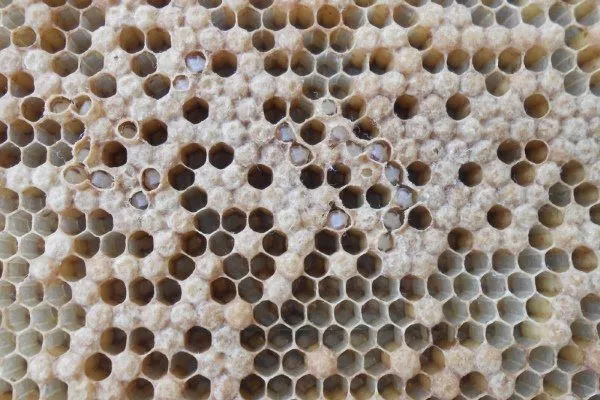
As the disease progresses, most insects die during the capped brood stage and the subsequent molting of the resulting larvae. The pathogen begins to actively multiply in the insect's intestines, leading to the emergence of fungal growth in the honeycomb.
Infected larvae gradually begin to swell and expand their cells. As the disease progresses, they turn yellow and become noticeably shiny. The insects' bodies take on a doughy consistency, and over time, the damaged area completely dries out.
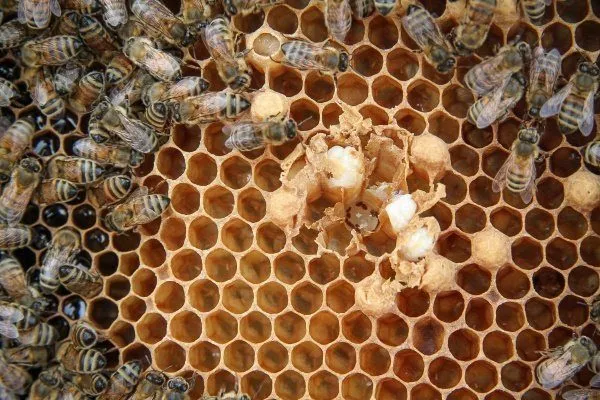
If damaged honeycombs are shaken, the dried larvae produce a distinctive clanking sound, and when cut, they fall out of the cells. However, the damaged areas are fairly easy to remove. This material must be destroyed, as it contains infectious fungal spores.
At the initial stage, drone brood appears, as more favorable and natural conditions for reproduction are created at the edge of the frame.
The presence of the disease is indicated by the detection of the following visual symptoms:
- significant increase in the size of larvae;
- change in the brood caps, which have a concave shape with perforated holes;
- the appearance of a characteristic coating on the surface of the honeycombs;
- formation of pieces of chalk inside the honeycombs.
Diagnostics
Diagnosis of the disease is based on clinical symptoms and methods such as microscopy and mycology. To determine the exact pathogen, the collected material is examined at a veterinary clinic.
Honeycombs with a diameter of 10-12 cm or the resulting infected larvae are used as test material.
If suspicious symptoms are confirmed, the veterinarian will prescribe an appropriate treatment regimen and necessary preventive measures.
Treatment methods for ascospherosis in bees
Timely treatment and control of fungus consists of the following steps:
- removal of frames with affected larvae;
- melting of honeycombs with dead and affected brood;
- updating the bee nest (using a frame with dry wax, artificial wax);
- replacing the queen bee (this radical method is used when the affected area is large, more than 50% of the apiary).
- Remove frames containing affected larvae.
- Melt down the combs containing dead brood.
- Upgrade the bee's nest.
- Replace the queen bee if necessary.
Before treatment, infected bee colonies are moved to disinfected hives to continue producing honey and kill the fungus. In this case, it's best to use proven treatments.
Drug therapy
Drug treatment of ascospherosis involves the use of polyene antibiotics, imidolate-containing compounds from the azole group, and substances containing plant components.
The most effective and frequently used drugs:
- A therapeutic feeding with a sweet solution containing Nystatin. The dosage is 0.5 g per liter of liquid. The solution is applied three times, followed by a 5-day break. The serving for one frame is 120-150 ml.
- Spraying with a 20% Nystatin solution is done during the summer. The procedure is performed three times, followed by a similar break of three times. The dosage per spray is 20 ml.
- Use special medicinal tablets containing Ascopol in the spring and summer. The tablets are attached to the nest and left until completely eviscerated by the insects.
- Using Candy as a therapeutic supplement. Add 10 ml of the substance to the prepared sweet mixture (1 kg). The recommended dose for one bee colony is 500 grams. The frequency of application depends on the severity of the disease (one or two times). For the desired effect, flower pollen is also added.
- Poly-sot. This medicinal product contains the following ingredients: Nystatin, pollen, and PAN (a combination of essential microelements, enzymes, amino acids, vitamins, and other biochemicals). 100 grams of the product is diluted with cool, boiled water and mixed with the sugar mixture, then applied to 10-12 streets.
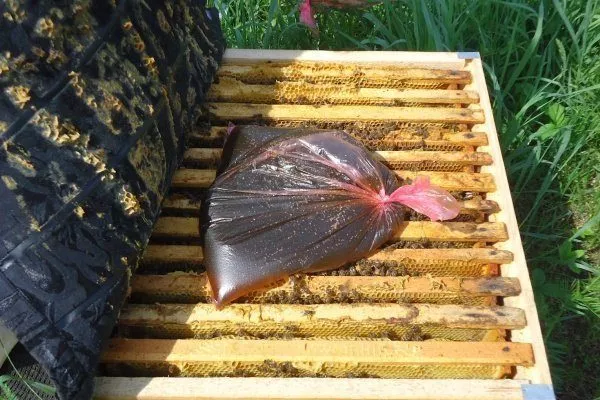
The use of medicinal products allows to increase the fertility of the bee colony and ensures resistance to pathogenic microorganisms.
When using medications to eliminate fungus, it is important to strictly follow the dosages prescribed by your veterinarian, as excessive amounts can have the opposite effect.
It should also be remembered that eliminating fungus with antibiotic drugs has a large number of side effects, which can negatively affect the future life of bee colonies.
If necessary, repeat treatments are carried out after a 10-14 day interval. This interval must be maintained to prevent any negative impact of the treatments on the insects.
Carrying out disinfection
Disinfection for ascospherosis involves the use of various medicinal solutions to disinfect bee nests. In this case, a special veterinary solution (GLAK) is used. The procedure takes at least 2.5 hours.
Infected honeycombs are treated with a solution of iodine monochloride, hydrochloric acid, a solution containing methanoic acid, and hydrogen peroxide. Disinfection of the hive with a flame for 20-30 seconds is also effective.
To thoroughly disinfect and completely fill the cells, use a disinfection unit or a hydro-gun. Wooden equipment cleaned mechanically requires the use of the following therapeutic solutions:
- a combination of 10% hydrogen peroxide and 0.5% methanoic acid (the duration of double disinfection is 60 minutes with a break of one hour);
- use of iodine monochloride (disinfection duration is at least 5-7 hours);
- a combination of 15% formaldehyde and 5% sodium hydroxide requires treatment for 4-6 hours.
Metal equipment should be treated with the last solution from the above list for 6 hours. After this time, rinse thoroughly with cold water and leave to air dry.
Folk remedies
Folk remedies for the treatment of ascospherosis can be used in the early stages of the disease and as a preventative measure. The most popular recipes are:
- Crushed yarrow leaves are used to sprinkle infested bee alleys.
- The tops of horsetail are dried, then poured with water, boiled for 10 minutes, and left to steep for about 2 hours. The finished mixture is strained and mixed with sugar in equal parts. The dosage for one bee colony is 1 liter, and the treatment duration is 5 days.
- Crushed garlic heads, combined with ground celandine, are wrapped in cheesecloth and spread across the top of the frames. The cheesecloth is replaced every four days.
- Diluting 10 ml of iodine in one liter of sugar syrup. The prepared solution is given to the sick family or used to spray contaminated equipment.
When using folk remedies, it is best to consult a qualified veterinarian who will recommend effective methods for preserving the continued existence of the apiary.
Experienced beekeeper Konstantin Yakimov talks about effective ways to combat ascospherosis in bees:
Prevention
Preventive measures for ascospherosis involve beekeepers creating favorable conditions (avoiding high humidity and low temperatures) for the safe and successful reproduction of insects, followed by the production of high-quality honey.
- ✓ Sufficient ventilation
- ✓ Access to sunlight
- ✓ No high humidity
When setting up an apiary, it's important to select a suitable location with good ventilation and adequate sunlight. To prevent infection, hives must be well insulated and prevent excessive humidity inside the bee houses.
Preventing possible relapses of the disease depends on the following actions:
- timely implementation of preventive measures (burning of fallen infected honeycombs, good disinfection);
- the use of medicinal plants that have a bactericidal effect on fungi.
Do not feed healthy bees nectar collected by infected bees. Failure to do so increases the risk of recurrence and further fungal growth.
Professional beekeepers are committed to taking preventative measures to prevent insects from becoming infected with fungi and to creating favorable conditions for their successful survival and reproduction.
Ascospherosis is a fairly serious disease that can lead to the complete extinction of bee colonies and disrupt the normal functioning of the apiary. Complete elimination of the problem is only possible through the use of comprehensive measures.