
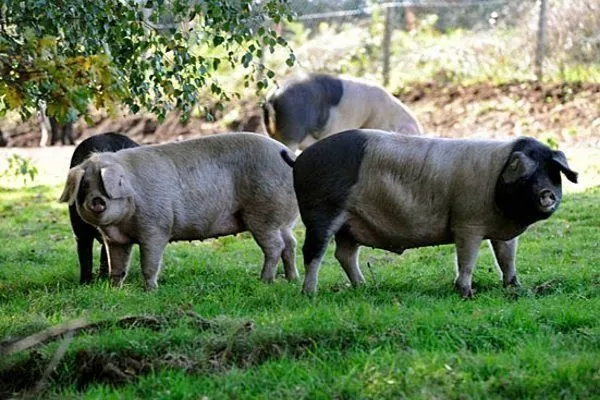
Pigs are primarily raised for their delicious and abundant fat, but the meat obtained from pigs is no less delicious than lard. Pork is prepared in all countries, in cafes and restaurants, and at home. The most popular meat breeds are described below.
| Breed | Weight of boar, kg | Pig weight, kg | Meat yield, % | Thickness of lard, cm | Fertility, piglets | Daily weight gain, g |
|---|---|---|---|---|---|---|
| Duroc | 250 | 230 | 80 | 3 | 10 | 700 |
| Pietrain | 260 | 240 | 60 | 2.6 | 8 | 500 |
| Landrace | 310 | 260 | 70 | 2 | 10 | 800 |
| Vietnamese | 200 | 180 | 75 | 1.5 | 20 | 600 |
| Hampshire | 310 | 250 | 65 | 2 | 8 | 900 |
| White | 330 | 230 | 80 | 3 | 12 | 750 |
| Barbecue | 300 | 200 | 85 | 5 | 16 | 650 |
| Cornish | 300 | 250 | 60 | 2 | 11 | 700 |
| Kemerovo | 330 | 250 | 70 | 2.5 | 11 | 800 |
| Estonian | 350 | 240 | 60 | 2 | 12 | 750 |
| Poltava | 300 | 240 | 62 | 2.5 | 10 | 700 |
What are the differences between meat pig breeds?
These pigs are also called bacon pigs. They can be identified by their appearance: a long body and a shallow brisket. The hindquarters are larger than the front, due to the large hams. The main difference between meat pigs and lard pigs is that the latter develop muscle tissue intensively, while fat is deposited more slowly.
- ✓ Disease resistance
- ✓ Feeding requirements
- ✓ Adaptation to climate
- ✓ Fertility
- ✓ Meat quality
Piglets gain weight quickly if properly cared for and well-fed. At six months, a piglet can weigh 100 kilograms. The meat yield per carcass will be 67%, and the fat yield 25%.
Duroc beef breed
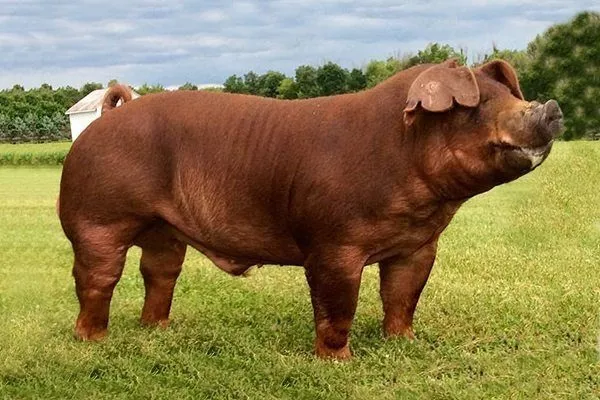
The meatiest breed of pigs is DurocAn adult animal can reach 250 kilograms live weight. The fat is only 3 centimeters thick.
This breed is distinguished by its large size. Males can reach almost two meters (1.8 meters). Females are slightly smaller. Generally, meat breeds are characterized by an elongated body, but this breed is different. The Duroc's body is broad and massive, with a convex back and a small head, where the pointed ears either protrude upward or extend forward.
Another distinctive feature of this breed is its coloring, which comes in many shades: golden, dark brown, and brown. The bristles are medium-length, matching the skin color. Pigs gain weight rapidly, so the older the pig, the less active it becomes.
Duroc Productivity
If you've decided to raise pigs, you need to know how to achieve high meat and fat yields with minimal investment. As mentioned above, the meat yield per pig is 80%, but this only occurs if the animal is well-fed. To achieve such a good result, the animal must be fed a high-protein diet.
A few months of good feeding are enough for pigs to reach a respectable weight of 100 kilograms. Weight gain continues, even in adulthood, with the exception of calving.
Research has shown that the quality and quantity of pork is also affected by the conditions in which the animals are kept. The pen must be well-ventilated, regularly cleaned, and kept clean and dry. In winter, it must be insulated, and there must be no extraneous noise or irritants.
Advantages and disadvantages of the breed
The advantages of the Duroc breed include:
- rapid growth and the same weight gain;
- endurance and adaptability to any conditions;
- obtaining a large amount of tasty and juicy meat;
- there is almost no subcutaneous fat;
- calm character: they do not fight, do not bite, and are also careful with their piglets.
The Duroc breed is an excellent choice for raising and breeding meat pigs. However, even this "ideal" breed has its drawbacks:
- a sow can give birth to no more than 10 piglets at a time, but on the other hand this is good, because the fewer piglets there are in the belly, the higher the percentage of their survival;
- susceptibility to respiratory diseases;
- Weight gain will directly depend on the amount of protein consumed.
Caring for pigs
Fortunately, this breed is easy to maintain and can be kept in open pens during the warmer months, with ample space. The animals need to be fed three times a day in winter and twice a day in summer. It's important to ensure they receive sufficient protein. The premises should be kept unventilated, dirty, and free of drafts, as pigs are prone to illness.
Breeding the Duroc breed
Farmers say that Duroc pigs are not profitable for breeding and meat production, as their cost exceeds their productivity. After all, a sow of another breed can produce more than 30 piglets at a time, while a Duroc can produce a maximum of 20 piglets.
Active estrus in sows lasts two days, during which time it's best to leave them completely alone. The next day, they are mated with a boar, twice to ensure 100% success. The survival rate of newborn piglets is 93%.
Pietrain pigs
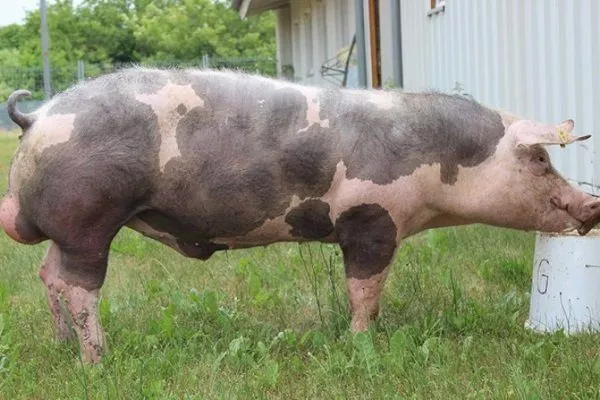
Another meat breed is the Pietrain. Pietrain boars can reach 260 kilograms in live weight, while sows are slightly smaller at 240 kilograms. The body of this pig is short but fairly wide, with well-developed muscles, although this might not be apparent from its appearance due to its thin and light bone structure. The hams are substantial.
The head is straight, small, and light, with small, erect ears and a broad, shallow chest. The back is muscular and fairly wide, with rounded flanks, indicating the pig has a moderate fat content, rather than a high accumulation of meat. The pigs are white or variegated.
Productivity
It's impossible to say definitively whether keeping this breed for meat is profitable. Everything depends on the owner, whether they can provide proper care and adequate feeding. It's important to know that a sow can only produce eight piglets at a time, and she can only fully nurse six; the rest must be bottle-fed.
They have a high vitality, but gain weight rather slowly. Even if piglets are fed meat products, they will only gain 100 kilograms by 230 days of age.
With proper care and feeding, a 60% meat yield can be achieved per carcass, with a fat content of only 26%. A mature boar's leg weighs approximately 9 kilograms, not to mention the rest.
Advantages and disadvantages
Pietrain pigs have both advantages and disadvantages. Let's discuss the advantages:
- the slaughter yield of meat is 70% per carcass;
- disease resistance;
- not predisposed to obesity.
Now the disadvantages:
- they have difficulty adapting to new climates and temperature changes;
- do not handle stress well;
- low quality meat;
- low weight gain;
- picky about feeding.
Care and maintenance
The main focus of this breed is on caring for the pigs, as they are demanding animals and do not tolerate both heat and cold very well. Pigs won't survive on feed alone; they require a balanced and varied diet containing protein, carbohydrates, fats, micronutrients—in short, all the necessary nutrients and beneficial substances.
Pig breeding
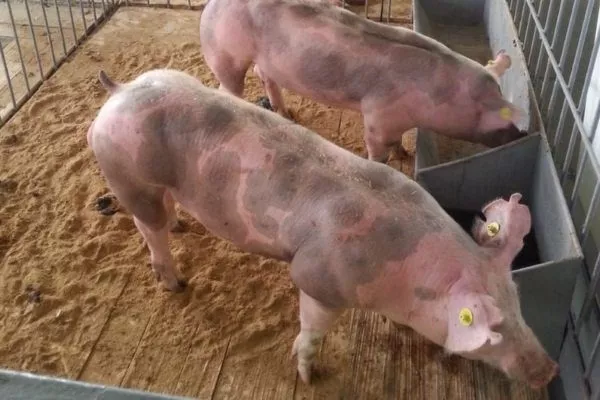
Despite their good meat production, these pigs are not very fertile. Because Piétrain sows have difficulty producing milk, they can carry and give birth to up to eight piglets at a time.
Before purchasing this breed of pig, it's important to familiarize yourself with the care, housing, and feeding requirements. Without proper care, the piglets will either die or not be born at all. Currently, these pigs are kept not only for productivity but also for crossbreeding with other breeds to achieve even greater qualities.
Landrace breeds
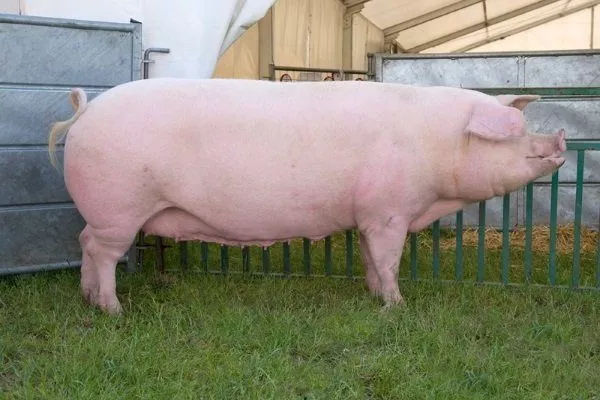
A good meat breed of pig is the Landrace. Males weigh up to 310 kilograms, with a body length of 180 centimeters and a chest circumference of 162 centimeters. Females weigh up to 260 kilograms. This breed can be identified by its appearance: a long body, large ears drooping over the eyes, thin skin, and sparse white bristles.
Productivity of Landrace pigs
Landrace pigs are distinguished from other pigs by their high productivity, with a meat yield of 70% per carcass. The fat layer is thin—about 20 millimeters. A sow can produce approximately 10 piglets at a time. These pigs mature early, with a daily weight gain of 800 grams.
Advantages and disadvantages
This breed of pigs has its advantages and disadvantages, among the advantages we can note:
- mobility;
- rapid growth;
- high development rates;
- endurance;
- high quality meat.
Now about the disadvantages:
- very timid, which may result in disturbances;
- wiggling of the butt;
- the sides are weak.
Care and maintenance
To ensure good productivity and good farrowing, the pigsty must be properly set up, cleaned regularly, the animals must be fed properly, and the water must be changed as needed. This breed of pig is very clean, so if sanitary standards are not met, they may become ill.
Breeding
This breed was developed in Denmark in the 20th century. The selection process was rigorous, seeking the fastest maturing and meatiest animals. Ultimately, an English pig breed was crossed with a Danish one, resulting in the Landrace breed.
Breeders claim that crossing Landrace with another bacon breed produces excellent offspring. The piglets are unique in that when fattened to over 100 kilograms, meat production increased by 3%.
Breeding Landrace sows is not an easy task, as sows and young animals are very demanding. Even the slightest deviations in feeding or housing can affect fertility, conception, and other performance indicators.
Vietnamese pigs
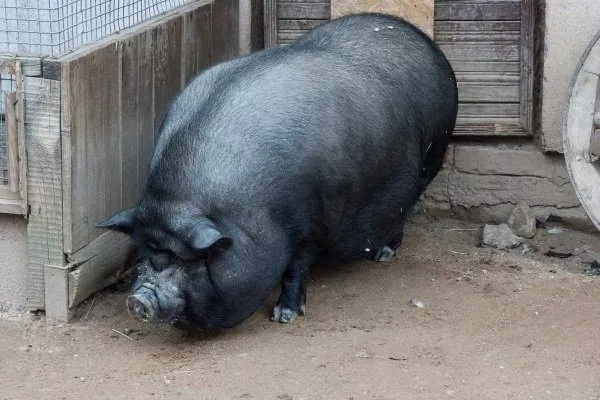
The Vietnamese pig breed is also considered a meat breed, but its production is not as high. This breed matures early and is highly fertile. Sexual maturity occurs at 4 months, and after 4 months, a sow can produce her first litter of up to 20 piglets. She can continue to give birth for 18 years, producing approximately 24 piglets per year.
Productivity
Slaughter for meat occurs at eight months of age, when cholesterol is still absent, and the meat is very tasty and sells quickly. This superior taste is due to the good digestibility of plant-based foods.
Advantages and disadvantages
Every pig breed has its own advantages and disadvantages. The advantages of the breed are:
- rapid ripening;
- high fertility;
- high quality meat;
- unpretentiousness to food;
- disease resistance;
- calm character;
- quick payback.
Flaws:
- don't like drafts;
- Any feed will not do, you need to choose only feed for Vietnamese pigs;
- The sow feeds her piglets for a long time, and therefore becomes exhausted.
Care
Before purchasing a Vietnamese pig, you need to prepare a dry, clean area for it. This breed is easy to keep, and since they are small, a pigsty can become a whole farm. In the summer, the pigs need to be exercised; for this, an area of one hundred square meters (100 square meters) per adult pig should be set aside. Logs should be dug into the ground in the exercise area for the pigs to rub their backs against.
Vietnamese pigs are extremely clean, and when in the range, they relieve themselves in only one corner. If access to the range is not immediately possible, they will defecate as long as necessary. The area must be kept clean. The pigs' water must be kept clean at all times..
Pigs and piglets should be fed grass, and they will eat any grass in large quantities. Their daily diet should include wheat, barley, oats, peas, and corn, but not in pure form, but in porridge form. If dry grains are fed, they must be ground first.
Breeding
The main rule for producing healthy and viable young is that the boar should not be related to the sow, especially if the animals are being bred. Generally, pigs of this breed mature quickly, but the sow should be bred to the boar if she weighs less than 30 kilograms.
The following signs can help you determine if a sow is ready for mating:
- the sow is worried;
- the genital loop becomes swollen;
- discharge appears;
- If you press on the croup, the pig does not move from the spot, but listens to the sensations.
Hampshire breed
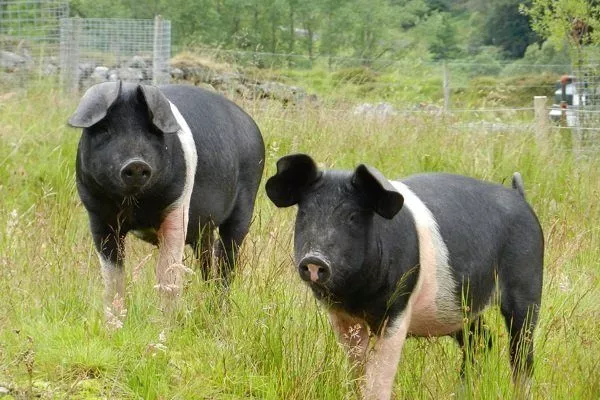
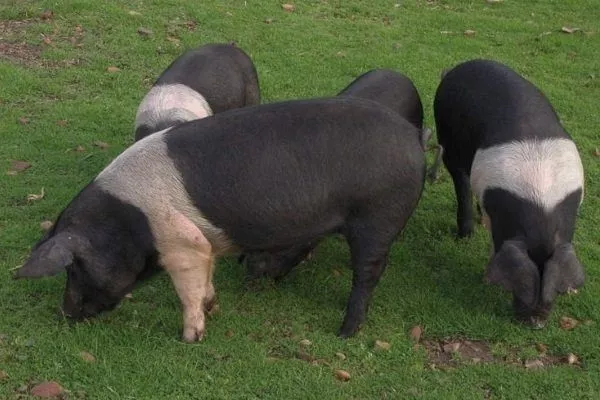
Another meat breed is the Hampshire pig. Hampshire pigs are most effective when crossed with other breeds to produce a new bacon breed. The main distinguishing feature of this breed is its solid black color, but it must have a wide stripe encircling the body where the shoulder blades and front hooves are located. The head is light and small, with a straight snout.
The ears are small and erect, the body is long, and the back is strong yet broad. The legs are short but strong and powerful, and the hooves are straight. The breed itself doesn't have a lot of meat, but there are key characteristics:
- The animal's size is medium, although compared to other meat breeds, this breed is at the top. A boar can reach 310 kilograms live weight, and a pig 250 kilograms.
- Young piglets are quite strong, but they still gain weight slowly until they are 8 months old, but after that they grow rapidly.
Productivity
This breed's productivity is very low; higher yields can be achieved by crossing it with other breeds. Creating hybrids produces a different meat quality. Today, Hampshire pigs are actively crossed with other breeds, resulting in the constant use of their hybrids as a commodity.
A sow can give birth to around 8 piglets at a time, with some sows having 10 or even 12 piglets. Because sows are so attentive mothers, piglet mortality is virtually nonexistent, and piglet weight gain is higher than in other breeds.
Advantages and disadvantages
Any breed of pig has both advantages and disadvantages, among the advantages we can note:
- endurance;
- have strong immunity;
- not prone to diseases;
- well developed maternal instinct;
- the meat is long with a thin layer of fat;
- large daily weight gain.
Flaws:
- low fertility;
- increased excitability;
- low quality meat.
Breeding
Breeding this breed is advantageous because it adapts well to any weather conditions, withstanding both cold and hot weather. With proper feeding and care, the pig will always perform well.
The advantage is that they can be left to graze all day long in open or closed pastures. A pig's carcass consists almost entirely of meat, with a very thin layer of fat. With high-quality, balanced feed, daily weight gain can reach as much as 900 grams.
The downside of pigs is that they are very skittish; any fright can even lead to weight loss and developmental delays. Therefore, it's important for them to have a calm environment, free from irritants and loud noises.
Sows have a low fertility rate, typically producing 8 piglets at a time, though in rare cases this number can reach 10 or even 12. Despite this, they are excellent mothers, capable of feeding any number of piglets and raising them all.
White pig
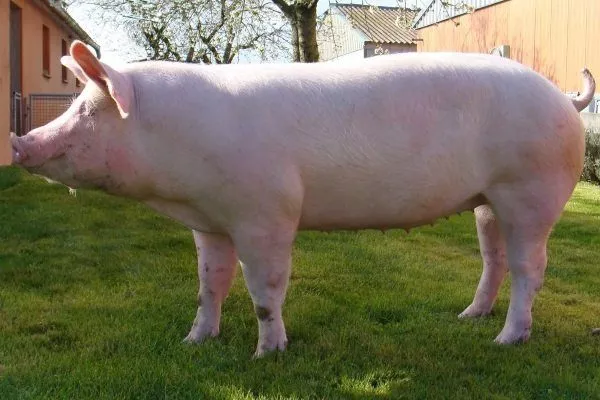
Today, the white pig is the most common breed throughout Russia. This animal adapts well to any climate. White pigs easily adapt to any climate and are also easy to care for and feed. However, they do not tolerate severe frosts or extreme heat well.
Pigs can be fattened for both lard and meat, or they can be raised to produce equal amounts of both. They have a light build, strong bones, and a white coat. A boar's body is 190 centimeters long, while a pig's is 165 centimeters. The head is large, the forehead broad, and the neck thick and receding. The ears are thin and not drooping, but tilted forward.
The chest is deep and fairly wide, the back is long and broad, the rump is not sagging, and the hams are round. White pigs are not very tall, their legs are strong, and their hooves are straight and wide. The skin is elastic yet firm, without folds, and the bristles are thick but fine.
Productivity
This breed belongs to the meat and fat category. An adult boar can weigh up to 330 kilograms, while a sow can weigh 230 kilograms. A sow can give birth to up to 12 piglets at a time, with a milk yield of 90 kilograms. The piglets gain weight rapidly, reaching 20 kilograms by two months. The meat yield is high – 80% per piglet.
Advantages and disadvantages
White pigs are profitable to breed because they have many advantages:
- endurance and adaptability to various weather conditions;
- early maturity;
- good fertility;
- the meat is tasty;
- high yield of meat and fat;
- flexible structure.
But they are not so ideal, as they also have disadvantages:
- tendency to obesity;
- unpleasant appearance;
- pendulous sacrum;
- the ham is poorly defined.
Care and maintenance
Pigs are prone to obesity, so it's important to feed them properly. During the spring and summer, pigs should be left out to pasture all day, where they will readily graze on lush grass, and vegetables are a good supplement. Additionally, you can add compound feed, fruit, and cabbage if desired. Pigs should have constant access to water, and in winter, they can be given snow.
The pigs' stalls must be free, dry, and, most importantly, clean. Drafts are unacceptable, and ventilation is essential in the summer.
Breeding
White sows are highly fertile, capable of producing 12 piglets at a time, yielding up to 60 kilograms of milk. Two-month-old piglets weigh 5 kilograms, and by 190 days, they reach 100 kilograms.
Breed of barbecue
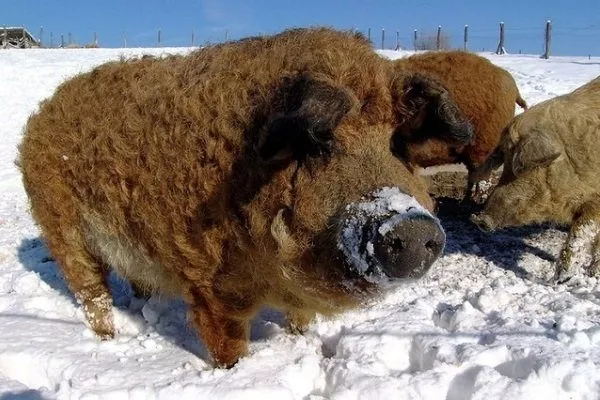
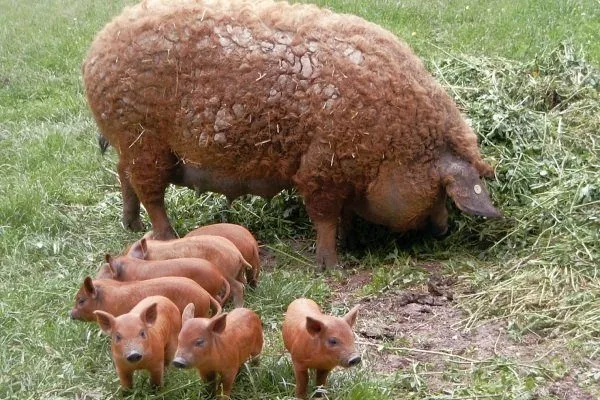
In the 21st century, specialists developed a new breed of pig, the Mangal, with a distinctive feature: wool. Mangals are hard to confuse with any other breed, as their coat is thick and curled like that of sheep. This thick hair allows the animal to easily withstand severe frosts and, in the summer, protect itself from pesky insects. Mangals can be classified into four types by color:
- black;
- red;
- white;
- mixed.
The black type of barbecue is practically no longer available.
Mangals are on the verge of extinction; there are very few of them left in the world, but the meat of these pigs is incomparable to anything else; it is the most delicious, tender and juicy.
There are many types of meat-producing pigs, each with its own characteristics, advantages, and disadvantages. Many breeds are easy to raise, even at home, even without experience. The meat yield from these breeds is approximately 80% per carcass. If you decide to raise a specific breed of pig, you should first familiarize yourself with it before proceeding with its care and feeding.
Productivity
A pig's live weight can reach up to 200 kilograms, while a wild boar's can reach up to 300 kilograms. The largest recorded boar weight was a whopping 500 kilograms. Marbled meat is of high quality and delicate in flavor, but they also produce fat, which is 5 centimeters thick when the pig is 8 months old, and by 10 months, the fat layer reaches a full 10 centimeters.
Advantages and disadvantages
The Mangal breed of pigs has the following advantages:
- high meat productivity;
- unpretentious in feeding, they can eat even the cheapest food;
- simplicity of maintenance;
- resistance to temperature changes;
- precocity.
Now about the disadvantages:
- the breed is rare;
- To purchase it you need to have a lot of money.
Care and maintenance
These pigs need freedom to roam, and the area where they will graze must be securely fenced to prevent access by dogs and other predators. It's important to ensure the area is free of poisonous plants, as they love grass and eat it indiscriminately. While roaming, they should be protected from constant sunlight, so a shelter is a good idea.
In addition to grass, pigs can be fed vegetables, fruits, and food scraps. In the summer, they can browse on succulent grass, but in the winter, this should be replaced with high-quality hay. Newborn piglets begin to receive supplementary feeding on the third day after birth.
Breeding
Breeding these pigs is quite difficult, as Mangals are very rare. Pure-bred piglets are quite difficult to find, and non-purebred piglets, when fully grown, are not as good in all respects. If you are lucky enough to acquire Mangals, they can only be bred once they reach 100 kilograms. A sow can give birth to up to 16 piglets at a time.
Cornish breed
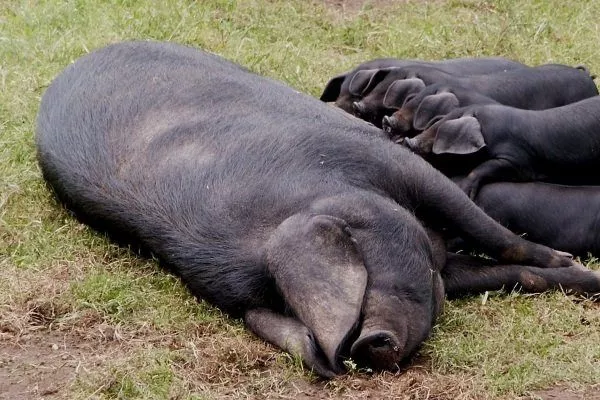
The breed was developed in the UK by crossing English long-eared pigs with Chinese black pigs. They have a strong constitution, an elongated body, and large ears that droop over the eyes. These pigs adapt well to any climate and are easy to care for and feed.
Productivity
The meat is not very fatty and is juicy, possessing excellent flavor. When raised for meat, the fat thickness will not exceed two centimeters. A boar can weigh up to 300 kilograms, while a sow can weigh 250 kilograms live. A sow can give birth to up to 11 piglets in a single litter, and milk production is good, reaching 72 kilograms. By six months, the young piglets already weigh 100 kilograms. The meat yield per carcass is 60-65%.
Advantages and disadvantages
Each breed has its advantages and disadvantages, among the advantages we can note the following:
- strong constitution;
- multiple pregnancy;
- the physique is proportional.
As for the disadvantages, there are few of them:
- many folds on the skin;
- sagging butt;
- When pigs are kept without pasture, their hooves become weakened.
Care and maintenance
Since pigs are large, their exercise area must be spacious. The same applies to the barn; it shouldn't restrict the animal's movement. Furthermore, the pigs' barn should be regularly cleaned to ensure it's clean and dry. As for feeding, they primarily eat succulent grass; vegetables, fruits, and mixed feed can be used as supplements.
Breeding
This breed is often crossed with others to produce a superior strain. These pigs mature early and can be bred as early as four months of age. A sow can carry and give birth to 11 piglets on her own.
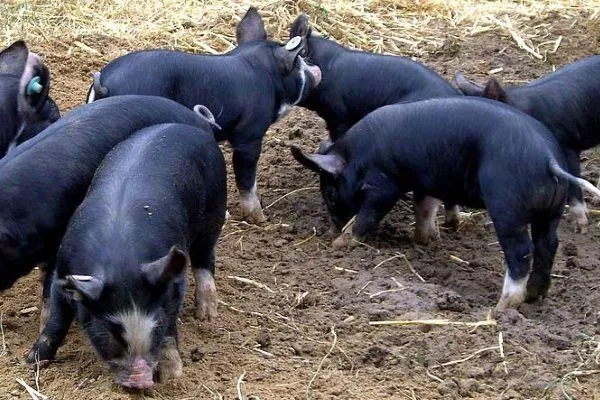
Kemerovo breed
This breed originated in Siberia, making it well-adapted to cold temperatures. The pigs have a strong constitution, a nearly black coat (though spotted patterns are less common), dense bristles, and a long, wide body.
Productivity
Kemerovo pigs are a meat-and-fat breed. Their meat is lean, tasty, and juicy, with little fat, despite being raised for their fat. A boar can reach 330 kilograms live weight, and a sow can reach 250 kilograms. A one-month-old piglet weighs 8 kilograms live, and at six months, 100 kilograms live weight. The meat yield per carcass is approximately 70%.
Advantages and disadvantages
The advantages of Kemerovo pigs are as follows:
- adaptability to any climate;
- endurance;
- high survival rate;
- calm character;
- good reproductive performance.
Flaws:
- demanding in terms of feeding and care;
- sensitive to inadequate or improper diet.
Care and maintenance
Green grass shouldn't be the main diet for pigs; it's important to supplement with fruits, watermelon, and vegetables. In winter, grass should be replaced with high-quality hay. Vitamins and micronutrients in capsules are also important.
They must be kept clean and dry, with no drafts in the pigsty and frequent ventilation. In the summer, pigs need to be allowed to roam freely throughout the day. This is naturally impossible in the winter, so the owner must be mindful of their care and feeding.
Breeding
The piglet survival rate is 90%, and a sow can produce up to 11 piglets at a time. They are fussy about feeding, but their consumption is much lower than that of other breeds. Mating occurs as early as five months of age, but only when the piglets weigh at least 85 kilograms.
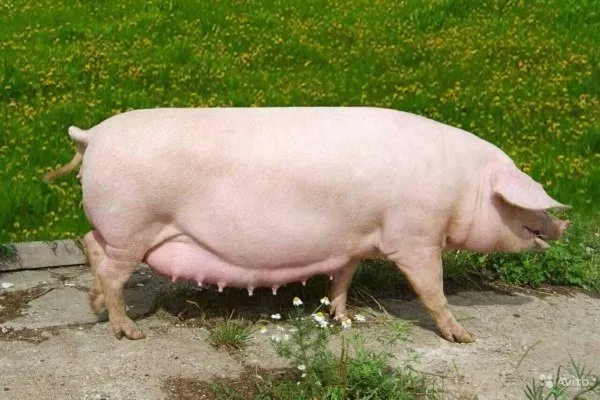
Estonian beef breed
Estonian pigs produce very tender, juicy meat with a pleasant aroma. Wild boars can weigh up to 350 kilograms, while pigs can reach 240 kilograms live weight, with a body length of up to 180 centimeters. At six months, a piglet already weighs 100 kilograms.
Productivity
The meat yield per carcass is 60%, and a sow can give birth to up to 12 piglets at a time, with farrowing occurring independently without human assistance. The meat is marbled and highly palatable, making it especially appealing to those who enjoy tasty and filling food.
Advantages and disadvantages
The following advantages can be noted:
- unpretentious in the choice of food;
- they live easily on pasture alone;
- strong constitution;
- healthy offspring;
- very low mortality rate;
- high quality meat.
Among the disadvantages we can note:
- instability to diseases;
- looseness of the pasterns;
- sagging butt.
Care and maintenance
Pigs of this breed are easy to care for and maintain, thriving even on daily pasture. Naturally, animals won't gain weight on grass alone; it's important to add vegetables and fruits, but they forage for their own food. The pigs' stalls should always be dry and clean, and the space should be ventilated periodically.
Breeding
This breed is often crossed with other breeds to achieve better productivity, but this isn't always successful, often resulting in poor growth, poor-quality meat, and so on. Sows can be bred 24 hours after the sow begins to come into heat. The Estonian sow is a good mother, capable of raising all her piglets without any problems.
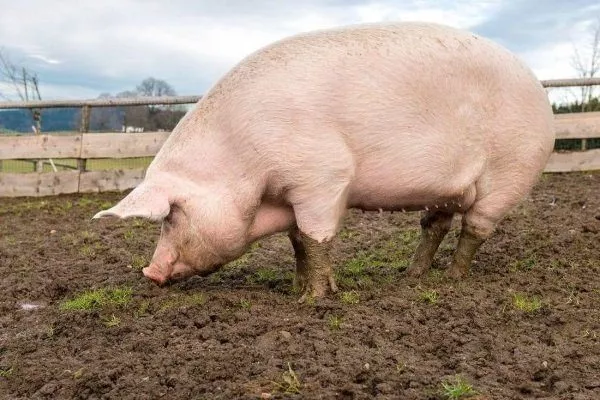
Poltava pigs
A purely Ukrainian breed of meat pig. A boar can weigh 300 kilograms, and a sow 240 kilograms live. They have strong legs and a beautiful appearance.
Productivity
A sow can give birth to 10 piglets at a time, but there have been cases where the number has increased to 12. The piglet survival rate is 95%. The meat yield per carcass is 62%, which has a delicate flavor and pleasant aroma, with very little loss during cooking. Lard has a pleasant taste and is nutritious.
Advantages and disadvantages
Poltava pigs have both positive and negative sides:
- strong build;
- good fleshy forms;
- not picky about food;
- high fertility;
- high immunity;
- high quality meat and lard.
Flaws:
- They gain good weight only in Ukraine;
- if the climate is hot or, conversely, cold, then their productivity deteriorates;
- increased cleanliness.
Care and maintenance
It is unpretentious in care and feeding, it will eat everything that is offered:
- roots;
- vegetables;
- grass;
- fruits;
- porridge;
- food waste.
Pigs accustomed only to the Ukrainian climate will thrive in this country even if kept permanently on pasture. Productivity is entirely dependent on care and management; if the owner provides proper care, the pig will delight with the taste of its meat and its fertility. The pigsty, like that of all pigs, must be clean, draft-free, and constantly ventilated.
Breeding
Poltava pigs are rarely crossed with other breeds, as even purebreds have excellent performance. Sows are ready for breeding at 5 months, and boars at 6 months. For 100% success, mating should be performed twice a day.
There are many breeds of meat pigs, each with distinct appearance, fertility, and feeding and maintenance requirements. Before purchasing a particular breed, it's important to learn everything about it and then make your choice. Some pigs are difficult to keep as pets, while others are ideal for indoor farming.