
Appaloosa horses attract attention with their unique, beautiful appearance, distinctive coloring, and peaceful nature. This horse is easily recognized by its beautiful, even figure and piebald coat. Appaloosas are often entered into competitions, shows, and shows. Appaloosa enthusiasts own several specimens of the breed.
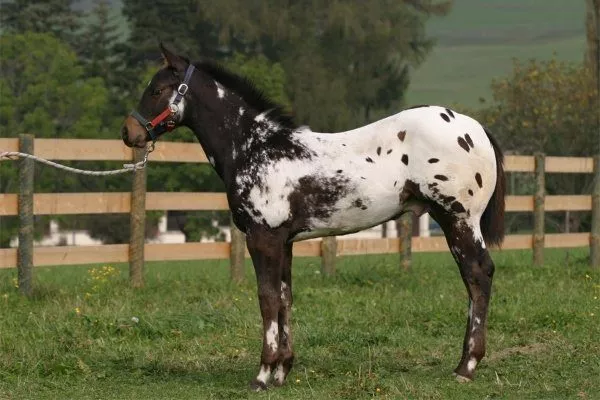
History of origin
The first horses appeared in the American Republic in the 16th century. They arrived there after the discovery of America by the Spanish. The ungulates wandered among the local Indians, where they multiplied, and by the 18th century, virtually everyone living in the North and West had begun riding horses. Spotted horses were imported from Europe, and over time, they were crossed with local horses, resulting in the new Appaloosa breed.
The name "artiodactyls" was given to the horses by settlers who, after the arrival of horses in the Paloosa region, called them "Paloosas." This name was later shortened to Appaloosa.
In 1870, the army began fighting the Indians, and the Nez Perce needed to flee. The horses proved resilient and carried the men for 1,300 miles as they fled the cavalry.
After this, the horses' numbers dwindled, as some Appaloosas were taken by farmers, some by the army, and the rest died. The tradition of "racing" horses faded, and crossbreeding failed to produce positive traits. But in 1938, Claude Thompson officially recognized the Appaloosa horse, and its numbers began to increase.
Spreading
The breed's primary distribution is North America, but each year, individuals of this breed can be seen in various corners of the world. Often, groups are small and used for various competitions.
Appaloosa Horse Data
The height of a fully grown horse is 1.45-1.50 cm at the withers. These measurements are average, so Appaloosas can grow slightly shorter or taller. The maximum height can reach 1.65 cm, but this is very rare. As for weight, this breed ranges from 450 to 500 kg.
Exterior
The main characteristic of this breed is its interesting color and color combinations. The spotted skin is a distinctive feature that identifies an Appaloosa. Appaloosas can have flesh-colored skin without pigmentation or pigmented skin with dark patches.
Appaloosa exterior:
- a beautiful and smooth head with pointed ears;
- muscular neck;
- good understanding of commands;
- unpretentiousness to food;
- courage and friendliness;
- quick learner;
- shortened pumped back;
- round and powerful body;
- muscular lower limbs, hard hooves;
- the tail is set high;
- The tail and mane are soft.
The next key characteristic of the Appaloosa horse is the light sclera (the area around the eye that covers the globe). This is present in all even-toed ungulates, but in Appaloosas, the sclera is more noticeable and lighter than in other breeds. Furthermore, almost all horses of this breed have white spots on their muzzles.
These horses have excellent racing qualities, so if you're planning on owning one specifically for that purpose, the Appaloosa is ideal. They can change tempo and speed quickly and smoothly, without losing their breath.
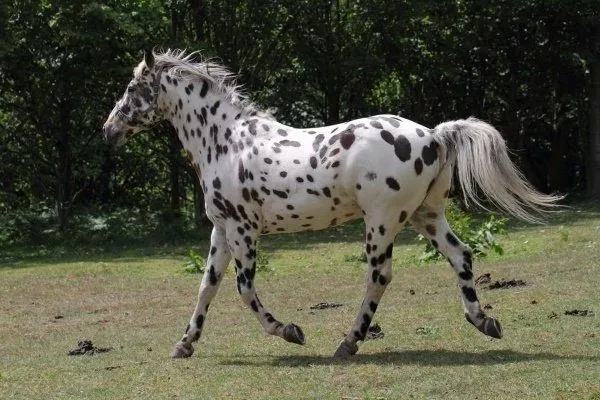
Appaloosa color
| Name | Suit type | Color features |
|---|---|---|
| Cheprak | Basic | White leather with black patches |
| Roan | Basic | Mix of white and colored hair |
| One-suited | Basic | Uniform color |
| Roan saddle | Hybrid | Combination of roan and saddle colors |
| Stains | Basic | Individual spots on the main background |
| Saddle cloth with spots | Hybrid | Saddle cloth with additional spots |
| Roan spotted saddle | Hybrid | Combination of roan, spotted and saddle colors |
There are several colors used for the Appaloosa horse:
- Cheprak.
- Roan.
- Suited.
- Roan saddle cloth.
- Spots.
- Saddle cloth with spots.
- Roan spotted saddle.
There are also hybrids, but they are much more common and don't fit into any category. Newborn stallions are often light-colored, but their skin darkens with age, while gray horses, on the contrary, become lighter.
The exact color can only be determined once a horse reaches five years of age. Then, the final coat can be determined, which can be leopard (white skin with black spots all over the body), marbled (white body with frequent small black spots), saddleback, snow (many black spots directly on the thighs), or frost (a black horse with white spots).
Horse character and lifestyle
Every horse breed has its own personality, including the Appaloosa. Historically, horses interacted with humans, so they are genetically programmed to get along with riders. They are gentle, docile, and not brash, and they are devoted to their owners. A change of owner or rider can cause stress in horses, which can lead to their temperament being revealed.
Horses are not afraid of danger, are quite active and intelligent, and are quick and easy to train. They quickly learn various tricks, which is why they often compete in races. There have been cases where a horse has chosen a single rider and served them exclusively until death. They are docile and good-natured with people.
Nutrition
Appaloosa horses are sensitive to high-quality feed and balanced nutrition.
The table provides a diet for a horse weighing 500 to 600 kg:
| Feed | tons per year | kg per day |
| Hay | 2 | 13 |
| Bran | 1.6 | 1.5 |
| Succulent feed | 1.2 | 3 |
These days, you can find a wide variety of pet food options: compound feed, herbal pellets, root vegetables, and more. The choice of feeding your pet is entirely up to you. Some pet owners prefer to save money and buy store-bought pet food, while others, on the contrary, prefer natural foods.
- Meadow or cereal grain. Grain is the highest-quality feed because it contains many nutrients. It is often mixed with wheat, oilcake, or peas. Some choose traditional feed, while others buy it from specialty stores.
- Hay. During winter, hay is the main source of feed for all horses. To ensure better nutrition, farmers feed hay harvested from several fields.
- Straw. Oat, millet, or corn straw are the best choices. They are often mixed with hay and fed to animals.
- Oats. Oats are most often given pure, without mixing them with other feeds. If the animal has strong teeth, oats are given whole, but if the teeth are weak, they are ground.
- Peas. The daily dose should not exceed two kilograms. Whole peas should not be fed; they should be crushed or ground before being fed to the animals.
- Succulent feed. This category includes tuber and root vegetables, such as carrots, fodder beets, and potatoes. Before offering vegetables to an animal, they must be washed, peeled, and chopped before being fed. Potatoes can be fed both raw and cooked.
- Green. This feeding method is used in the summer. However, after winter, large portions should not be given suddenly; it's best to start with a small bunch and then gradually increase the size.
- Combined feed. Store-bought mixtures contain several ingredients. They can be added to the main diet.
- Drink. A constant supply of clean water is essential. It would be convenient if each stall had a room with a water supply.
Feedings are scheduled at specific times so the animal gets used to it and the digestive tract is prepared in advance. Disrupting this schedule can cause stress.
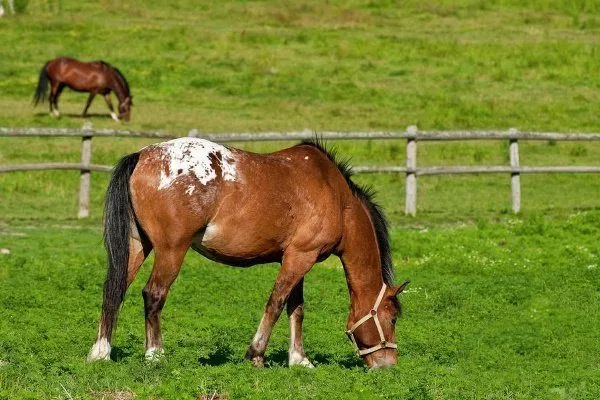
| Parameter | Appaloosa | Average by breed |
|---|---|---|
| Annual feed costs, RUB | 120,000 | 100,000 |
| Frequency of veterinary visits, once a year | 2 | 3 |
Care and maintenance conditions
Appaloosa horses don't require any special care or maintenance; they simply require following a few guidelines. The main criteria are gentleness and restraint. If you love your horse, feed it regularly, clean it, and bathe it, it will serve you well for many years.
- Stable. In the summer, ungulates live outdoors, and in the winter, indoors. The stable must be equipped with stalls: one for eating and sleeping, and the other for the rest of the animal's life. The walls should be constructed of durable materials, and the doors should be sliding. Concrete or stone are the best flooring materials. Straw bedding is essential.
- Cleaning of premises. Before cleaning the stall, the horse should be taken outside, then the feeders and waterers removed. Any urine-soaked bedding should be removed, as should any manure. Afterwards, the entire stall should be swept with a broom and disinfectant. After the floor has dried, new straw should be laid down and clean water provided.
- The appearance of the horse. Before turning a horse out to pasture, it should be thoroughly groomed with a special scraper. If necessary, the horse can be saddled. For grooming, it's best to invest in natural hair tools, such as brushes and mane and tail combs. A hook, which can be used to remove debris from the hooves and other parts of the horse's body, is also a good idea.
- Forging. Hooves must be shod by a skilled craftsman, called a farrier. They know how to properly size and fit a shoe. Different nails are suitable for each horse, and a horse can only be reshoed after six weeks.
Cleaning. Bathing is best done during the warmer months, as in winter, such procedures can lead to a cold. However, if your pet is afraid of water, don't force it. In this case, simply washing it with a hose and shampoo is sufficient.
Don't wash your horse immediately after racing; wait until it cools down and dries. Immediately after racing, cover the horse with a blanket to protect it from hypothermia.
For more information on horse care and maintenance, please visit here.
Breeding
Horse breeding follows a number of rules, and a rigorous selection process begins before the process begins. The animal must be completely healthy, with no behavioral or personality issues. It's preferable for the female to be older than the male when mated. They should be at least three years old; only after that age are their bodies fully developed.
- ✓ Optimal age for the first mating: mares – not earlier than 3 years old, stallions – not earlier than 4 years old.
- ✓ Recommended interval between matings for a mare: at least 1 year to allow the body to recover.
Mating can be accomplished either artificially or naturally. In the former case, the stallion's semen is taken and injected into the mare's uterus. In the latter case, the stallion is brought to the mare between March and July, and the mating occurs.
Diseases
A healthy horse will always look well-groomed and cheerful. Appaloosas are healthy, have strong immune systems, and are adaptable to a variety of living conditions. However, they are still susceptible to injury and certain illnesses, so preventative measures are a good idea.
Leg diseases. The lower limbs are the most vulnerable and require special attention. Although the hooves are strong, the legs still frequently suffer injuries and inflammation, which can hinder a horse's career.
Infectious diseases. Pied pigeons are also susceptible to various infections, but any disease is easier to prevent than to treat. There are a number of preventative measures that can prevent illness, which are carried out every six months.
The first aid kit should always contain:
- Peroxide, alcohol, iodine and brilliant green for bruises.
- Zinc ointment, Vishnevsky, Levomekol.
- Vikasol or aminocaproic acid to stop bleeding.
- Non-steroidal anti-inflammatory drugs.
- Bandage, cotton wool, tourniquet for dressing.
Vaccinations and tests are required every six months or every year. Deworming should be done on the same schedule, and most importantly, the premises should be disinfected.
Purpose, use and price
Appaloosa horses are excellent racehorses because they originated in North America, where Native Americans lived, and they bred for them. They needed a fast, agile steed. Thanks to these qualities, the horses have repeatedly helped people escape from pursuers.
These days, the breed is used in competitions and races. They are fast and at the same time resilient. Furthermore, these horses are endowed with agility, meaning they can quickly change tempo, speed, or whatever the rider commands.
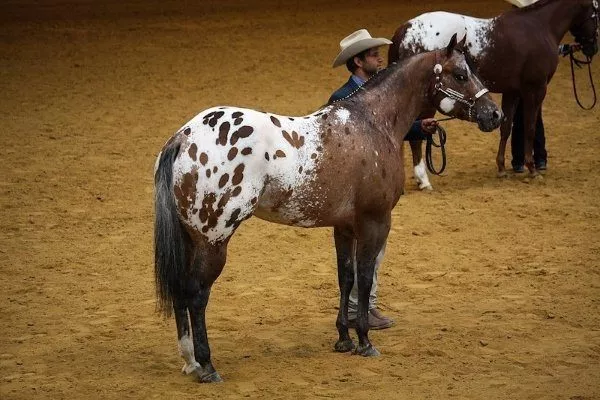
Horses are friendly, kind and smart, they are called mounted, as they are often used in rodeos, racing, jogging, and competitions. They are often hired for family vacations. Appaloosas quickly learn even the most difficult tricks.
Buy a piebald stallion for between 70,000 and 150,000 rubles. Prices vary depending on age, color, and other characteristics.
Measures that were aimed at preserving the breed
No efforts had been made to preserve the Appaloosa breed's appearance until Claude Thompson founded a club where all Appaloosa enthusiasts gathered. Thanks to this, the farmer was able not only to preserve the breed but also to promote it beyond other horse breeds.
Today, there are one and a half million Appaloosa horses, and over time, new foals are born and their number increases.
Famous representatives of the breed
There are famous representatives of the Appaloosa breed in our world, among them:
- Foal Joker. Born in 1941, this renowned horse competed in numerous races, competitions, and shows, always placing first. The colt won his first prize in 1965 in Texas, after which he gained popularity and was purchased for $26,000, a considerable sum at the time. He died a year later at the age of 24.
- Mighty Bright foal. The renowned Appaloosa stallion was born in 1960. He frequently competed in races, competitions, and shows, but unfortunately, his dreams for the future were not realized. At one year old, he broke his leg, but he went on to become a successful sire, helping sire 189 foals. He died at age 14.
- Absaroka Sunset foal. This black and brown Appaloosa stallion was foaled in 1956. He won many competitions, became the most beautiful specimen of the breed, and earned a place on the Appaloosa Club board. He sired 500 foals, some of whom also won races, and one even became an all-around champion. He died at the age of 18.
- Foal Prince Plaudit. Born in 1963, he was repeatedly awarded the title of best sire. He also frequently took first place in competitions and races. The horse was sold for $300,000 and died at the age of 25.
Appaloosa horses have long been known; they were depicted in ancient Chinese and French caves. Today, archaeologists are finding 20,000-year-old drawings of the spotted ungulates.
Interesting facts
Appaloosa horses are fascinating because they are beautiful creatures born with a single color, which can change dramatically over time. For example, a foal is born with a light coat, then sheds heavily over five years, after which they noticeably darken. Dark-colored foals, on the other hand, also shed over the next few years, but develop a lighter skin color.
Horses are predisposed to a condition called uveitis, which progresses very rapidly. If not treated promptly, the horse may go completely blind or even die.
The Appaloosa breed is ideal for calm and quiet walks, as the horse doesn't kick or make sudden movements. Scientists have proven that they inherited little from their ancestors due to extensive selective breeding.
In this video, a farmer discusses the behavior and character of Appaloosas, their care, and feeding. This video also showcases their unusual coloring, herd behavior, and other interesting facts:
Appaloosa horses are among the most beautiful horses in the world, primarily acquired for competitions and shows. They are very quick to learn tricks and are also ideal for family horseback riding.