
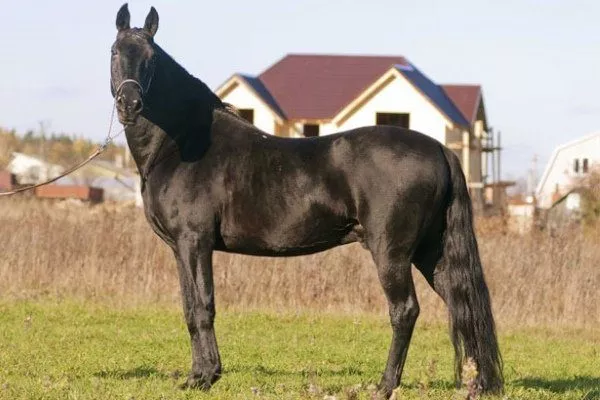
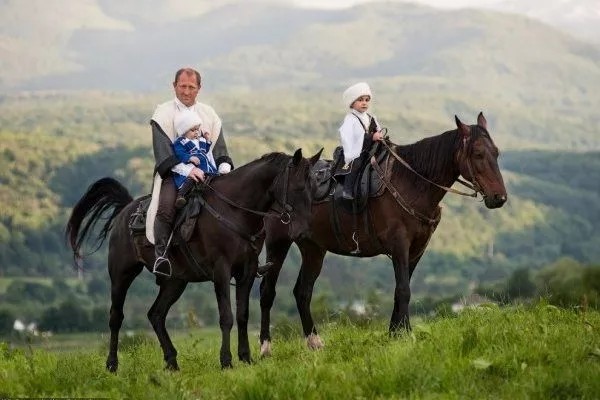
The Karachay horse is one of the most ancient riding and draft breeds. For centuries, these strong and hardy animals helped mountaineers herd livestock, transport goods, and travel between villages. Thanks to its unique qualities, the Karachay breed is experiencing a renaissance today – it continues to be valued, bred, and actively used in a variety of fields.
Historical excursion
The Karachay breed was formed approximately half a millennium ago. Its homeland is the area northwest of Mount Elbrus. The first mentions of the breed date back to the 17th century. The first detailed description of the breed was written by the German P.S. Pallas, who traveled through the Caucasus in 1793.
Horse breeding farms have long existed in the Caucasus. Since tsarist times, the Malkinsky Stud Farm has operated here in Kabardino-Balkaria, and two more stud farms were later built in Karachay-Cherkessia. There was competition between breeders, which was unspoken during the Soviet era.
Breed characteristics
Adapting to the unique characteristics of mountain life, the breed developed unique body biomechanics. For example, the Karachays' front and hind legs are different: the former are straight, like those of ordinary horses, while the latter are bent. Thanks to this unique leg structure, these horses move quickly across rocky mountain terrain. The breed is beautiful in appearance.
Advantages
Compared to other breeds, Karachay horses have the following advantages:
- Adapted to life in high altitude conditions, in particular to thin air.
- Unique endurance – they easily withstand prolonged loads and long treks across mountainous terrain.
- Incredible resilience. The breed has repeatedly been on the brink of extinction, but despite the potential for extinction, it has recovered time and again.
- Undemanding living conditions. These horses, roaming the mountain trails, never lived in stables or received grain forage. Instead, they were accustomed to spending their nights under the stars and living off the grass.
- Adaptation to the mountains. Their unique body structure and biomechanics make this breed ideal for mountain living.
- The strong hooves of the Karachays do not need horseshoes.
The remarkable endurance of the Karachay breed is confirmed by the famous 1936 horse race. The route ran along the Caucasus Mountains. The Karachay horses participating in the race not only demonstrated unprecedented endurance but also served as "bulldozers" for other breeds. The Karachays were always in the lead, clearing a path through the snow for those following behind.
Flaws
This breed has few disadvantages, and they are not critical for mountainous areas:
- They are inferior in speed riding breedsBut the main purpose of the Karachays is mountain trekking, so the downside is natural.
- Aesthetics. This is also a subjective aspect – Karachay horses have no apparent flaws in appearance, but there's nothing remarkable about them, no particular grace, no obvious nobility of line.
The natural conditions in Karachay-Cherkessia are a separate issue. The area where the horses live has such a healthy climate, excellent air, and clean water that, once they reach the city and civilization, these horses begin to get sick. Their bodies can't adapt to the polluted air, and respiratory diseases begin.
Scope of application
The Karachay breed is irreplaceable in mountainous areas, it also finds use in:
- breeding selection;
- equestrian sports;
- equestrian tourism and hunting;
- hippotherapy;
- transportation of goods;
- military service;
- circus programs;
- rental.
Exterior of Karachay horses
Exterior features of the Karachay breed:
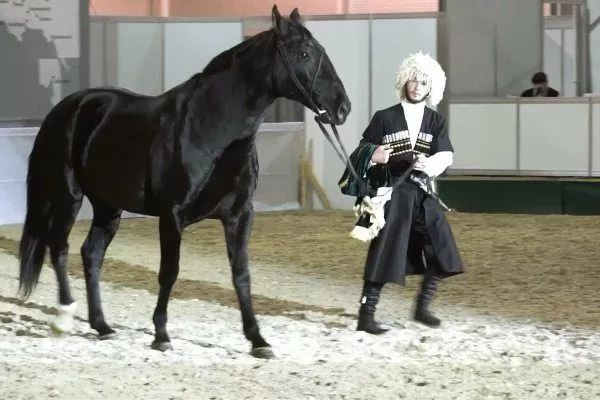
- squat and lean body;
- muscular body;
- head of medium size, slightly elongated;
- in profile there is a characteristic hump;
- ears are small, pointed;
- long mane - often wavy;
- broad and strong chest;
- the color is most often black and brownish, but there are others - the Karachay breed has about 40 shades, and each has its own name;
- height at withers - 142 cm;
- pronounced bony structure of the frontofacial lobe;
- neck of moderate length and medium muscle;
- the straight neck flows smoothly into the straight line of the back;
- the loin is strong, and the wide croup is slightly lowered;
- legs of medium length, with correct positioning, sometimes a slight clubfoot is observed;
- The mane and tail are moderately fluffy.
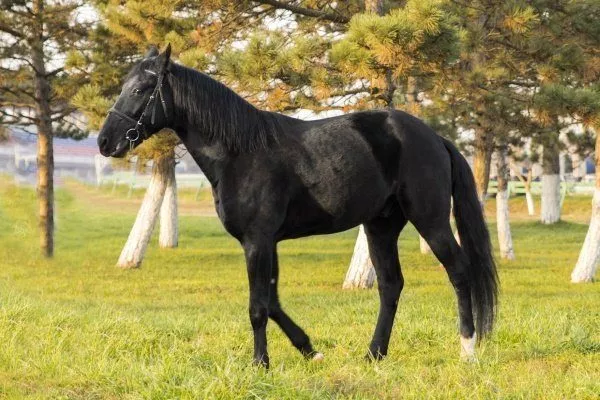
In the old days, when horse breeders belonged to different clans, several families were distinguished within the breed, which were determined by color:
- Kubanovsky - red;
- Boycharovsky - bay;
- Bairamukovskys - gray.
The breed is popular not only in the Caucasus but also in Europe. It is bred, in particular, at Czech and German stud farms.
Genealogical lines of stallions
The breed is divided into eight male lines, six of which were developed by private breeders. The genealogical lines were established in the late 1920s. Among the most notable is the Dausuz line. This black stallion passed on the following traits and qualities to his descendants:
- massive body;
- strong constitution;
- fertility;
- performance.
A separate line developed from the Dausuz line, started by the Karachay stallion Dar, and then Dubochek took over, producing horses that grew taller and acquired a riding habit. Another famous breeding line was founded by the Karachay stallion Borey, whose representatives were particularly large. Horses from the Kobchik line are lean and spirited, and perform well under saddle.
Karachay stallions pass on their traits well through their lineage, with Orlik's descendants displaying a strong build and endurance. The stallion Argamak passed on riding traits through his lineage—his tall stature and long legs. One of the most valuable lines of the Karachay breed descended from a stallion named Louvre. This line—large, efficient, and prolific—completed the breed's genealogy.
Karachay horses are excellent breeding stock. They are prolific, and their offspring have a high survival rate. The breeding line characteristics are listed in Table 1.
Table 1
| Tribal line | Peculiarities |
| Dausuz | The most common line. Distinguishing features:
The most common color is black. |
| Borey |
The offspring easily pass on the characteristic traits of the line when crossed. |
| Kestrel |
|
| Eagle |
|
| Argamak |
The most common color is bay. They have won many sporting awards. |
| Pledge |
The most common color is bay. |
| Arsenal | The group is bred by combining with descendants of the Dausuz line. |
The percentage of breeding lines in the total number of livestock in 1993 is shown in Table 2.
Table 2
| Tribal line | mares | stallions | number of heads | % | ||
| number of heads | % | number of heads | % | |||
| Argamak | 11 | 8.5 | 41 | 8.3 | 52 | 8.3 |
| Atlas | 7 | 5.4 | 35 | 7.1 | 42 | 6.7 |
| Borey | 15 | 11.5 | 74 | 14.9 | 89 | 14.2 |
| Dausuza | 21 | 16.2 | 54 | 10.9 | 75 | 12 |
| Oak tree | 32 | 24.6 | 92 | 18.6 | 124 | 19.8 |
| Zurab | 14 | 10.8 | 61 | 12.3 | 75 | 12 |
| Kestrel | 10 | 7.7 | 53 | 10.7 | 63 | 10.1 |
| Orlik | 8 | 6.2 | 22 | 4.4 | 30 | 4.8 |
| Lock-Sen | 7 | 5.4 | 38 | 7.7 | 45 | 1.6 |
| Historian | 5 | 3.8 | 5 | 1.0 | 10 | 1.6 |
| Other | — | — | 20 | 4.0 | 20 | 3.2 |
| Total | 130 | 100 | 495 | 100 | 625 | 100 |
Representatives of various lines are frequent participants and winners of various shows. Breeding work continues, as breeders strive to produce horses for competition and agricultural work.
Karachays are excellent herd animals. They are long-lived and rarely get sick. The breed is widely used in military service, hunting, tourism, agriculture, and sports.
Intrabreed types
| Name | Height at withers (cm) | Body length (cm) | Pastern girth (cm) | Chest circumference (cm) |
|---|---|---|---|---|
| Horseback | 152 | 154 | 19 | 180 |
| Massive | 148 | 154 | 19 | 185 |
| Characteristic | 150 | 156 | 19.1 | 183 |
In the old days, Karachay horses were small, lean, very agile, and hardy. Over time, through extensive selective breeding, the breed's representatives became larger and more efficient, while retaining all the valuable qualities of mountain horses. Three types of Karachay horses are distinguished within the breed; their characteristics are listed in Table 3.
Table 3
| Type | Height at withers | Body length | Metacarpus girth | Chest circumference |
| Horseback | 152 | 154 | 19 | 180 |
| Massive | 148 | 154 | 19 | 185 |
| Characteristic | 150 | 156 | 19.1 | 183 |
Features of intrabreed types:
- Character horses. They have a riding and harness build. These specimens best match the breed standard. They are used under saddle and in harness.
- Horseback. Typically, these individuals possess only one-eighth the bloodline of purebred riding horses. Karachay riding horses are distinguished by their height and lean build. They are prized for their riding abilities and are widely used for tourism and in competitive sports.
- Massive. They are distinguished by their short stature. These individuals have a broad, elongated, and bony body. They are usually used in harness for transport. They make excellent packhorses and are also often used by shepherds. They are very undemanding and can withstand any weather conditions.
Popular suits
| Name | Number of heads (stallions) | Number of heads (mares) | Percentage (stallions) | Percentage (of mare) |
|---|---|---|---|---|
| Gray | 0 | 4 | 0 | 0.8 |
| Redhead | 0 | 3 | 0 | 0.6 |
| Black | 36 | 141 | 27.7 | 28.5 |
| Karakova | 4 | 16 | 3.1 | 3.2 |
| bay roan | 1 | 11 | 0.8 | 2.2 |
| Dark bay | 35 | 94 | 26.9 | 19 |
| Light bay | 1 | 9 | 0.8 | 1.8 |
| Bay | 53 | 217 | 40.8 | 43.9 |
The basic color of the Karachay breed is dark. The most common colors are black and bay, with the latter having many variations. Gray, chestnut, and dun specimens are less common. White markings are almost never seen in Karachays. The percentage of popular colors among Karachay horses is shown in Table 4.
Table 4
| Suit | Stallions | Mares | ||
| number of heads | % | number of heads | % | |
| Gray | — | — | 4 | 0.8 |
| Redhead | — | — | 3 | 0.6 |
| Black | 36 | 27.7 | 141 | 28.5 |
| Karakova | 4 | 3.1 | 16 | 3.2 |
| bay roan | 1 | 0.8 | 11 | 2.2 |
| Dark bay | 35 | 26.9 | 94 | 19 |
| Light bay | 1 | 0.8 | 9 | 1.8 |
| Bay | 53 | 40.8 | 217 | 43.9 |
| Total: | 130 | 100 | 495 | 100 |
Care and maintenance of the breed
Karachay-Cherkessia is a mountainous republic with very little grazing land. In the summer, horses are grazed on mountain pastures; in the winter, they are taken to the foothills. Agriculture is undeveloped here, and forage feeding has never been practiced. Grass is the only food available to horses.
Harsh conditions have hardened the local horse breeds. Thanks to natural selection, Karachay horses are exceptionally hardy. Modern management of Karachay horses is close to the historical traditions. Horses in the Caucasus are not pampered. This tactic preserves the breed's best characteristics—easiness and endurance.
Feeding
Horse breeders note that the Karachay breed responds very well to proper conditions and high-quality feed. Each breeder or owner chooses their own diet – they can keep their horses on pasture or feed them nutritious feed. However, even horses fed on pastures are recommended to be supplemented with:
- vegetables;
- legumes;
- oats;
- millet straw.
When kept in stables, Karachays are recommended to have a balanced diet:
- meadow hay – 60%;
- fresh vegetables – 30%;
- concentrates – 10%.
To help your animal digest food better, it is recommended:
- mix crushed grain with chopped straw;
- give vegetables chopped into large pieces.
Lactating mares kept in stalls are given boiled beets and potatoes to improve lactation. Stallions used for transport or endurance and speed competitions are given daily:
- mixed grass hay – 50%;
- beets, carrots and chopped potatoes – 10%;
- concentrates – 40%.
To help horses develop healthy skeletal and muscular tissue, they are fed fish oil, oilcake, and bone meal. Other factors to consider when feeding:
- the horse should receive 50 liters of water per day;
- succulent feeds are supplemented with vitamin supplements and concentrates;
- The food must be of high quality and free from mold or insects.
Stable keeping
Rules for organizing a stable:
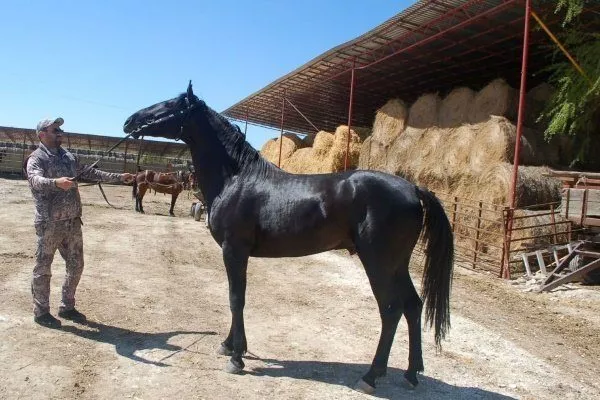
- For an animal to feel comfortable in a stall, 4 square meters is enough.
- Sawdust is scattered on the floor. The bedding is changed daily.
- A thorough cleaning of the stable is carried out once a week.
- The room should be free from drafts, strong odors, and changes in temperature and humidity.
- The stable should be disinfected from time to time to prevent the growth of dangerous bacteria.
Vaccinations
The Karachays need winter and summer pastures, which should be located near villages, in areas protected from the winds. Animals must be examined and vaccinated by a veterinarian twice a year:
- After returning from summer pastures.
- Before going out to spring pastures.
Recommended vaccinations:
- from anthrax;
- from dermatophytoses;
- against flu;
- against leptospirosis;
- from rabies;
- from tetanus.
Stages of breeding the breed
This horse breed began to be actively bred in Russia as early as the 18th century. Subsequently, there were declines and renewed attempts at active breeding, which are described below.
Breeding before the 20th century
Karachay became part of the Russian Empire in 1828. At that time, the Karachay breed was numerous. The horses were actively used by Cossack troops, and Karachays formed the backbone of the fighting horses.
Breeders bred horses specifically for the "Cossack saddle"—they were intended for the Kuban Cossacks. These horses stood 151 cm tall—this was their main distinguishing feature. Due to high demand, Karachay horses cost 150 rubles—a considerable sum for the time.
Karachays were also used as mountain packhorses. They were used by travelers and soldiers to transport cargo along mountain trails.
Due to the shrinking of pasture land, horse breeding gradually died out. It was replaced by herd-type horse breeding, where herds were broken up into smaller groups.
Horse breeding was one of the main occupations of the Karachays. Local breeders sold horses to various provinces and supplied Cossack troops. Every year, Karachay breeders sold nearly 10,000 horses.
Breeding in the Soviet Union
After the Civil War, horse breeding in Karachay was nearly destroyed. Thousands of horses were lost in the conflict between the opposing sides. Between 1917 and 1926, the number of horses in the area decreased threefold.
The valuable breed needed to be restored, and that's what the locals did. For a long time, Karachays weren't used as harness horses; they were pampered and protected, rebuilding their numbers. To boost horse breeding in the republic, several Karachay breeding facilities were opened: a stud farm, a breeding state farm, and a state stable.
As the herd grew, the horses began to be sold to collective farms, where they were used for field work and transporting goods. Soon, the breed spread throughout the Soviet Union.
Since 1930, the Karachay Stud Farm has been working to restore and improve the breed. The breed's original appearance had some aesthetic flaws—the horses were short and lanky. Thanks to selective breeding, modern Karachays look significantly better than their ancestors.
Organization of the Karachay State Regional Party
The Karachay State Breeding Center (GPR) was established in accordance with the decree of September 1, 1937. The decree provided for the introduction of breed-specific zoning. The breeds included in the Karachay State Breeding Center are listed in Table 5.
Table 5
| Breed | Stallions | Mares | ||
| absolutely | % | absolutely | % | |
| Karachay | 132 | 66.4 | 2742 | 79.2 |
| Improved Karachay | 28 | 14.1 | 367 | 10.6 |
| Kabardian and improved Kabardian | 17 | 8.5 | 69 | 1.9 |
| Anglo- and Anglo-Arab-Karachai | 10 | 5 | 125 | 3.6 |
| Other | 12 | 6 | 161 | 4.7 |
| Total: | 199 | 100 | 3464 | 100 |
The GPR worked to improve the breed's characteristics in two ways:
- They improved the breed internally by selecting mares and stallions with suitable qualities.
- By infusing the breed with English blood, both Thoroughbred and Half-Blood stallions were used.
By the start of the Great Patriotic War, there were nearly 20,000 head of horses on the region's stud farms. As breeding progressed, the horses' height parameters changed. An example of the adjusted measurements of Karachay horses from 1930 to 1963 is shown in Table 6.
Table 6
| Years | Stallions | Mares | ||||
| height at the withers | metacarpal girth | chest circumference | height at the withers | metacarpal girth | chest circumference | |
| 1930 | 149 | 18.7 | 171.2 | 140.5 | 17.6 | 168.8 |
| 1946 | 157.6 | 20.2 | 188 | 152.4 | 18.4 | 183.4 |
| 1953 | 158.2 | 20.4 | 188.4 | 154 | 18.8 | 186 |
| 1963 | 158.5 | 20.3 | 185.4 | 153.3 | 19.3 | 185.6 |
In the 1930s, the Karachay State Regional Herd occupied a leading position in the USSR's livestock industry. The herd in the Karachay Region, which is geographically much smaller than Georgia, outnumbered its own. Karachay horses were evacuated to Georgia during World War II. Their decline began in 1943, during the purges against the Karachay people.
Deprivation of breed status and restoration of the breed
During World War II, the breed suffered greatly again. In 1943, repressions against the Karachay people began, accusing them of collaborating with the Nazis. Karachay horses were deported to Asia, which had a negative impact on the breed. They began to be confused with the Kabardian breed. However, breeding continued. Horses continued to be used in competitions, shows, and breeding. The breed only regained its official status in the 1980s.
When the Karachay people were repressed, the Karachay breed was also persecuted. It was simply "forgotten," equated with the Kabardian breed. Since 1943, it has been listed as Kabardian in all literature.
After 1990, when the "parade of sovereignties" began, residents of the two republics again couldn't decide on the breed—stallions and mares from neighboring stud farms mated successfully and produced offspring. Visual differences between the Kabardian and Karachay breeds are virtually nonexistent. The distinction exists only on paper—under the heading "breed."
| Parameter | Mountain conditions | Flat conditions |
|---|---|---|
| Survival rate of young animals | 86% | 60% |
| Frequency of respiratory diseases | 5% | 45% |
However, in the late 1980s, the decision regarding the identity of the Karachay and Kabardian breeds was disqualified, and both breeds began to coexist. The Karachay breed was included in the fifth volume of the state stud book, which listed 130 stallions and 495 mares.
To end the debate over which breed is more purebred – the Karachay or the Kabardian – some experts advise returning the Caucasian horses to their original name – “Adyghe”.
Nowadays
Today, the Karachay breed is highly valued by professional and amateur equestrians. These horses are ideal for long hikes, hiking, and hunting. This breed is especially suited for border guard duty in mountainous areas.
Since 2008, the breed has grown to approximately 20,000 horses. Three thousand are the breed's elite, individuals with verified pedigrees. The decision was made to monitor the breed's purity using special genetic markers.
In 2009, the Regulation on the State Stud Book of Karachay Horses was approved, and all the regalia and awards it had won were returned to the breed.
In 2014, the Russian Association of Karachay Horse Breeders and Enthusiasts was established, making it easy for all owners of these remarkable horses to contact. Thanks to the association's work, the breed has been represented at numerous shows in Moscow, St. Petersburg, and Europe.
About the breed's fertility
Karachay mares are widely used for breeding for good reason – they are very fertile. According to statistics, their conception rate is approximately 89%, and the survival rate of young is 86%. Horses of this breed, although characterized by a somewhat late sexual maturity, are considered long-lived. They can be used for breeding for up to 25 years or more. 92% of mares regularly produce offspring.
- ✓ Optimal altitude for keeping: 1500-2500 m.
- ✓ Minimum pasture area per head: 1 ha.
The introduction of stallions to mares begins in late April and continues until September. Then, only one stallion remains with the mares to maintain order. One adult stallion typically manages a herd of 30 mares, while a three-year-old stallion is entrusted with 10-15 mares.
Foals are usually born without human assistance. Newborns remain with their mothers until they reach the spring pasture.
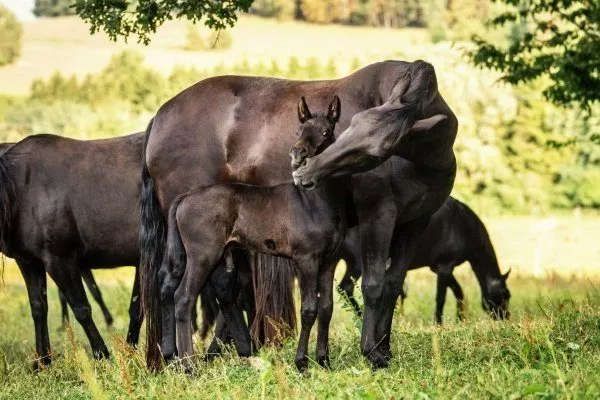
A single adult stallion can breed up to 30 mares per year. Mares must be at least three years old to be suitable for breeding.
Personality traits
Karachay horses appear almost sinister in appearance—their dark coat, angular bony heads, and flowing manes. In reality, they have a character quite appropriate for an aboriginal breed, shaped by the conditions in which they must survive without human assistance. They forage for their own food and make their own decisions.
At the same time, in the mountains, horses are happy to cooperate with humans. True, they don't always understand why they're chasing cows or riding around a fenced enclosure. But horses understand why they need to follow their rider along mountain trails—to get to a pasture or a mountain village.
These character traits lead many to consider Karachay horses stubborn. And this is true. Their obedience is incomparable to that of trained sport breeds, which obey humans without question.
Karachay horses are not vicious; they are intelligent and approachable. Breed experts note that Karachay horses prefer to obey one person once they have chosen them. However, this person won't immediately become a friend—the native horses are extremely distrustful and must first be proven to have the right to make demands.
Breeding prospects
Today, there are 20,000 Karachay horses in Russia. This is a remarkable achievement for a world where the horse has long since lost its status. This breed has always been valued as a pack animal and a military service animal.
Areas of use of Karachay horses:
- Karachay horses continue to be a lifesaver for locals when it comes to traversing mountainous terrain. This breed is capable of traversing trails inaccessible to any other vehicle.
- Shepherds tend their flocks of sheep on horseback. Sheep farming is a vital industry in Karachay-Cherkessia.
- Participation in tourism events. Organizing mountain hikes. Tourism is one of the main sources of income for the republic's budget.
- Service in paramilitary units. The breed is ideal for border patrol in mountainous areas.
- Participation in sporting events. Karachays cannot beat riding breeds in short races, but they can demonstrate unparalleled endurance over long distances.
Given their diverse range of uses, it's safe to say that Karachay horses are versatile, and in some respects, unrivaled. It's no surprise that this breed is in demand and is sold in various regions of Russia.
Along with developing purebred representatives of the breed, work is currently underway to improve it. As demand for racing trotters grows, breeders want to develop a new line with improved riding characteristics. To achieve this, Karachays are being crossed with stallions of riding breeds.
Through systematic selection, horses are created that, while retaining the breed's valuable qualities, are more presentable. Today, one of the most successful stud farms in Karachevo-Cherkessia breeds mares up to 156 cm tall, and stallions grow even taller.
The nuances of sports life
Representatives of the Anglo-Karachay breed have won numerous events, obstacle courses, and style-chasing competitions. The breed is used for long-distance racing, but in races of 100 kilometers or more, purebred Karachays (except for crossbreds with saddle horses, which are faster) cannot compete with Arabian horses.
According to the competition rules, participants must not only complete the distance but also recover quickly afterward. Each stage of the race ends with a veterinary examination. Caucasian breeds cannot withstand the stress that saddle horses can endure. Karachay horses have an excessively long recovery time, making them unable to outrun their rivals. Furthermore, overexertion can cause lameness in Karachay horses.
Karachays, being small in stature and slow in speed, are inferior in show jumping. And due to their unique build, they are unable to win dressage competitions. However, Karachay horses are ideal for amateurs. They are also relatively inexpensive.
Important notes by researchers about the breed
Explorers, scientists, and travelers visiting the Caucasus invariably noted the characteristics of the local horses in their records. The size and capabilities of the Karachay horses were truly astonishing.
In 1973, geographer and zoologist P.S. Pallas visited the Caucasus and described the Karachay horses. He particularly noted their endurance and energy, describing their temperament as "hot." The researcher considered the local horses to possess simply "outstanding" abilities.
In the 1820s, the writer S.M. Bronevsky wrote a description of the Northern Caucasus, in which he noted the unique horses. He noted that the highlanders had an unusually strong and powerful breed of horses. It was Bronevsky who first called these horses "Karachay horses."
In 1829, the Hungarian explorer J.-C. de Besse described the highland horses, calling them "beautiful." He noted that these animals were unrivaled for mountain travel. Besse also noted the breed's exceptional suitability for cavalry.
A breed for highlanders
Horses, now known as Karachay horses, appeared in the North Caucasus in the 14th and 15th centuries. In the Caucasus, they say, "A horse is a man's wings." Horses have always been treated with special reverence and respect. It's no surprise that the breed, bred by the highlanders themselves, is distinguished by unrivaled strength and grace. Each of its qualities is the result of years of natural selection. Life in harsh conditions has become the best breeder, able to create a unique breed adapted to the specific mountain conditions.
Unlike cars, horses were more than just a means of transportation. For the highlanders, horses were a friend and helper, capable of helping out in the most difficult situations. Every young highlander took a unique "course" in trick riding. Today, the tradition of holding trick riding competitions has survived, and riders on graceful black steeds are a magnificent spectacle.
Records and ascents
The maximum speed attained by Karachay horses is 50 km/h. A winter race was organized in the Caucasus in 1936. The distance was 300 km. The route ran along a mountain range. The track presented extremely challenging conditions—the horses had to climb, descend, negotiate passes, and navigate dense thickets. The Karachay horses confidently won the race. Having outrun all competitors, they reached the finish line first, showing no signs of fatigue.
The Karachay breed also holds fertility records. The mare Sadnaya produced 21 foals during her 24 years of life.
The speed record for the Karachay breed was set in 1974. Then the horse managed to cover 3 km in 3 minutes 44 seconds.
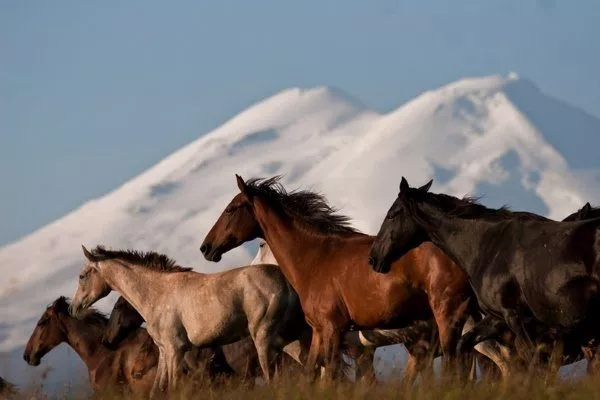
In 1996, Karachay horses set another record by participating in an ascent of Elbrus. The stallions Khurzuk, Daur, and Imbir participated in the climb. By taking the horses with them, the climbers demonstrated the inexhaustible capabilities of the Karachay breed. The horses climbed to the eastern summit of Elbrus, tackling steep slopes and a glacier. The animals were loaded, carrying people and cargo.
Elbrus is the highest peak in Europe, at 5,642 meters above sea level.
In 1999, the ascent record was further broken when horses reached the western summit of Elbrus. The team was almost the same, with only Khurzuk missing—he was replaced by the stallion Igilik.
Karachay horses are true friends of the highlanders. Their unique abilities allow people to feel extremely comfortable and safe in the mountains. This hardy breed is a true treasure of the entire Russian equestrian industry.
The article mentioned that Karachay horses are uncompetitive alongside Arabian horses in long-distance endurance races (100 km or more). However, it's worth noting that a Karachay horse won the 2018 Russian Endurance Championship (120 km), setting a new Russian speed record (averaging 19 km/h). That same year, a Karachay horse took second place in the Russian Cup. Also in 2019, a Karachay horse won the Russian Cup. The competition took place in April in Nartan, Kabardino-Balkarian Republic. The same horse won the North Caucasus Federal District Championship (120 km) in May. This all happened despite the fact that all of these competitions featured the best Arabian, Anglo-Arabian, Arab-Terek, and other breeds found in Russia.
In conclusion, I'd like to note that in 2018-2019, Karachay horses won five 120-kilometer races. It's worth noting that the same horse competed in the competition three times, taking the lead. This information can be verified on the FCSR website. The technical results are publicly available.