
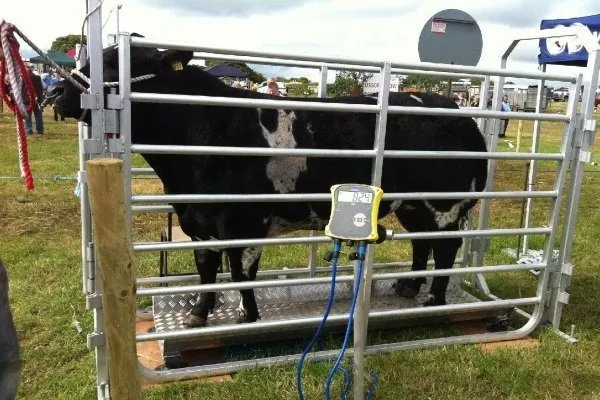
Cattle weight is an important indicator for livestock farmers. It not only relates to the health of the bull or cow, but also impacts future productivity and live weight gain. Based on weight, farmers develop rations and calculate vaccination doses.
What does weight depend on?
The weight of an individual depends on the following criteria:
- floor - bulls are usually 350 kg larger than cows;
- age;
- breed.
In animal husbandry, there are several categories of cattle (cattle) according to weight category:
- select - a bull or cow weighs more than 450 kg;
- first grade - the animal's weight reaches 450 kg;
- second grade - weight is within 400 kg;
- third grade - an animal weighing 300 kg.
An error of 30 kg is permissible for an adult. However, if the weight deviates significantly from the average, this indicates poor nutrition or illness.
The weight of the animal may also depend on:
- climate;
- conditions of detention;
- diet.
Comparison of the influence of factors on the weight of cattle
| Factor | Impact on weight | Possibility of correction |
|---|---|---|
| Breed | The difference between breeds is up to 300-500 kg | Only when choosing a breed |
| Floor | The difference between bulls and cows is 350 kg. | Not adjusted |
| Diet | Up to 30% of potential weight | Full control |
| Conditions of detention | Up to 15-20% of the mass | Full control |
If man cannot influence the climate, he can create favorable conditions for breadwinners.
The barn should be well-lit, quiet, and free of noise. A certain temperature regime must be maintained: for adult cows, the thermometer in the barn should not fall below 10°C, and for calves, 15°C.
Cows should definitely have access to fresh air, but there are some nuances here. For example, beef cows shouldn't be left out in the open for long periods of time. They begin to lose weight, so the optimal solution is to keep them confined to a stall for longer periods. Dairy cows, on the other hand, require long walks in the pasture.
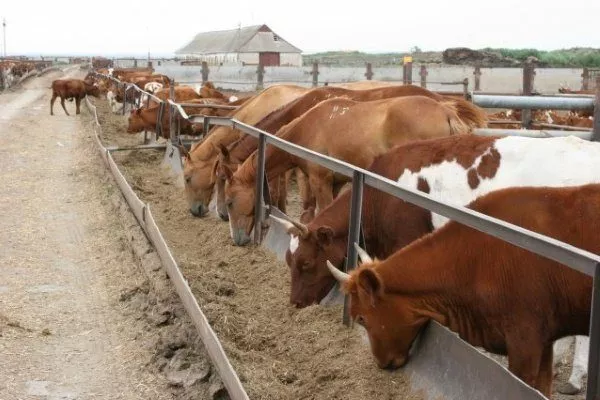
The diet must be balanced and high-quality. Cattle must be fed:
- plant feed (these are succulent feeds - silage, grass, fresh root crops; coarse feeds - hay, straw and concentrated feeds - grain, bran, oilcake);
- animals - meat, fish and bone meal;
- compound feed and feed mixtures;
- Vitamin and mineral supplements are added to food.
Average weight of cattle
A bull is a heavyweight, weighing up to a ton and even 1,600 kg for beef breeds. On average, the scale will tip the scale at 700-800 kg.
The average weight of a cow reaches approximately 350 kg, two-year-olds of meat breeds will be larger - 700 kg or more.
A newborn calf's weight is 10% of its mother's, averaging 40 kg, but it's important to remember that it can vary depending on the parents' breed. After a month, the calf's weight should increase by at least 10 kg, but healthy calves typically double their weight. Young calves should be weighed regularly to detect growth retardation and identify the cause.
Cattle weight depending on breed
In animal husbandry, three types of breeds are distinguished:
- dairy;
- meat and dairy;
- meat.
Comparison of weight indicators of cattle breeds
| Breed type | Weight of cows (kg) | Weight of bulls (kg) | Record figures (kg) |
|---|---|---|---|
| Dairy | 450-600 | 700-900 | Holstein up to 1200 |
| Meat | 550-800 | 900-1200 | Charolais before 1600 |
| Meat and dairy | 500-550 | 800-900 | Simmental up to 1100 |
Dairy breeds produce higher-fat milk, but their meat is less nutritious. On average, cows weigh 500 kg, and bulls 800 kg. The Holstein breed holds the record for heaviest body weight. Cows are impressively large, weighing 800 kg, and bulls weigh over a ton.
Beef cattle breeds gain weight very quickly. They produce higher-quality meat due to their special muscle development. Cows can weigh 550-800 kg, and bulls 800 kg or more, often weighing over a ton.
Dairy and beef breeds are versatile, providing their owners with both milk and meat. Naturally, they will produce less milk than dairy cows and less meat than beef bulls. Cows weigh an average of 550 kg, and bulls around 900 kg.
How often should cattle be weighed?
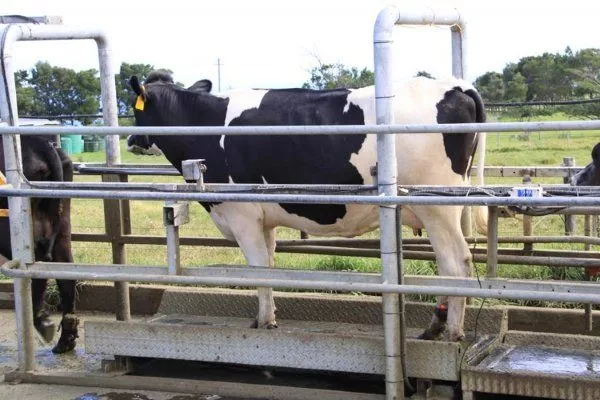
Young animals are weighed immediately after calving, then every two weeks, and then every six months. For adults, this procedure is performed less frequently, but at least twice a year. It is recommended to weigh the animal before the morning meal.
How to find out the weight of an animal yourself?
Not every farmer has scales to weigh livestock, nor the time or money to transport their livestock for this procedure. Therefore, other measurements are often used to determine the approximate weight of a cow or bull with an error of plus or minus 10 kg.
Popular types of weighing:
1Using scales
Scales greatly simplify the weighing process. The animal is brought to the platform, and the scale needle stops at the number corresponding to the animal's weight.
2Trukhanovsky method
For this method, you need to stock up on a measuring device - a centimeter and a rope in case the centimeter is not enough.
First, you need to find out two indicators:
- chest circumference a(cm) - measure the circumference of the chest immediately after the shoulder blades;
- the straight length of cattle (cm), we will designate it as - b — this is the distance from the base of the neck to the base of the tail. Measured with a stick.
Recommendations for measurement accuracy
- ✓ Take measurements in the morning before feeding
- ✓ Restrain the animal during measurements
- ✓ Take 3 consecutive measurements and calculate the average
- ✓ Use a rigid tape measure, do not allow the tape to sag
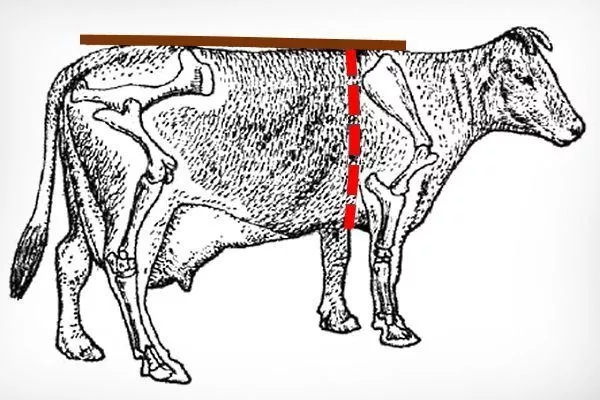
Then the values are substituted into the formula: live weight (kg) = ((a*b)/100)*k,
where k is the coefficient. For dairy breeds k = 2, for meat breeds k = 2.5.
The method's margin of error is 5-7% of live weight, but its advantage is much greater: weight determination can be carried out under any conditions, even on a farm with a large livestock population.
3Kluver-Strausch method
This method also requires measurements, but special tables are used to calculate the mass. This is more convenient since it eliminates the need for calculations.
Two indicators are measured:
- chest circumference (cm), as in the previous case;
- oblique body length (cm) - the measurement is taken from the base of the humerus to the ischial protrusion.
In the table, based on these two indicators, they look for the correspondence of the animal’s weight:
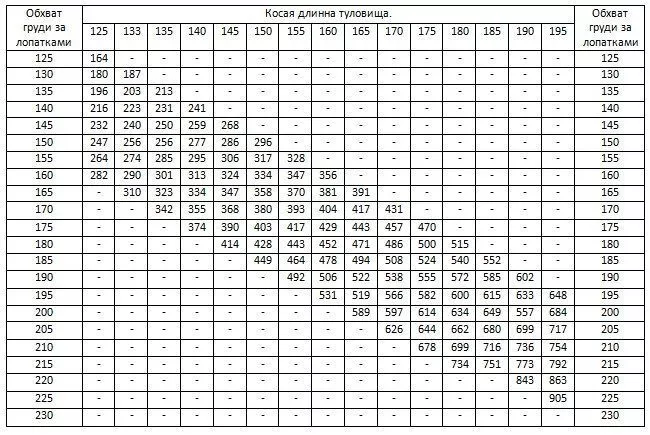
This method helps determine the weight of adult cattle, as their skeleton is already formed. However, it doesn't take into account whether the animal is a beef or dairy breed.
4Indirect methods of calculating mass
In most cases, they have a major drawback: a large margin of error. This can reach 40-60 kg. For example, there's a table for calculating weight based on just one measurement—full chest circumference. This method is only suitable for one breed of cow—Schwyz. For other cows, this option is unacceptable, as the margin of error will be very high.
There's also a specialized tape measure for cattle, which deserves the attention of livestock breeders. It only requires one measurement—the chest circumference, where the ribs end. Then, look up the result in a table. The animal should stand still during the measurement; if it struggles, take several measurements and average the reading. The tape should fit snugly against the animal's skin.
The weight of young calves is calculated differently. To calculate the weight of calves aged 6 months to 2 years, a chart is used that correlates the chest circumference (cm) with the animal's weight. For example, a heifer with a chest circumference of 59 cm will weigh an average of 20 kg, while a heifer with a chest circumference of 100 cm will weigh 84 kg. Livestock breeders should purchase these charts to keep them handy.
There is another table for determining the weight of young animals, which correlates the chest circumference behind the shoulder blades and the oblique length of the body:
| Chest circumference behind the shoulder blades, cm | Oblique body length | ||||||||||||
| 90 | 92 | 94 | 96 | 98 | 100 | 102 | 104 | 106 | 108 | 110 | 112 | 114 | |
| 84 | 54 | ||||||||||||
| 86 | 57 | 58 | |||||||||||
| 88 | 59 | 60 | 61 | ||||||||||
| 90 | 63 | 64 | 65 | 67 | |||||||||
| 92 | 67 | 68 | 69 | 70 | 72 | ||||||||
| 94 | 70 | 71 | 73 | 74 | 75 | 76 | |||||||
| 96 | 73 | 75 | 76 | 77 | 78 | 79 | 81 | ||||||
| 98 | 77 | 78 | 80 | 81 | 82 | 83 | 84 | 86 | |||||
| 100 | 80 | 82 | 84 | 85 | 86 | 87 | 88 | 90 | 91 | ||||
| 102 | 84 | 85 | 86 | 88 | 89 | 91 | 92 | 93 | 95 | 96 | |||
| 104 | 88 | 90 | 91 | 92 | 94 | 95 | 97 | 98 | 99 | 101 | 102 | ||
| 106 | 93 | 95 | 96 | 98 | 99 | 100 | 102 | 103 | 104 | 106 | 107 | 109 | |
| 108 | 99 | 100 | 102 | 103 | 105 | 106 | 107 | 109 | 110 | 112 | 113 | 114 | 116 |
The weight of cows, bulls, and calves can be determined in various ways—directly and indirectly. However, it's important to remember that weight gain varies from animal to animal. This depends on genetic predisposition, breed, and the type of livestock they are used for. When calculating weight using tables and formulas, be mindful of the margin of error. A more accurate way to determine a cow's weight is to use a scale.