
Every farmer dreams of having animals that are profitable and easy to care for and maintain. Simply buy Jersey cows. Although some believe they don't perform as expected in Russian climates, they are still worth keeping due to their high milk fat content.
The history of the Jersey cattle breed
The Jersey dairy breed was created by crossing three breeds. Because the climate allowed the cows to graze on green, lush meadows, they thrived and gained weight quickly.
Jersey cows were crossed with black-and-white bulls, resulting in calves with lower body weight and lower milk yield, but higher milk fat content. In the past, private farming operations began to show interest in Jersey cows, but due to the high cost of the cows themselves and minimal meat yield, they soon became rare.
Their milk produced a high butter yield due to its high fat content. To prevent crossbreeding, the import of any cows to the island of Jersey was banned in 1789. The breed was added to the stud book in 1866, where information on its productivity was recorded. Within six years, it had become renowned in the farming community.
The cows were named Jersey because of their place of birth: they appeared on the island of Jersey between France and England.
This breed is expensive. In 1947, animals were brought from Denmark to the following regions:
- Moscow;
- Novgorod;
- Leningrad;
- Ryazan.
Description and appearance of Jersey cows
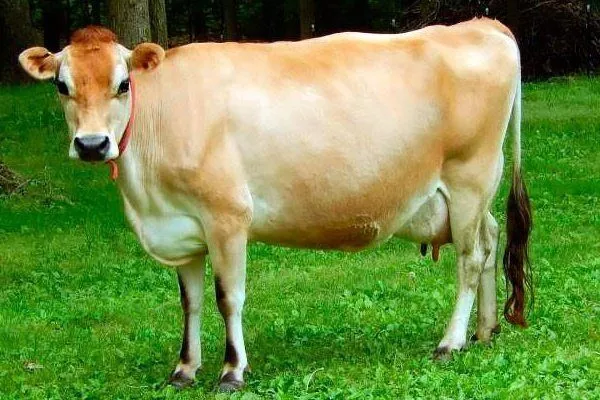
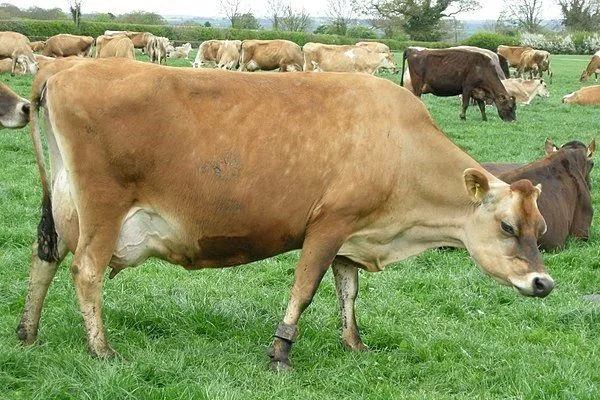
Because Jersey cows are dairy cattle, they don't appear massive. The following characteristics distinguish this breed from other dairy cattle:
- the body is long and proportional;
- short stature (120 centimeters at the withers);
- the weight of an adult cow reaches 450 kilograms;
- the head is small and light, the forehead is narrow;
- the facial bone is short, the profile is concave;
- the neck is thin with a lot of folds;
- the body is flat, the ribs are oblique, the back is concave;
- the tail is raised, the back is not positioned correctly;
- deep but narrow chest;
- The udder is large, bowl-shaped.
One of the important characteristics of the Jersey breed is the animal's color. These cows can be:
- redhead;
- light brown;
- dark brown.
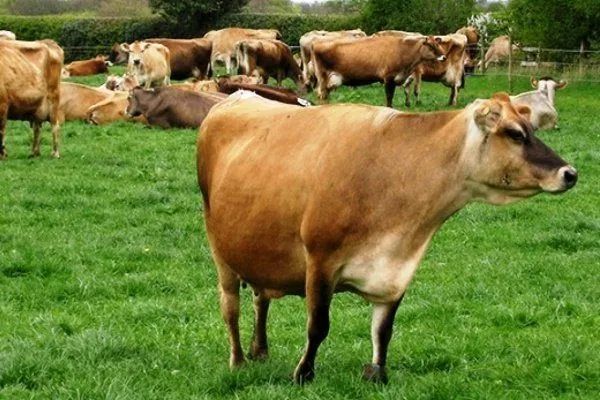
Some cows have white spots on their legs and lower body. Bulls have darker skin on their heads, legs, and necks. There are white hairs around their dark noses, as well as inside their ears.
The animals are playful, curious and kind, but they have a hard time adjusting to new owners, so it is advisable to acquire them when they are still small.
How popular are Jersey cows in Russia?
This breed of cows was brought to Russia in small numbers in the 19th century, but soon disappeared without a trace. In Russia, the milk of these cows is often used to create fermented milk products, such as:
- fermented baked milk;
- kefir;
- cottage cheese;
- yogurt.
The high fat content of dairy products also allows them to produce the most delicious cheeses, butter, cream, and sour cream. Today, this breed is renowned only in the Moscow region; in other parts of Russia, they are quite rare, and only found on private farms.
Feeding and housing conditions in Russia are suitable for both home-based farming and large-scale farming. As has already been established, milk yields are low, making this breed unsuitable for those seeking to sell large quantities of cheap milk. These cows should be kept by breeders who sell high-quality, expensive milk to regular customers or who use it to produce dairy or fermented milk products.
Care and maintenance
On the island of Jersey, where the animals originated, it's always quiet. The cows are used to it, and in other noisy places they become frightened because they're not used to noise. Therefore, it's important to avoid creating noise and fuss around the cows.
Care
Jersey cows graze peacefully from dawn to dusk in any pasture, and they aren't gluttonous. Farmers are pleased that the cattle don't trample everything around them and eat whatever grass is available. They are fed hay, mixed feed, and vegetables.
The barn must always be clean, dry and, importantly, free from drafts.
The room also needs to be frequently ventilated. During winter, the stall should always be stocked with hay, feed, vegetables, and water.
It is important to consult a veterinarian in a timely manner and get all necessary vaccinations.
Jersey cows are somewhat shy, so it's recommended to keep them away from noisy factories, commuter trains, and airports. Jersey cows are rarely crossed with other breeds because they react poorly to non-related animals.
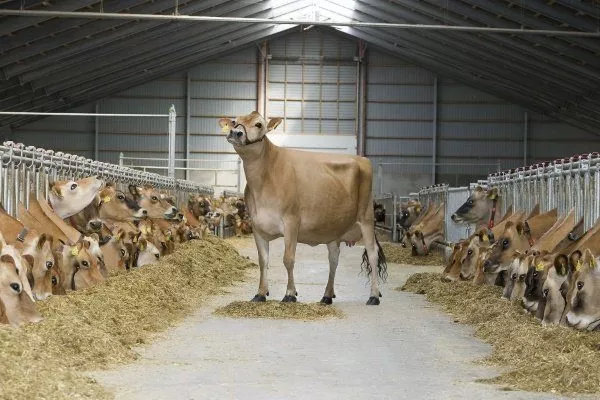
Cows are advantageous in terms of housing conditions, as they only need a standard barn with ventilation and adequate lighting. In winter, it needs to be heated to keep the animals warm, and naturally, the barn must always be clean and dry. Since cows are small, a single barn can accommodate more cows, which also saves space.
Feeding
Cows aren't gluttonous and don't trample pastures, contenting themselves with the amount of grass available in front of them. Due to their small frame and short stature, cows require less supplemental feed than other animals. dairy cows, which allows you to save on feeding.
On the island, cows were fed seaweed, and the land itself is saturated with trace elements found in the water. These beneficial substances wash onto the shores during storms, and over many millennia, the land around the ocean has absorbed them.
Productivity is directly dependent on the quality of feed. Average milk yields of 4,000 liters can increase to 11,000 liters with the addition of high levels of protein to the diet.
The Jersey breed should be fed:
- hay;
- silage;
- straw;
- potatoes;
- rutabaga;
- beets.
The feed is fed depending on the amount of milk - 300 g per 1 liter.
| Period | Hay (kg) | Succulent feed (kg) | Concentrates (kg) |
|---|---|---|---|
| Deadwood | 8-10 | 15-20 | 1.5-2 |
| Milking | 12-14 | 25-30 | 3-4 |
| Lactation | 10-12 | 20-25 | 2.5-3.5 |
| Launch | 6-8 | 10-15 | 1-1.5 |
Hay should be plentiful, 16 kg per head per day. Lump salt should be placed in the barn to replenish missing micronutrients.
Diseases
If animals are properly fed and cared for, their strong immune system will resist disease. Because cows are light in weight and have strong hooves, they are less likely to experience lower limb diseases than other large breeds.
If not kept properly and sanitary and hygienic conditions are not maintained, cows can become ill with any disease that is common to cattle.
To raise a strong and healthy animal, the farmer must take full responsibility and feed, care for and maintain it according to all the rules.
Breeding
The Jersey breed has excellent reproductive performance, as they can give birth to calves as early as two years of age.
Pregnancy monitoring schedule
- Day 0: Insemination
- Day 18-22: Checking for Return to Heat
- Month 2: Ultrasound diagnostics
- Month 5: Monitoring fetal development
- Month 7: Start-up (milking stop)
Calving is very easy, requiring no human or veterinary assistance. However, calves are born small and vulnerable, weighing no more than 22 kilograms at birth. They require proper supervision and care during the first few weeks.
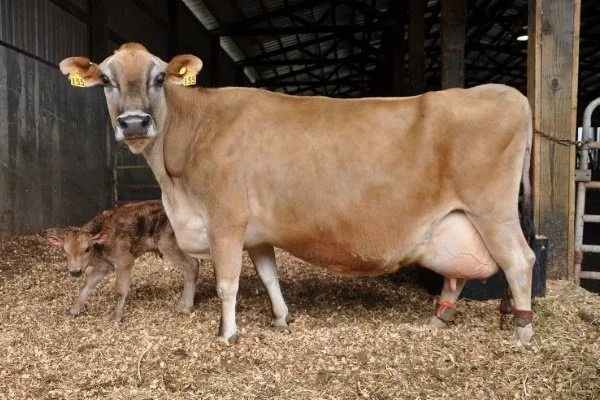
Immediately after birth, the calf should be placed near its mother's muzzle for her to lick. If she is very weak and doesn't do so, the calf should be wiped with straw. After 20 minutes, the calf is wrapped in a warm blanket and taken to another location for a short time, allowing the cow to recover.
Jersey cows produce little colostrum, so it's crucial that the calf consumes it within the first hour of life. A healthy calf will consume approximately 1.5 liters of colostrum.
As soon as the cow recovers from the birth, she should be offered warm water and hay; from this point on, the amount of milk produced depends on the quality and quantity of milk in the future.
- the first 4 days after birth it is necessary to milk 5 times a day;
- for the next 8 days the cow is milked 4 times a day;
- after that, three times a day and gradually reduce the number of milkings to 2 times a day.
Initially, after giving birth, the cow should be fed only compound feed, then nitrates should be introduced gradually. After three weeks, regular vegetables (potatoes, beets) and other foods can be added to the diet. Drinking fluids should be offered twice a day, but if the udder is very swollen, the amount should be reduced.
Productivity
Jersey cows aren't particularly productive, but their 8% fat milk would be the envy of any farmer. Because of their small frame, their milk yield is not small, but not greater than that of some other dairy breeds, and it has a pleasant aroma and delicate flavor. The fat-filled globules dissolve quickly, resulting in a rich creamy milk.
A single cow can produce approximately 4,000 liters of milk per year, and with proper nutrition, this figure can double, sometimes reaching 11,000 liters per year. The minimum fat content of the milk can be 5%, which has a positive effect on all dairy products made from Jersey cows.
Since cows are not large and massive, their main asset is milk, and they produce very little meat.
Care and feeding of Jersey calves
It's important to feed a newborn calf milk, and as much as it desires. The longer the calf nurses, the stronger and healthier it will be.
During the first week, a baby can drink about 3 liters of milk at a time, with three meals a day.
| Age | Milk (l/day) | Hay (kg) | Concentrates (kg) |
|---|---|---|---|
| 1-7 days | 6-7 | — | — |
| 2-4 weeks | 5-6 | 0.1-0.3 | 0.1 |
| 1-2 months | 4-5 | 0.5-1 | 0.3-0.5 |
| 3-4 months | 3-4 | 1.5-2 | 0.8-1.2 |
Between meals, calves should be offered one liter of slightly salted water twice a day.
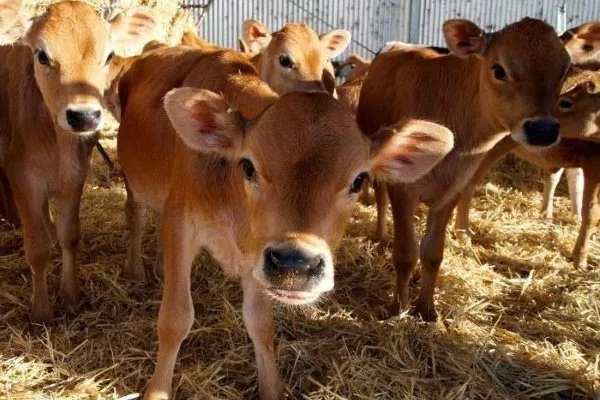
A newborn calf's immune system is very weak, so immediately after birth and until it is one month old, it should be kept warm until it gets stronger.
A week-old baby should be fed clean hay sprinkled with chalk. At one month, they should be fed clean vegetables (potatoes, beets). Then, compound feed is added to the diet, and the amount of vegetables is increased. From two months of age, milk is diluted with water.
Starting at two months, the strengthened digestive system is capable of digesting any food, so don't skimp on hay. It's a good idea to add red clay to the diet (it's very beneficial for both young and mature cows). As for water, don't give too much; 3 liters three times a day is sufficient.
During the first months when the calf is grazing on pasture, the amount of water it receives should be limited; a maximum of 3 liters can be given at a time to avoid digestive tract problems.
More about feeding calves from birth – read here.
Advantages and disadvantages
Reviews of Jersey breeds are generally positive. Among the advantages noted are:
- High-fat milk production. High-fat milk is much more expensive than regular milk, so even if Jersey cows produce slightly less milk than others, their high fat content makes up for it. Their milk also contains a lot of calcium and protein, not to mention fat. If the farm produces high-fat butter, the benefits are even greater.
- They don't require much space. Because cows are compact, they don't take up much space, and a single barn can accommodate more animals.
- Saving on feed. Because their body type is small, cows don't eat much feed. This isn't noticeable in the summer, as they graze on pastures, but in winter, you can save a lot on feed.
- Their low maintenance requirements are another positive aspect of these animals: they can live in the most ordinary barn.
- No problems with calving. Due to the cows' small size, calves are also born with low birth weights. A heifer is capable of delivering her calf on her own, without human assistance, but the calf will require some initial supervision.
- Good reproductive function. Jersey cats fertilize easily and always give birth to live, healthy, and strong babies.
- Absence of mastitis and other diseases. The breed is not predisposed to illness; cases of animal illness are very rare. Hoof problems, especially lameness, are also excluded.
As for the downsides, they are not trivial, and it is for these reasons that farmers change their minds about purchasing this cow:
- Low milk yield. High milk fat is a given, but if a farm recruits cows for pure milk, the yield is low compared to other dairy breeds. Therefore, the low milk yield can only be compensated for by the high fat content.
- Low meat yield. Livestock farmers are accustomed to the idea that a single cow can produce not only high milk yields but also a lot of tasty beef. This is not the case with Jersey cows; their meat yield is low, which discourages many farmers.
- High cost of animals. Jersey cattle are tens of times more expensive than Black and White cows; not all farmers have the resources to buy even calves.
- Shyness. At first glance, this doesn't seem like a serious drawback, but if the farm is located near noisy highways, an airport, or a railway, then shy cows are not suitable.
Although the Jersey breed's advantages far outweigh its disadvantages, they are still very rare in Russia compared to England, where they originated. They eat moderately, 20% less than other dairy breeds, so farmers in central Russia still raise this breed.
Farmers' reviews
Reviews from people who have kept or currently keep Jersey cows.
Jersey cows fully live up to expectations, producing a fair amount of delicious, rich milk. However, there are some nuances to consider before purchasing an animal. Jersey cows are considered the best dairy breed worldwide, but unfortunately, they produce very little meat, as all the nutrients are used up in milk production.