
The reishi mushroom is a unique saprophyte that feeds on wood sap. Essentially, it is a destroyer, parasitizing plants. This mushroom, with its broad spectrum of action and lack of side effects, has been used in Eastern medicine for over two thousand years.
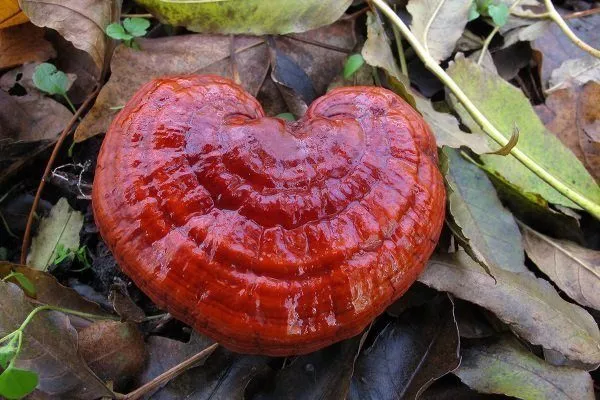
Description and value of the mushroom
The reishi mushroom is rare in nature, so it was once highly prized. This saprophyte is considered an annual, but can sometimes live for two or three years.
Botanical description:
- Mushroom body. Reishi consists of a stem and a cap.
- Hat. The mushroom's color is variable, ranging from reddish to purple. The cap is shaped like a human kidney. The maximum diameter is 25 cm. The surface is wavy. The mushroom is smooth and shiny. Numerous growth rings can be seen on the cap.
- Leg. Its length can reach 30 cm, diameter – 3 cm.
- Pulp. In young specimens, it resembles a white sponge. Over time, it hardens, hardens, and takes on a brownish tint.
The reishi mushroom has no smell or taste, only a slightly bitter taste.
The mushroom is valued for its medicinal properties – it strengthens the body, has antibacterial, antiviral and antitumor effects, removes toxins and protects against radiation.
What else is the reishi mushroom called?
Reishi is the name given to this unique mushroom by the Japanese. Translated into Russian, it means "mushroom of spiritual power." The Ganoderma lucidum mushroom belongs to the genus Ganoderma, family Polyporaceae. It is also known as:
- Mannentake is translated from Japanese as “ten thousand year old mushroom”.
- Lingzhi is translated from Chinese as “mushroom of immortality”.
- Ganoderma splendens.
- Varnished tinder fungus.
The mushroom is especially prized in Japan and China, where it is considered a source of eternal youth.
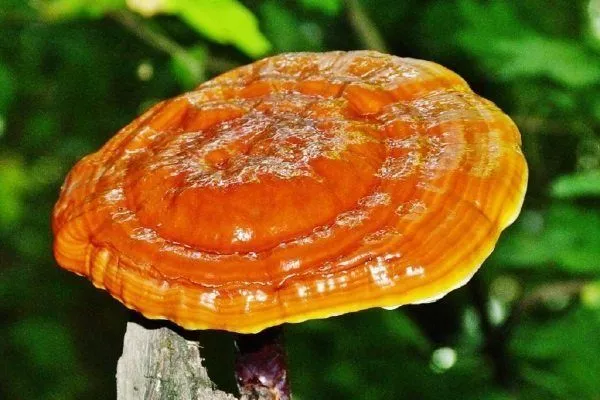
Edible or not?
The varnished polypore has a distinctly bitter taste, making it an inedible mushroom. It is used only for medicinal purposes. The mushroom is consumed as:
- tinctures;
- teas;
- dietary supplements;
- tablets;
- extracts;
- powders.
The miraculous properties of the mushroom are due to its unique composition, which contains:
- polysaccharides – they strengthen the immune system;
- amino acids – they remove waste and toxins from the body;
- organic and polyunsaturated fatty acids - they prevent the formation of tumors.
Also, the varnished tinder fungus contains coumarins, saponins, triterpenoids, phytoncides, flavonoids, alkaloids, vitamins B, C, D, micro- and macroelements (copper, zinc, selenium, phosphorus, sodium, manganese, magnesium, sodium, calcium).
Where and when does it grow?
Lingzhi was once found only in the East, but it has now spread throughout the world, grown on farms for medicinal purposes. However, the main suppliers of varnished tinder fungus remain Japan, China, and Vietnam.
In Russia, lingzhi can be found in the subtropics—in the Krasnodar Krai and the Caucasus. The favorable climate allows the saprophyte to fully mature over the summer—slowly, in its natural environment.
In temperate latitudes of the Russian Federation, the fungus is extremely rare. However, it has recently been spreading in Altai, where it has been found in clear-cut areas. The fungus prefers weakened, dying, and dead trees. It prefers to grow on deciduous trees and is rarely found on conifers. Lingzhi grows at the base of the tree, sometimes growing on roots buried deep in the ground.
Varieties
There are a lot of varieties tinder fungiThey are all different from each other:
- appearance;
- chemical composition;
- medicinal properties.
The healing properties of the reishi mushroom vary depending on where it grows. It can be distinguished from the tinder fungus by its long stalk—other parasitic fungi that grow on trees lack one.
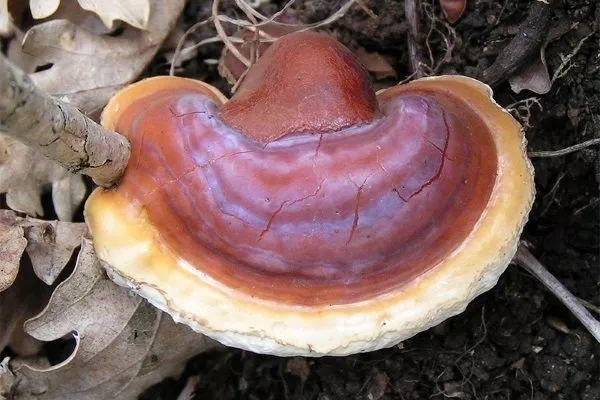
Who can be confused with?
Reishi is sometimes confused with agaric, also known as white larch sponge. This mushroom is used to treat tumors. Its flesh feels like a sponge, hence the name. What's the difference between agaric and varnished tinder fungus?
- it does not have a shiny and smooth surface, but a rough and uneven one;
- The mushroom is white in color and covered with brown spots.
- It grows mainly on larch trees, as well as on firs, cedars, and less often on birches.
| A type of tinder fungus | Cap color | Presence of a leg | Medicinal properties |
|---|---|---|---|
| Reishi | From reddish to purple | Yes, up to 30 cm | Antibacterial, antiviral, antitumor |
| Agarik | White with brown spots | No | It is used for tumors. |
Agaricus grows up to 10 kg in weight and up to 30 cm in length.
Collection Features
Lingzhi grown in natural conditions is much more beneficial than its artificially grown counterparts. If you're lucky, you can find varnished polypores in the wild—in the subtropical zone of our country. They grow on deciduous trees. The most beneficial mushroom is considered to be that grown on oak wood.
The chances of finding many Ganoderma splendens are extremely small - there is one mushroom for every 100,000 trees.
Ganoderma reishi is difficult to find in the wild—its spores germinate on specific trees and under specific conditions. To obtain this valuable mushroom for consumption, it must be cultivated artificially. Reishi was first cultivated in Japan in 1972. Harvesting and harvesting of the mushroom begins in July and continues until the first frost.
Is it possible to grow this mushroom yourself?
If not for artificial cultivation, the lingzhi mushroom would be worth a fortune. Fortunately, it can be grown using wood sticks infected with mycelium. Seeds are available in specialized stores. A single sowing provides a harvest for 4-5 years. There are two methods for growing this medicinal mushroom: on tree stumps and in sawdust.
An expert explains why growing reishi mushrooms can be a profitable business venture and how to create the conditions for its growth:
Growing on stumps
You'll need tree stumps, substrate, and mycelium. The area where the reishi will grow should be protected from the sun. It's best to grow the mushroom in a humid environment. The procedure for cultivating on tree stumps is as follows:
1Preparing stumps
The ideal option is to have stumps from fruit or deciduous trees on the site. Stumps from conifers are not suitable. If stumps are not available, they will need to be prepared in advance. This is best done between autumn and spring, when the stumps' bark is at its strongest. The bark contains the most nutrients during the pre-spring period.
2Soil preparation
The stumps where the Ganoderma splendens will grow are placed in nutritious soil. These saprophytes require enhanced nutrition, including vitamins and microelements. Not every soil type can support reishi cultivation. To ensure a successful harvest, it's best to create your own substrate.
- Mix peat, limestone and soil in proportions 5:1:4.
- Add manure or straw to increase nutritional value.
- Mix the ingredients thoroughly and fertilize the stump hole.
Substrate preparation:
- Take peat, limestone and soil in proportions of 5:1:4.
- To increase the nutritional value, manure or straw is added to the mixture.
- The ingredients are thoroughly mixed and the hole in which the stump will be placed is fertilized.
- When the stump is placed in the hole, it is also lined with nutrient substrate around its perimeter.
3Sowing mycelium
Growing lingzhi mycelium on your own is virtually impossible, so mushroom growers purchase pre-grown mycelium. Before sowing, they make planting holes—7 cm deep and 1.2 cm in diameter. Mycelium-infected rods are inserted into the holes. The rate of germination and yield of the mushroom depend on the number of rods infected with mycelium—the more seed material is added, the faster the first lingzhi mushrooms will appear.
4The planted area is covered with film
The optimal temperature for mushroom development is 20-26°C. Stumps are often moved indoors to promote mycelial rooting. If this is not possible, the cuts containing the mycelium can be sealed with paraffin and then the stumps can be covered with soil.
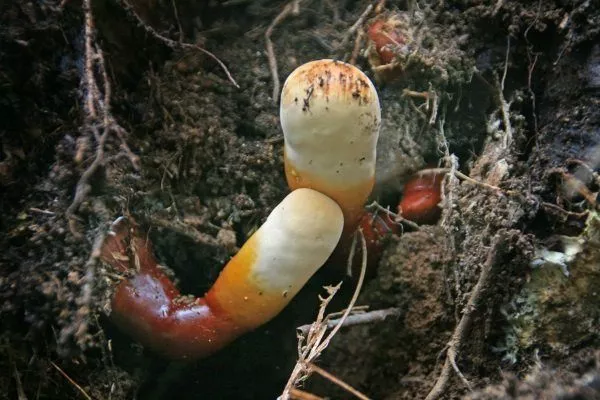
Growing on sawdust
The advantage of this method is speed. Sawdust yields a harvest faster than stumps. However, this method of cultivation requires more effort. The procedure for growing lingzhi on sawdust:
1Preparing sawdust substrate
Sawdust is mixed to make up 80% of the mixture, with 20% of other nutrients. Oat or barley husks can be added, for example. Minerals such as chalk or gypsum are also added, but no more than 2%. After mixing and moistening the mixture, it is dried and sterilized at 90 degrees Celsius. The processing time is 5 hours. If a large amount of substrate is being prepared, it is recommended to repeat the sterilization process.
2Sowing mycelium
The prepared substrate is laid out in boxes. The mycelium should be sown at 30 degrees Celsius (86 degrees Fahrenheit) – simply immerse it in the prepared soil. Cover the seedlings with soil and allow them to germinate for 15-20 days. Maintain a temperature of 18-26°C (64-80°F) and a humidity of 75%. The substrate should be carefully monitored – it shouldn't be wet, but it shouldn't dry out either.
Reishi Growing Conditions
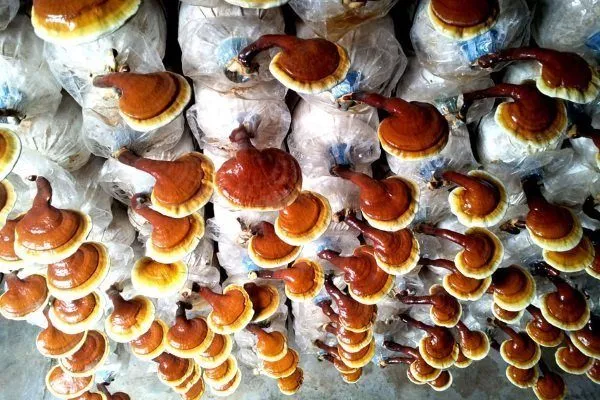
To ensure that the varnished tinder fungus successfully bears fruit, mushroom growers must provide it with the most favorable growing conditions:
- To ensure mushrooms appear more quickly, holes are made in the container with the substrate.
- The "plantation" should be in partial shade - direct sunlight should not be allowed.
- During growth and development, the optimal temperature is +23 to +25°C. Winter temperatures should not fall below -18°C.
- To maintain the proper humidity level of 75%, place damp expanded clay in the room—it can be spread on a baking sheet. Mushrooms should be sprayed with warm water weekly.
- Watering should be done depending on the condition of the substrate. If it dries out, moisten it with rainwater or boiled water.
- If the substrate is prepared correctly, no additional feeding is needed.
Overwatering and over-humidifying can lead to rot and mold. Humidity also attracts various insects, including spiders, mites, and slugs. To prevent this, you should:
- disinfect the room before planting;
- ensure ventilation of the room.
How to prepare and store raw materials?
It's recommended to harvest varnished polypores between July and November. Purchased mushrooms are usually sold dried—they're already prepared for storage. If you're using your own harvest, you'll need to dry the lingzhi yourself.
- Cut mushrooms are wiped dry with paper towels to remove soil and debris. Reishi mushrooms should never be washed after harvesting.
- After cleaning the mushrooms, cut them into large pieces. Then, spread the pieces evenly on parchment paper and place them in the oven to dry at 45 degrees Celsius (115 degrees Fahrenheit). Once the slices have stopped sticking to the paper, increase the heat to 70 degrees Celsius (158 degrees Fahrenheit). Now close the oven completely.
- The dried mushrooms are placed in jars, sealed with lids, and stored. The storage temperature should be maintained at no more than 25 degrees Celsius.
In a cool, dark place, reishi can be stored for up to two years without losing its healing properties.
To prevent the medicinal reishi mushroom from causing further problems, it should be harvested only in ecologically favorable areas. Those planning to use it for treatment should consult with a specialist.