
Automatic irrigation allows homeowners to maintain order in their gardens, vegetable plots, and surrounding areas. There are many irrigation systems available, varying in operating principles, features, and price. Let's learn what automatic irrigation systems consist of and how they work.
What is an automatic irrigation system?
To enhance your property, flowers, shrubs, trees, and lawns require regular watering. The most effective way to provide plants with water is to install an automatic irrigation system (AIS).
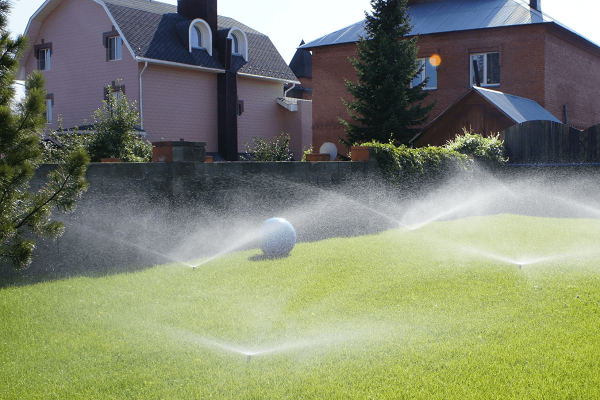
Automatic irrigation in a garden plot is a technical complex that supplies plants with water evenly and regularly, without human intervention.
SAP consists of a large number of elements, including:
- special sprinklers;
- valves;
- taps;
- hoses;
- pump;
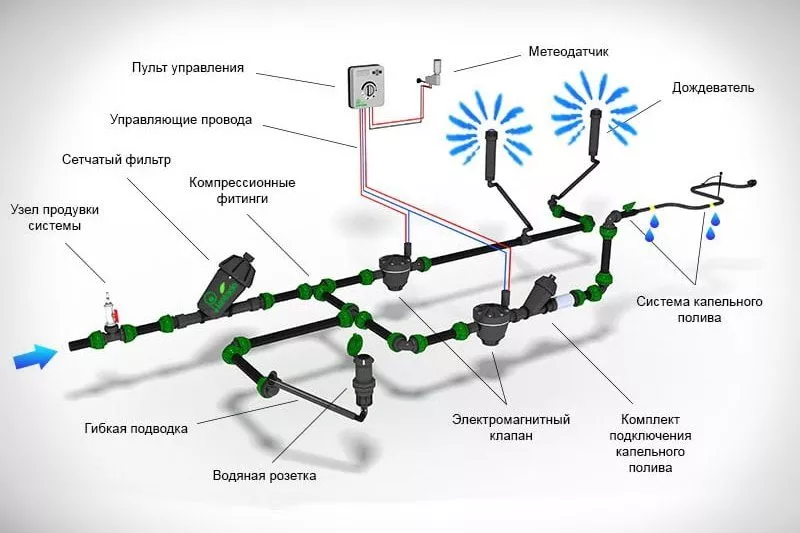
- The control center is a small controller that determines when to turn on the irrigation and operates according to the program.
The SAP operates according to a schedule created by a human and programmed into the control software. Depending on weather conditions and the local climate, the settings determine when irrigation will be started and the volume of water to be supplied.
Pros and cons of automatic watering
Developing a SAP system requires considerable investment. Their installation requires the services of professionals, and their operation requires compliance with certain rules and regulations.
Advantages:
- it is possible to control the system - set the frequency and intensity of watering;
- you can set watering hours by site zones;
- saving time and effort;
- rational use of water;
- the possibility of being absent from the site for a long time without damaging the plants;
- the system switches off if it starts to rain;
- Thoughtful placement of automatic irrigation circuits allows you to water the most hard-to-reach places;
- the device reacts to changes in humidity;
- long-term use.
Flaws:
- serious financial investments;
- require regular maintenance;
- for different types of plantings it is necessary to establish individual irrigation regimes;
- the services of a plumber and electrician are required if the owner of the site does not have skills in plumbing and electrical work;
- The water supply system must be in constant operation.
Elements of the system
Any automatic irrigation system consists of a large number of components. Let's look at the components of a standard irrigation system.
Capacity
SAP operation is characterized by the consumption of large volumes of water in a short period of time. It is known that watering vegetables, flowers, and other plantings with cold or unsettled water is not recommended.
Why do you need a container:
- to settle water - it can be silty or ferruginous, which negatively affects the condition of plants;
- Heat water from a tap or well in the sun; if its temperature is +4…+6°C, plants may get sick.
The container or storage tank is usually made of plastic. Its capacity depends on the site's needs, but typically holds several hundred liters.
Pump
An essential element of the SAP, it ensures water supply under a specific pressure. For the system to function efficiently and smoothly, a pressure of 3 atmospheres per element is required if the water flow rate is 3.5 cubic meters per hour.
The SAP requires high pressure to operate—higher than standard water supply pumps. If the system is connected to a household water supply, the house may run out of water, but there will still be no irrigation due to insufficient pressure.
Remote control
This element is the “brains” of the system, controlling all automatic watering processes.
What is the control panel responsible for:
- sets the switch-on time and ensures that it operates at the right moment - essentially, it acts as a timer;
- determines the number of inclusions per day;
- collects information from sensors that react to the weather and changes the program depending on the readings.
There are two types of automatic irrigation control panels:
- street;
- intra-house.
Remote controls installed outdoors are supplied with a sealed box, while indoor remote controls are produced without a door.
Example of setting up the remote control in standard mode:
- watering is turned on at 6:00 and 23:00;
- watering rate: 4-6 mm (for the middle zone).
Solenoid valves
The entire irrigation system is divided into irrigation zones, separated by electromagnetic valves.
SAP is divided into several zones:
- drip irrigation;
- micro-drip irrigation;
- sprinkler groups.
Each zone is watered at different times and requires different water pressure. Each sprinkler group or drip irrigation zone is equipped with its own solenoid valve. The solenoid valve is located underground and is therefore housed in a protective plastic box.
Upon receiving a command, the valves open according to a preset program. At the scheduled moment, the valves close and the water flow is stopped.
Sprinklers
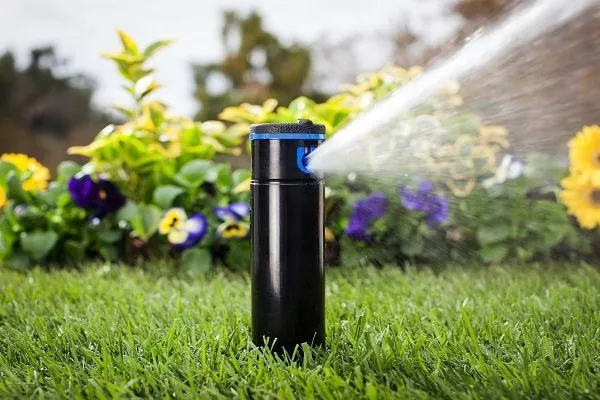
They are installed in the ground, flush with the ground surface. When water is applied, a mechanically extending stem is activated, dispensing water. When watering is complete, the stem retracts, leaving no visible surface on the lawn or ground.
- ✓ For optimal lawn watering, choose sprinklers with an adjustable spray angle from 0 to 360 degrees.
- ✓ Consider the sprinkler irrigation radius (from 1.8 to 10.5 m) depending on the size of the area and the location of the plants.
A sprinkler is a plastic element with a retractable stem, and water flows from a nozzle, which can be:
- Rotary. For small and medium-sized areas with varying numbers of plants. They are categorized by coverage radius—4–10.5 m. A 6 mm application rate is achieved in 20 minutes. Watering angles:
- 90-120°;
- 210-270°;
- 360° without adjustment.
- Fan-shaped. They are used in small areas with many plants or for lawns. The irrigation radius is 1.8-5.2 m. The adjustable spray angle is 0-360 degrees. A 6 mm irrigation rate is achieved in 6 minutes—3 minutes each morning or evening (with two irrigations).
To keep sprinklers flush with the lawn, flexible pipe components that can be adjusted in different directions are used. Flexible elbows are used for this purpose. One end is screwed into the lower end of the sprinkler, and the other is connected to the pipe via a fitting.
Hoses
Drip irrigation systems use hoses. They are installed where sprinklers cannot be installed. Hoses are especially popular for delivering water to flower beds and vegetable plots. Watering is targeted, accurate, and economical, without splashing water. The downside of hoses is that they can interfere with weeding.
Water outlets
A water outlet is a threaded device designed for connecting hoses. They can be located anywhere, eliminating the need to run hoses to watering points. They are attached to pipes with compression fittings and installed at ground level, ensuring they don't interfere with garden landscaping.
Compression fittings
These are devices used to securely and reliably connect pipes. Fittings tightly compress the pipes from the inside, creating a completely airtight connection. These connecting devices create a unified system of pipes and irrigation elements.
Selection criteria
If a property owner is planning to install a self-propelled aerial tram system (SAPS), they can choose a ready-made system. Do-it-yourselfers can design their own system, but this is much more difficult and time-consuming. It's easier to buy a ready-made system.
SAP selection criteria:
- Type of irrigation system. According to the operating principle, the following types of SAP are distinguished:
- drip and micro-drip;
- sprinklers;
- fog-forming;
- basal;
- subsurface.
- Pump power. It varies from 300 to 2200 W for single-phase current and even more powerful for three-phase current.
- Irrigated area or the number of plants being watered. There are systems designed for several dozen plants, and models that can water an entire plot.
When choosing, you need to consider what types of plants will need to be watered and how far the irrigation objects are from the water intake point.
Examples of the best manufacturers and their models
The Russian market offers a wide selection of ready-made automatic irrigation systems. They differ in their operating principles, technical specifications, and prices.
Aquadusya
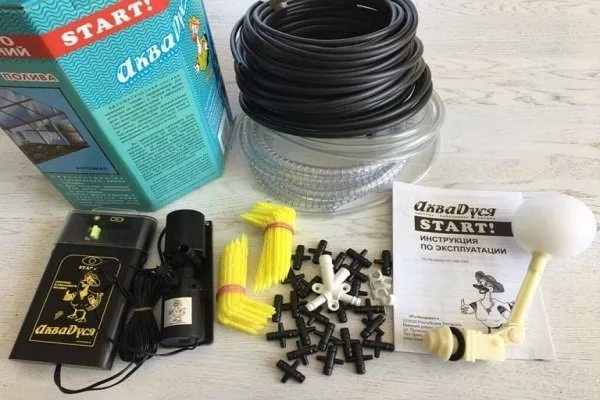
The system is designed for full-cycle irrigation of plots. "AquaDusya" can replace industrial systems that require special operating conditions. Such systems are popular with professional farmers.
All AquaDusi models consist of a drip system and micro-hoses that deliver water to the plant roots. Watering is done from a storage tank. Some models feature overflow control, equipped with a faucet and a float.
Peculiarities:
- ease of installation and operation;
- works without electricity and running water;
- automatic watering stop;
- Water is supplied to the roots through special drippers
- The manufacturer produces automatic and semi-automatic systems.
Hunter
These are popular irrigation systems from an American manufacturer, which can be purchased ready-made or as components for self-assembly.
System features:
- There are fan and rotary sprinklers;
- The nozzles are made of high quality plastic;
- there is a programmable controller powered by a 220 V network or a battery;
- The system can be installed in two versions: outdoor and indoor;
- Suitable for any soil and landscape;
- economical water consumption;
- environmental friendliness, reliability, trouble-free operation;
- convenient operation.
Green Helper
This equipment is from a Russian brand that produces a wide range of gardening products. The company also offers drip irrigation kits for continuous watering.
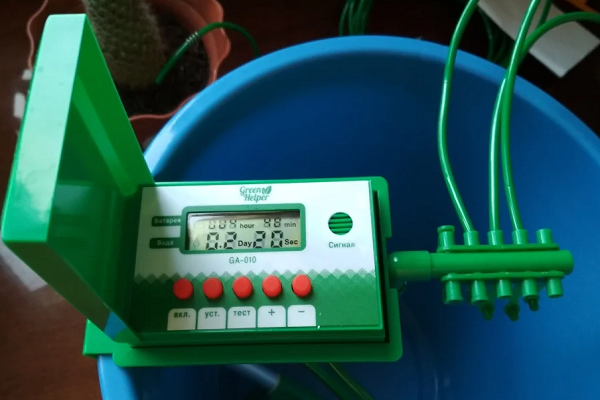
Peculiarities:
- You can add fertilizers along with water;
- equipped with an electronic timer;
- can work by gravity - water flows from a barrel, or under pressure;
- ease of installation.
Kits with hoses of 10, 25, 100 meters, and longer are available. Kits are designed to water different areas and numbers of plants.
Bug
The manufacturer produces several versions of this drip irrigation system, all of which are reliable and easy to use. The greenhouse kit is designed to water 60 plants, while the hotbed kit is designed to water 30 plants.
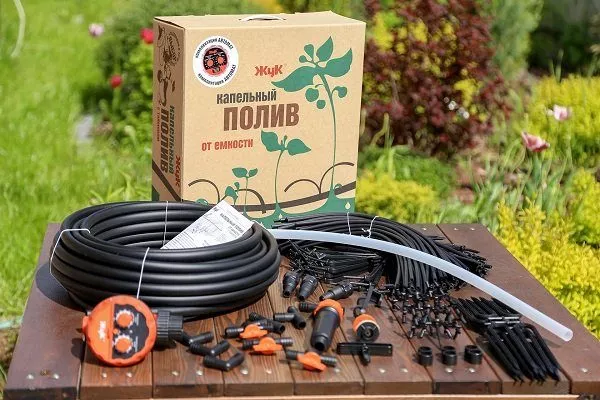
System features:
- automated watering is provided - from a barrel and from a water supply;
- There are modifications equipped with a timer;
- There is a nipple for connection to a water tank.
The manufacturer offers various "Zhuk" irrigation systems, differing in hose length and area of irrigation, for greenhouses and hotbeds.
GARDENA
This is a German-made micro-drip irrigation system for above-ground and underground irrigation of greenhouse plants. The system is popular due to its simplicity and reliability, and is designed for watering small areas.
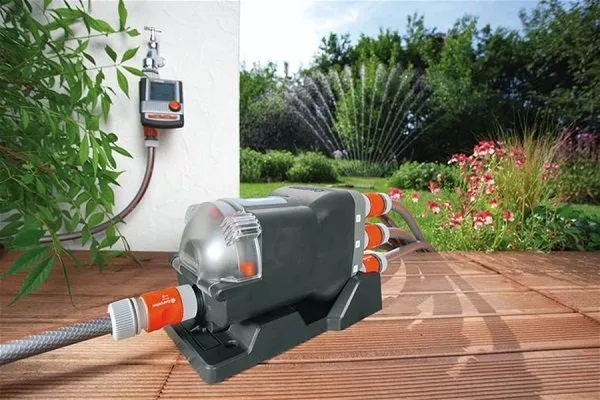
System features:
- ease of installation;
- UV resistance;
- long-term;
- comes complete with a base unit, hoses, fittings, and cleaning needles;
- automation settings are provided;
- There are rain sensors that can turn off watering;
- precipitation, wind and temperature sensors are provided;
- The system is configured taking into account the characteristics of the site - soil type, age of plants, number and density of plantings.
There are ready-made kits with a controller, sprinklers and polyethylene pipes.
What does the system water?
The choice of SAP type largely depends on the type of planting. Flowers, lawns, garden beds, and trees are irrigated using different irrigation systems.
Watering features:
- Sprinklers. They are recommended for watering plants that allow moisture to reach their leaves and flowers. Trees are watered without a sprinkler—water simply flows from the sprinkler into the tree trunk.
- Drip. It's suitable for watering a wide variety of flowers, from delicate roses to common dandelions. This option is ideal for shrubs, hedges, vegetable gardens, strawberry plantations, greenhouses, and hotbeds. It's not suitable for lawns, as the hoses will spoil the appearance and interfere with mowing.
- Micro-drip. It is typically used in greenhouses, winter gardens, and agricultural complexes—where conventional drip irrigation is insufficient and the most precise water supply and distribution is required.
- Fogging. These installations are recommended for use for watering tropical plants.
Types of irrigation systems and irrigation variations
There are a wide variety of irrigation system solutions. They are primarily classified by their intended purpose and water delivery method.
There are two types of automatic irrigation:
- Landscape — installed in gardens and adjacent areas. Ideal for watering lawns, flowerbeds, front gardens, trees, and shrubs.
- Agricultural — to provide water to garden crops grown for harvesting.
In private garden plots, landscape-type automatic irrigation is used, it can be:
- fully automatic - the switching schedule is entered into the program, and the system waters the plants strictly according to the specified schedule;
- with manual switching on;
- combined - the system's operation is programmed or controlled manually.
All automatic irrigation systems are divided into the following groups:
- Superficial. Water is supplied through hoses laid on the soil surface. They are connected to special water tanks or to the water supply. The downside is the risk of insufficient water penetration to the roots.
- Sprinklers. Sprayers are placed at a certain distance from each other, and water is delivered to them through a hose. The spray not only waters lawns and flowerbeds but also refreshes them and washes away dust and insects.
- Drip. They allow for the most economical use of water. Water is delivered to the root system through special drippers positioned at a specific angle.
These systems allow for the addition of dissolved fertilizers along with water. The water rate and timing can be controlled. This type of irrigation has proven effective in greenhouses because it prevents excessive air humidity. - Intrasoil. These systems consist of a system of pipes buried 30-70 cm into the ground. Water is delivered directly to the roots. This option is suitable for areas with numerous trees, shrubs, and other plantings.
Intrasoil systems are in demand in areas where there is a water shortage, as they allow for significant savings in water consumption. - Fogging. These systems create tiny droplets that create the appearance of fog. Watering is accomplished using micro-droplets.
Installation of automatic irrigation
Installation of the SAP is the most complex stage of the process, requiring specific knowledge and skills, as well as the ability to use a wide variety of tools. The installation details and the scope of work required depend on the type of SAP.
If the water comes from a barrel, it should be installed about 2 meters above the ground. If the water comes from a well or reservoir, a pump is required.
Approximate installation plan for automatic irrigation systems:
- Site marking.
- Carrying out excavation works.
- Layout of pipes/hoses.
- Assembly of system elements (supply and distribution).
- Installation of irrigation elements.
- Commissioning and hydraulic testing.
Video about SAP installation:
Instructions for using the device
It is recommended to assemble the system in the fall, after the plants have faded, or in the spring, before flowering begins. Once installation is complete, all that remains is to operate the system properly.
Once it is running, it is necessary to check the pipes for leaks, configure and conduct a comprehensive test of the SAP functionality.
Operating procedure for drip-type SAP:
- Install the pump and its piping.
- Install the piping of the storage tank.
- Place plugs on the hoses.
- Check the filter operation, wash it.
- Open the tap that supplies water to the pipes/hoses or to the container (wait until it fills).
- Test the automatic float valve that controls the water level in the tank. Replace it if necessary.
- Connect power to the pump. It will turn on and off automatically. Check the pump pressure.
- Ensure the system is properly pressurized. Inspect all connections for leaks.
- Turn on the power supply of the control panel.
- Insert the battery into the remote control, if necessary.
- Turn on the remote control. Set up a watering schedule following the instructions in the manual.
- Start the SAP and check its operation, including the sprinkler settings on all irrigation lines. Adjust each sprinkler element manually or with a wrench. Rinse the sprinkler element filters.
- Test the drip lines and each water point. Determine how tight the system is.
- Start the auto mode - set to Run.
When using systems, it is important to handle them correctly and know how to properly supply plants with water using them.
What you need to know about SAP irrigation:
- If the grass cover has become dull, the lawn should be watered after 2-3 days of drought in summer and after 5 days in spring;
- It is better to water in cool weather, early in the morning and late in the evening - water is effectively absorbed into the soil without evaporating;
- lawn watering should be done to a depth of 15-20 cm;
- You can’t water lawns every day - this will lead to root rot;
- watering rate: 5-12 liters per 1 sq. m;
- To reduce water consumption rates by 50%, it is recommended to use absorbents;
- The flow of water should be slow.
Maintenance and care
To ensure the system operates flawlessly, it requires regular maintenance. This is performed seasonally. Property owners can hire companies that specialize in this type of equipment to service their SAP systems.
Seasonal maintenance of the SAP system involves mandatory spring maintenance, which involves de-preserving the system. This is performed once stable warm weather returns, typically in May.
Spring maintenance procedure:
- installation of external equipment;
- system startup;
- automation testing;
- cleaning and adjustment of sprinklers;
- introduction of software settings.
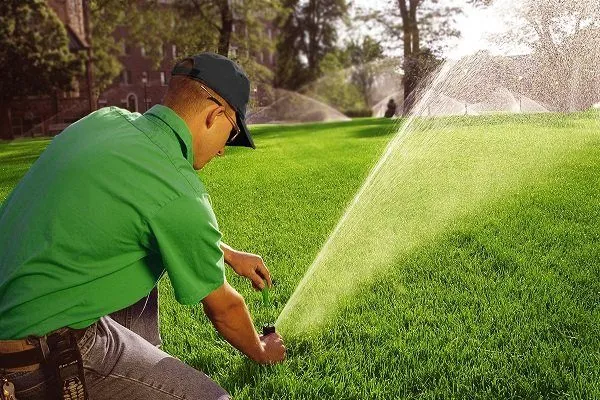
Summer maintenance is carried out as necessary and includes the following work:
- diagnostics;
- making changes to irrigation systems;
- cleaning and adjustment of sprinklers.
Autumn maintenance involves preservation of the system and consists of the following works:
- draining water from the tank and pump;
- pneumatic blowing of pipes and other hollow elements;
- turning off the pump, automation and controller from the power supply;
- removal of external equipment.
Automatic watering on your own
To install the SAP yourself, you need to draw up a project – an installation plan, prepare the necessary tools, and purchase all the necessary components.
Design
When creating an automatic irrigation system, you need to start with a design. All equipment will then be installed according to this design.
Design stages:
- Use a tape measure to measure the garden plot. Mark all significant objects—buildings, paths, fences, and borders. Draw a plan on paper.
- Transfer the plan to graph paper at a scale of 1:1000. Draw the drawing accurately, maintaining the actual dimensions.
- Mark on graph paper the locations where sprinklers should be installed, hoses should be laid, or pipes should be laid, depending on the type of SAP.
- Place all automatic irrigation elements on the plan.
- Determine the irrigation radius to select sprinkler heads accordingly. The plan should include all plants on the site, water and power sources, and sprinkler installation locations. It's a good idea to note elevations and differences in soil composition.
- Divide the area into zones taking into account hydraulic loads and losses.
- Select a pump and tank capacity, if needed.
- Calculate the number of connections and select suitable fittings, couplings, filters.
Next, according to the completed plan, you'll need to mark out the area and dig the necessary trenches. Mark out the sprinklers to ensure their placement is as efficient as possible.
What will you need?
Once the precise plan of the future SAP for the garden plot is ready, you can move on to transferring it to the plot.
What you need to have with you:
- a large barrel - no less than 200 liters (necessary if there is no running water);
- taps and filters in the appropriate volume;
- pipes - hard and soft;
- drip nozzles;
- tees;
- sprinklers;
- pump;
- controller;
- valves, hoses, various sensors;
- tools - shovels, square, tape measure, screwdriver, adjustable wrench, screwdriver, pliers.
Step-by-step instructions
The installation procedure for homemade irrigation systems depends on their type. Let's look at several installation options.
Steps to create a basic automatic irrigation system:
- Take 2-5 dozen (depending on the size of the future system) plastic bottles with a capacity of 1.5-2 liters or more, and make holes in them (6-10 pieces), stepping back 3 cm from the bottom.
- Bury the plastic containers 15 cm deep and periodically replenish their water supply.
This is the most basic option, which any gardener can build. A more advanced system would require much more time, effort, tools, and components.
Installation of rain system:
- Instead of a hose, lay a branched network of pipes throughout the entire area.
- Attach spray nozzles to the ends of the pipes; they are sold in hardware stores.
- Replace your traditional faucet with an automatic valve. Set a timer.
Video about installing an automatic irrigation system on a site:
SAP is a modern solution for providing water to plants throughout a property. A variety of technical solutions, from the most basic to sophisticated technological systems, can achieve this goal.
We've been dreaming about an automatic watering system for ages, but we never got around to it. I recently came across this article, and I'm so grateful for it. I read so many interesting things! I couldn't resist letting my husband read it. He's also thrilled. Now I'm sure we'll finally buy one soon.