
Breeding pond fish requires careful and meticulous attention. While monitoring their pets, fish keepers sometimes encounter the problem of excessive mucus production on their skin. Let's explore the causes of this problem and how to solve it.
Can mucus be normal?
The mucous coating on a fish's body is natural. Normally, the mucous layer is barely noticeable or not noticeable at all. Its abundance varies among different fish species.
The mucus layer performs the following functions:
- It is a protective layer on the fish’s body and prevents the penetration of bacteria.
- Promotes skin restoration after damage or injury, accelerates blood clotting.
- Thanks to mucus, the slipperiness of the body in water and the speed of movement increase.
However, under certain circumstances, fish produce more mucus than usual. This indicates that the fish's skin is affected by an irritant, disease, etc.
Causes of Excessive Mucus Production and Their Solutions
Let's consider the circumstances under which increased mucus secretion is observed in pond fish, and when the fish farmer notices that the body is covered with a thick layer of thick mucus and has a grayish tint, rather than a transparent (healthy) one.
Diseases
The appearance and behavior of fish can indicate various illnesses. Although only microscopic examination of scrapings from the body surface, fins, and gills allows for a definitive diagnosis, excessive mucus secretion can indicate several diseases.
Costiosis
The disease causes the destruction of the fish's skin and excessive mucus secretion. It manifests itself as the appearance of dull bluish-gray spots on the skin, which later merge into a continuous coating, and hemorrhages. The disease is caused by costia, a parasite that feeds on the mucus and bacteria in damaged skin.
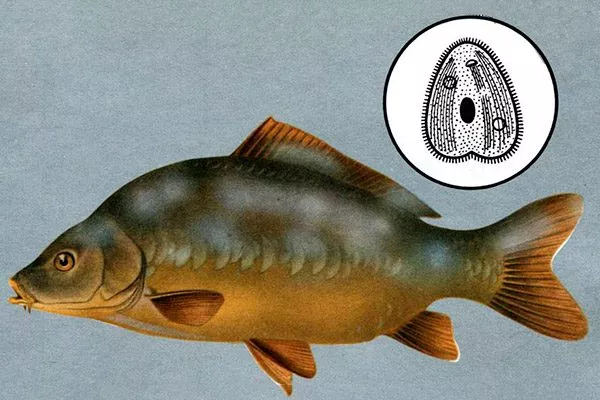
Infection occurs through infected fish transferred from other bodies of water, or through drinking water from them. It also occurs through feeding raw minced meat made from infected fish.
Treatment methods:
- Young fish. Immerse in a bath containing a 1-2% aqueous solution of table salt for 15-20 minutes, or in an aqueous solution of formaldehyde diluted 1:4000 for 1 hour.
- Older fish. Yearlings, yearlings and more mature individuals are immersed in 5% salt baths for 5 minutes, followed by rinsing them in running water for two hours.
Preventive measures:
- Treatment in a 5% salt antiparasitic bath. To prevent the introduction of pathogens into the pond, treat new fish three times for 5 minutes every 5-8 days. Treat all fish with the same solution for 5 minutes before wintering.
- Disinfestation with quicklime (25 c/ha) or chlorine lime (3-5 c/ha). This treatment is performed on spawning ponds before filling them with water. It is also used to treat contaminated ponds immediately after catching fish and draining the water.
Lernaeosis
The disease is caused by parasitic crustaceans of the genus Lernaea, which attach themselves to fish. The disease affects freshwater pond fish, including carp, crucian carp, grass carp, bream, and others. Sick fish spread the disease.
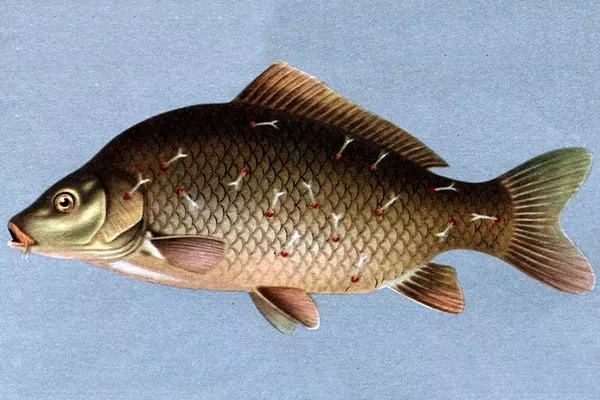
The crustaceans burrow deeply into the skin, penetrating muscle tissue throughout the fish's body. The tissue at the site of penetration becomes inflamed, swollen, and reddened, with ulcers. Pathogenic fungi and bacteria develop, causing scale loss. In advanced stages, the fish's body becomes covered in mucus and a gray-blue coating.
Treatment methods:
- Place the fish in a bath with a formalin solution of 1:500 concentration for 45 minutes.
- Treat the fish directly in the pond with chlorophos at a rate of 0.3-0.5 g/m3, at a water temperature of up to 20°C – once every 15 days, above 20°C – once a week.
- Add quicklime to the water at a dose of 100-150 kg/ha twice (in May and September).
Prevention:
- Carry out general measures to prevent the import of affected fish.
- Raise juveniles and older fish separately.
- Treat the pond by drying the bed and disinfecting it.
Chilodonellosis
The disease is caused by the parasitic ciliate Chilodonella cyprin. It actively reproduces at 4-8°C, and under unfavorable conditions, the parasite's cysts survive for a long time in silt or water. It affects fish of all species, primarily weak and poorly nourished individuals.
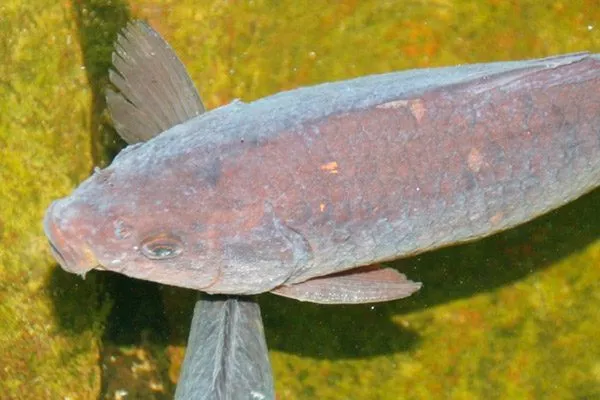
It appears in yearlings during the wintering period. Older fish may be carriers of the parasite. The pathogen can also be introduced with water from another body of water.
It manifests itself as the appearance of a slimy, bluish-gray (milky) coating on the fish's body. The gills become coated with mucus. Affected fish stay near freshwater inflows rather than hibernate near the bottom like other fish. They gulp air and even jump out of the pond.
- ✓ A gray-blue coating and flaky mucus indicate trichodiniasis.
- ✓ A milky coating on the gills is characteristic of chilodonellosis.
- ✓ Excessive mucus with hemorrhages indicates costia.
Treatment methods:
- Carry out antiparasitic treatment in the pond, treating the fish twice every other day.
- Determine the volume of water in the pond and add salt in the amount of 1-2 kg per 1 m3 at a temperature of +1°C, keep the fish for 1-2 days.
- At lower temperatures, add malachite green (stock solution 5:1000) to the pond, cutting through the ice in several places, creating a therapeutic concentration of 0.1-0.2 g/m3, and stop water exchange for 4-5 hours.
Prevention:
- Treat the added fish in an antiparasitic bath of a 5% salt solution (5 min) or a 0.1-0.2% ammonia solution (1.0-0.5 min).
- Wintering ponds where fish diseases have been observed should be treated with quicklime (35-40 c/ha) or bleach (5-7 c/ha) - with the bleach containing at least 22-26% free chlorine.
- In summer, keep wintering ponds dry; do not use them for spawning or keeping fish.
Trichodiniasis
A group of diseases caused by ciliates of the Urceolariidae family. These parasites reproduce rapidly and affect the skin and gills of fish.
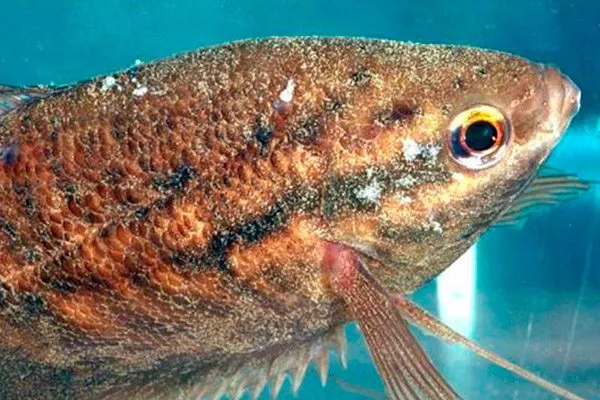
These pathogens are widespread in nature and can be found in any aquaculture facility. They affect all fish species. They are especially dangerous for yearlings overwintering in crowded conditions. They can lead to mass fish mortality.
The disease is detected by the appearance of a gray-blue coating and abundant mucus secretion. The fish's body becomes matte, and the mucus flakes off. The fish become emaciated, approach a freshwater influx, gulp air, and quickly die.
As a treatment, treat the fish in a bath with one of the following solutions:
- 5% saline for 5 minutes;
- 0.1-0.2% ammonia for 1-2 minutes.
Prevention:
- Treat the fish directly in the pond by creating a concentration of table salt of 0.1-0.2% (duration – 1-2 days), or malachite green (0.5-1.0 g/m3 for 4-5 hours).
- Clear the pond of sick individuals and disinfect it with quicklime at a rate of 40 c/ha or with bleach at a rate of 5-7 c/ha, with a free chlorine content of at least 22-26%.
- Dry the pond thoroughly after disinfection.
Gyrodactylosis
The disease is caused by Gyrodactylus flukes, small, spindle-shaped parasites. These viviparous parasites produce fully formed offspring that are quickly ready to reproduce.
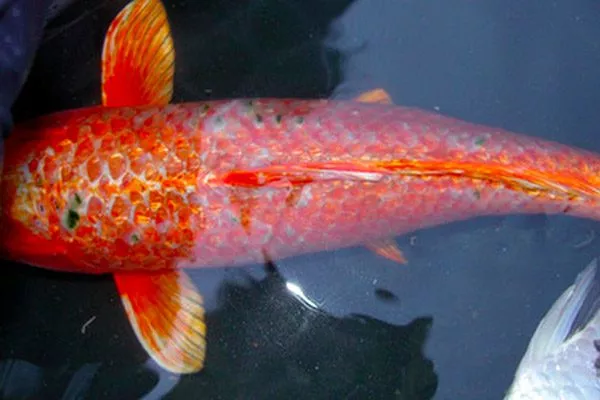
The disease primarily affects yearlings of common carp, wild carp, and their hybrids, as well as crucian carp and juvenile grass carp. Older fish are carriers of the parasite.
It manifests itself as a dulling of the skin and fins, the appearance of spots, and then a solid gray-blue mucous coating. The epithelium peels off, the fish weakens, loses weight, swallows air, and dies.
Treatment methods:
- Place the fish in a salt bath prepared from a 5% solution of table salt for 5 minutes or a 0.1-0.2% solution of ammonia for 0.5-1 minutes.
- Treating sick fish in a formalin solution at a dilution of 1:4000 has proven effective; the pets should be kept in it for 25 minutes.
- In winter, treat fish directly in the pond with malachite green at a concentration of 0.16 g/m3; keep the fish in it for 25 hours.
Prevention:
- Before placing the fish in fattening and wintering ponds, treat them in a salt bath of a 5% solution of table salt.
- After catching fish, dry and disinfect ponds with quicklime or bleach; keep them without water in winter.
- Install screens to prevent the passage of wild and diseased fish.
- Use complete feeding to strengthen the fish's immunity and increase resistance to diseases.
Unsuitable water quality
Skin irritation and increased mucus production may be related to water conditions. Mucus is one of the fish's first defense mechanisms against poor aquatic conditions.
The main indicators of water quality are oxygen and acidity. They should be within normal limits:
- pH (water acidity). The ideal pH should be between 6.5 and 8.5. A pH below 4-4.5 and above 10.5 is harmful. Acidic water causes excessive mucus production, agitation, and jumping of fish.
A pH of 9.0 or higher means the water is too alkaline. It destroys the mucus film on the fish's body. They become susceptible to disease and parasites, and they die. - Oxygen saturation. The normal level is 5-7 mg of oxygen per liter of water. A minimum level that is harmful to fish is 0.3-0.5 mg/L. The presence of heavy metals in the water is especially dangerous when oxygen levels are too low, as they disrupt the normal mucus layer. The mucus thickens on the gills, sticks together, and makes it difficult for the fish to breathe.
The fish farmer must monitor the water quality, set up a forced aeration system, and periodically conduct a chemical analysis of the water.
Skin irritation from chemicals
Fish skin can become irritated and subsequently produce excessive mucus if chemicals are used incorrectly. Use them strictly according to the instructions, avoiding overdosing.
Typically, chemistry is used for:
- disinfection of a reservoir;
- getting rid of mold and mildew;
- stopping the growth of unwanted vegetation.
Sometimes paint, gasoline, or other harmful chemicals end up in a pond. In this case, drastic measures are required. In severe cases of contamination, you'll have to remove all the inhabitants, pump out the water, clean it, and only then refill it and stock it with fish.
The appearance of copious mucus from under the gills may indicate irritation caused by medicinal substances in the water when overdosed.
Excessive mucus production in pond fish is a common symptom. It indicates exposure to an irritant, illness, or poor pond water quality. Timely prevention, careful monitoring, and proper treatment can help manage the condition.