
Roach belongs to the carp family, and is a ray-finned fish. Several species are known. Some are freshwater, found only in rivers, ponds, and canals, while others are semi-anadromous, meaning they live in estuaries and brackish seas or lakes, ascending rivers to spawn. Read more about this fish, including its description, classification, fishing techniques, and much more useful information below.
How to recognize a fish?
This easy-going fish is widespread in waters around the world, is undemanding in its diet, and easily switches from one food source to another. In Russia, such species diversity is not observed; waters are inhabited by the common roach and its two subspecies—vobla (Russian roach) and roach.
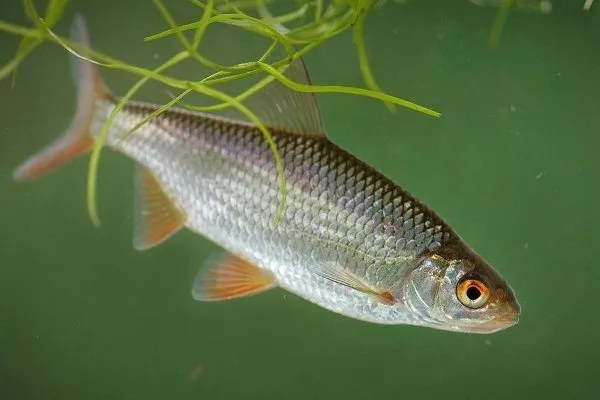
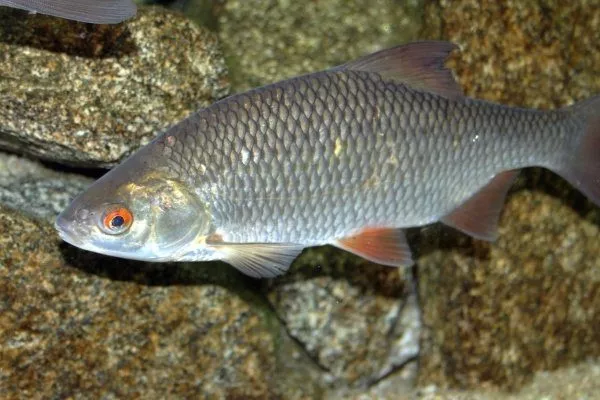
The roach has an elongated body, somewhat reminiscent of a herring in shape. Its back is black with a greenish or bluish tint, while its sides and belly are silvery. Before spawning, some fish become covered in small whitish spots. Over time, these darken and harden, giving the scales a rough feel. The silvery scales are large and tightly pressed together.
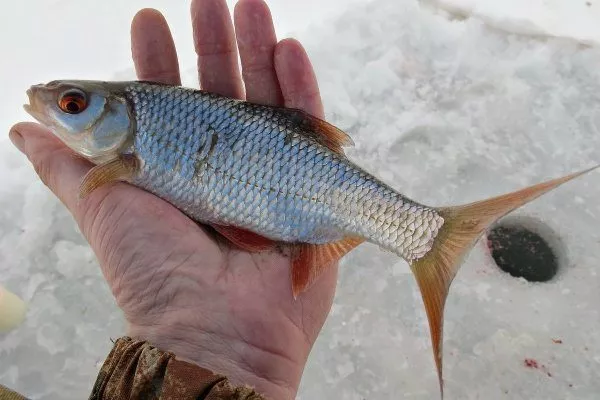
Coloration depends on the age and nature of the water body. Occasionally, specimens with rather bright golden scales are encountered, with their backs and sides having a more reddish hue.
The roach's small mouth is located at the end of its blunt snout. The pharyngeal teeth are unserrated and single-rowed. The forked caudal and dorsal fins are gray-green, while the other fins (pelvic, pectoral, and anal) are reddish-orange. This is the roach's coloration. Other subspecies differ not only in body shape but also in coloration.
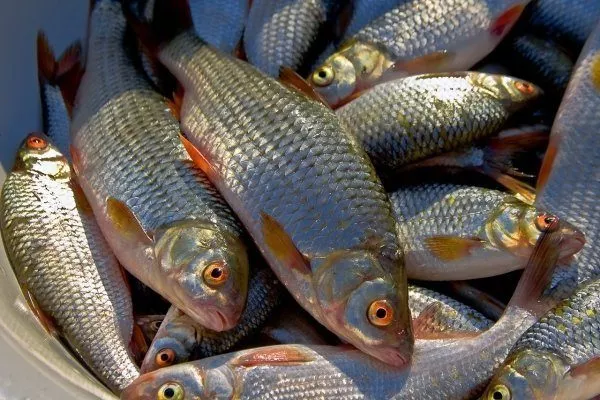
A characteristic feature of the roach, by which it is distinguished from numerous representatives of the carp family, is the color of the iris of the eye - it is orange with a blood-red spot on its upper part.
If we talk about size, namely body length, then the semi-anadromous roach has the greatest length - up to 50 cm, while the resident roach, which is constantly in fresh water, is smaller in size and grows on average up to 30 cm.
Classification
Numerous subspecies are divided into freshwater representatives that never leave rivers and freshwater reservoirs, called resident fish, and those that prefer to live in brackish water.
Freshwater subspecies:
- Common roach. The fish is small in size, barely reaching 30 cm. It lives in the Caspian and Azov seas, and in Lake Chebakule.
- Chebak or Siberian roach — is a commercial fish, harvested on an industrial scale. It differs from other species by its rapid growth and reproduction. Its habitat is the freshwater bodies of the Urals and Siberia.
Non-freshwater species:
- Aral roach This schooling fish is found in the Amu Darya and Syr Darya river basins. It reaches 40 cm in size and weighs a maximum of 1,200 g.
- Caspian roach The roach is a commercial fish native to the Caspian Sea, migrating to the Volga River for spawning and wintering. It can be distinguished from the roach by its dark gray fins with a black border. It grows up to 30 cm and weighs 1,500 g.
- Azov-Black Sea roach — also a commercial semi-anadromous fish that inhabits the Sea of Azov and the Black Sea. It migrates to river waters to spawn. It averages 35 cm, but specimens up to 50 cm long and weighing 2 kg have been recorded. The fish is larger than the common roach, and its teeth are thicker.
| Average length, cm | Average weight, kg | Number of scales in the lateral line, pcs. | |
| Common roach | 50 | 1.5 | 40-45 |
| Chebak | 35 | 0.9 | 40-45 |
| Taran | 25-30 | 2 | 48-52 |
| Vobla | 30 | 1.5 | 41-48 |
Habitat
Roach prefers calm rivers and quiet backwaters with lush vegetation. A sandy bottom and warm water are all they need to thrive.
It hides from predators in reeds and cattails, and in hot weather, it retreats to the shade of flooded bushes and tree trunks. It can be found in small ponds, rivers, streams, and lakes. Numerous schools of roach are found in the basins of the Black, Caspian, and Azov Seas.
The fish prefers to swim at the bottom of the reservoir, but is forced to rise to the middle layers of the water to feed. In hot weather, it swims near the water's surface, where it feasts on insects that have accidentally fallen into the water.
What does it eat?
This fish species is omnivorous. Roach feeds on both plant and animal matter, so there's no shortage of either. Among plants, it prefers algae and other plants, and also enjoys larvae, various insects, fry, and mollusks. Semi-anadromous species feed on plankton, bivalves, and crustaceans.
Lifestyle
You won't find roach alone; they gather in schools, usually consisting of individuals of similar size. Smaller fish stay closer to the shore, while older roach prefer deeper water.
At the beginning of spring, all fish living in stagnant water rush to shallow, warm water, since here they warm up faster under the sun's rays, and prepare for spawning.
In the summer, when hot weather sets in, large fish leave shallow rivers and migrate to deeper places.
During the colder months, the entire flock migrates to deeper waters for winter to protect itself from the freezing temperatures. It hides under snags and vegetation.
Spawning
Two-year-old roach (the time it takes for the fish to reach sexual maturity) begin spawning in the second half of April, when the water temperature reaches 8°C. The water temperature should subside after the ice clears. A couple of weeks before spawning, the fish "dress" in their nuptial plumage; as mentioned above, white spots appear on their body. However, these spots disappear a week after spawning.
Roach arrive in large schools to spawn. This process is accompanied by noise, and the splashing and playing of the fish is clearly audible, especially if they're spawning in the lake. As if on cue, the fish leap out of the water, soaring upward, and then splash back onto the surface; the rest swim in small circles or zigzag in a rather strange "position"—upside down or on their sides.
The abundance of fish creates the impression that they are "rubbing" against each other and the water's surface. This spawning ensures a high rate of fertilization of the eggs, with female resident roach laying up to 100,000 eggs. In rivers, spawning is less noisy, but it is also noticeable and lasts longer due to the cold water. During cold weather, spawning can last up to three weeks.
Semi-anadromous subspecies must first migrate upriver to a lower freshwater area to spawn. Females lay eggs at a time, spawning between 10,000 and 202,000 greenish-tinted eggs. The eggs are soft, transparent, and sticky, allowing them to adhere easily to blades of grass or moss. After spawning, the fish return to the sea.
After 7-14 days, the young hatch from the eggs. By mid-May, nimble schools of fry dart near the surface of the water. They hide in the grass and reeds from predatory fish, including their larger relatives. Initially, they feed from their yolk sac—an intestinal outgrowth that stores a reserve of yolk—but eventually it empties, forcing the fry to seek new food: small plankton. As they grow, the young gradually switch to crustaceans and plants. In July, the young leave their hiding place and swim into open water, finally settling there by the end of August.
Roach fishing
Resident roach is not only a commercial fish, often used to make cat food and as an additive to mixed feed, but also a sport fish. Catching it demonstrates the angler's skill, and it also serves as bait for larger predatory fish like pike-perch, pike, and catfish. Roach is caught almost year-round, and only escapes hooks during the severe frosts of December and January.
The best period for fishing:
- May - the second half of the day, the water warms up well by this time;
- summer dawns;
- a week before spawning - the roach starts to feed voraciously, it loses its vigilance and is less picky about the bait;
- on the first and last ice.
Features of fishing at different times of the year
In spring, as soon as the waters clear of ice, roach inhabit the shallows. To catch them, use a fishing rod equipped with thin line, a light float, and a small hook. Bait includes bloodworms, dung worms, dough, or maggots, which are either floated downstream or dropped to the bottom of the water, depending on the chosen tackle.
Breadcrumbs and rolled oats are used as bait. During spawning, roach fishing is prohibited in most bodies of water. During this period, the fish are so fearless that they practically "jump into your hands."
In summer, with the onset of hot weather, only small fish are found near land. The bite is very capricious. Well-fed roach are not interested in bait. To catch them, choose a short rod with a size 16-20 hook and a thin leader. Maggots, bloodworms, or caddisfly larvae are used as bait, but grasshoppers, bark beetles, and water buttercups are more tempting.
In autumn, the fish bite picks up. During this period, it's best to choose shallow, but large, bodies of water for fishing. To attract the fish, hook an earthworm or a bunch of maggots. In October and November, with the first noticeable cold snap, the fish gather in schools and retreat to deeper waters for the winter.
In winter, fish are attracted by bloodworms and burdock moths, and are caught with jigs. The fishing line used is thin—0.1-0.12 mm.
What gear should I choose?
Both bottom fishing rods and float rods are suitable for this method. You'll need a thin line (up to 0.15 mm), and a float (even thinner, up to 0.1 mm). Small hooks are recommended. If the fish are not biting, use a yellow hook, as it's less visible. The float should be lightweight and camouflaged to avoid spooking the fish, as they are usually caught in shallow water or near the surface.
For summer fishing, gear is more discreet and sensitive, with thinner line and hooks. During this period, roach have no shortage of food, so they become picky and skittish. The bait is rigged so that the hook point is completely hidden.
How are the fish biting?
Roach are cautious and intelligent fish. Their bite is quick and sharp, often leaving the angler unnoticed before they've even pulled the bait off the hook. Larger roach are more daring, and a keen angler won't miss the chance to hook them. Smaller fish can be quite nerve-wracking, sometimes seeming like they're simply tormenting the would-be angler. But this is far from the case. Roach, like any living creature, want to live; they sense danger and act with extreme caution.
Growing roach
Roach is not bred on an industrial scale. It is usually grown alongside other carp species to remove excess pond vegetation.
- ✓ Availability of rich vegetation for natural food.
- ✓ The reservoir depth must be at least 2 meters for wintering.
- ✓ No strong currents.
You can add roach to your own pond, providing it with the necessary living conditions. Their appetite depends on the water temperature and the season. The optimal water temperature is 18 to 24°C. As the temperature cools, their feeding rate decreases; in winter, they require virtually no food. It's important to remember that roach eat a lot of zooplankton, which feeds on algae, so a pond can quickly become overgrown.
So, while roach may be a low-value fish, fishing for it is a pleasure for anglers. Properly chosen locations, gear, and bait are all part of a successful fishing trip. Observation and attention are another key component, and depend entirely on the angler.