
Tench are lazy, sedentary fish, yet omnivorous, making them ideal for home breeding or pond rearing. Tench farmers earn excellent profits not only from selling the fish but also from providing pond fishing services. This article discusses such factors as breeding sites, behavior, diet, and spawning.
General description and characteristics
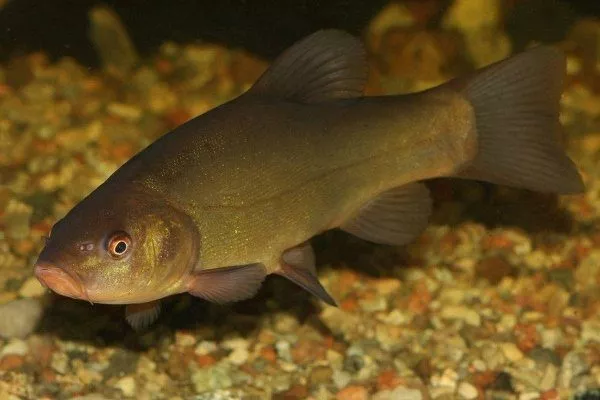
Tench are similar in appearance to their carp relatives. Their body color often changes shades depending on their habitat. Silvery-olive and bronze-hued fish are found on sandy bottoms. Dark green, almost black, fish also inhabit heavily silted and peaty waters. Distinguishing features of tench include small, bright red eyes and a small mouth with plump lips. Their body is covered in fine scales coated in mucus. Tench are virtually impossible to confuse with other fish.
Despite its unique appearance, tench shares similarities with crucian carp and common carp. Tench have barbels similar to carp, located at the corners of their mouths. Like carp, tench consume food by sucking particles from the bottom. While tench are capable of diving deeper into the silt in search of food, carp typically forage on the surface of the bottom.
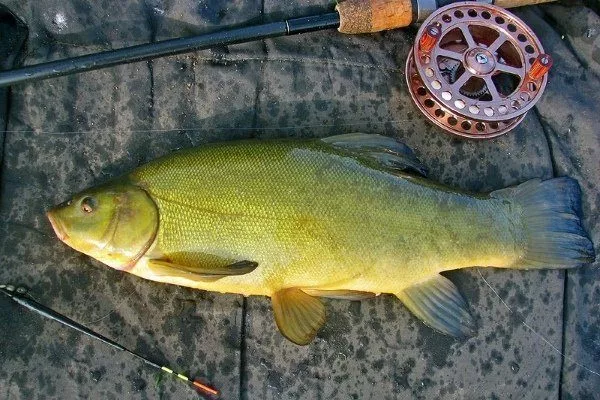
Tench shares a similarity with crucian carp in that it doesn't require high levels of dissolved oxygen in the water. Tench only requires 0.5-2 mg/L of oxygen for respiration. Therefore, in winter, when oxygen is depleted beneath the ice of some fish-killing ponds, only tench and crucian carp survive, burrowing into the mud and entering a state of suspended animation. Their metabolism slows significantly during this period, requiring even less oxygen than in the hot summer.
Tench, an average size of 150-700 grams, is caught in Russia. The average size for tench in central Russia is around 1 kilogram. Occasionally, lucky fishermen manage to catch a specimen of around 3-4 kilograms. Record-breaking specimens were caught in England—the largest tench, weighing 6,890 kilograms, was caught in 2001.
Tench is one of the few domestic fishes with distinct external sexual characteristics. Males have larger pelvic fins with noticeably thicker second rays. Females, however, are larger than males, growing 30-40% faster than males.
Where is tench found in Russia?
In Russia, tench inhabits the temperate zone of Eurasia. It is found in rivers and lakes of the Black, Caspian, Baltic, and Azov Sea basins. In Siberia, tench are found in the upper reaches of the Ob and Yenisei rivers, and a variety has also been recorded in the western part of the Lake Baikal basin.
Lifestyle and habitat
Tench prefers areas with slow currents, quiet river bays overgrown with soft vegetation. They feel comfortable in large ponds and lakes, and along banks overgrown with reeds, rushes, and sedge.
In summer, tench prefer shallow water, in sun-warmed thickets with a muddy bottom, at depths no more than 2 meters. The fish stays in one spot. Their search for food involves digging through the mud and slowly moving along the bottom. However, they won't stray far from their original location. Locating their habitat in the morning and evening is possible when the fish feed by following air bubbles—a long chain of them rises to the surface.
Although medium and large specimens live alone, juveniles and small fish gather in small schools. As cold weather approaches, closer to autumn, tench stop feeding, gather in schools, and hibernate for the winter around early November.
Winter is considered a dangerous time for tench, as a sharp drop in water levels can lead to the fish's death, and in shallow waters, they can be crushed by ice. Tench are protected from the cold by the mucus on their scales, which acts as a kind of protective capsule.
Tench are solitary fish with a sedentary lifestyle. They thrive near the bottom, avoiding bright light and hiding in undergrowth. Tench don't require high oxygen levels in the water, allowing them to survive in areas where other fish cannot.
Habits
Tench dig into the silt layer to search for food. They often dive deep into aquatic vegetation to feed. Fishermen claim it's impossible to spot tench on the surface. Others note that at night, when insects are abundant, the fish swim to the surface.
Daily activity
Tench are a fish that can feed throughout the day, but are most active in the morning and evening, when they typically migrate toward the shore. The rest of the time, they spend in deeper waters, but continue to feed there. It has been noted that on cloudy days, tench can feed throughout the daylight hours.
Seasonal activity
In spring and summer, tench inhabits shallow, vegetated lakes and rivers with a high silt content. They inhabit sun-warmed areas at depths of 1-2 meters and remain permanently in one location.
In autumn, when cold weather sets in, tench form schools, stop feeding, and freeze in the silt pits of ponds and rivers. In winter, the fish are inactive—they hibernate.
Tench are caught only during warm periods, as there will be no bite at other times. They fish from spring until spawning, then every 2-3 weeks. During this period, the fish experience incredible feeding frenzy. In the spring, when the water warms up, tench move closer to the shore to small patches of vegetation and algae, where they search for food.
Migration
Despite their sedentary lifestyle, tench are capable of making daily feeding migrations within the reservoir, moving from deep waters to the shore, avoiding vegetation along the same route. They may also make short migrations during spawning.
What do tench eat?
The main diet of these fish is animal matter, although they may occasionally consume plant matter. Their prey includes invertebrates found in and around water bodies, including insects and their larvae, mollusks, crustaceans, and worms. In the spring, they happily feed on algae and the green shoots of pondweed, reeds, sedges, water locusts, and cattails.
Fish have no seasonal preferences; they are completely unpretentious in their diet and consume everything edible that they can find.
Tench primarily feed in bottom areas with peat or silt soil, and in thickets of underwater plants. To obtain food, these fish must dig into the bottom. In autumn, tench feed less than in summer, and during wintering, they eat nothing at all.
But after awakening in spring, when the weather warms up, tench emerge from hibernation and migrate closer to shore in search of nutritious food. They feed on fish and mosquito larvae.
The process of reproduction
Tench are considered warm-water fish, capable of spawning relatively late, typically in late spring or early summer. They typically choose shallow, slow-moving waters as spawning grounds, sheltered from the wind, and richly overgrown with aquatic vegetation. They lay their eggs at a depth of 30-80 centimeters and often attach themselves to the submerged branches of shrubs or trees growing near the shore.
Spawning occurs several times, with intervals of 10-14 days. Spawning occurs only in fish that reach sexual maturity at 3-4 years of age. Reproduction is possible only for individuals weighing at least 200-400 grams. In a single season, the fish can lay approximately 20,000-500,000 eggs, which mature within three days.
At hatching, tench fry are no larger than 3.5 millimeters in size. They attach themselves to the substrate, and after 3-4 days, they remain in the same place where they were born. During this time, the larva grows rapidly, feeding on the reserves remaining in the yolk sac.
After the fry begin swimming independently, they gather in schools and hide in dense underwater vegetation, consuming animal plankton and single-celled algae to survive. Later, when the fish reach about 1.5 centimeters in length, the juveniles move to the bottom, where they begin to feed on more nutritious food consisting of benthic organisms.
Varieties of tench
Depending on its habitat, tench is divided into four ecological varieties. These varieties differ slightly in body features and, to a lesser extent, in scale color. The following tench varieties are found:
- Dwarf. The reason for this name is the tench's small stature—no more than 12 centimeters in length. This is because it inhabits areas overpopulated by fish, which leads to a sharp slowdown in growth. Dwarf tench is more common than other varieties and can be found in virtually any freshwater body.
- Lake. The fish is similar in appearance to the river tench, but is larger. This species prefers to inhabit large lakes and reservoirs.
- River. Tench are found in river backwaters or bays, branches, or channels with slow currents. They differ from lake and pond tench in their significant thinness. River tench may also have a slightly upward-curved mouth.
- Pond. Tench live in small artificial or natural ponds. They are slightly thinner and more slender than lake tench. However, when introduced to a lake, pond tench will quickly begin to gain weight and become similar in appearance to lake tench.
| Variety | Medium size | Preferred habitat | Nutritional Features |
|---|---|---|---|
| Dwarf | up to 12 cm | Freshwater reservoirs | Small invertebrates |
| Lake | larger than the river | Large lakes and reservoirs | Benthic organisms |
| River | thinner than lake | Slow-moving river bays | Insects and their larvae |
| Pond | thinner than lake water | Artificial or natural reservoirs | Vegetation and detritus |
Tench fishing
Tench fishing is prohibited in the Irkutsk and Yaroslavl regions, the Republic of Buryatia, and throughout the spawning season. Below, we'll discuss fishing for this species where it's legal.
Tench spend most of their time sedentary and are picky about bait. This can make catching tench seem like a rather challenging process. However, understanding the fish's habits in a particular body of water can make fishing more enjoyable.
In summer
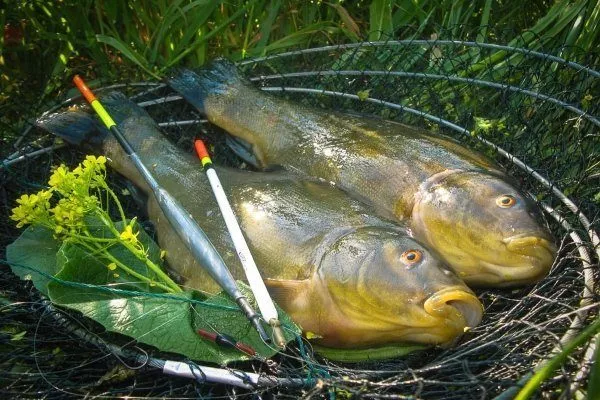
Summer is prime tench fishing time. The fish are more active during this period. Depending on their feeding habits, tench are caught using several types of tackle: float rods and bottom rods. The former method is advantageous because it yields excellent catches. When using a bottom rod, it's best to opt for a feeder rod.
At the very beginning of the open-water season, tench feed on animal matter, so caddis flies, bloodworms, worms, and maggots are used as bait. They also enjoy the leeches that inhabit the pond. A little later, when pond plant shoots (reed, cattail, pondweed, and water lilies) appear, the fish's diet becomes more varied. During this period, it is recommended to catch tench using pieces of shoots and the tender leaves of these plants.
Good fishing with plant-based baits begins towards the end of summer. Anglers use pearl barley, peas, and dough. Fish are also partial to cottage cheese. Some anglers report significantly improved bites when adding cottage cheese to certain baits.
To attract tench to your fishing spot, it's advisable to use standard groundbait. Considering the fish are known to "follow trails," they can be tamed by feeding them for several days. If you know exactly where the tench are, there's no need to feed them.
In winter
Although tench are not particularly active in winter, in some well-oxygenated waters and during prolonged thaws, the fish may emerge from hibernation and begin feeding. This is rare, and anglers often miss such moments. If a tench bites the hook in winter, it's considered pure luck.
However, some amateurs specifically go for tench in winter, but the maximum catch can be modest.
Bite and landing
In rare cases when tench are overly active, they will confidently grab the bait, but more often they are cautious and don't always bite. Their bite is somewhat similar to that of crucian carp. However, tench tend to "enjoy the process" for a couple of minutes: they lightly nip the bait with their lips and then drop it to the bottom. This causes the float to oscillate for a long time, which the angler might perceive as a bite from a small fish. However, at this point, there's no point in setting the hook. If the float suddenly dives and drifts to the side, or flips to one side, set the hook immediately.
Many fishermen have noticed from personal experience that fish, especially larger ones, will fight hard after hooking. They will also try to entangle the line in the weeds, trying to bury themselves in the mud. Landing a tench can often be very difficult, requiring serious focus from the angler. Tench tend to "falsely" release slack in the line, after which they immediately tighten it. This often causes the rig to break. It's advisable to use a strong line.
Losses are rare when fishing for tench, as the hook usually pierces the fish's fleshy mouth. After the tench tires, it's gently brought to the shore, into the surface water, without allowing it to splash around, so as not to disturb any other fish that may be hiding nearby. A landing net is used to finally remove the fish from the water; this prevents it from slipping due to its thick layer of mucus.
Use as live bait
It's generally accepted that the small tench, despite its resilience, is a poor live bait fish, as it offers no appeal to predators. However, some anglers disagree. They argue that there are bodies of water where tench abound, and where predators become accustomed to feeding on the fish.
Tench for sale: preparing for business
Tench is farmed as a secondary commercial fish, although in pre-industrial Russia it was farmed alongside crucian carp and common carp. Generally, pond tench farming is virtually no different from carp farming.
The most difficult stage is the first one, which involves overcoming administrative barriers. The pond can either be leased from the state or dug independently. In both cases, the necessary permits will need to be obtained.
- ✓ Presence of a muddy bottom
- ✓ Abundance of vegetation
- ✓ Depth not less than 1.5 meters
- ✓ Possibility of water level control
When choosing a pond or a site for its digging, a number of factors are taken into account, including the specific body of water suitable for tench breeding. The fish prefer warm, muddy bodies of water with abundant vegetation. Very small, stagnant ponds are not suitable for tench.
To run a profitable tench farming business, you'll need a site with a water surface area of at least 20 hectares. Larger sites are also possible, depending on your budget. A large pond not only produces a large number of fish but also generates income from paid fishing services. If the pond is located near a populated area, earnings from fishermen may be higher than from selling the fish.

When choosing a pond, it's also important to consider a drainage system. A drainage system not only helps control the water level but is also considered the easiest way to catch commercial fish. If installing a drainage hose isn't feasible, consider abandoning the pond and choosing another option.
Tench is a fish that requires a muddy bottom and abundant vegetation in a pond, at least 1.5 meters deep, to safely overwinter. When extensively farmed, the fish feed on small invertebrates extracted from the mud, plant debris, and detritus. This is advantageous because the fish farmer doesn't have to invest in pond maintenance. However, this method is only suitable for large ponds, and the number of commercial fish is small.
To increase the yield from a pond of the same size, intensive farming is recommended, with artificial feed being the mainstay of the tench diet. This method is suitable for raising mature fry, which are released into the pond in the spring and harvested in the fall for sale. Several tons of fish can be produced per hectare of pond, but intensive farming is also quite expensive.
The intensive method of tench breeding involves feeding the fish with compound feed, chopped fresh vegetables mixed with porridge, weed seeds, and grain waste.
Breeding and raising tench for sale
Tench farming begins with fry purchased from specialized fish hatcheries. Purchased juveniles weigh 30-40 grams and reach a weight of approximately 200 grams by the age of two. By the third year, they weigh approximately 400 grams, which is considered excellent for commercial fish. Average tench productivity is 1.2 tons per hectare. When grown in polyculture with carp, total productivity can reach 1.5 tons.
In small bodies of water, catching commercial fish is not a problem, as tench are considered lazy fish that stay close to their feeding grounds—they're easily caught with a drag. Large lakes and ponds present a more challenging challenge, as dragging them makes no sense as you won't be able to cover the entire water area. The only effective option in this case is to drain the water. This process is carried out at night with minimal noise to prevent the tench from burying themselves in the mud.
A distinctive feature of the fish is its unpretentiousness and the ability to transport it without problems - with sufficient air humidity, the fish can survive without water for about 48 hours.
Profitability of tench breeding
Calculating the average farm profitability is difficult, as it requires taking into account specific factors that can yield different financial results depending on the entrepreneur's operating conditions. Furthermore, today in Russia, there are no tench farmers who exclusively raise tench. At best, they release it into a pond with carp. For these reasons, we will consider a typical cost chart for setting up a fish farm:
- On average, the construction and preparation of a 100-hectare pond costs approximately 5-7 million rubles. This includes the creation of the pond's relief and the construction of sluice gates. If the pond is provided by the state, the costs can be significantly lower.
- You'll have to spend money on purchasing tench fry. Restocking a 100-hectare pond will cost around 2-3 million rubles. If you catch tench every fall, you'll have to spend money on fry every year. However, if you decide to let the fish reproduce, reducing the catch quota, it's possible that the spawning in the pond will cover the population loss from catches. This means you won't have to spend any more money on restocking the pond with fry.
- With intensive tench farming, the entrepreneur will need to invest in supplementary feeding. Agricultural waste is primarily used for this purpose. Bargaining with farmers can help reduce costs—they are willing to sell wholesale at lower prices.
- The expenses include the salary of a security guard who will monitor order at the pond and protect it from poachers.
- There will also be expenses when paying for services for catching fish and transporting it to the place of sale.
On average, the cost of a kilogram of fish farmed using intensive methods is about 70 rubles per kilogram. With extensive methods, it's much lower. Wholesale sales of frozen fish are around 100 rubles per kilogram, and live tench are 120-140 rubles. Retail sales will be several times higher. Thus, net profit per kilogram will be approximately 30-40 rubles, depending on the cost, current wholesale prices, and the distribution method.
On average, 1.2 tons of commercial fish are harvested per hectare using intensive methods. Therefore, a single 100-hectare pond can generate a net profit of up to 3.6 million rubles per catch for an entrepreneur. Profits can be increased through additional sources of income, such as organizing paid fishing trips. For example, in the Moscow region, a fisherman pays several thousand rubles per day. If 10 people fish at the pond daily, the additional income will be approximately 10,000-20,000 rubles per day.
Gastronomic features
Tench caught in late April or early May are considered particularly tasty. During the spawning season, the carcasses are not eaten. The taste and aroma of this fish often discourage many people from eating it. It's a freshwater fish that thrives in marshy waters, which can cause its flesh to smell muddy. However, there's a simple solution: place the live fish in clean water for 12-14 hours. If this doesn't help, try adding spices and lemon juice.
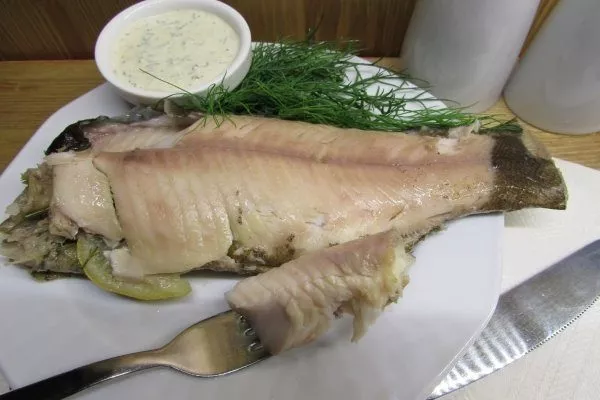
Before cooking, the fish is cleaned. At this stage, it's important to remove all scales without damaging the fish skin, which develops a delicious golden crust after frying or baking.
Tench is a versatile fish, as it can be boiled, marinated, baked, fried, and used to make fish soup and jellied meat. Various fillings are made from the fish fillet. Tench is delicious cooked in sour cream and wine, stuffed, and baked with herbs. Many gourmets enjoy fried and baked tench, as this results in a particularly tender and juicy fillet.
If you bake tench, first marinate the fish in lemon juice and spices, then bake it with a bunch of dill placed in the belly of the carcass.
About the properties of tench mucus
The mucus that covers the tench's body has healing properties due to its natural antibiotic properties. Research by ichthyologists has found that sick fish swim to healthy ones for healing: they rub against the mucus-covered fish. This also helps protect against aquatic parasites.
The fish itself, thanks to the mucus, survives even during winter, when it hides from the freezing temperatures. Surprisingly, tench will even allow a sick pike to approach it for "treatment," and the pike won't attack. However, a healthy pike is not averse to feasting on the healing fish. Predators generally don't consider tench as food, probably because of the thick mucus covering the fish.
The fish got its name from the unusual mucus it contains. When the fish comes out of water and into the air, the mucus on its body dries and darkens, changing its color. Afterward, it falls off in chunks, leaving behind light-colored scales. In simple terms, the fish molts. Hence the name "tench."
Interesting facts
Some characteristics of the tench are surprising. The fish has incredibly strong and thick skin. But that's not the only thing that particularly astonished the researchers. The fish's body is capable of producing a unique protein substance, not found in other fish, with powerful antiseptic properties. Experiments have confirmed that this substance is highly effective against many viruses, bacteria, and skin parasites.
The presence of this substance protects tench from many diseases that affect other aquatic inhabitants. This attracted the attention of Japanese scientists, so much so that they wanted to create a powerful antibacterial agent from tench mucus. However, several years of research revealed that while this was feasible, it was very difficult and expensive.
Scientists were surprised by what their studies of fish blood revealed. It turned out that the fish contained ichthyotoxins—substances with toxic properties. Similar compounds had previously been identified in the carcasses of river eels, bonito, carp, tuna, and several other freshwater and marine creatures. The conger eel is considered the most dangerous. A study using laboratory mice revealed that exposure to the toxic substance resulted in death in almost 85% of cases, and very quickly—within 10-30 minutes.
The highest concentration of the toxic substance in fish bodies is observed during the spawning season. Researchers have not yet been able to determine the cause of this peculiarity. The good news is that tench carcasses contain small amounts of ichthyotoxins, so there is no need to avoid eating this fish. The toxins are destroyed during cooking. The only danger to humans is the direct ingestion of the toxic substance into the bloodstream.
Tench is a fish from the carp family. Its distinctive features include its unique appearance, excellent taste, and low feeding requirements. It is profitable to breed tench alongside carp, as this significantly increases income.