
Fertilizing ponds can increase their natural fish production. There are several types of fertilizers, each with its own specific characteristics. They must be applied correctly, taking into account the factors affecting their effectiveness. Proper storage and safety precautions are also crucial.
Types of fertilizers for ponds
Pond fertilizers are similar to those used for soil. They can be mineral or organic in origin. Each group includes several other types.
| Name | Origin | Nitrogen content | Recommended dosage |
|---|---|---|---|
| Ammonium nitrate | Mineral | 35% | 20-25 kg/ha |
| Ammonium sulfate | Mineral | 21% | 20-25 kg/ha |
Nitrogen fertilizers
This species is of mineral origin. Nitrogen is needed for protein formation and other biochemical processes.
When this type of fertilizer is applied, plant growth actively develops and the water becomes oxygenated. This results in increased fry stocking density and a significant increase in the yield of fingerlings. All this ensures increased efficiency in the use of the fish pond's space.
Another positive aspect of using this type of fertilizer is that it inhibits the growth of certain algae.
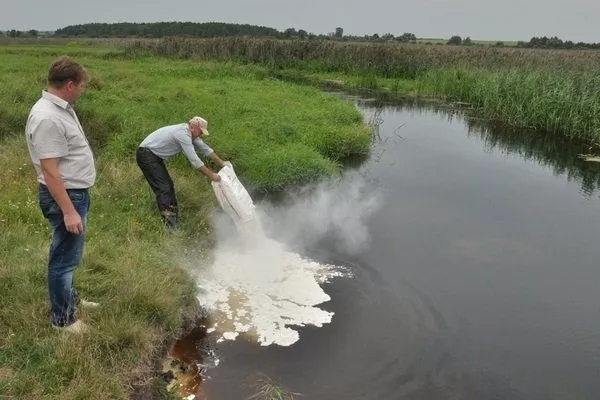
Ammonium nitrate, which contains 35% nitrogen, is most commonly used as a nitrogen fertilizer. An aqueous solution is prepared; 20-25 kg of fertilizer is required per hectare. It is applied annually by sprinkling onto the surface of the pond. This type of fertilizer can be applied in the required amount in one go.
High nitrogen concentrations should be avoided. One liter of water should not contain more than 2 mg of pure nitrogen. If this level rises to 5 mg, the fish will become toxic, leading to inevitable death.
In addition to ammonium nitrate, ammonium sulfate can also be used for ponds. It has a nitrogen concentration of 21%.
| Name | Soil type | Recommended dosage | Efficiency |
|---|---|---|---|
| Superphosphate | Clayey, loamy, sandy loam, podzolic, peaty | 25 kg/ha | Increase productivity by 15-100% |
| Thermophosphates | Clayey, loamy, sandy loam, podzolic, peaty | 25 kg/ha | Increase productivity by 15-100% |
| Phosphate rock flour | Clayey, loamy, sandy loam, podzolic, peaty | 25 kg/ha | Increase productivity by 15-100% |
| Bone meal | Clayey, loamy, sandy loam, podzolic, peaty | 25 kg/ha | Increase productivity by 15-100% |
| Tomashlak | Clayey, loamy, sandy loam, podzolic, peaty | 25 kg/ha | Increase productivity by 15-100% |
| Precipitates | Clayey, loamy, sandy loam, podzolic, peaty | 25 kg/ha | Increase productivity by 15-100% |
Phosphorus fertilizers
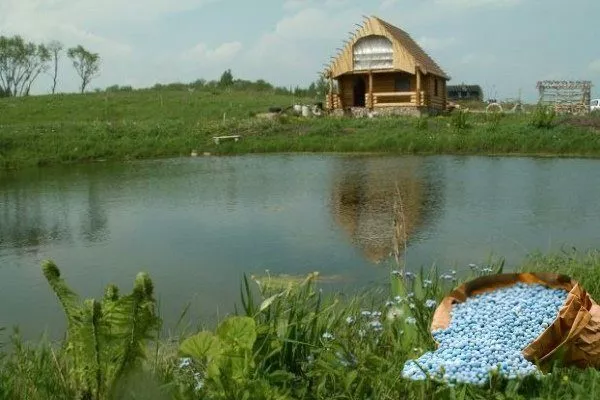
Phosphorus is one of the most essential minerals. It enables various organisms and microorganisms to build cells. This element is especially important during the initial feeding period, when organs are forming. A phosphorus deficiency at this stage cannot be compensated for later, even by generous feeding.
Phosphorus fertilizers are especially important if the pond is based on the following soil types:
- clayey;
- loamy;
- sandy loam;
- podzolic;
- peat.
Fertilizers of this type must be applied according to the recommended dosage—an average of 25 kg of phosphoric acid is required per hectare. Providing phosphorus at the right time and in the right amount can increase a pond's productivity by 1.5-2 times (at least 15%).
It is recommended to apply these fertilizers in portions. This should be done approximately every 1.5-2 weeks. The dosage should be calculated to achieve a constant concentration of 4 mg per liter. The following is used:
- superphosphate (simple, double);
- thermophosphates;
- phosphate rock;
- bone meal;
- Thomas slag;
- precipitates.
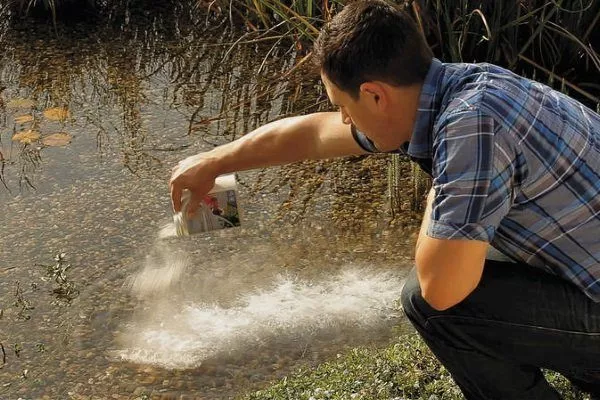
It's effective to use both phosphorus and nitrogen fertilizers simultaneously. The amount of nitrogen fertilizers should be 4-8 times greater.
Calcium fertilizers
A certain calcium content is crucial, as this element is needed for fish skeletal development, various chemical and physiological reactions in the pond's soil and water, and the regulation of bacterial processes. Fertilizer is also added to prevent gill diseases and to precipitate organic matter and some phytoplankton.
Calcium is supplied by lime—slaked or quicklime. The fertilizer should be finely ground. Due to its ameliorative properties, it is recommended to add it to ponds with excess organic matter and acidic soil. If calcium reserves are high, lime sterilizes the water. The concentration of this element should average 80 mg per liter.
Calcium content in water can be determined by certain plants. Deficiencies are indicated by horsetails and peat mosses, while excess is indicated by elodea and chara.
Watch a video about adding lime to a pond:
Potash fertilizers
Such fertilizers aren't always necessary, as potassium salts can be present in sufficient quantities in the soil. Potassium ensures the proper development of pond plants, and its deficiency manifests itself as brown spots on the leaves.
The following are used as potassium fertilizers:
- wood ash (10% potassium);
- sylvinite (17%);
- kainite (21%);
- potassium sulfate (42-53%);
- potassium chloride (54-57%).
Potassium fertilizers are applied at a rate of 30-100 kg per hectare. It is recommended to use phosphorus fertilizers in combination. Potassium is especially important in sandy loam or podzolic soils.
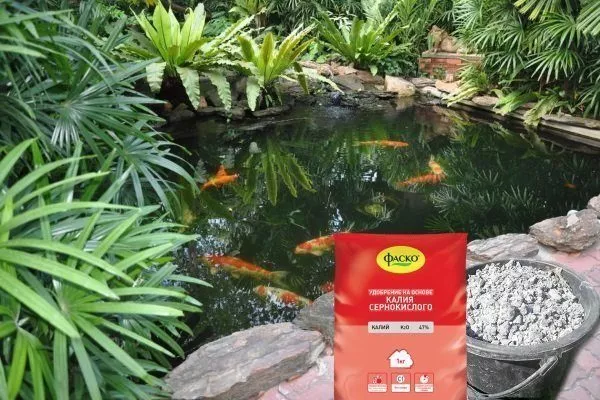
Timely application of fertilizers can increase fish productivity by an average of 35%.
Organic fertilizers
This type of fertilizer can be used when the fish pond has a good oxygen supply. This is important, as decomposing organic matter consumes large amounts of oxygen, and a lack of it can impair the fish's respiration.
Excessive organic fertilizers can also cause gill rot.
The following is used as organic matter:
- manure - horse, cattle, bird droppings;
- compost – manure, plants and soil, this fertilizer should mature for at least six months;
- Green manure – vegetation of aquatic or terrestrial origin.
The required amount of organic fertilizer is calculated based on the soil type. One hectare will require:
- 10-12 tons of organic matter for clay, sandy or sandy loam soil;
- 6-10 t, if the pond bottom is silty;
- 3-6 tons in fertile soil rich in organic matter.
Organic fertilizers are applied in the spring or fall, before the pond is filled with water. When applying manure, it should be spread over the soil surface and then tilled to a depth of 5 cm. If applying fertilizer to a pond already filled with water, it should be distributed in small portions along the shallow parts of the shoreline.
Water lilies, elodea, and pondweed are often used as green manure. They can be applied either separately or mixed with manure. Approximately 4-5 tons of green manure are required per hectare.
Factors Affecting Fertilizer Efficiency
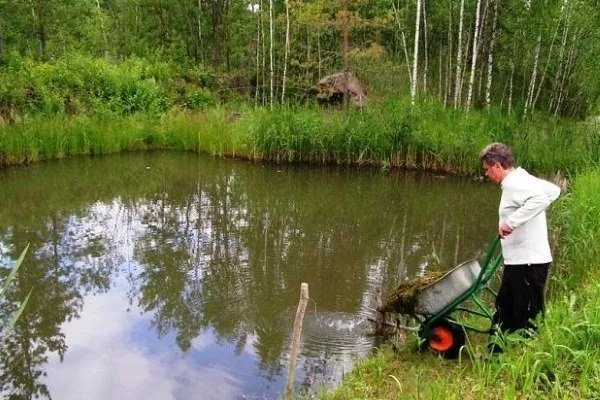
The effectiveness of fertilizer application depends on several factors:
- quality of the aquatic environment as a whole;
- water temperature;
- pH level;
- oxygen regime and other indicators of the gas balance of the reservoir;
- soil characteristics – refers primarily to its type, composition, and structure;
- silt deposits - their density, degree of growth;
- movement of water masses;
- fish living in the pond, their ratio;
- age of aquatic organisms, their physiological characteristics;
- pond fish stocking density;
- Features of feeding aquatic organisms - its intensity, type of feed used.
A special coefficient is used to evaluate the effectiveness of a fertilizer. It shows how much fertilizer is needed to increase the fish growth per kilogram (only the growth due to the fertilizer is taken into account). When using complex fertilizers, this coefficient is calculated separately for each component, and the resulting values are then summed.
To determine a pond's fertilizer needs, you can use a biological method called a bottle test. This procedure is based on observing phytoplankton, which release oxygen and consume organic matter. Phytoplankton photosynthesis increases, which in turn enhances their growth. This response to fertilizer indicates the pond's need for it.
Rules for adding fertilizer to a pond
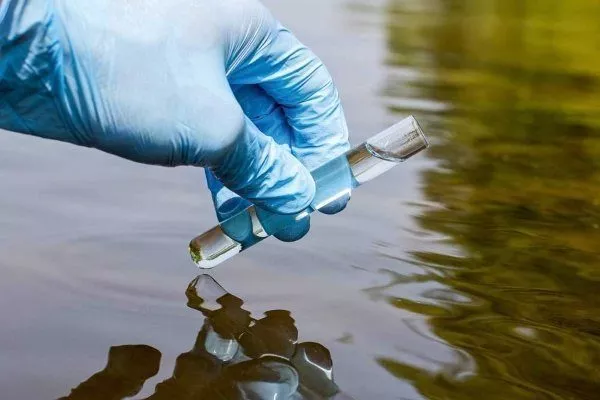
Organizing this process requires taking into account a number of nuances. This concerns not only the substances and quantities required for a particular application, but also other specifics. When applying fertilizers, it's important to adhere to the following rules:
- Properly prepare the pond for fertilization. If there are any marshy areas, drain them first. Lime the pond's acidic zones, which helps improve soil fertility.
- Removing hard aquatic plants. This includes sedge, cattail, reed, and rush.
- Thinning soft plants. They tend to grow too large. They should be thinned so that they occupy no more than a quarter of the pond's total area.
- The water and soil should be neutral or slightly alkaline. The pH should be 7-7.5. Lime is often used to balance the acidity.
- Fertilizers can be added to an empty pond or after it's filled. The former is used primarily for organic matter, while the latter is used for mineral fertilizers.
- A motor pump or sprinkler system can be used to apply fertilizer to a small pond. A nursery and rearing pond requires a boat and hanging mesh drums.
- To influence phytoplankton, fertilizers should be added to the water column, and to promote the reproduction of benthic organisms, to the bottom of the pond.
- Liquid fertilizers are preferred for applying mineral fertilizers. Dry fertilizers are acceptable if they dissolve well in water, with the exception of phosphorus fertilizers.
- Fertilizer application should begin when the water temperature is at least 15 degrees Celsius. This is when bacteria, phytoplankton, zooplankton, and zoobenthos begin to thrive. At temperatures below this point, stop applying fertilizer.
- Manure and compost should be added twice during the growing season – first before filling the pond, then at the beginning of July.
- When working with lime, you should use a respirator.
- When working with any mineral fertilizers, you must wear protective clothing: a coat with a high collar, gloves, and boots. These measures are mandatory safety requirements.
If fertilizer gets into your eyes, immediately rinse with water and seek medical attention. If saltpeter or ammonia water gets on your skin, rinse the affected area with water and treat with petroleum jelly or zinc stearin ointment.
Workers handling fertilizers are required to undergo training before starting work. This training is then required every six months.

Fertilizer storage rules
The effectiveness and safety of fertilizers used in ponds largely depends on proper storage procedures:
- a special storage room is required, which must always be dry;
- organization of a drainage channel around the warehouse;
- providing free space between the floor and the ground;
- storing each type of fertilizer in separate sections - solid partitions are installed to separate them;
- It is prohibited to store ammonium nitrate in rooms with wooden floors;
- Ammonium nitrate is stored in bags, which are stacked in 8 rows crosswise;
- When storing ammonium nitrate, a fireproof wall is required to separate the substance from other fertilizers;
- When storing ammonium nitrate, it is prohibited to smoke, use open fire, use faulty electrical wiring, or use electrical appliances in this room;
- the presence of any petroleum products, peat, or feed in the warehouse is prohibited;
- When storing ammonium nitrate, a corresponding sign is placed on the outside of the warehouse wall: “flammable”;
- For storing loose fertilizers, heaps are used - the permitted height is up to 3 m;
- for storing fertilizers packaged in containers, stacks are organized - 20 rows;
- each container or compartment must be marked with a label, which must indicate the name of the fertilizer and the amount of active ingredient;
- the warehouse must be equipped with a washbasin;
- It is essential to have soap (preferably liquid), a towel, and a first aid kit;
- A drinking water fountain must be provided in the warehouse.
- ✓ Maintain humidity in the storage area below 60% to prevent fertilizer clumping.
- ✓ Ensure good ventilation of the warehouse to prevent the accumulation of toxic gases, especially when storing ammonium nitrate.
Pond fertilization is organized to enhance natural fish productivity. Various types of mineral and organic fertilizers are used, each of which must be applied according to specific rules. Storage conditions must be observed and the safety of the work performed must be ensured.