
Fish farming becomes a profitable business if you provide your fish with a balanced and nutritious diet. To ensure rapid weight gain, the feed must be appropriate for the fish's species and age, and the feeding schedule must be tailored to their natural needs.
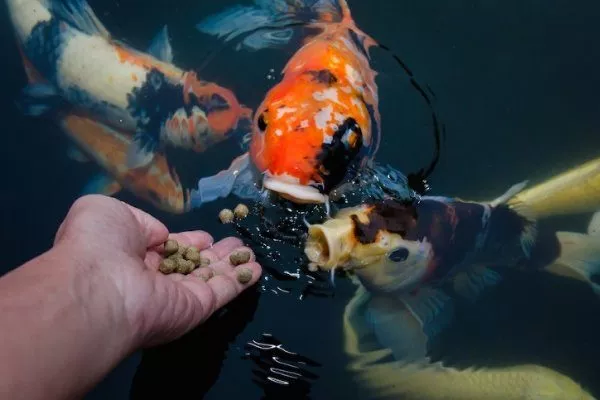
Types of feed
When raising fish, proper nutrition is the key to good weight gain and the foundation of a successful fish farming business. Compared to livestock farming, fish require significantly less feed per kilogram of weight gain. The key is to choose the right feed and provide it to your fish.
| Name | Type of feed | Protein content | Fat content |
|---|---|---|---|
| Ready-made feeds | Granules | 30-40% | 5-10% |
| Natural food of fish | Plankton, benthos | 20-30% | 2-5% |
| Self-preparation | Mixture | 25-35% | 3-7% |
Ready-made feeds
Prepared foods are the simplest option for feeding fish. They contain a complete set of nutrients required by fish of a certain species and age. They are available in granules of various sizes.
Advantages of dry food:
- significantly simplify the feeding process;
- completely solve the nutrition issue, providing the inhabitants of the reservoir with a complete diet;
- are created specifically for certain types of fish;
- do not pollute water.
When selecting food, consider:
- what and how fish feed (predators, herbivores, omnivores);
- age of the fish, its nutritional needs;
- The size of the fish - the size of the granules depends on this.
When choosing prepared foods, pay attention to the nutritional content. All foods are divided into two groups:
- Plant-based. These include cereals. Commonly used are ground wheat, bran, legumes (soybeans, vetch, lupine), as well as meal and cake.
- Animals. These include fishmeal, meat and bone meal, blood meal, and krill meal. Fishmeal is the best of all, as it contains amino acids essential for fish growth.
In addition to prepared feed, premixes and enzymes are introduced into the fish diet to facilitate food digestion.
Natural food of fish
For fish to thrive, there must be plenty of food in the pond. Fish rely primarily on animal and plant organisms for their nutrition.
To gain 1 kg of weight, a pike perch must eat 3 kg of fry, and a perch – 5 kg.
A fish's diet depends on its type. A distinction is made between peaceful and predatory fish. When they're young, they feed on the same things—larvae and plankton. As they grow, their preferences change. Predators prefer to prey on the fry.
The entire food supply of ponds is divided into two groups:
- Plankton. These are small plants and animals. A distinction is made between zooplankton, which is eaten by predatory species, and phytoplankton, which is consumed by fish fry and larvae.
- Benthos. The food supply for peaceful species includes larvae, insects, mollusks, and worms.
Natural food sources are greatest in ponds with stagnant water and well-warmed by the sun. In such conditions, plankton reproduces especially actively.
Natural food should make up at least 30% of a fish's diet. This is especially important for young fish. To effectively use live food in feeding pond fish, it's important to determine the natural food supply in the pond. For this purpose, hydrobiological studies are periodically conducted in ponds.
To enrich ponds with natural food, insects are attracted to it. Natural food is also bred locally, for example, by raising worms in boxes filled with black soil.
The choice of food is influenced by the fish's feeding method:
- Collection from the water surface. These species are fed aquatic and terrestrial insects.
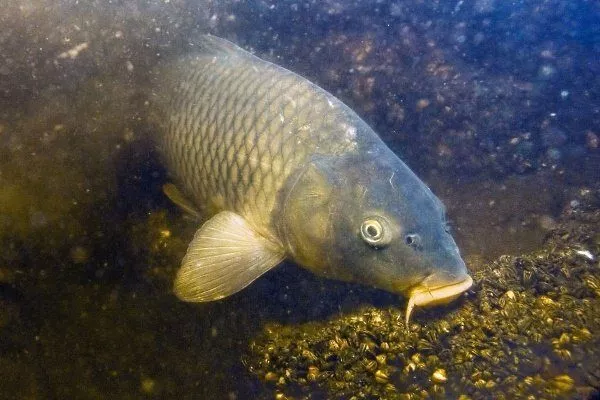
- They eat food from the bottom. They are given crustaceans, worms, and insect larvae.
Self-preparation
If necessary, store-bought food can easily be replaced with homemade food. Crucian carp food recipe:
- Mix the ground meat with ground corn. Add the bran and bone meal.
- Pour boiling water over and let steep for 30 minutes.
- Roll the resulting mixture into balls.
The food will be even more nutritious if you add chopped nettle or dandelion leaves, dung worms, and bloodworms to it.
Another recipe for compound feed for crucian carp, carp and other cyprinids:
- To obtain 100 g of the mixture, steam 40 g of oatmeal.
- Pour cold water (300 ml) for 15-20 minutes.
- Grind beans, peas, and kidney beans (15 g) and herbaceous plants (10 g) – bluegrass, spinach, and dandelion – in a meat grinder. Add crushed eggshells, oven-baked bones (5 g), semolina (10 g), chalk (2 g), dried bloodworms (10 g), boiled potatoes (5 g), 1 Undevita dragee, and gelatin (0.4 g).
- The mixture passed through a meat grinder is stored in plastic bags for no longer than a week.
How to choose the right food?
Don't feed fish just any old food. Commercially available feeds are formulated based on the age of the fish—see Table 1.
- ✓ Consider the digestive specifics of predatory and peaceful fish when selecting food.
- ✓ For fry, use food with a high protein content (at least 40%).
- ✓ Add vitamin premixes to the diet of adult animals to improve immunity.
Table 1
| Age | What to feed? |
| Fry | Starter feed made from krill meal with glucan (immunostimulant). |
| Juveniles | Transitional food based on fish meal, with fish oil and gluten. |
| Adult fish | Mixtures of fish meal with added vitamins. |
The composition of feed for carp and salmon also differs. Carp feed contains grain and grain production waste.
When choosing food, also consider:
- Type of fish. The composition of feed for carp and salmon differs significantly. Carp feed contains grain and grain production waste.
- Release form. A distinction is made between granulated and extruded feed. The former uses a binder, while the latter uses denatured protein. Extruded feed crumbles less and doesn't pollute water. It swells six times slower than granulated feed.
- Manufacturer. When choosing a feed supplier, you should consider reputation, as well as value for money.
Fish food manufacturers offer a variety of options and forms. How can you figure out which food your fish need? Table 2 lists the types of food and the fish they're suitable for.
Table 2
| Type of feed | Who are they suitable for? | Peculiarities |
| Starting | fry | Contains a lot of nutrients and proteins. |
| Production | adult fish | They are highly digestible, ensuring high weight gain and feed savings. |
| For manufacturers | producers before spawning | Ensure high-quality reproductive development and allow for the production of high-quality fish seed. |
| With pigment | for salmon breeds | They contain a lot of carotenoids, which give the fish meat a beautiful orange color. |
Feeding rules and conditions
If fish lack natural food for normal growth, they are fed artificial feed. The volume, type, and feeding schedule are determined on a case-by-case basis. Feeding schedules are influenced by a number of factors, including the chemical composition of the water and the degree of pollution.
The following factors influence fish feeding:
- Season. In summer, fish are given more food than in cold weather. Many species do not eat at all during the winter, hibernating.
- Species and age. Young fish require more food.
- Accommodation. Fish living in ponds and open water bodies/pens are fed differently.
- Temperature. Fish are usually fed twice a day – before 10:00 a.m. and at 2:00 p.m. In the summer, in July and August, when natural food is abundant, they are fed a couple of hours after sunrise. In the fall, they are fed once a day – between 10:00 and 12:00 a.m. Feeding rates are gradually reduced based on water temperature. For example, carp are stopped feeding when the water cools to 10 degrees Celsius.
- Edibility. To determine if fish are getting enough food, pay attention to their consumption rate. A single serving of feed is consumed within 2-3 hours. If the feed disappears quickly, the feeding rate should be increased. If food remains uneaten for more than 3 hours, the feeding rate should be reduced.
Feeding place
The feeding schedule is influenced by the fish's habitat. This could be a private pond, a natural reservoir, or an artificial one. If the reservoir is large, the feeding area is marked with a pole or floating buoy.
Feed the fish at a consistent time each day to develop a conditioned reflex to the location and time of feeding, which prevents the food from becoming soggy and eroding. Feed the fish in the coastal zone. The optimal depth is 60-80 cm.
Private ponds
If fish are raised in a natural pond, feed requirements are not as stringent as when raising stock in artificial ponds. Natural ponds contain a variety of plankton, which is supplemented with pellets or dough-like feed.
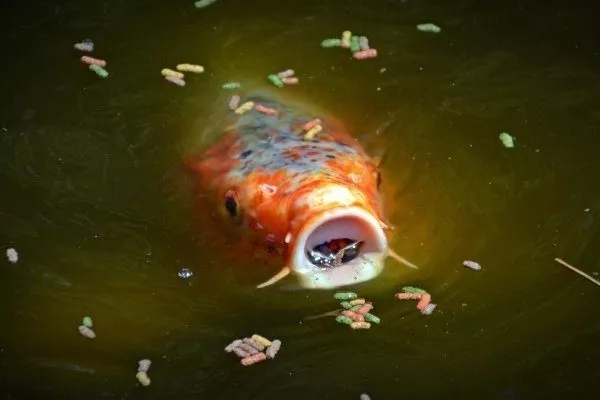
Preference is given to pelleted feeds and briquettes, as these types of feed are characterized by good moisture resistance. Dough-like feed is inferior to pelleted feed in this regard: after an hour, it loses 50% of its nutritional value.
When raising fish in cages and tanks, feeding is 100% artificial. Feed selection and feeding rates must be approached with particular care, as the success of a fish farming business depends on the correct selection of feed.
At the dacha
Fish kept in small country ponds need to be fed regularly. The food supply is either nonexistent or very limited. For the fish to grow, gain weight, and reproduce, they require artificial food.
Feed is dispensed in measured doses. If you feed more than required, the fish will not eat it, and the pond water will become polluted. Dirty water will starve the pond inhabitants of oxygen, weaken their immune system, and cause them to become ill. It is not recommended to scatter feed on the pond surface; special feeding bowls are provided for feeding.
You can see what fish are fed in country ponds in the video below:
What kind of fish can be bred in a summer house or on a farm is described in next article.
Feeder
Fish feeders are simple structures that can be purchased at specialty stores or made at home. Feeders come in:
- lifting;
- motionless;
- self-floating;
- automatic.
The simplest feeder is a float with food containers attached. To make one, you'll need a plastic canister cut in half or a wooden box.
A wooden block is attached to the plastic container to help move the feeder around the pond. It's recommended to have two sections for different types of food. The structure is submerged in the water. A regular brick can be used as a weight. To adjust the depth of the feeder, weights of varying weights are used. The structure is secured to the shore so that food can be quickly lifted and placed inside if needed.
Automatic feeders come in different types, with and without an electric drive. In non-electric designs, food is dispensed mechanically. For example, by touching a pendulum—fish swimming toward it move it, and food is automatically dispensed into the feeder. There are models in which portions are dispensed by a clock-like mechanism.
How does the feeding regimen depend on the season?
Fish are cold-blooded animals, so their metabolism depends on the ambient temperature. As the temperature rises, their metabolism speeds up, and as the temperature drops, it slows down.
Rules for feeding fish depending on the season:
- Feeding pond fish begins when the water temperature reaches 8-10 °C.
- The feeding season in the pond begins in spring and ends before winter.
- In summer, feeding is restricted when water temperatures reach 26-30°C. Oxygen dissolves poorly in hot water, causing fish to have difficulty breathing. Feeding during this period is detrimental.
- A month before the onset of cold weather, increase the proportion of fat in the feed to accumulate energy reserves.
- Two weeks before wintering, gradually reduce the frequency of feeding.
- Just before the cold weather sets in, carry out a control feeding with fortified food.
In winter, fish become completely or partially dormant. Their bodies draw nutrition from their stored reserves. Table 3 shows the monthly food distribution (for temperate climates).
Table 3
| Month | % of total feed volume |
| May | 5-10 |
| June | 20-25 |
| July | 20-35 |
| August | 25-30 |
| September | 5-10 |
Feeding depending on the type of fish
Different fish species have different nutritional needs. To ensure profitable fish farming, consider not only the fish's age and weight, but also its species:
- Catfish. By the time catfish are introduced to artificial food, their digestive system has matured and is capable of digesting a wide variety of foods. Catfish are not particularly picky about their food composition. SB-1 and SB-3 mixtures, supplemented with calcium, are commonly used. The fry are fed eight times a day. Later, they are fed four times a day. The portion size depends on the temperature.
- SalmonThe main ingredients are marine and freshwater fish, meat processing waste, dry skim milk, meat and bone meal, fish meal, and krill meal. The ingredients are mixed independently or pelleted salmon feed is purchased.
- Acne. They require high-protein feed, as this determines their growth rate. Young animals are fed 10 times a day.
- Sturgeons. These fish are fed high-fat diets. The older the fish, the less frequently they are fed. Fry feed 10-12 times a day, while adults eat 4-8 times. Pelleted and paste-based diets are suitable. The rate of weight gain and meat quality depend on their balance of minerals and vitamins. You can find more information on sturgeon farming. Here.
- Cyprinids. The daily feeding rate depends on the fish's weight and temperature. For fish weighing up to 0.5 kg, it is 2.8% of their body weight. Yearlings and two-year-olds are fed pelleted food twice a day. Juveniles are fed hourly at first, then less frequently. The frequency of feedings is reduced as the water cools. More has been written about carp farming. here.
An experienced fish farmer will explain in detail how to feed carp in a pond in his video:
Fish shouldn't be fed bread—it contains sugar and yeast, which fish don't need. Furthermore, baked goods quickly become soggy and pollute the water.
How to increase the food supply of a pond?
To increase the pond's food supply, insects are attracted by fluorescent lamps positioned 30 cm above the water. If the temperature is warm outside, at least 15°C, the greatest number of insects appears between 10 and 11 PM. The lamps are left on for several hours. The recommended pond lighting is one lamp per hectare. Under these conditions, 100 grams of insects can be attracted per square meter.
To increase fish productivity:
- Bottom sediments are loosened using special rakes. This promotes plankton growth.
- If fish are raised without wintering, humus is added to the bottom of the pond: 2-3 tons per 1 hectare.
Proper feed selection and adherence to a feeding schedule are the foundation of successful fish farming. The fish farmer's job is to consider all factors affecting dietary requirements and provide the fish with feed that meets their needs.