
In addition to creating comfortable conditions for pond fish, it's essential to ensure proper, balanced feeding. Learn how to prepare your own food so it contains everything your fish need to thrive—read more in this article.
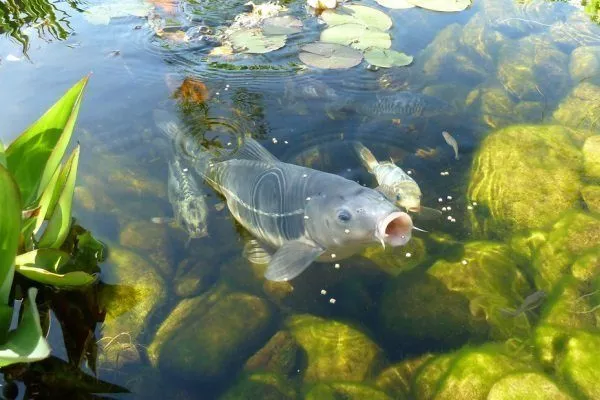
Live food
It's a staple food for fish, as it contains all the nutrients needed to fully satisfy their needs. Various flours are most commonly used:
- bloody;
- meat;
- fish;
- krill.
- ✓ Protein content should be at least 70% to ensure fish growth.
- ✓ Flour digestibility should exceed 85% for maximum feed efficiency.
But home-grown maggots, bloodworms and worms are also used to feed fish that feed on bottom dwellers.
At the very beginning of their development, all fish larvae, hatched from eggs, require plant food and bacteria. If the reservoir has an insufficient food supply, it must first be created. As the fry grow, they eventually transition to larger, more nutritious food sources—plankton and benthos.
Zooplankton farming
| Name | Protein content, % | Fat content, % | Digestibility, % |
|---|---|---|---|
| Bloody torment | 80 | 10 | 90 |
| Meat meal | 70 | 12 | 85 |
| Fish meal | 75 | 8 | 95 |
| Krill meal | 65 | 15 | 80 |
It can be grown year-round, and the process requires no additional financial investment. Simply dig a trench 60 cm deep during the warmer months, or select a container of the same depth for winter cultivation, and add the simplest parameciums and daphnia.
They are either caught in a natural pond or purchased in a store. In the former case, there's a high risk of them being contaminated with cyclops and hydras, which pose a mortal threat to the larvae. It's important to remember that a regular pond also contains pathogenic microbes and viruses that can kill all the fish.
Therefore, experts recommend growing healthy live food yourself, following these instructions:
- dry hay (30 g) is poured with 1 liter of water and boiled for 30–40 minutes;
- leave it for 5 days;
- then water with microorganisms is poured into the mixture - 4 drops of water per 1 liter of infusion, and so that they do not die from hunger, fodder yeast is added (0.1 g of yeast per 1 liter);
- After 7 days, the larvae are fed with the prepared food.
A fish breeder shares his experience growing live food in the video below:
Vitamins
| Name | Protein content, % | Fat content, % | Digestibility, % |
|---|---|---|---|
| pondweed | 15 | 2 | 75 |
| Duckweed | 20 | 3 | 80 |
| Cabbage leaves | 10 | 1 | 70 |
| Nettle | 25 | 4 | 85 |
| Milky ripeness of corn | 12 | 2 | 65 |
| Lupine | 30 | 5 | 90 |
| Vetch | 28 | 4 | 88 |
Vitamin supplementation is essential, especially if the fish are stocked at high densities. A paste made from plant-based ingredients is used as a vitamin supplement:
- pondweed;
- duckweed;
- cabbage leaves;
- nettles;
- milky ripeness of corn;
- representatives of legumes - lupine, vetch.
Vitamin B12 (cyanocobalamin) is added. It is necessary for proper protein metabolism and, therefore, has a direct impact on the growth of living organisms.
What grains are best to add to fish food?
| Name | Protein digestibility, % | Starch content, % | Energy value, kcal/100g |
|---|---|---|---|
| Wheat | 50 | 70 | 340 |
| Rye | 70 | 60 | 330 |
| Barley | 45 | 65 | 320 |
| Corn | 40 | 75 | 365 |
| Oats | 35 | 55 | 310 |
| Soybeans | 90 | 10 | 450 |
| Peas | 85 | 15 | 440 |
Of the wide variety of cereals, the following are best suited for fish:
- Wheat. It's the main diet. Carp absorb about 50% of the nutrients from 1 kg of wheat—the best results. However, the diet shouldn't consist solely of it, as the fish begin to suffer from obesity and their growth slows;
- Rye. This is a product that fish don't really like; they eat it very poorly, even though the protein is 70% digestible.
- BarleyIt's nutritionally comparable to wheat, but the vegetable protein it contains is less digestible by fish, resulting in reduced weight gain. It's also low in vitamins, minerals, and enzymes. Before feeding crushed barley to fish, it's cleaned of the chaff, otherwise it can cause digestive problems.
- Corn. It is used only in crushed form and added to compound feed, since it contains very few nutrients, but, on the other hand, is rich in carotenes;
- Oats. It is used only in feed mixtures, and must first be cleaned of any film. This grain is the least nutritious of all the other grains, and fish growth on it is insignificant. It is added in small quantities.
- Soybeans. It's a plant protein that contains amino acids, but it also contains toxic substances. These must first be neutralized by heat treatment.
- Peas. It is also rich in proteins and is not inferior to cereals in terms of the amount of macro- and microelements.
- Oilcakes, meals. These are processed oilseed products. Sunflower and soybean meals are commonly used. When using the former, they are tested for the presence of gray mold, which is highly toxic. The soybean components are heat-treated before use.
Raw grain is not recommended for feeding to fish. It must be prepared first: crushed, steamed, or sprouted.
Feeding carp with grain
They feed it only crushed wheat. The rule is: the smaller the fish, the finer the grain size. Follow these instructions:
- For 500-gram carp and larger, 8 mm grains are suitable;
- individuals whose weight reaches 150-500 g - 6 mm;
- for representatives weighing 40-150 g, it is enough to crush the grain to 4.5 mm;
- small fish weighing 10-40 g require a size of 3.3 mm.
Read more here about the intricacies of carp breeding at home.
This type of fish enjoys raw grain, but it is better to pre-process it, which improves their taste, since at high temperatures some of the starch is broken down into sugars.
To do this, pour the grain into a suitable container in a layer no more than 1 meter thick, add hot water (90°C), stir, cover, and let sit for 4 hours.
- ✓ The temperature of the water for soaking should not be lower than 20°C.
- ✓ The length of the sprout should not exceed 4 mm for optimal absorption by carp.
It's better to sprout wheat rather than heat it. Carp eat almost all of the grain this way. The key is not to overcook it; it's enough for the sprout to reach 2-4 mm in length.
From an economic standpoint, it's more cost-effective to buy commercial feed. It's cheaper than grain, requires no pre-processing, and produces greater gains. However, its nutritional value is still inferior to natural feeds of plant and animal origin.
It's recommended to alternate feedings between commercial food and grain. As a treat, carp are given a white loaf of bread, which they eat with great relish. To prevent pieces of bread from "furrowing" across the pond's surface, they are placed in feeders made from plastic pipes.
Adding vegetation to feed
Fish should be fed 20-30% plant matter, such as duckweed, cattail, reed, and sedge. If the pond is new and the flora hasn't developed well, young, soft, chopped meadow grass, such as clover, is recommended.
It is crushed no more than 2 hours before feeding.
Basic feed recipes
To formulate the ideal food for pond fish, it is necessary to know the nutrient requirements of the fish.
We recommend that you read the article, which will tell you more aboutHow and what to feed pond fish.
For yearling carp
The nutrient requirements for yearling carp weighing 1-25 g, i.e. the current year's young fish, raised in a pond:
- crude protein - 26% or more;
- fat - not less than 4%;
- fiber - no more than 9%;
- calcium - 1.2%;
- phosphorus - 1%.
The ideal feed for them is the VBS-RZh-81 brand of commercial feed. It contains:
- meat and bone meal - 1%;
- herbal flour - 2%;
- fish meal - 3%;
- yeast - 4%;
- crushed wheat, which can be completely replaced with wheat flour - 11%;
- wheat flour - 12%;
- soybean meal - 17%;
- crushed barley or millet - 20%;
- sunflower meal - 30%.
For commercial carp
Nutrient requirements of commercial carp grown in pond farms:
- in crude protein - 23% or more;
- in lipids - 3.5% or more;
- fiber - no more than 10%;
- calcium - 0.7%;
- phosphorus - 0.8%.
These fish are fed MBP commercial feed, which contains:
- chalk - 1%;
- wheat bran or wheat or barley grain - 4%
- hydrolytic yeast can be replaced with protein-vitamin concentrate (PVC) in a ratio of 1:0.7 - 4%;
- soybean meal - 5%, can be replaced with peas in a ratio of 1:1.5;
- peas - 10%, it can also be replaced with soybean meal, but in a ratio of 1:0.7;
- fish meal or krill meal - 16%;
- wheat - 20%;
- barley - 20%;
- sunflower meal - 20%, it can be replaced with soybean meal (1:0.75).
Each type of fish requires menu adjustments, since they all have different needs for vital substances and have their own food preferences.
Food for crucian carp
In the wild, crucian carp have a varied diet. They eat duckweed, algae, bloodworms, and a variety of bottom-dwelling creatures. However, initially, while the reservoir is just beginning to be populated by flora and fauna, the fish need to be fed.
Crucian carp are fed from late spring, when the water temperature reaches +10°C, until early fall. Their appetite decreases in extreme heat or cold, so it's important to take these factors into account when feeding and adjust portions.
Feed base:
- rye;
- steamed beans;
- bran;
- corn;
- boiled potatoes.
They are fed dragonfly and beetle larvae, which are collected by hand. Bloodworms, dung worms, and ground meat are bred or purchased for them.
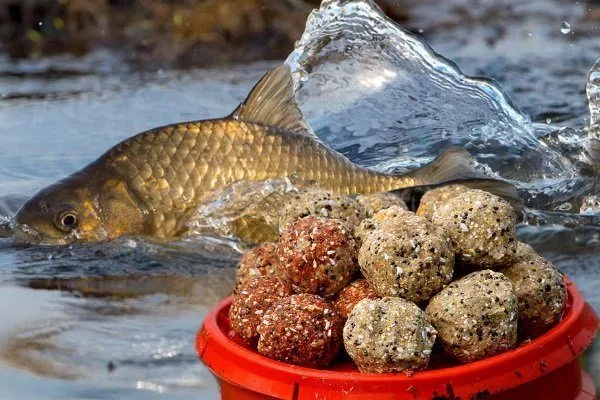
The grain is pre-crushed. The plant material is mixed with ground meat, bone meal, and bran. The mixture is steeped in boiling water and left for half an hour. The mixture is then rolled into small balls and fed to the fish. It is recommended to add fresh chopped grass to the balls—green dandelion, nettle, duckweed, worms, or chopped bloodworms.
Experts do not recommend using compound feed. It settles to the bottom and negatively impacts water quality.
The fish are fed twice a day, at the same time, to develop a conditioned response. The food is diluted with water, placed on a metal tray, and lowered and raised using a special mechanism. In the evening, the feeding area is illuminated with lamps.
The optimal amount of food for a single feeding is 5% of the total body weight of all crucian carp in the pond. So, if there are 20 crucian carp in the pond, each weighing 100 g, then 5% of the live weight is 100 g.
We also recommend reading an interesting article about How to properly breed crucian carp.
Catfish food
Clarias catfish are commonly raised in artificial ponds. However, their exact nutritional requirements have not yet been determined. Therefore, fish farmers feed them carp or trout feed. The latter has been shown to improve their nutritional status. catfish Gains weight faster. To accelerate growth, the probiotic "Subtilis" is added to the diet.
However, some fish farmers formulate their own feeds through trial and error. They mix dry ingredients, vitamins, and minerals with water or whey to form a paste-like consistency. They then grind the mixture and dry it in a dry place. They grind it into pellets and feed it to the fish. For example, they prepare a feed mixture from the following components:
- chalk - 1%;
- herbal flour - 2%;
- blood meal - 2%;
- vegetable oil - 2%;
- yeast - 4%;
- barley flour - 5%;
- wheat flour - 8%;
- sunflower meal - 20%;
- soybean meal - 26%;
- fish meal - 30%;
- vitamins;
- cobalt chloride - 0.03%.
Helpful Tips
When organizing feeding, adhere to the following recommendations:
- To make feeding easier, install feeders. You can make them yourself or buy ready-made ones from a store. There are several types. Some are fixed to the bottom and are called stationary, while others are liftable and are raised to the surface before dispensing food.
- Automatic feeders are commonly used in fish farms. Feeding with these devices helps determine the required amount of food for the fish. If there is still food left after 4 hours, the portion is reduced. Food should not be left in the water for more than 24 hours, otherwise it will turn sour and the fish will not eat it. Consequently, the food will continue to rot in the water, which will negatively impact the microflora of the entire pond.
- The diets of fish raised in ponds and commercial cages (pools) differ. The former, even at high stocking densities, have sufficient natural food. This food serves as the main source of vitamins, amino acids, and minerals.
How to grow fish in a pool, will tell you This article.
Preparing your own fish food is a challenging task, as you need to consider the characteristics of the fish you're raising and their daily vitamin and mineral requirements. By following these guidelines, you can learn how to prepare food that will provide your fish with everything they need.
Wheat "8mm semolina"! What semolina is this? It's not even semolina, but a real whole wheat grain! And not even wheat, but medium-sized oats!