
Farming crucian carp in a dedicated fishing pond is a profitable business and an interesting hobby. These ray-finned carp-like fish have a strong immune system and are easy to care for. Their meat is delicious and in demand. Keeping and catching this freshwater fish in winter has its own unique challenges, determined by changes in the fish's behavior during the cold season.
When does crucian carp go into hibernation?
Crucian carp tend to change their behavioral habits with the onset of cold weather. These fish don't always hibernate. They typically spend the winter buried in mud, leading a sedentary lifestyle.
Will the carp representative lie down? for the winter or spend the winter awake, depends on:
- depth and area of the pond;
- bottom features;
- degrees of water saturation with oxygen;
- weather conditions;
- climate of the fish farming region;
- and others.
With the onset of winter, small crucian carp tend to burrow into the bottom mud. Larger specimens are less fazed by the cold and continue to swim in the water column.
The behavior of crucian carp in the cold season largely depends on the water temperature:
- When the water temperature drops to +8°C, the fish's vital functions slow down. They become less active and less interested in food.
- At water temperatures below +5°C, the crucian carp's respiration and heart rate decrease several times. The fish conserve energy by remaining virtually motionless, entering a state close to anabiotic.
Is it possible to catch crucian carp in winter?
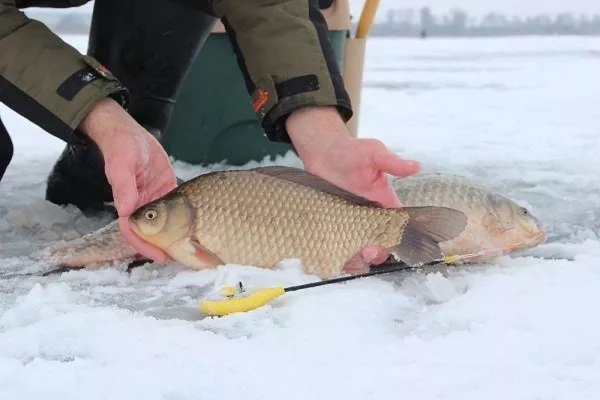
Catching crucian carp during the winter months is challenging. In some areas, crucian carp can be caught throughout the winter, while in others, they bite only during the ice drift or refuse bait altogether. Successful crucian carp fishing during the cold season depends on the characteristics of the body of water.
Carp can be found in:
- depressions in the muddy bottom;
- snag;
- backwaters.
Unless there's a lack of oxygen, crucian carp remain active even in winter. They spend the day in deep water, occasionally leaving their shelter to search for food and even swimming to shallow water.
In harsh winter conditions, this freshwater ray-finned fish bites poorly. It's passive and shows little interest in bait.
A good day for crucian carp fishing in the winter months meets the following requirements:
- windless;
- slightly frosty;
- solar.
Crucian carp don't bite during snowfalls, blizzards, or severe frosts. In such weather conditions, the fish stop feeding.
Ice cover creation
When keeping crucian carp in a small fishing pond, it needs to be insulated for the winter. Creating a protective cover using the following materials will help create more favorable wintering conditions for the carp-like inhabitants of the pond:
- boards;
- reed.
The boards are stacked together to form a shield, which is then used to cover the pond.
Reed stem protection is the best option for pond insulation. Bundles of reeds are frozen into the ice crust. The resulting ice cover will not only protect the crucian carp from the freezing wind and frost but will also be well-ventilated.
Video review. Inspection of a wintering pond for crucian carp:
Crucian carp are left to overwinter in a fishing or decorative pond (in the absence of an air compressor or pump), if it meets the following characteristics:
- the protective ice cover on the surface of the reservoir in frost is at least 0.7 m;
- the layer of unfrozen water under the ice is at least 1 m;
- the depth of the reservoir in the deepest places is 6-7 m;
- pond area - 20-30 m²;
- there is a thick layer of silt at the bottom;
- The water is sufficiently saturated with oxygen.
- ✓ The minimum depth of the reservoir for wintering should be at least 1.5 m to avoid complete freezing.
- ✓ The oxygen concentration in the water must be maintained at a level of at least 4 mg/l to ensure the vital activity of crucian carp.
Peculiarities of fish behavior under ice
With the arrival of winter, crucian carp are still quite active. They often feed heavily at first ice. In the dead of winter, the fish become passive, moving sluggishly in areas with stable oxygen levels and food availability.
The behavior of crucian carp during wintering varies in different climatic zones:
- In reservoirs with warm water. Where the water doesn't freeze during the cold months, crucian carp are active year-round and don't hibernate. This winter behavior is typical of fish living in deep-water ponds in mild climates.
- In northern regions with a harsh climate. In such regions, crucian carp tend to hibernate, burying themselves in bottom sediments, and spend the cold season sleeping.
- In moderate winter conditions. This freshwater carp seeks out a suitable wintering hole with warm water. It spends most of the day dozing there, periodically emerging from its hiding place in search of food.
The crucian carp's habit of sinking to the bottom to hibernate is driven not only by the need to find a warmer spot in the water but also by the need to forage for food. During the cold season, when the fish are less active, they prefer animal food. Crucian carp obtain bloodworms and larvae by burrowing in the bottom sediment.
What problems may arise in connection with wintering crucian carp?
When keeping crucian carp in a fishing or ornamental pond during the cold season, difficulties arise if:
- Sick fish were sent for wintering. Fish that are sick, injured, or infested with parasites have little chance of surviving the winter cold. Only healthy fish will survive until spring.
- The sanitary condition of the pond is insufficient. This means the pond is swampy, silted, overgrown with algae, and littered with food debris. Overwintering for crucian carp in such conditions is difficult.
If the water in a reservoir is not drained for the winter, cleaning and preparatory work is carried out before winter so that the decomposition of organic matter does not consume the oxygen needed by the fish. - The fish remained to feed on the ground for the winter. The crucian carp won't gain weight and will become emaciated. They are prepared for winter in the fall. All carp are switched to protein feed.
In a 50 m² pond, no more than 1/2 kg of fish are kept on natural food. Large numbers of crucian carp in a pond require increased feeding before winter to gain weight. - It's too cold. The water temperature is lowered to 2-3°C at shallow depths. This poses a danger to young fish. They are susceptible to cold burns on their bodies and gills. Injured fish will not survive until spring.
The problem of low oxygen content in water and ways to solve it
The most common mistake when wintering crucian carp in an artificial pond is completely covering the pond with ice. This results in a lack of air, which is detrimental to the fish.
Photosynthesis is absent during the winter and has no effect on the oxygen balance in the water. Oxygen is supplied in winter only through contact between the water surface and air.
The problem of low oxygen concentration in the aquatic environment can be avoided by:
- disruption of the integrity of the ice crust covering a body of water by creating and maintaining an ice-free hole;
- making a hole in the ice and then pumping out 20 cm of water.
In order for crucian carp to be able to breathe freely under the ice in winter, they need to live in a fairly deep and large decorative fishing pond (deep places up to 6-7 m, area - 20-30 m²).
Carp keeping in a shallow pond (from 0.8 m) is only possible with special equipment, such as electric water pumps and air compressors.
Video tutorial: Aerating a fishing pond using a compressor:
Without electrical equipment, holes in the pond's ice cover are essential. They are drilled, not punched, using a hammer. Otherwise, there's a risk of injury to pond inhabitants from the shock wave.
You can also make a hole using a saucepan filled with boiling water. Simply place it on the ice and let it sit for a while to melt it.
Interesting to know
Common crucian carp have a difficult winter in bodies of water that freeze right to the bottom. They're reluctant to burrow into the mud, as there's no oxygen there. Compared to their counterparts bred in artificial ponds for commercial purposes, crucian carp's wintering in the wild is often extreme.
When air temperatures drop, a small, stagnant pond or shallow lake freezes completely. Under these conditions, crucian carp hibernate on the bottom until warmer temperatures return.
Often, the ray-finned creature becomes frozen into the ice and dies. Remarkably, some individuals recover from such extreme wintering.
Their larger and more active relatives, carp, often spend the winter months alongside crucian carp.
Breeding crucian carp requires proper winter preparation. Approach this preparation carefully and meticulously. Creating optimal winter conditions for the fish is the key to successfully overwintering crucian carp without significant losses.