
If you've decided to build a pond and stock it with fish, consider feeding them. While fish are capable of foraging for themselves, a pond is an artificially created biotype, meaning the food supply is limited and cannot serve as a basis for feeding.
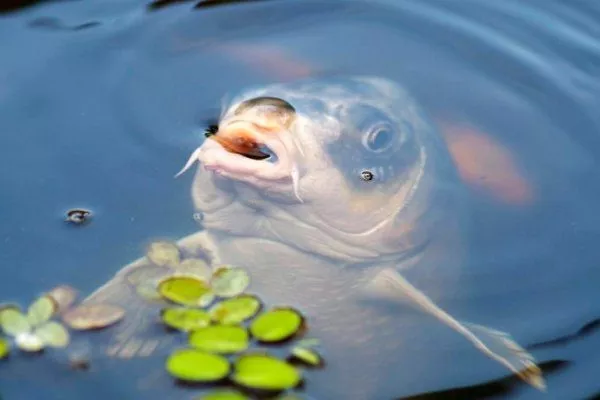
Types of feed
Fish feeds are divided into artificial (pelleted feeds and feed mixtures) and live (which make up 25-25% of a fish's diet and include natural live food). They are also divided by other criteria, which are described below.
- ✓ Consider the feeding season: in spring and autumn, the nutritional needs of fish change.
- ✓ Pay attention to the size of the food pellets so that they match the size of the fish's mouth.
- ✓ Check the expiration date of the food, as expired food may lose its nutritional properties.
By composition
Food should be selected based on its composition – it should indicate certain nutrients and microelements.
- Squirrels – play a vital role in metabolism. Protein content in the diet should be between 30 and 60% of the total dry feed. Providing adequate protein is especially important for young animals. It contains essential amino acids, and their deficiency can lead to reduced growth and the emergence of diseasesProtein foods include beef heart, chicken eggs, frozen and cooked fish, shrimp meat and krill.
- Fats – are the primary source of energy; a deficiency will lead to reduced growth rates and cause physiological disorders. Requirements vary depending on the species (for example, for carp – 1%, for eel and trout – no more than 0.5%). Fat is found in various seeds (flax, for example) and oilseed meal.
- Carbohydrates – the amount shouldn't exceed 25%, which is a complete energy source, but the requirements vary for different fish species. For example, in carp or eel, high fiber content can slow growth and increase the fat content of the meat. Also, the amount of carbohydrates should be calculated not only by the breed but also by the age of the fish. They are found in plant and grain raw materials.
- Minerals Some minerals (calcium, phosphorus, chlorine) are obtained by fish from the water. The rest must be obtained artificially, through careful selection of dietary elements. Mineral deficiencies can affect growth rates, but severe deficiencies can result in decreased appetite or even death of the young. Fish obtain minerals from plants and algae.
- Vitamins All vitamins are responsible for specific processes in the body: vitamin A regulates metabolism, vitamin D is responsible for bone formation, and vitamin E promotes caviar production. But vitamin B is considered especially important, as it aids in the digestion of proteins and carbohydrates. Live food—insects, crickets, and dodrophylla flies—is a source of vitamins.
Depending on the type of fish
| Name | Type of feed | Recommended water layer | Feed form |
|---|---|---|---|
| Fish feed on the surface | Easy | Upper | Chips, sticks, cereal |
| Fish in the middle layers of water | Average | Average | Flakes, chips, granules |
| Fish on the bottom | Heavy | Lower | Granules, tablets, wafers |
Fish have their own feeding habits: some feed in the upper layers of water, others in the lower, and still others in the middle. And it's based on these physiological characteristics that they select their food:
- Fish feed on the surface – Use food in the form of chips, sticks and flakes for them, as they are light in weight, which helps them stay afloat.
- Fish in the middle layers of water – They can also eat flakes and chips, as they become heavier when wet and sink lower to the bottom. Another solution is pellets, as they sink slowly, allowing the fish time to eat them.
- Fish on the bottom – They eat pellets, tablets, and wafers. They're heavier than chips and immediately sink to the bottom.
By manufacturer
When choosing food, look for high-quality, market-proven foods. Some of these foods have therapeutic properties:
- Tetra – a leader in the production of products for aquarists and garden fish farming. The following types are offered for coldwater fish:
- Tetra pond sticks – universal food for pond fish in the form of floating sticks. The price varies depending on the packaging. For example, a 1-liter jar (containing 100 grams of food) costs 250 rubles.
- Tetra pond sticks mini – granulated food for small pond fish (up to 15 cm) and fry. Price: approximately 350 rubles per 1-liter jar (approximately 135 g of food).
- Tetra goldfish (Goldfish, Goldfish Granules, Goldfish Pro, Goldfish Color, Goldfish Energy Sticks) – Goldfish flakes and sticks. Prices range from 50 to 3,500 rubles, depending on the packaging and type of food (for example, a 1-liter jar will cost 700-1,000 rubles).
- Tetra pond holiday – long-lasting food for pond fish during vacation (provides nutrients for 14 days). Price: 260 rubles for 98 g.
- JBL – the food of this company is well suited for organizing the feeding of goldfish:
- JBL NovoRed – flake food. Price: 700 to 1200 rubles per 1 liter jar (190 g of food). It will be much cheaper JBL NovoRed refill, which is sold in a refill package at a great price (450 rubles for 750 ml/135 g).
- JBL NovoPearl – wheat germ-based food in granular form. Price: approximately 350 rubles for a 250 ml jar (93 g of food).
- Aller Aqua – Polish fish food, rich in protein, minerals, and vitamins, allowing fish to grow and gain weight quickly. Different types and grades of food are available depending on the fish species, age, habitat, and water temperature:
- Aller ArtEx– premium quality feed for sturgeon, whitefish and pike perch.
- Aller Parvo EX – starter food for carp.
- Aller Platinum– high-energy feed used fortrout breeding, which is found in fresh water.
- Aller Primo – production feed for carp and trout.
A 25 kg bag costs from 2,300 to 5,500 rubles.
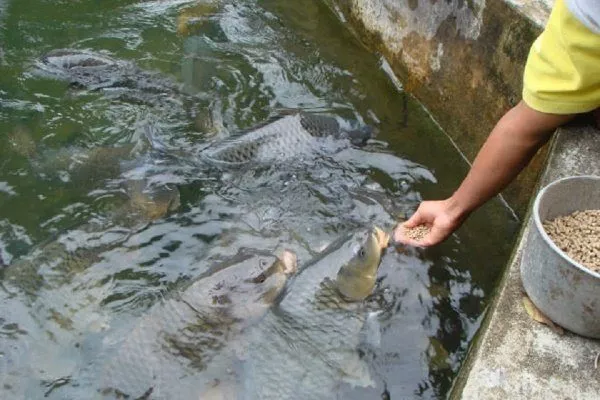
How to choose the right food for your fish?
If you've chosen prepared food, you should understand that not all of them are the same or beneficial, so pay attention to certain characteristics:
- Purpose of feed. Use balanced food for pond fish, not aquarium fish;
- Balance. The food should be balanced and include proteins, minerals, and vitamins to ensure healthy and complete nutrition.
- Digestibility. The diet you choose should be easy to digest and promote good digestion, as this will help keep the water clean for a longer period of time.
- Components. They must be selected, so do not buy economy-class food made from low-quality raw materials, as this does not provide any nutritional value for the fish and accelerates water pollution with organic matter and algae growth due to poor digestibility.
- Package. Avoid purchasing bulk foods or foods in damaged packaging, as there's no guarantee they'll remain fresh or of good quality. Packaging should be made of sturdy material, impermeable to light, and have a zip lock.
- Protection of immunity. Particularly useful fish foods are those that help boost the body's defenses.
Feeding Features
When raising fish in a pond, feeding requirements are somewhat lower, as natural waters contain natural food that requires little supplementation. Fish food is typically provided in the form of pellets, briquettes, or paste-like substances. Focus on pellets or briquettes, as they are highly moisture-resistant, while paste-like substances will quickly lose half their nutrients.
In early spring, when the fish wake up, feed them more generously than in summer. In hot weather, fish don't eat as much, as they can find food in the pond itself. And in autumn, when the water temperature drops below 10 degrees Celsius, stop feeding the fish completely, as most species go dormant in winter.
How to feed fish properly?
While feeding, observe how the fish consume the food. The amount of food should be sufficient to ensure there are no leftovers. If uneaten food accumulates, the feeders and pond should be cleaned; otherwise, the leftovers will decompose and promote the growth of pathogens.
Appetite status is assessed approximately 40-60 minutes after the food has been distributed.
Rules
To ensure that feeding your fish produces the desired results, you must adhere to the following rules:
- Don't just scatter dry food on the pond bottom. Add a little water to it to form a thick paste, then add it to the pond.
- Feed your fish at the same time every day to develop a reflex.
- When feeding in the evening, add lighting so that the fish begin to reflexively react to this light, which will simplify the catching process in the future.
- Provide the feeding area with a galvanized metal tray and a lifting device. This will allow you to raise and lower the tray into the pond at any time and monitor feeding progress. You can also regulate the amount of food dispensed and ensure that the food does not rot or turn sour, which will help keep the water clean.
More information about feeding pond fish is available. Here.
Compliance with the terms and conditions
Feeding fish in a pond depends on a large number of factors, including:
- Water temperature – During the summer months, if there is a large natural food supply, feeding occurs 2-3 hours after sunrise. Water temperature should be 12-15 degrees Celsius or higher;
- Age – Yearlings should be fed twice a day – morning and evening, in small portions. Two-year-olds are fed once a day – in the morning.
- Edibility To avoid overfeeding your fish, monitor how quickly the food disappears. If the food is consumed too quickly, the fish aren't getting enough. If the food remains untouched for three hours, it's time to reduce the amount.
Feeding regimen for different fish
Separating fish species into different types plays a major role in feeding efficiency, as each food has specific nutritional requirements.
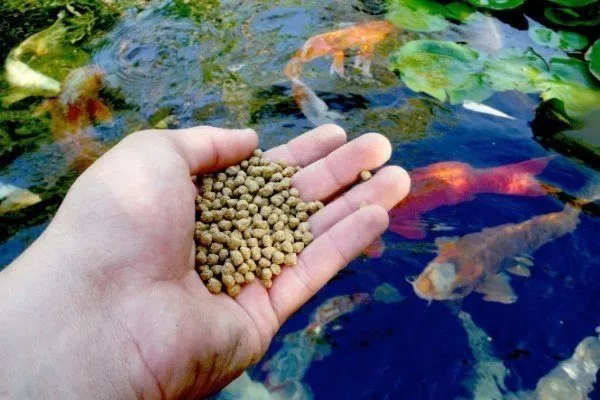
Carp
Daily feed intake for carp breeding The amount is determined by the fish's weight and water temperature. If the carp weighs up to 0.5 g, the daily allowance is 100% of its weight; if it weighs 500 g or more, the daily allowance is 2.8% of its total weight.
Yearlings and two-year-olds are fed pellets placed in special feeders. The young are fed hourly, decreasing the amount as they gain weight. Feeding frequency is also reduced when the water temperature drops. Carp can be fed protein feed (worms, bloodworms, snails, and shells), potatoes, oilcake, and bread, as well as finely chopped soft grass and special compound feed (preferably pre-mixed in a bucket until it forms a dough-like mass).
If the pond water is very warm—23-26°C—the fish's appetite increases and they need to be fed more frequently. Feed the fry almost every hour. Carp weighing between half a kilo and 2 kg should be fed 4-5 times a day. If the water temperature is 22-24°C, the number of feedings can reach 5-6 times a day; if it's 14-20°C, 4 times a day; and if the temperature is below 14°C, 2-3 times a day.
Crucian carp
Crucian carp is a fish considered practically omnivorous. It won't be harmed even if you forget to feed it, as it will always find the bare minimum of food it needs in a pond, especially if the pond has already developed an ecosystem.
Crucian carp thrive on algae, steamed beans and grains, worms, insect larvae, and bloodworms. Bread is not recommended.
The amount of feed introduced should be no more than 5% of the fish's weight. Calculating this amount is simple: if a pond contains approximately 30 fish, each weighing 200 grams, the total fish weight is 6 kg, meaning the single feed amount should not exceed 300 grams.
Feed crucian carp 1-2 times a day, at the same time.
Read about breeding crucian carp, including feeding them. here.
Salmon
Salmon are fed meat scraps, low-fat dry milk, and meat-and-bone meal, fish meal, and krill meal. These ingredients can be mixed together, or you can purchase ready-made feeds that vary by age group: for example, RGM-6M and S-112-Lat are used for fry weighing up to 5 grams, while LK-5P is used for juveniles.
Catfish
Catfish The catfish is a special fish because by the time it begins to eat properly, its stomach and intestines have already developed, allowing it to produce specialized enzymes for digestion. This characteristic makes the fish less demanding in terms of feed composition. SB-1 and SB-3 are typically used for catfish, supplemented with calcium if they are raised in soft water.
Catfish fry should be fed eight times a day, gradually reducing the number of meals to four. The amount of food per feeding depends on the water temperature – the warmer the water, the more food you need.
Acne
To successfully raise young fish, it's important to monitor the amount of animal protein in the eel's diet; the more protein, the more rapidly the fish grow. The young fish are fed up to 10 times a day in shaded areas of the pond and are fed primarily animal feed. For fish weighing up to 2 grams, the daily requirement is 16%, for those weighing 2-4 grams, 12%, for those weighing 4-8 grams, 10%, and for those weighing 8-25 grams, 8%.
Sturgeons
Sturgeon require high-fat diets, especially for juvenile bester. The number of feedings depends on their age: larvae and fry are fed up to 12 times per day, while adults are fed 4 to 8 times per day.
Tilapia
Tilapia thrive on both plant and animal sources, with protein being a priority.
Tilapia are fed grain waste, meal, and compound feed. Larvae begin to consume artificial feed as soon as they begin actively feeding externally, making them ideal for breeding in pools and ponds.
For juveniles weighing up to 50 grams, use VBS-RZh-81 and RZGK-1 feeds, and for those weighing 50 grams and above, use PK-Vr, RGM-2Ke, etc. The daily feed rate is determined based on the weight of the fish.
What does feeding efficiency depend on?
The conditions in which fish are raised directly impact the growth rate and quality of their meat. Water temperature is a key factor – many species experience increased growth as the water temperature rises. If temperatures drop to 0°C, digestion initially slows, and eventually stops altogether.
The quality of feed also plays a role (protein-rich foods accelerate fish growth) and the amount of oxygen in the water (1 mg/L is too low for fish, and they stop growing and feeding). A major drawback of low oxygen levels is the increased concentration of ammonia and nitrates, which also negatively impacts growth.
Ensure adequate daylight hours. Since daylight hours tend to decrease as the colder months approach, it makes sense to use artificial lighting to stimulate growth hormone production and improve digestion.
Monitor the salt level in your water, as some fish species can only be kept in either fresh or salt water. Tilapia is an exception, as it can grow in either type of water.
Use special feeders to dispense food, which you can make yourself. For detailed instructions on how to make one, watch this video:
Preparing your own food
There are times when it's not possible to buy ready-made food. In such cases, you can always prepare it yourself.
- Check the water quality in the pond before feeding.
- Prepare food taking into account the age and type of fish.
- Observe the fish's reaction to the new food during the first days.
For example, you can make a long-term storage feed mixture that will include the following components:
- fish meal – 15 parts;
- shrimps – 5 pieces;
- dried bloodworms – 5-10 parts;
- boiled egg – 5 parts;
- dry daphnia, cyclops and gammarus – 5-10 parts;
- dry milk – 5-10 parts;
- bread crumbs;
- red bell pepper (for coloring) – 5 parts;
- underwater plants;
- yeast – 6-10 parts;
- shoots of nettle, dandelion and plantain scalded with boiling water - 10-14 parts.
Grind all ingredients and add multivitamins, then stir in boiling water until a paste forms and simmer for another 2-3 minutes. Place into molds and freeze. The fish can be served frozen or thawed. Garnish with freshly cut herbs or ground green peas.
Feeding your fish is important if you want them to live a long time and be a joy to look at (for example, when breeding koi carp as ornamental fish). Therefore, be very careful when choosing food, read the ingredients of prepared foods, and don't hesitate to ask questions from more knowledgeable people who can help you understand the matter.
I'm thinking: if I feed pond fish with canned food that costs 150 rubles per 100 grams (by the way, I've never seen anything like that. Are those prices from the early 90s?) - then I'd rather order sturgeon from a restaurant and eat red caviar by the spoonful. It'll definitely be cheaper.
PS iPhone heads are coming!!!
and I also thought: how will pond fish please my eyes...
We'll probably have to build a pond right next to the house's foundation and make one basement wall transparent.
went down to the basement and delighted your eyes with pond fish.
(and nothing else comes to mind...)
Depends on the pond structure and the purity/transparency of the water.
A true fisherman's heart and ears are delighted by the splash and slurp of fish in the reeds, and his heart and eyes are delighted by the splash and ripples in the water. And seeing a big fish jump out is a thrill, just like catching one.
Poachers get angry when crayfish get caught in their nets—they get tangled up, and it takes a long time to remove them, sometimes even cutting them up. But a fisherman, even if he's setting a net for his own use and caught crayfish, is happy because he knows the water is so clean he can drink it.
You can drink water from the lake if it is BOILED!
An excellent, helpful article, but it didn't answer one of my questions: what should I feed my rotan? They don't eat stationary food (like perch and pike-perch), so how can I get a piece of meat to move? Rotan only eat worms when they're hooked; they won't eat them if you just throw a worm in.