
Growing and breeding grass carp in both commercial and domestic settings has become possible thanks to research by Russian and Japanese scientists. After all, they don't reproduce in captivity! By following breeding rules and techniques, you can successfully launch a new business!
Breeding Features
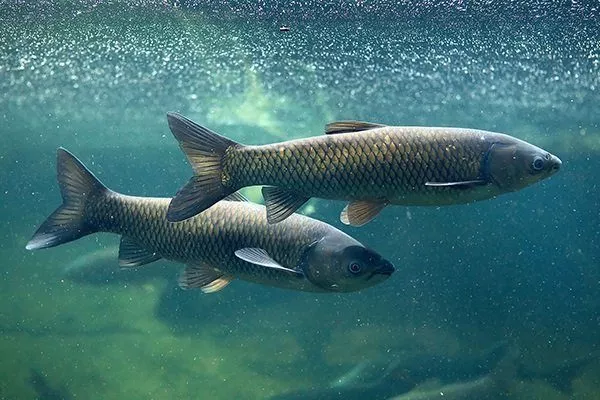
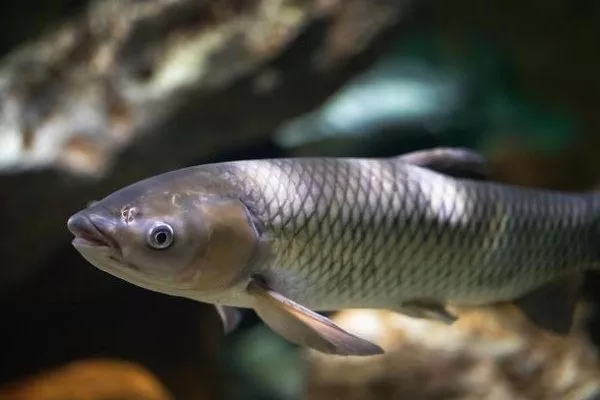
The grass carp, or white amur, is a large herbivorous freshwater fish of the Cyprinidae family and the only species in the genus Ctenopharyngodon idella. In the wild, it prefers slow-moving or stagnant waters.
Grass carp is bred for two reasons:
- Dense white meat of high quality.
- As a method of controlling algae growth in water bodies.
Advantages of breeding grass carp:
- They have increased commercial potential due to their rapid growth. When reared properly, grass carp gain 800 g in two years, 1.5 kg in three years, and four-year-olds reach 3-3.2 kg. Adults can grow to 1.2-2 m in length and weigh up to 35 kg.
- Weakly susceptible to infectious diseases.
- The meat has good taste.
- Unpretentious to the level of oxygen in the water.
- They do a good job of purifying water and preventing blooms.
| Parameter | 1 year | 2 years | 3 years | 4 years |
|---|---|---|---|---|
| Average weight | 0.8 kg | 1.5 kg | 2.5 kg | 3.2 kg |
| Body length | 35-40 cm | 50-55 cm | 65-70 cm | 80-90 cm |
| Daily gain | 2.2 g | 4.1 g | 6.8 g | 8.7 g |
The most common growing methods are:
- Experience of growing in China. In China, grass carp are raised in intensive and semi-intensive ponds, stocked as a primary or secondary species along with other carp. Stocking densities range from 750 to 3,000 fish per hectare. Weedy algae and pond-side terrestrial grasses are the grass' primary food source. Specialized feeds, such as granules and grain and vegetable oil byproducts, are also used. These feeds are used to reduce labor costs associated with maintaining pond algae.
The second most popular cultivation method is an intensive monoculture system in cages, where grass carp is the primary species. Cages measuring 60 square meters and up to 2-2.5 meters deep are used. The fish feed on weed algae, terrestrial vegetation, and food. The harvest period lasts 8-10 months, with yields of 30-50 kg of fish per cubic meter. - Experience of breeding in Vietnam. Grass carp are raised in clay ponds using cages. Polyculture systems are used with other species, such as silver carp, common carp, and rohu. Grass carp make up 60% of the pond's total population. Grass carp are fed green fodder consisting of terrestrial grasses, cassava and corn leaves, and banana stems.
- Indian breeding experience. In India, grass carp are farmed alongside Indian and Chinese large carp. The stocking density is 5-20% of the total fish population, depending on the amount of algae (Hydrilla, Vallisneria, Wolffia) and pond grass.
Grass carp reach 0.5-1.5 kg in weight within 8-10 months. Typical yields in such systems can reach 8-10 tons per hectare per year.
Conditions of detention
When farming grass carp in Russia, it's important to remember that when temperatures drop below 12°C, the fish stop feeding completely. At optimal temperatures of 25-30°C, the lack of food is easily compensated for by cutting grass, and the carp develop very quickly.
In the southern part of the country, carp gain weight faster and grow larger than in the northern regions.
Currently, grass carp are bred using various production systems:
- semi-intensive - natural feeding of grass carp on algae with minimal addition of feed is used;
- Intensive ponds – keeping in closed ponds using artificial feeding methods.
- cages in open water bodies (reservoirs, lakes, ponds) - only one species of fish is grown.
For cultivation in semi-intensive and intensive ponds, the polyculture method is used – keeping different species of fish in the same area.
Stocking with fish
When breeding grass carp in a natural reservoir, it is stocked with fish. To do this, the following rules must be followed:
- purchase high-quality material for breeding (fry or adults);
- transport it according to transportation rules;
- During transportation, the water temperature should be approximately equal to that in the reservoir;
- for transportation, do not collect water from the water supply system, wells, or springs, but only from a river, pond, or lake;
- transportation should be carried out in cool weather, in the morning or in the evening;
- If transportation occurs during the day, the water should be cooled using ice wrapped in burlap or gauze;
- gradually mix water from the reservoir with water used for transportation, allowing the fish to get used to the new conditions.
- ✓ Temperature control during transportation (±1°C from the reservoir)
- ✓ Use of only natural donor reservoirs
- ✓ Acclimatization duration: 30-40 minutes
- ✓ Water change ratio: 1:10 every 5 minutes
- ✓ No feeding for 12 hours before transport
You can't release fish into the pond immediately, especially if there is a large temperature difference, as they may die from temperature shock.
The video shows how to stock a pond with fish for the purpose of further breeding white amur and preventing the pond from becoming overgrown with vegetation.
Cultivation from eggs
The main problem with cultivation is that the fish do not reproduce naturally, although they reach sexual maturity under home cultivation conditions.
To achieve spawning in such conditions, hormone injections and environmental stimulants such as running water are used.
Sexual difference
The grass carp's body is elongated, cylindrical, torpedo-shaped, and compressed at the rear. It's virtually impossible to determine whether it's a male or female, but there are some characteristics that can determine the sex of grass carp during the spawning period.
Features of the female:
- reaching sexual maturity, females begin to overtake males in growth, acquiring a rounded abdomen in which up to 500,000 eggs mature;
- During the spawning period, the female grass carp's genital opening becomes enlarged, slightly swollen, and acquires a reddish tint;
- pectoral fins have a rounded shape;
- the gill covers are covered with mucus and smooth to the touch;
- when pressing on the abdomen of the female, the eggs are not released until they mature;
- the anal opening is oval and elongated.
Male characteristics:
- the body of males is thinner and longer;
- During the spawning period, something like whitish warts can be seen on the gill wings, cheeks and on the back of the head;
- the pectoral fins are pointed;
- gill covers are rough to the touch;
- when you press on the male's abdomen, a small amount of milk or whitish liquid will be released;
- The anal opening extends from the head towards the tail, resembling a triangular fold.
In flocks, the number of males is twice as large as the number of females.
Preparatory stage
Females ready to spawn are provided with optimal temperature conditions, reaching spring and summer temperatures of 25-30 degrees Celsius. During the fertilization stage, two-stage pituitary injections are administered.
The material for pituitary injection is an extract from the pituitary gland of crucian carp or grass carp.
At this stage, the following manipulations are carried out:
- males are separated from females;
- carry out preliminary injections;
- Immediately after the first injections, the Amur fish are sent to a reservoir with running water;
- After another 1 day, the final injections are administered;
- The fish are placed in calm, slightly running water (reservoir).
After these procedures, the caviar is collected by straining.
Fertilization and incubation
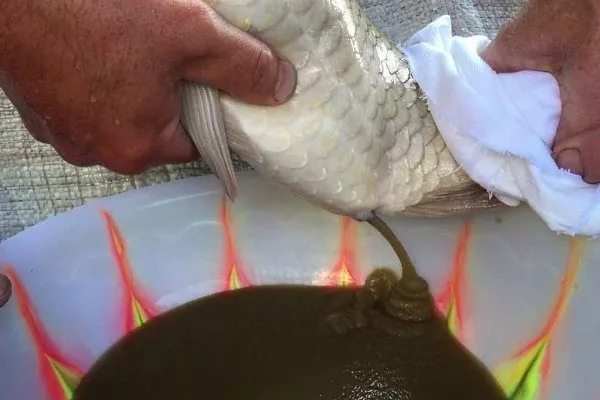
For fertilization, eggs from 4-5-year-old females are collected. 5 ml of male semen (semen from two male grass carp is used due to low fertility) is mixed with the eggs of one female.
From time to time, the use of wild-collected seed helps maintain the genetic quality of the population.
The contents must then be carefully mixed, as the eggs are easily damaged. A feather is often used for mixing. Water is then added to the mixture in a 1:2 ratio and the eggs are washed 9-11 times. After this procedure, the eggs noticeably increase in size and are placed in a Weiss apparatus for incubation.
The incubation process is characterized by a high mortality rate. The average survival rate is 1 in 5, which equates to 100,000 yearlings out of 500,000 eggs.
Hatching
After hatching, the larvae are placed in special nylon nets, installed in artificial pool or a body of water with low current.
A specific mode is set:
- the temperature remains at 21°C for 6 days;
- over the next 4 days the temperature rises to 23°C;
- For the next 2-3 days, the maximum temperature is maintained at 30°C.
Provided that the temperature regime is maintained, the larvae take the required position in the reservoir and begin to feed.
Maintenance of larvae
Before placing the nets containing the larvae in the pond, it must be cleared of pests, as insects can eat the grass carp larvae. This is done after complete drying, using quicklime to eliminate all pests. The typical dose is 900-1125 kg/ha.
In addition to zooplankton, which the larvae feed on, a mixture of cottage cheese and egg yolk is used as a supplementary feed in home cultivation conditions.
Organic feed, compound feed, or green feed are added to increase the natural biomass of algae and zooplankton 5-10 days before net installation. The feed rate is 3,000 kg/ha for compound feed or 4,500 kg/ha for green feed. Green and organic feeds can be used simultaneously, but the amount of each should be reduced accordingly.
Soy milk can also be used as both a primary feed and a supplement. The recommended daily feeding rate is 3-5 kg (dry soybeans) per 100,000 fish. Pasty soybean meal or other grain by-products are used starting on the fifth day after net installation, typically at a rate of 1.5-2.5 kg per 100,000 fish daily.
The normal survival rate in hatcheries is 70-80%, although it can reach over 90%. Larvae typically reach a length of about 30 mm after 2-3 weeks of rearing.
Maintenance of yearlings
To maintain fingerlings, fry ponds with a volume of up to 200 square meters are used. When the fry reach 2-3 cm, they are transferred to a pond of up to 500 square meters. The fry are raised at a rate of 250 larvae or 45 fry per 1 square meter. The pond stocking density is calculated at 120,000-150,000 fingerlings per 1 hectare if this is the main species in the pond, or 30,000 fish per 1 hectare if grass carp is a secondary species.
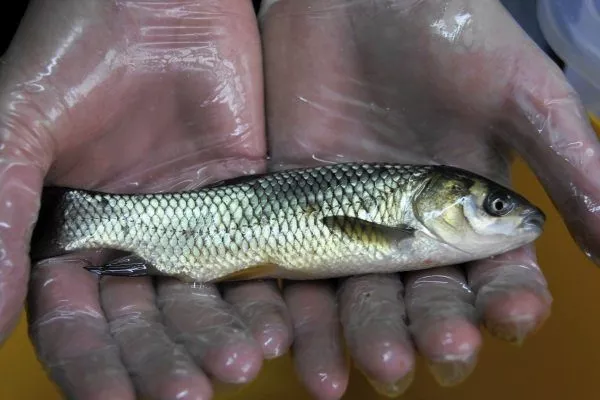
Grass carp can be kept together with other species of carp except black carp (Mylopharyngodon piceus).
Grass carp up to 70 mm in length feed primarily on Wolffia. Initially, feeding is 10-15 kg per 10,000 fish per day and is gradually increased to meet the fish's growing needs. The feed is replaced with duckweed (Lemna minor) when the fish reach 70-100 mm in length. After this, the fish can be fed tender weed algae and terrestrial grasses. Additionally, compound feeds (soybean and rapeseed meal, wheat or rice bran, and others) are added at a daily rate of 1.5-2.5 kg per 10,000 fish.
Even if zooplankton is abundant, young-of-the-year fish are fed once a day. To do this, place and secure a feeder with the food mixture on the surface of the water to prevent it from being washed away by the current.
Normal survival rate throughout the entire fry rearing period should be above 95%.
Maintenance of young individuals
The feeding regimen is similar, but increases as the fish grow, consuming 1.2-2 times their own body weight in food. By the end of this period, the fish typically reach around 250 g. Weight gain is directly dependent on diet and ambient temperature.
Maintenance of adult fish
Adult grass carp feed exclusively on plant matter found in the pond. When stocking a pond with large amounts of fish, special compound feed is used. Land vegetation, such as mown grass, corn leaves, and other sources, is also used for supplementary feeding. Adult grass carp require feeding four times a day.
To ensure that the Amur fish develops and grows fully, the population size must be calculated at a rate of 1-2 individuals per square meter of vegetation.
One way to provide additional food for grass carp in a home-based fish farm is demonstrated in this video. Igor Kramarchuk shares the idea.
Profitability
The key to successful grass carp farming is calculating profitability, minimizing expenses on feed and other plant-based diets. A proper farming approach increases the commercial impact—your income.
Approximate calculation of basic costs
Profitability is calculated for a water area of 2,000 m2. The calculations use average data:
- estimated productivity – 1000 kg/ha;
- the average weight of an annual white amur is 50 g;
- approximate price – 235 rubles/kg;
- average survival rate is 75%;
- Commodity weight – 1000 g;
- wholesale price – 125 rubles/kg;
- cost of feed – 7 rubles/kg;
- grain ratio in feed – 5 kg;
- cost of lime (calculated at 1500 kg per hectare) – 7 rubles/kg;
- the total weight of the fish is 1500 kg;
- the planting density per 2000 m2 will be 2666 pcs.;
- price of planting materials – 30,590 rubles;
- total cost of the offspring – 239,400 rubles;
- feed: 69825 rub;
- lime: 20950 rub;
Total expenses: 121360 rub.
Net income: 118,000 rubles.
This example shows that with a cost of 121,360 rubles for pond maintenance, breeding and raising white amur at home, the profit will be 239,400 rubles, which indicates a profitability of 197%.
Net profit from supplying adult fish to stores and food service establishments will be realized after the first hatch. This demonstrates the high profitability of grass carp farming.
Breeding and raising grass carp at home in ponds and other bodies of water requires careful attention to all stages: from pond preparation, incubation, and proper feeding according to age groups to catching the fish. Only then will breeding be profitable.