
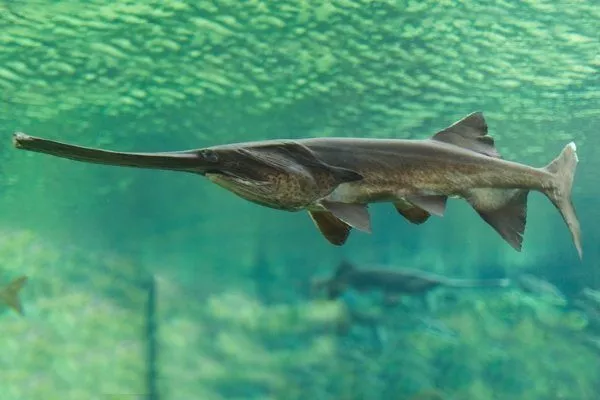
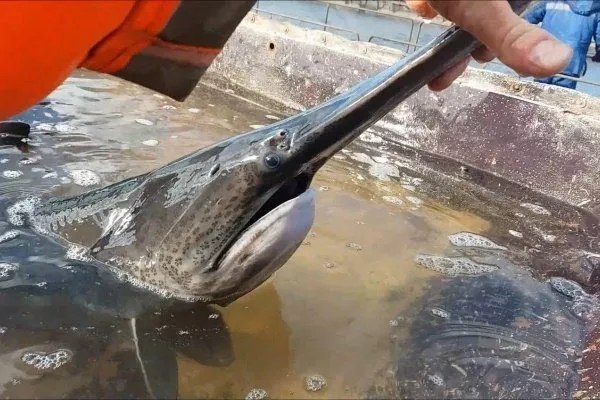
The paddlefish is a sturgeon with a distinctive oar-shaped snout. Paddlefish are highly adaptable and undemanding of habitat conditions. This makes this fish species profitable to farm on an industrial scale.
General characteristics of paddlefish
Paddlefish are fish belonging to the paddlefish family and the ray-finned genus. They are members of the sturgeon order. In the wild, paddlefish inhabit the freshwaters of Asia and the Americas.
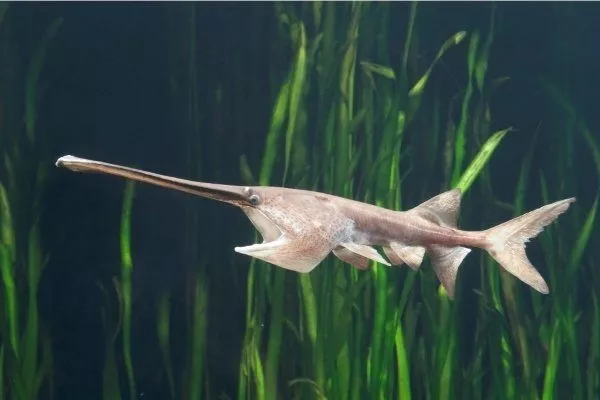
There are two main species of this fish: the American paddlefish and the Chinese paddlefish. American paddlefish inhabit the Mississippi River basin, as well as other rivers that flow into the Gulf of Mexico. Chinese paddlefish inhabit the Yangtze River basin.
These giant fish have existed for over 100 million years. They were once much more numerous, and their habitats were more diverse. Paddlefish populations have declined significantly due to water pollution, overfishing, and the construction of numerous hydroelectric dams.
The fish stays far from the shore, at a depth of about 2 meters. Its body is elongated. Its eyes are small, and its vision is poorly developed. Its mouth is motionless.
These fish are quite large: the average adult reaches two meters in length and weighs between 70 and 80 kg. They have a very long snout, which accounts for up to a third of their total body length. This snout is designed for successful hunting: it's the paddle-like snout that allows them to locate food.
Paddlefish have virtually no scales on their body surface. They have a single, slightly rearward-facing fin on their back.
Paddlefish feed on phytoplankton and zooplankton.
In natural conditions, they are threatened by fish-eating birds, lampreys and some parasitic microorganisms.
Comparative characteristics of paddlefish species
| Parameter | American paddlefish | Chinese paddlefish (psephurus) |
|---|---|---|
| Average length | 1.5-2 m | 2-3 m |
| Weight | 70-80 kg | 100-150 kg |
| Habitats | Mississippi Basin | Yangtze River basin |
| Population status | Vulnerable species | On the verge of extinction |
Paddlefish flesh is not only delicious but also contains numerous beneficial substances and microelements, as well as omega-3 fatty acids. Paddlefish is beneficial for the thyroid gland, regulates cardiovascular function, and improves gastrointestinal function.
Breeding Features
This fish can be farmed commercially: this species is rare and highly prized. In Russia, paddlefish are bred exclusively by artificial means. Under these conditions, they successfully mature and reproduce.
Growing this fish doesn't require much labor: paddlefish don't require any special conditions. When farmed on an industrial scale, paddlefish can yield up to 100 kg of paddlefish per hectare of pond. Paddlefish farming is most effective on specialized farms located near protected reservoirs.
The advantage of this type of business is that paddlefish can be raised alongside other plant-eating fish. Furthermore, this fish survives the winter well in carp wintering ponds.
Another important advantage of breeding these fish is their rapid growth. Paddlefish are considered fast-growing organisms. This rapid growth is due to their high ability to filter plankton using a wide filter plate. Paddlefish actively capture prey, significantly expanding their feeding range. Paddlefish keep their mouths open, so they are sure to capture suitable food as they swim.
Fish are demanding of oxygen levels, so it is necessary to regularly monitor the oxygen content in the water.
Construction of a pond for paddlefish breeding
Paddlefish are a valuable resource for reservoirs, cooling ponds, and lakes in central and southern Russia. Most of these reservoirs lack the conditions necessary for fish reproduction, requiring periodic stocking and the installation of necessary equipment.
To start a paddlefish farming and cultivation business, you need to prepare a suitable reservoir. The best climate zones for paddlefish farming in the former Soviet Union are the forest-steppe and steppe physiographic zones.
Paddlefish breeding stock can be raised in regular carp ponds. The pond must have a well-planned bed.
Paddlefish farms must be equipped with a direct-flow water system. This means that water flows into the pond from the source and is then discharged into the receiving water.
It is recommended to grow fish of the same age group in one pond, since otherwise the growth and development of older fish, which are much more demanding of living conditions, slows down.
When designing a pond, the following characteristics must be taken into account:
- the temperature should be between 22-26 degrees;
- the optimal level of oxygen dissolved in water is not less than 5 mg/l;
- the optimal salinity level is up to 4%;
- The biomass of zooplankton, which is the natural food for paddlefish, is 5 g/m3.
Before introducing the fry, organic fertilizer is added to the pond bed. The soil should be harrowed to a depth of 5-7 cm.
Mineral fertilizers are applied only in a well-dissolved form. Typically, rotted manure, lime, superphosphate, and potassium permanganate are used.
If fish are raised in multi-purpose reservoirs, their area must not exceed 2,000 hectares. The non-freezing water depth must be at least 1.5 meters.
Necessary equipment, material
First, you need to acquire breeding stock. Each fry weighs approximately 25 mg. The recommended stocking density is 2,000-3,000 specimens per hectare.
Standard carp ponds don't require any special equipment. The key is ensuring complete drainage and an independent water supply and collection system. It's also essential to ensure the constant growth of phytoplankton and zooplankton.
You will need netting equipment for catching fish and containers for transporting paddlefish, equipped with devices for aerating the water.
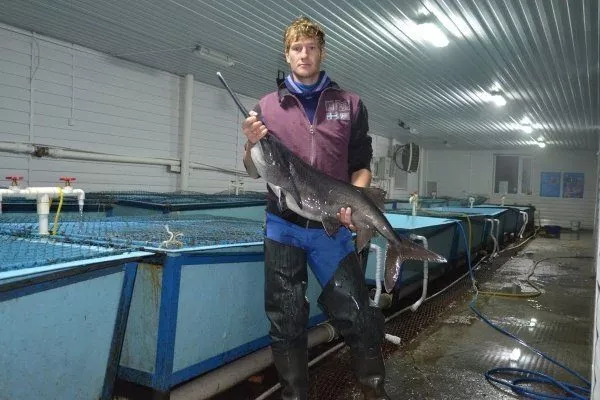
Caught paddlefish are inspected, weighed, and measured. Catching these fish is not difficult.
Peculiarities of paddlefish breeding on a home farm
Paddlefish reach sexual maturity at 5-10 years of age, with a total lifespan of up to 55 years. The onset of sexual maturity depends largely on climatic conditions.
To stimulate the maturation of producers, the pituitary glands of sturgeon fish are used.
Reproduction
Artificial breeding work should begin when the water temperature becomes stable and is within 13-15 degrees above zero.
The complete development cycle of the paddlefish includes 5 successive stages:
- Obtaining fertilized eggs and embryos.
- Growing larvae.
- Growing of juveniles.
- Obtaining commercial fish.
- Growing producers.
Calendar of artificial breeding work
- April: Preparation of producers (pituitary injections)
- Late April – May: Egg production and fertilization
- May-June: incubation of eggs (9 days at 13-15°C)
- June-August: rearing larvae in pools
- August-September: release of juveniles into ponds
Spawning for these sturgeons begins in late April or early May. Paddlefish spawn in schools. Females lay their eggs at depths of 2 to 12 meters.
A single female paddlefish lays up to 250,000 eggs, each about 2.5 mm in diameter. Paddlefish eggs are sticky and dark in color.
Females do not spawn every year.
Features of cultivation
The fry hatch after just 9 days. They grow and gain weight rapidly: by the age of one, they reach 70 cm in length.
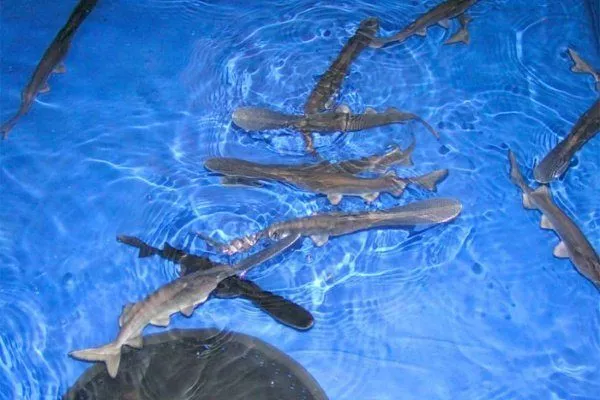
It's important to note that it's not recommended to introduce fry of this fish into ponds due to their low survival rate. It's best to raise them first in trays, tubs, or pools with running water.
Dead larvae must be removed regularly. The young must be sorted by size.
Juveniles that have grown in pools and reached 5 g can be released into ponds. By autumn, they will have reached the required weight.
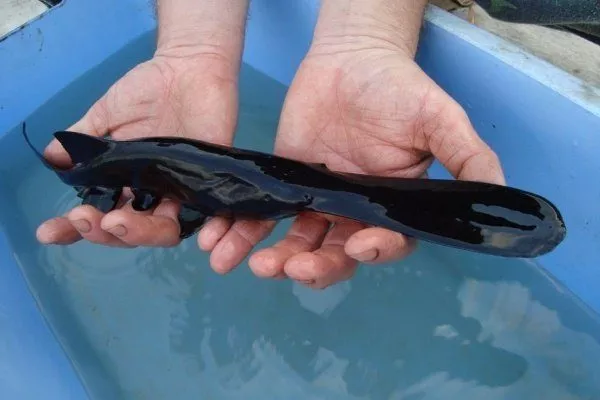
Under favorable conditions, the weight gain of juvenile paddlefish will be about 6 kg in one summer; in less favorable conditions, up to 3 kg.
Dangers
Severe algal blooms and an abundance of thread algae, which can entangle young sturgeons, pose a danger to fish and their fry. To suppress excess pond vegetation, grass carp are introduced into the pond.
The development and vital functions of these fish are also negatively affected by the insufficient technical equipment of fish breeding facilities and the inadequate nutrition of paddlefish during the rearing periods, until they reach viable stages.
Nutrition
For fish to actively develop and gain weight, the average mass of zooplankton should be within 3-5 g/m3.
Paddlefish are the only sturgeon species that feed exclusively on natural vegetation found in the water. A distinctive feature of these fish's diet is that when hunting, they vigorously wiggle their tails to draw up more microorganisms from the water's bottom, which they then consume.
Both adults and juveniles feed on plankton. In particular, this fish prefers detritus, phytoplankton, and lower crustaceans. Much less frequently, paddlefish consume insect larvae. When they feel the need to feed, they rise closer to the surface of the water with their mouths open. The fish pass streams of water over their gills. This unique filtering action ensures that all the plankton is retained in the mouth and then sent to the stomach.
Composition of the paddlefish's natural diet
| Type of feed | Share in the diet | Nutritional value |
|---|---|---|
| Phytoplankton | 40-45% | 2.5-3 kcal/g |
| Zooplankton | 35-40% | 3.5-4 kcal/g |
| Detritus | 15-20% | 1.8-2.2 kcal/g |
Paddlefish compatibility with other fish
Paddlefish can be grown separately, but as practice has shown, this is not economically feasible.
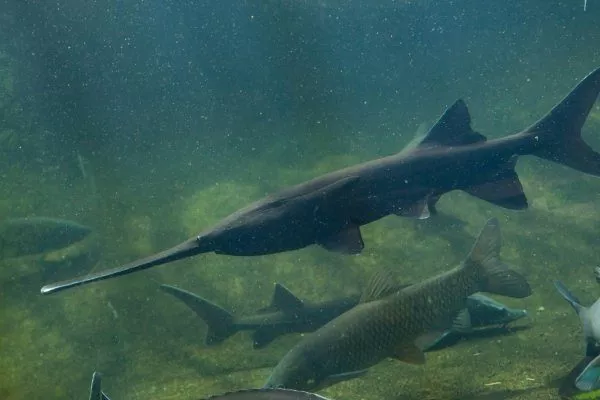
Paddlefish can share their habitat with other herbivorous fish, such as carp, grass carp, and channel catfish. Best results are achieved when kept with bester, buffalo, and carp.
Application in the food industry
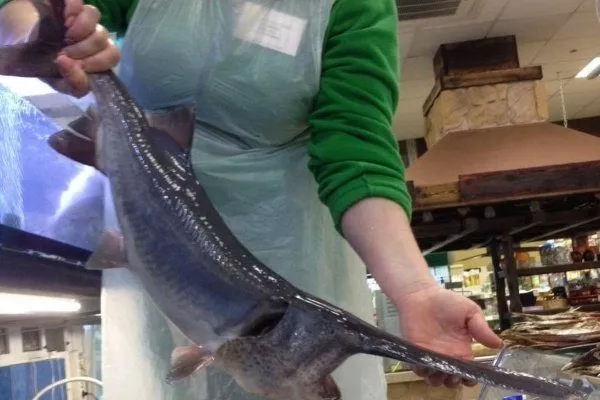
Paddlefish are widely used in the food industry for processing. They have high nutritional value.
These sturgeons are particularly fatty. Their caviar is considered a delicacy.
Because the muscle tissue of this species of fish contains a high amount of fat, they can be used to produce excellent smoked products. Paddlefish, in particular, is used to produce hot-smoked products with a unique flavor.
The percentage of meat yield in paddlefish is higher than in such sturgeon representatives as stellate sturgeon and osetra – up to 61%.
Heat treatment of fish helps eliminate the specific smell and distinctive damp taste that are characteristic of the muscle tissue of these sturgeons.
Paddlefish liver is also valuable for the food industry. It has a delicate, light texture and is easily digestible. The liver is used in canned products.
Business plan for paddlefish farming and breeding
Since paddlefish are not particularly demanding in terms of habitat, with the right approach and organization of the breeding process, a business in breeding this fish species will be promising and profitable.
The total cost of setting up the business, including pond preparation, purchasing fry, and other necessary investments, will be approximately 1,000,000 rubles. Paddlefish meat and caviar are expensive, so the payback period will be approximately 1-1.5 years.
The profitability of paddlefish farming, assuming the fish reach market weight (1.6-3 kg), is approximately 90%. If the farmer also harvests caviar, this figure increases several times, ranging from 900-1800%.
Economic indicators of breeding
| Parameter | Meaning |
|---|---|
| Cost of fry (pieces) | 15-20 rubles |
| Cost of 1 kg of weight gain | 80-100 rubles |
| Wholesale price of meat (kg) | 450-600 rubles |
| Price of caviar (kg) | 8000-12000 rub. |
Paddlefish are members of the sturgeon family that feed on zooplankton and phytoplankton and are undemanding in terms of their habitat. Farming this fish can yield a good profit, especially if the caviar is harvested. Paddlefish meat is used to make various canned goods, as well as hot- and cold-smoked products.