
Sturgeon farming at home is an activity that, when properly managed, can generate a significant and consistent income. Although this fish is not a cheap one, setting up a business to breed it for subsequent sale does not require significant investment.
General information about the business, pros and cons
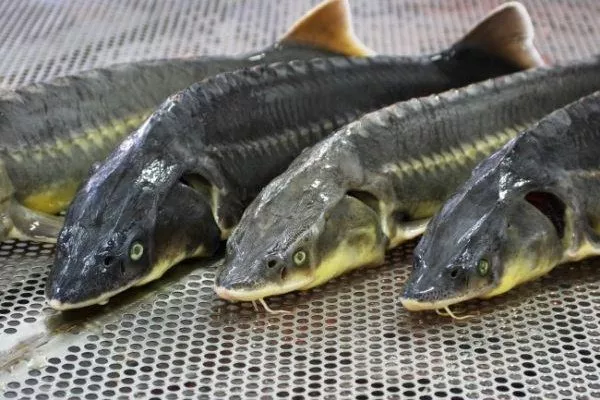
Breeding sturgeon at home is entirely possible; the key is to provide all the necessary conditions. The sturgeon family includes not only the Siberian and Russian sturgeon, but also the sterlet, stellate sturgeon, and beluga.
The fish species described above have tasty and healthy meat and caviar. They are easy to breed, and demand for them is always high.
The advantages of a business in growing and selling sturgeon fish include the following:
- high demand for carcasses and caviar;
- sturgeon's unpretentiousness to breeding conditions: this fish easily adapts to temperature changes and is not too demanding in terms of food;
- quality and environmental friendliness of products;
- rapid growth of fish;
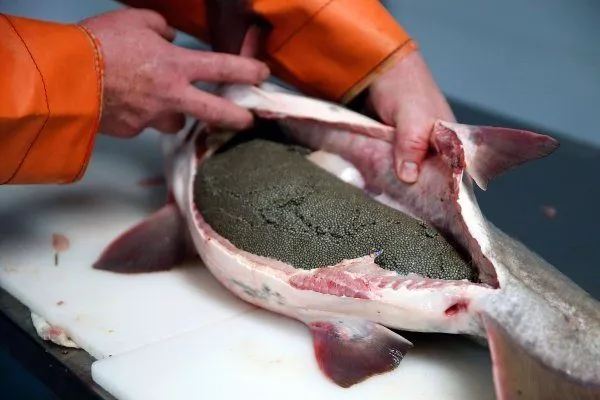
- obtaining not only fish meat, but also caviar, which is highly valued;
- quick business payback – it takes about 9 months;
- no need to spend a lot of time caring for fish;
- sturgeons have low susceptibility to various diseases.
If an entrepreneur plans to breed sturgeon for caviar, they should be aware that it is a lengthy and labor-intensive process. While a fish farming business can pay for itself within nine months, breeding sturgeon for caviar will only pay for itself after several years.
Business plan
Before you begin implementing a business idea, you need to develop a detailed plan that will take into account all expenses and income, as well as determine the business's profitability and payback period.
If we assume that a ton of sturgeon will be grown within 9 months, then the cost items will look like this:
- fish farming tank: the cost depends on the size and the manufacturer, the price can range from 100,000 to 500,000 rubles;
- pump – 9,000 rubles;
- purchase of sturgeon fry in the amount of about 1,800 pieces – about 30,000 rubles;
- biofilters – 10,000 rubles;
- oxygen generator – about 20,000 rubles;
- purchase of fish feed (1,500 kg) – 70,000 rubles;
- payment for electricity (up to 30,000 rubles per year);
- various minor expenses (50,000 rubles);
- payment of wages to hired workers, the level of costs depends on their number.
With the right approach and organization, the business can be expected to break even within the first year of launch. The fry rearing cycle, culminating in the production of commercial products, takes approximately nine months. Net profit at the end of this period will be approximately 250,000-300,000 rubles.
| Expense item | Amount (rubles) | Note |
|---|---|---|
| Tank | 100,000–500,000 | Depends on volume and material |
| Fry (1,800 pcs.) | 30,000 | Buying in bulk reduces costs |
| Feed (1,500 kg) | 70,000 | Protein, high-calorie |
| Equipment (pump, filters, generator) | 39,000 | Minimum set |
| Electricity | 30,000/year | Calculation for average power |
Starting from the second year of sturgeon farming, every thousand fry purchased and released into the reservoir will bring up to 200,000 rubles in net profit.
Options for arranging reservoirs for sturgeon
To ensure the necessary conditions for the life and reproduction of fish, it is necessary to properly equip the reservoir.
At the initial stage, one container is enough - a plastic one pool, which is relatively easy to maintain. If the initial production scale is not too large, the depth of such a tank can be 1 m, and the diameter can be from 1.5 to 2.5 m.
The sturgeon tank must be located in a building with an area of at least 30 square meters. It must be equipped with a heating system to prevent the fish from freezing during the cold season. Furthermore, the building must have electricity, sewerage, water supply, and ventilation.
To ensure active growth of sturgeon, the water temperature in winter should not be lower than 17 degrees.
Sturgeons, which are sensitive to stress and external stimuli, should be kept in a quiet area. Avoid close proximity to crowded areas, railway tracks, or highways. A garage, a solid shed, or a polycarbonate greenhouse are all suitable options for housing the sturgeon tank.
The construction of such an artificial reservoir is discussed in this video:
If you have a pond on your property, you can organize sturgeon breeding in it. Beforehand, you should thoroughly clean the bottom, ensure a fresh water supply, and enrich it with flora. You can also dig the pond yourself.
A natural pond should contain algae and various aquatic plants.
It is advisable to introduce snails, plankton, and worms into it.
Necessary equipment
To successfully grow and breed sturgeon, certain equipment is required. An entrepreneur must purchase the following:
- PumpIf fish are raised in a private home, a pump will be needed to supply water from a well or borehole.
- Compressor, which constantly oxygenates the water. It is recommended to install several such units so that if one pump fails, another can take over.
- Filtration unitThe equipment purifies contaminated water and allows it to be reused without harming the fish.
- Heat exchangers and heatersThese elements are necessary to maintain the required temperature. In summer, they cool the water, and in autumn and winter, they heat it.
- Diesel or gasoline generatorThis element will ensure an uninterrupted supply of oxygen and water to the reservoir, even in the absence of power. A generator is essential for sturgeon farms, as there is no way to be completely immune to power outages.
After purchasing and installing the necessary equipment, it is time to purchase sturgeon fry.
When introducing fry into a pond, you should adhere to the following schedule: at least 60 kg of live sturgeon per square meter.
Peculiarities of fry breeding on a home farm
To ensure a stable income from sturgeon farming, all necessary conditions must be met.
Fish keeping conditions
For sturgeon to thrive and develop, the water temperature they live in is crucial. It should remain between 18 and 25 degrees Celsius.
If sturgeon fry are released into a cleaned natural pond, this is done in the spring, using specialized mixtures for feeding.
It is important to take into account that the natural loss of fry bred in artificially created conditions is up to 30%, which is considered normal.
During the rearing process, individuals reach a certain size and require specific conditions. The fry should be housed in rectangular tanks 0.5 meters deep and wide, and approximately 2 meters long.
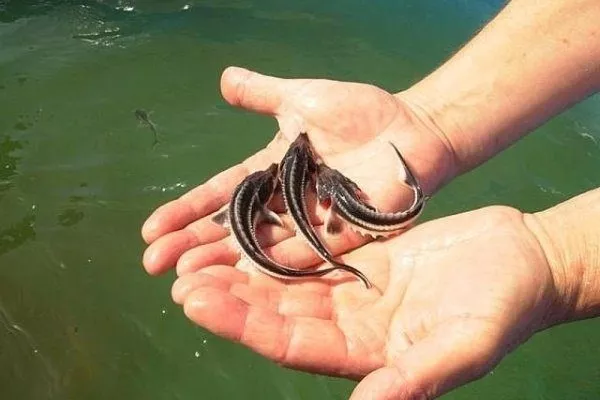
Sturgeons weighing up to 300 g are placed in tanks with a depth of 0.6-0.8 m and a diameter of up to 1.5 m. Sturgeons weighing from 300 g to 2 kg should live in tanks with a depth of 80 cm to 1.2 m and a diameter of 1.5 to 2.2 m.
Providing food for sturgeons
To ensure the full development of newly hatched fry, it's essential to provide them with adequate nutrition. The following principles should be followed:
- the food must necessarily sink to the bottom, since the sturgeon eats from the bottom;
- fish choose food based on their sense of smell, so food for them should have a pleasant smell;
- food for sturgeon fish should be high in calories so that the fry gain weight faster;
- The food must have the ability to swell in water so that the particles become softer and the fish eat them faster.
The percentage composition of sturgeon feed looks like this:
- protein – 50%;
- crude fats – up to 25%;
- fiber – 4%.
The remaining portion consists of minerals and vitamins, as well as microelements that promote the growth and development of fish.
| Age of fish | Feeding frequency | Granule size (mm) | Protein (%) |
|---|---|---|---|
| Fry (<5 g) | 6 times a day | 1.5–2.0 | 55–60 |
| Juveniles (5–300 g) | 4 times a day | 3.0–4.5 | 50–55 |
| Adults (>300 g) | 3 times a day | 6.0–8.0 | 45–50 |
Adults are fed about 4 times a day, young animals – up to 6 times.
Diseases
Representatives of the sturgeon fish species are susceptible to the following diseases:
- adenovirus and iridovirus diseases, as well as diseases caused by herpes viruses 1 and 2: they can be triggered by sudden changes in temperature, increased stocking density, and poor water quality;
- myopathy (muscle delamination): its development is associated with the presence of toxic substances in water;
- Saprolenziosis, a fungal disease that can also affect eggs, develops under poor conditions, injuries, and weakened immunity.
- Daily temperature and oxygen monitoring
- Equipment disinfection once a month
- Quarantine of new fry (14 days)
- Baths with salt (5%) during transportation
- Water analysis for NH₃/NO₂ weekly
Preventive plan
To ensure the proper development of sturgeon fish, it is important to constantly monitor the composition and temperature of the water, provide regular feeding, and carry out disease prevention.
Sales of products
Even before the first batch of products is ready for sale, effective marketing strategies should be carefully considered.
Sturgeon is a highly valued fish, so it can be distributed in a variety of ways:
- organize your own sales point at the market and sell fish at retail prices;
- enter into agreements with restaurants and cafes and supply products in the agreed quantities;
- supply goods to specialized stores focused on the sale of fish and seafood, as well as to large supermarkets and retail chains.
To attract as many customers as possible, you need to invest in advertising. You can learn about your products through the media and the internet.
| Distribution channel | Marginality | Requirements |
|---|---|---|
| Restaurants | 40–60% | Certificates, stable supplies |
| Retail (markets) | 50–70% | Availability of a point, refrigeration equipment |
| Wholesale bases | 20–30% | Lots from 100 kg |
| Processing (smoking) | 80–120% | Additional equipment, SanPiN |
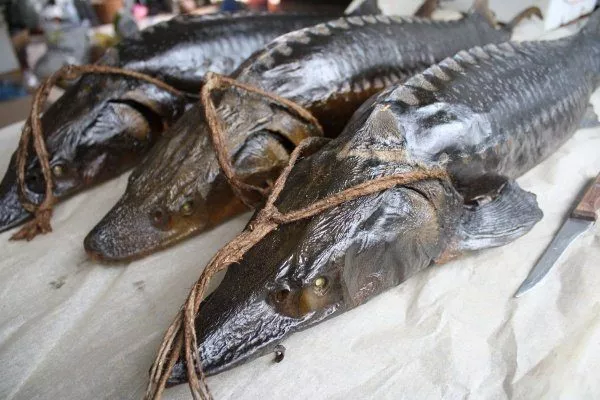
Selling fish isn't limited to raw fish: smoked fish is also popular, but this requires owning your own smoking facility. As your business grows, you can expand this sector as well.
In addition to the carcasses, sturgeon liver can also be sold: it is a delicacy, so restaurants and cafes will readily purchase it.
The most profitable option is to sell black sturgeon caviar, as its price can reach up to 100,000 rubles.
Sturgeon is listed in the Red Book, so catching it in waters around the world is prohibited by law. Therefore, black caviar is a scarce delicacy. Its sale, like that of fish, is permitted only to private farms that have all the necessary documentation to operate.
Sturgeon farming is a profitable business opportunity that can generate income in as little as nine months. It's crucial to approach the industrial process responsibly and ensure favorable conditions for the survival and reproduction of this noble fish.