
Pond fish feeders are essential for more efficient breeding and profitability. Fish adapt to new devices easily—sometimes 5-6 minutes is enough, but in other cases, it can take up to several days. To speed up this process, farmers initially add food under the feeder.
The need for feeders
Pond fish feeding devices are used in cases where the lake bottom is too silted or there is no feeding place that meets the breeding requirements.
- ✓ The water temperature should be between 20-25°C for optimal adaptation.
- ✓ The pH level of the water should be neutral (6.5-7.5) to avoid stress in fish.
Feeders are also needed for other purposes:
- the accumulation of rotting organic matter on the bottom of the pond is eliminated;
- the water remains clean;
- vertebrates eat only as much as they need, so overeating is excluded;
- the feed dosage is controlled, which prevents malnutrition;
- economical use of feed.
Choosing a location
The optimal area for feeding fish in a pond is the coastal zone, with a depth of 60 to 80 cm. However, this is best done in sloping areas of the shore, where the depth varies from 30 to 100 cm, allowing the water to self-cleanse from excrement and food (due to constant fluid circulation).
Other requirements:
- sunny side;
- good lighting;
- close location of the drain.
Types of feeders
Fish feeders are sold in specialty stores; their price depends on the design, materials used, and manufacturer. However, vertebrate breeders can make their own feeders. The key is to choose the right type of device.
Mobile
Stationary feeders are installed in ponds to encourage fish to swim up and consume food. However, this isn't always convenient, especially if you have multiple cages—you'll have to manually move the feeders to a different pond each time.
For these cases, mobile models have been developed. They come in automatic and mechanical versions.
Peculiarities:
- moves on the ground thanks to a lightweight chassis system - 2 main wheels and 2 support wheels;
- the classic bunker is designed for 120 kg of feed product;
- automated versions are equipped with an electric spreader;
- power is supplied by a battery (a car battery is fine);
- after recharging, it works non-stop for about 5 hours (depending on the model);
- the amount of raw material scattered per second is 400 g, therefore 120 kg will flow into the water from one classic bunker in 5 minutes;
- In simple models, the handle has a manual start button, while in automated models, a timer is installed to count down the time.
Mechanical
These are the simplest designs, equipped with feed bins. The operating principle is simple: the farmer dumps the feed into the bin and leaves the feeder in the designated location.
Next, the fish swim up and touch the pendulum releasers, after which the hopper releases a predetermined amount of feed. In other words, the feed only drops out when the jawed fish nudge the pendulum.
How mechanical equipment works:
- the frame consists of two solid loading floats, which have free space on top with a wooden flooring for the person who fills the trench with food;
- In the center, a bunker is installed on a metal frame, which is tightly closed with a lid.
This is a standard model, but there are many variations of mechanical feeders.
Automatic
This is an expensive but very convenient option for feeding fish in ponds, especially on large fish farms. Automation means programming the system with a pre-programmed feeding frequency algorithm.
Features depending on models:
- the volume of one bunker is 25-300 l;
- placement method – mobile (on floats in a reservoir), stationary (on the shore) and along a cage line;
- type of work – throwing feed only in one direction, fan-shaped, to a width of 4-5 m, to a length of up to 10-15 m and dumping raw materials around the system (used only for floating devices);
- Power supply type – regular battery, 12-volt power source or solar panels.
How to set up a feeding schedule – rules:
- Determine how much feed the system dispenses in grams in 10 seconds. To do this, press the button on the controller, which activates the ejector for this time (10 seconds). Collect the ejected feed and weigh it.
- Enter the received grams into the controller by going to the settings.
- Here you can also set a timer – the start and end time of the release, and the frequency of feedings.
What does an automatic feeder consist of:
- floats;
- frame for tanks made of metal rods;
- bunkers with feed spreaders and a rotating device;
- between the tanks – software control.
The operating principle is based on the fact that the bunkers are located above the water; at a time set by the timer, the locking mechanism automatically opens and the feed is ejected from the opening in one direction or along the perimeter (360°).
Multi-section feeders
There are feeders with sections for different types of food and vitamins. The best option is an automated system, which allows you to schedule the delivery of specific food or vitamin supplements at specific times.
For example, vitamins once a week, large granules – 2 times a day, finely granulated food – 3 times, etc.
Criteria for selecting purchased models
The first thing fish farmers pay attention to is the cost of the feeder. Automated models are known to be the most expensive, but despite the significant outlay, the payback is considered quick.
When purchasing equipment for feeding pond fish, you should pay attention to the following indicators:
- ease of installation, especially for beginners - the feeder should be universal so that it can be installed in the place where you need it, and not where the manufacturer intended;
- ease of use – ease of pouring food, cleaning, etc.;
- If you are purchasing a machine gun, carefully read the programming system – it should be understandable to you;
- Quality is the most important factor, so the design must be airtight (to prevent moisture from entering the bunker), durable, and made of stainless metals;
- a wide range of setting modes – feeding varies in different seasons;
- number of ponds - if there are several, it makes sense to buy a mobile model, otherwise you will need several stationary ones, and this will cost 3-4 times more;
- volume of the pond - for a huge pond, it is better to purchase a mobile floating version.
TOP 5 Best Store-Bought Feeders
There's a huge selection of pond fish feeders, from both foreign and domestic manufacturers, but experienced farmers recommend choosing Russian-made designs. There are many reasons for this, including the availability of spare parts in case of breakdown, cost, and the reliability of proven manufacturers.
Solar
Among the automatic models, the Solar feeder with its programmable system stands out. Features:
- type – stationary;
- tank capacity – 400 kg;
- feed projection length – from 15 to 18 m;
- granule scattering speed per 1 second – 200-400 g.
The equipment is equipped with a controller and a pellet size regulator. An oval pellet emerges from the ejector and spreads in a fan shape up to 7 meters wide. The ejection distance is adjusted by adjusting the ejection angle and the height of the feeder.
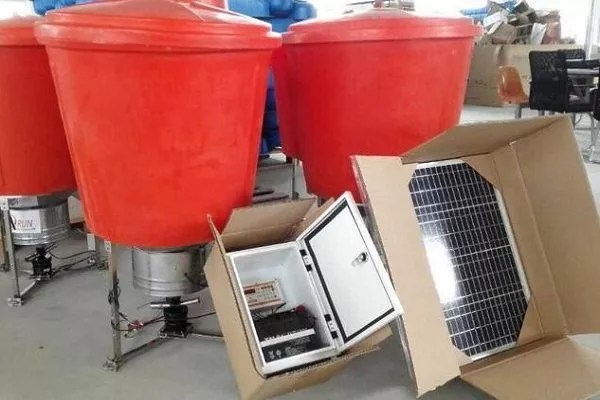
The hopper is made of translucent material, allowing visual control of its fullness.
Feed-380
For larger bodies of water, floating feeders are used. The Korm-380 model is one of the leading models. This feeder has six pendulum-type feed dispensers spaced 30 cm apart.
Peculiarities:
- type – floating;
- bunker volume – maximum 380 kg;
- type of flight - food is lowered into the water;
- raw material spreading speed – up to 400 g per second.
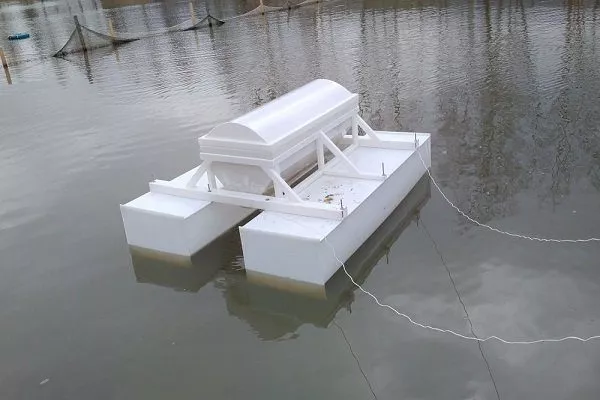
The model can be used even in strong winds, which create waves and splashes on the pond, because the reservoir is securely sealed with a lid. Even though the pendulums are submerged, they are sealed against water penetration thanks to protective plastic covers.
Reflex
Reflex-type feeders are extremely popular in small ponds. Domestic manufacturers produce the Korm-10 model.
Characteristic:
- type – floating;
- volume – 10 kg;
- a type of food release - into the water;
- The speed of spreading raw materials per 1 second is 2-4 doses.
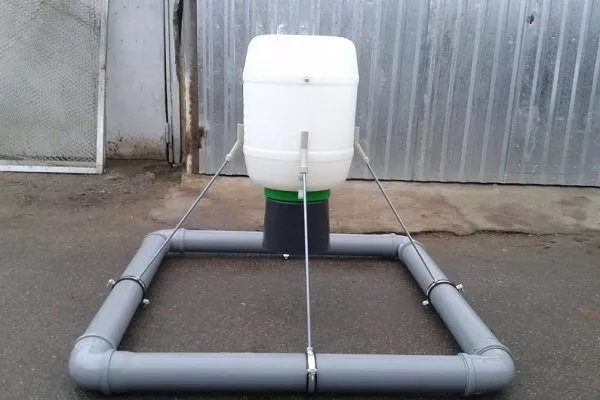
This pendulum-type feeder features only one release mechanism. Its unique feature is that it releases a small amount of food into the water, keeping a small pond clean for a long time.
If a farmer has several small ponds, he or she purchases a mobile feeder equipped with wheels. Among the most popular models, the
Mobile feeder on a chassis from Solar
It has an electric spreader, 2 main wheels and the same number of support wheels, which eliminate the risk of tipping over when moving over terrain with obstacles.
Indicators:
- type – mobile;
- volume – 120 kg;
- extension length – from 1.5 to 20 m;
- raw material scattering speed per 1 second – 200 g.
The model distributes fish food pneumatically and in only one direction, but the rotating device rotates fully around its axis. The spreaders are equipped with a movable tip, which adjusts the vertical flight angle. The discharge is carried out in a fan-shaped pattern.
The mobile feeder is charged by car batteries. One charge is enough for 36 tanks weighing 120 kg each (approximately 5 hours).
Solar – PZK
Stationary feeders are commonly used on small bodies of water. They are neither mobile nor launched into the water, but are installed in the coastal zone. The top 5 models include the pneumatic feeder model from Solar – the PZK.
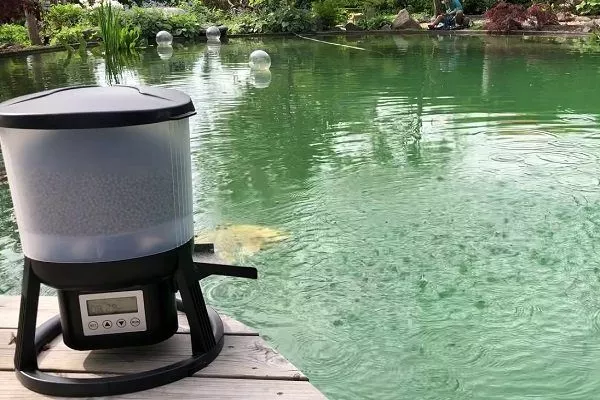
There are 2 options – 1.5 (runs on gasoline) and 1.1 (powered by a 2.5 kW electric motor).
Specifications:
- type – stationary;
- volume – 120-150 kg;
- loading sleeve height – from 1 m 50 cm to 1 m 80 cm;
- The speed of raw material spreading per 1 minute is from 15 to 18 kg.
Both types of pneumatic feeders operate using an air compressor.
DIY
Homemade feeders are simple. There are two options: submersible containers and closed-circle/square/rectangular designs that float on the water's surface.
How to make a bottom feeder:
- Take a plastic barrel.

- Cut the bottom off just enough to accommodate the required amount of food.
- Drill holes on both sides, where you will then insert the fixing ropes.
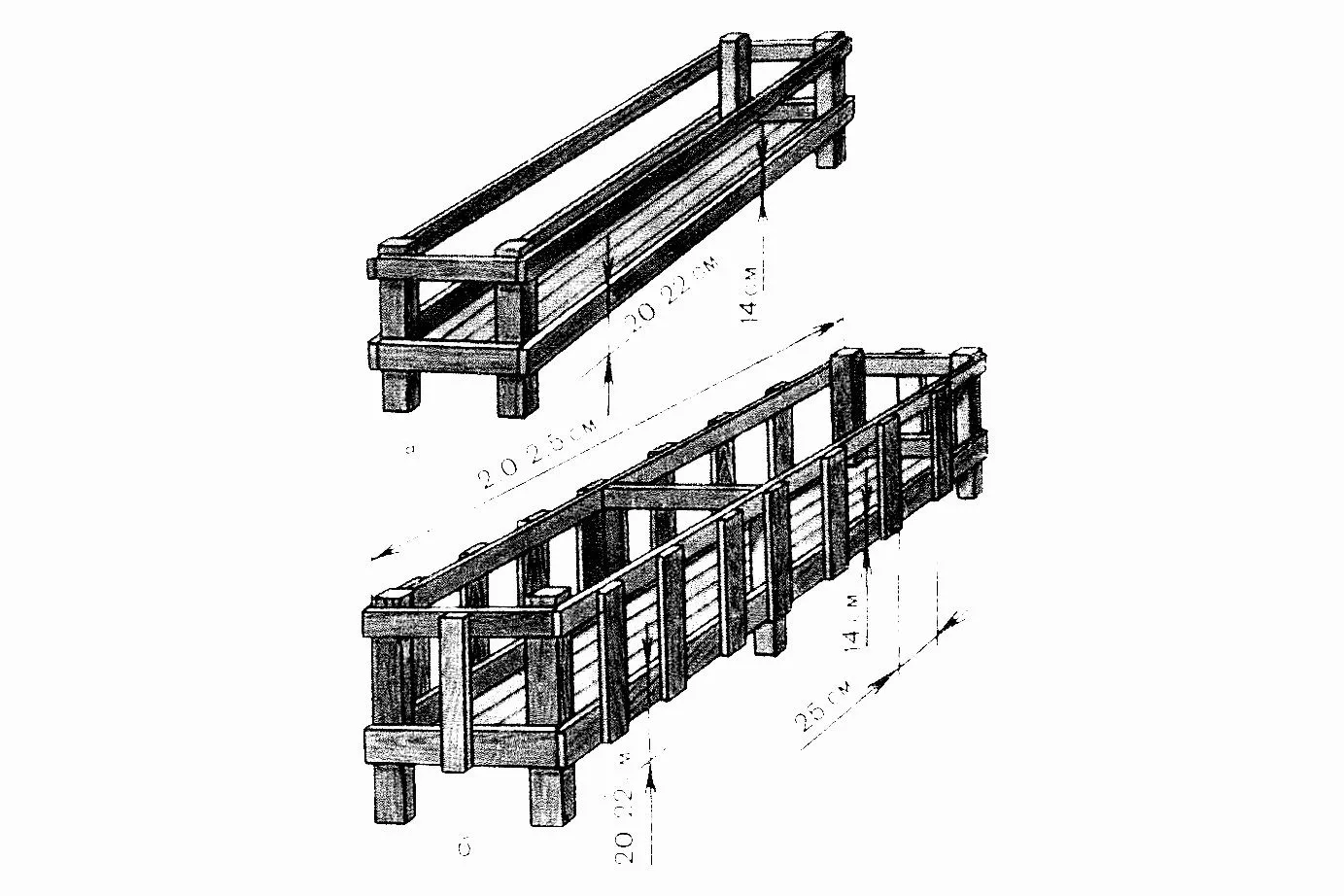
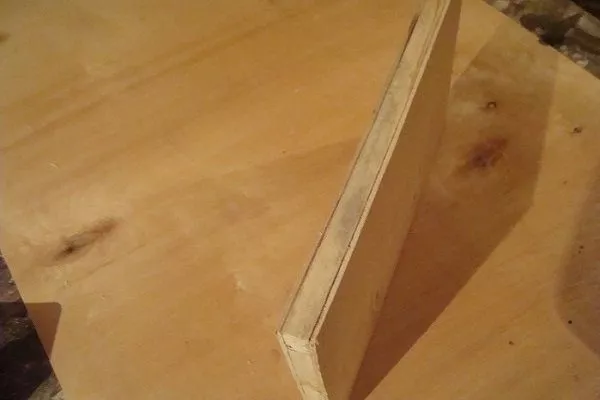
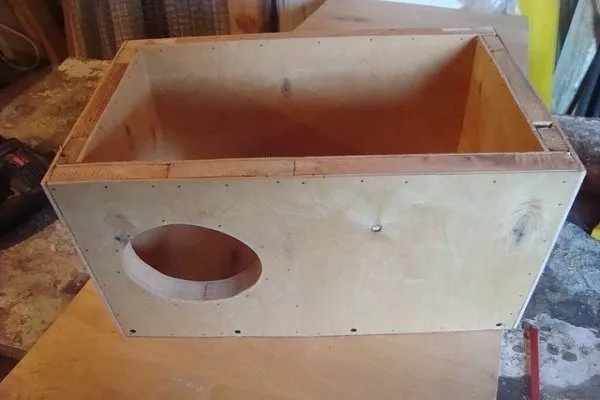
The second option involves using any available material—hose, wooden slats, plastic, etc.—to create a frame for the feeder. A hole must be drilled to secure the feeder in place.
For more information on how to make similar structures at home, watch our video:
Installation of the structure
Setting up homemade feeders is quick and easy. If you're using a cut-off barrel, simply tie a rope to it, fill it with food, and lower it to the bottom. Tie the end of the rope to a bridge or tree. When the fish empty the container, it will float to the top.
When using a floating feeder, you should also secure the feeder and lower it into the water. Then, scatter the feed over the surface. This way, the feed will always be in one place and won't pollute the pond.
How to increase the food supply of a pond?
To expand the food supply for fish, experienced farmers use a few tricks:
- attracting insects to the feeding area, for which fluorescent lamps are installed above the water (approximately 30-35 cm) - for 1 hectare, 1 lamp is enough (insects will appear in about a day);
- loosening natural sediments with water rakes, which allows plankton to develop;
- adding humus to water - lower to the bottom at a rate of 2 to 3 tons per 1 hectare.
Fish feeders installed in the pond reduce labor costs, accelerate production, and keep the water clean. Conserving feed, which is often purchased from specialized stores and is expensive, is especially important.
Why do you need a photo of a rabbit's entrails? And why do you need a drawing of a rabbit cage?