
Fish kills in private ponds and natural bodies of water lead to the destruction of aquatic life, negatively impacting catch rates and the pond's ecological health. This phenomenon occurs at different times of the year and for a variety of reasons.
What is fish kill?
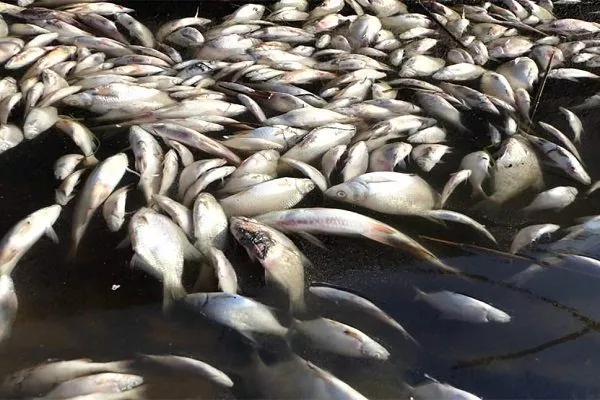
Fish kill refers to the mass death of aquatic organisms by suffocation due to hypoxia, or oxygen starvation. This occurs when there is a partial or complete lack of dissolved oxygen.
In this form, it penetrates into water in two ways:
- released during photosynthesis (due to the activity of algae);
- is transformed by capturing and dissolving air during rain and wind.
Reasons
| Name | Resistance to hypoxia | The ability to hibernate | Sensitivity to pollution |
|---|---|---|---|
| Trout | Low | No | High |
| Zander | Low | No | High |
| Pike | Average | No | Average |
| Perch | Average | No | Average |
| Chub | Average | No | Average |
| Asp | Average | No | Average |
| Crucian carp | High | Yes | Low |
| Tench | High | Yes | Low |
| Loach | High | Yes | Low |
| Rotan | High | Yes | Low |
All bodies of water without a constant current and with a high risk of eutrophication are susceptible to mass fish kills. This is the process of water becoming saturated with nutrients (most often phosphorus and nitrogen), which contributes to a deteriorating aquatic environment.
Perch, sturgeon, and salmon are the first to be affected by fish kills, as they are considered the most vulnerable. The following aquatic species are slightly less sensitive to oxygen deprivation:
Crucian carp, tench, loaches, and rotans can easily survive in a body of water without oxygen. Some species are capable of burrowing into the mud and hibernating during unfavorable periods.
Hypoxia is the main factor causing deaths. It occurs naturally when algae automatically reverse their photosynthetic process, meaning the plants absorb oxygen rather than release it.
Many natural factors contribute to hypoxia. Primarily, these include reduced light levels in winter, prolonged cloudy weather, and so on.
Other reasons that contribute to fish kills:
- Invasive diseases. Most often, this is an infection with pathogenic microorganisms such as trichodiniasis, ichthyophthirius, and chilodonellosis. The bacteria actively develop, excrete waste products, infect aquatic life, and consume oxygen.
- Increased iron concentration in water. This phenomenon is especially dangerous in the summer during hot, sunny weather, when vegetation begins to actively grow. Microorganisms break it down, resulting in the synthesis of organic iron.
This problem is easy to spot: a ferrous film forms on the surface of the pond, and in winter, a hydrogen sulfide smell emanates. - Trawling in winter. Fishing companies use bottom trawling. This process mixes all the water layers, pushing oxygen into the air.
- A sharp change in air temperature. The factor helps stop the growth of algae that produce oxygen vital for fish.
- Pollution of a water body. When municipal or industrial waste, including sewage, enters a pond, the water becomes contaminated with hydrogen sulfide, methane, hydrogen oxide, or hydrogen dioxide. These harmful gases deplete oxygen levels.
- Toxic influence. Substances such as phenol, cyanide, iron hydroxide, ammonia, formaldehyde, hydrogen peroxide, etc., when released into a body of water, cause mass poisoning of fish and other living aquatic organisms.
- Poisonous substances. They most often enter water during heavy rains, when soil is washed away from the ground surface. Such situations are common in bodies of water bordered by settlements, farms, and other businesses, as well as mining operations.
Types of the phenomenon
Oxygen deficiency in a pond is felt depending on external factors, particularly air and water temperature and light levels, which is known as a thermocline. The temperature regime in a pond fluctuates:
- on the surface the water is completely warmed up;
- at the bottom it is absolutely cold.
This gradient also affects the liquid's density—the colder the water, the higher the density. Moreover, the temperature drop is quite abrupt, meaning there is no smooth transition. The thermocline is the boundary where the temperature fluctuations sharply break.
This distinction affects oxygen levels, which become more concentrated at depth.
It is the temperature that allows us to divide the frost into seasonal types:
- Winter. It occurs most frequently from January to April. The main cause is severe frost. A dense ice crust forms on the pond's surface, preventing the water from mixing.
Winter fish kills are also affected by excessively dry summers, especially those repeated for more than two seasons. Due to shallow water, all the water freezes, significantly reducing the thickness of the warm layers. And if severe frosts occur with low water levels, the warm layer disappears completely. - Summer. The freezing period lasts from June to the end of July. There are several reasons for this:
- warm weather allows the aquatic environment to warm up well, i.e. the amount of cold masses - oxygen carriers - is significantly reduced;
- As the temperature in the reservoir increases, pathogenic bacteria and zooplankton begin to become active and multiply rapidly.
- Night. At night, algae, like most land plants, do not synthesize oxygen but absorb it from the water. A characteristic feature of this phenomenon is that the freezing of fish occurs primarily in the early morning, and when the sun rises, the fish stop dying.
There's another reason, linked to the summer period. Due to the intense algae growth, light doesn't penetrate deep into the water, but is instead concentrated on the surface. The lower layers of vegetation can't receive the necessary light to photosynthesize and, instead, struggle to survive, absorbing the remaining beneficial gas.
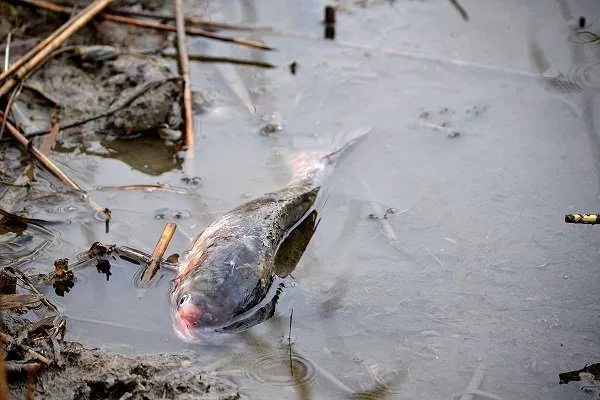
External factors causing fish death
When fish experience oxygen starvation, they become more active, thrashing restlessly around in the water. This increases their oxygen demand even further. At this point, oxidative processes occur, which contribute to the formation of lactic acid.
Hypoxia manifests itself as follows:
- blanching of the gills;
- lightening and even blueing of the mucous membranes of the mouth (depending on the degree of deficiency of the substance);
- clouding of the eyes;
- increased respiratory rate;
- opening of the oral cavity and gill covers;
- gill spreading;
- Darkening of the blood - the biological fluid takes on a dark cherry hue and does not clot.
There are also signs of an imminent fish kill. Fishermen and fish farmers always pay attention to them.
Indicators:
- small aquatic fauna begins to behave unusually - crustaceans, bugs and similar creatures float to the surface, first begin to thrash about, and then die;
- a low level of oxygen in the water causes darkening of fishing lines and lures (exclusively made of copper or brass);
- In winter, fish do not rise to the ice holes.
How to determine the oxygen level in a pond and save fish?
A special device, a thermooximeter, is used to measure oxygen concentration in water. Levels indicating an approaching freeze range from 6 to 7 mg/L.
Saving fish from freezing in reservoirs is a necessary measure from an environmental and fish farming perspective. Numerous methods have been developed for this purpose. They are carried out immediately during and before oxygen starvation, i.e., as a preventative measure.
- ✓ The cable length must correspond to the depth of the reservoir.
- ✓ The presence of a maintenance-free probe simplifies operation.
- ✓ Resistance to water and corrosion.
What can you do:
- Aeration. There is a special device for saturating water with oxygen - aeratorIt can be replaced with a compressor with an air spray function.
If the pond is large, it's advisable to use aerators with a flow generator. The unit also creates a stable current, which mixes the water to produce oxygen. - Drainage, cleaning. If the cause of the freeze is pollution in the pond, wastewater is diverted from the pond. If this is not possible, algolization is used.
This involves introducing a green algae called chlorella into the river. It quickly purifies the water of any unwanted impurities, absorbs nitrogen and phosphorus, and neutralizes petroleum products. - Oxygen tablets. Used in large-scale fish farms, special preparations are added to the water to diffuse oxygen.
- Aquatic vegetation. The procedure involves clearing the pond of excess vegetation during the summer. A water mower and bottom harrowing are used.
Another option is to stock the pond with fish that feed exclusively on algae. These include bighead carp, grass carp, and others. - Disinfection. To avoid invasive diseases, before wintering it is recommended to treat the pond with quicklime in a proportion of 100 kg per 1 ha.
Another preventative measure to prevent fish deaths is maintaining the ice hole. This method is used if an aerator is not available. This procedure is carried out in the winter before the fish die off period. Here's what to do:
- chop ice twice a week;
- freeze straw, reeds or rushes, tied into bundles, under the ice;
- make holes around the pond - at least 4 per hectare;
- to insulate the ice holes - place hollow stems of sedge or cattail in the hole;
- clear the surface of snow piles (ultraviolet light will penetrate under the ice blocks).
To avoid fish kills, preventative measures such as testing pond water for unwanted substances and bacteria by taking samples and having them tested in a laboratory cannot be ignored. Monitoring the external signs of kills in pond inhabitants will also allow for timely stabilization of the situation.