
Hexamitosis, or hole-in-the-hole disease, is a dangerous condition caused by parasites that can only be seen under a microscope. If the problem isn't addressed promptly, virtually all fish in fish ponds and tanks will become infected.
What is hexamitosis?
Hexamitosis (spironucleosis or octomitosis) is a parasitic (invasive) disease affecting marine and freshwater fish. It is caused by diplomonads, single-celled flagellates known as Spironucleus, which inhabit the environment. These flagellated ciliates are also called flagellates.
Hexamitosis parasites are especially numerous in dirty water. They can infest fish, amphibians, and mammals. Flagellates infest both wild and farmed fish.
The most well-known species of diplomonad is Giardia, which causes diarrhea in humans. It can be contracted by swallowing water from a pond or swimming pool. Chlorine is ineffective against this parasite.
Under a microscope, a flagellate resembles a droplet. Several pairs of flagella are attached to its body, giving these protozoans their name. The maximum size of this single-celled organism is 12 microns.
Causes of the disease
The most common reason for the active spread of diplomonads, leading to an outbreak of hexamitosis in fish, is pollution of the water body.
Factors that provoke hexamitosis in fish raised in ponds:
- decrease in oxygen concentration in water;
- violation of the diet;
- monotonous feeding or a sudden change in diet;
- a lot of fish per unit volume of the reservoir;
- keeping fish of different sizes in one pond;
- excess nitrates in water;
- avitaminosis due to deficiency of vitamins, especially groups B and C;
- stress caused by certain manipulations, for example, moving from pond to pond, transportation.
Hexamitosis most commonly affects salmonids. In them, the disease typically manifests on the flanks and scalp. Carp and grass carp are also susceptible. Catfish and eels can also become victims of these parasites.
The essence of the disease
Fish can carry flagellates throughout their lives without becoming infected with hexamitosis. Only under unfavorable conditions does an outbreak occur. The disease affects the intestines and gall bladder of fish.
Flagellates inhabit the intestines, in the area located after the stomach. Here, the parasites swarm in the intestinal tract and feces. The parasite is carried throughout the body by the bloodstream, where its numbers rapidly increase.
Chronic hexamitosis occurs. In farmed fish, exacerbations typically occur in the fall and spring. Increased mortality is observed among chronic fish.
Symptoms of the disease
The disease can be identified by its external symptoms. The fish's skin becomes covered with ulcers, holes, and furrows of varying sizes. Because of these, the disease is often called "holey disease."
Excrement
Hexamitosis can be detected by changes in the feces. They become translucent and white in color. They have a viscous, slimy consistency. The anus swells.
The change affecting feces is associated with the process of intestinal cell shedding, which is what's excreted as viscous mucus. Another type of digestive disorder is the excretion of almost undigested food.
Poor appetite
Sick fish refuse to eat. If the infection is not severe, the fish will "spit" by repeatedly taking and spitting out food. This behavior doesn't indicate the fish is picky about its food, but rather a serious underlying problem.
After adequate treatment, the fish's appetite returns to normal. Juveniles recover especially quickly.
Bloating
This symptom isn't mandatory, and distinguishing a normal belly from a pathogenic one isn't easy. A fish's belly can also be slightly enlarged for other reasons, such as after a large meal.
With hexamitosis, the bloating phase may be absent. Sometimes, the fish first lose weight, and then their abdomen becomes concave or keeled. The back also shrinks.
Erosion
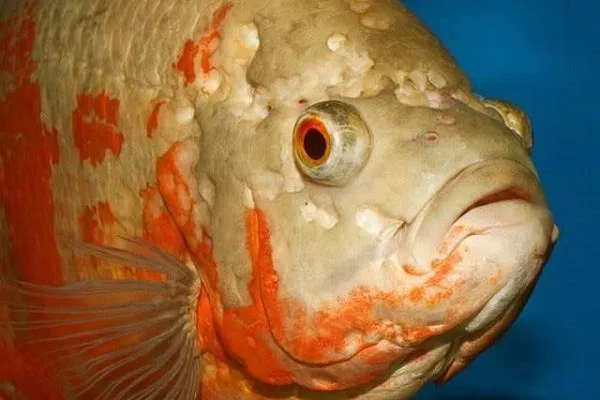
First, the lateral lines of the body darken. The skin becomes covered with holes and ulcers, from which white threadlike fibers are visible. Lumps and fistulas appear on the head of the diseased fish. The cause of this destructive phenomenon is the degradation of cartilaginous tissue.
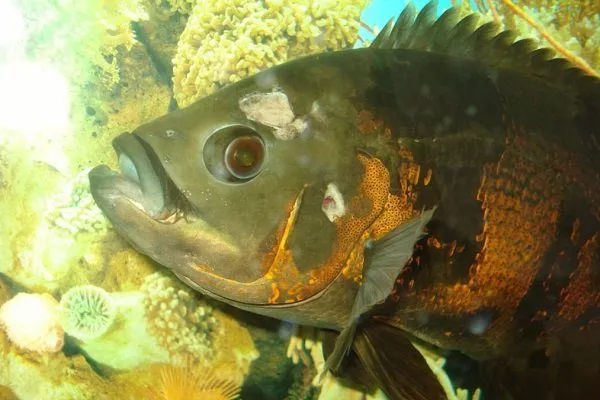
The holes and ulcers covering the frontal part of the head are the most characteristic and frightening symptom of hexamitosis, making it the easiest to recognize. Even after the fish is treated and the infection is controlled, scars and dents remain in the affected areas, which last for the rest of the fish's life.
Destruction of fins
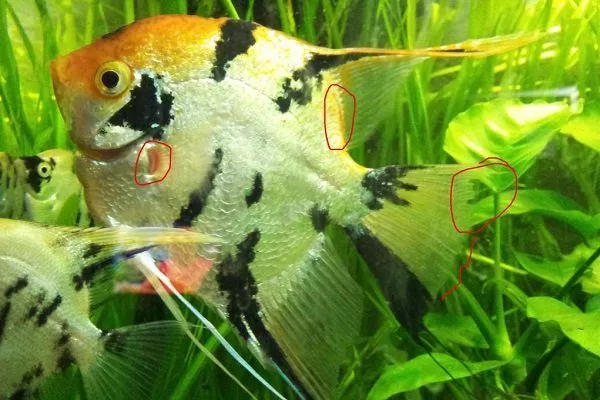
Affected fish may experience fin destruction. Their tips appear to burn away, creating a fused appearance. Treating the fins is pointless; the underlying cause—the flagellates—must be addressed. Left untreated, the fins will fall off completely.
Other symptoms
Other symptoms in fish affected by hexamitosis:
- hide in secluded places;
- in case of severe damage, they completely refuse food;
- white mucus is released from the mouth, anus, gills, ulcers and head of the fish;
- the eyes become covered with a white coating, and with the development of cataracts, vision is lost;
- In the final stage of the disease, there is a lack of oxygen, the gills of the sick fish are filled with blood, which makes it difficult to transfer oxygen to other parts of the body;
- The movements of the fish become unbalanced, they rise to the surface and then dive to the bottom.
Symptoms of hexamitosis may appear in different sequences. Some may be absent altogether.
Fish actively developing hexamitosis usually die within two weeks. Throughout the disease, affected individuals release flagellates into the water, spreading the infection throughout the body of water.
The disease primarily affects weakened and stressed individuals. It's virtually impossible to recognize the disease in its early stages, which is why timely treatment is difficult. Only indirect signs can help suspect a flagellate infestation.
- ✓ The presence of white mucus in the stool, which indicates the rejection of intestinal cells.
- ✓ The appearance of holes and ulcers on the fish's head, especially in the frontal part, is the most characteristic symptom.
Diagnostics
Making an accurate diagnosis is difficult and complicated by the vagueness and variety of symptoms. By the time the most obvious sign—holes in the head—appears, the disease has already progressed too far.
The symptoms of hexamitosis are very similar to those of diseases such as mycobacteriosis and ochthiophonosis. The exact cause of the pathology can be determined after an autopsy of the gastrointestinal tract and microbiological analysis.
Intestinal or fecal samples are analyzed. Flagellates move quickly and erratically, making them easy to see under a microscope during mass infestations.
How to treat?
To treat parasitic infections, only antiprotozoal drugs are used, since antibiotics are not effective enough against flagellates.
Currently, there is a wide range of medications available that can quickly and effectively treat hexamitosis. The choice of treatment strategy and method depends on the underlying factor. It has been proven that hexamitosis is always accompanied by a viral infection.
Before treatment begins, infected fish are placed in a separate pond or pool—a form of quarantine. Then, one of the following treatment methods is used.
Hyperthermic treatment
This treatment method involves raising the water temperature in the pond. This option is possible if the appropriate heating equipment is available. The treatment must be carried out in small containers, into which the sick fish are placed.
The temperature is increased by 3-4 degrees per day. If necessary, it can be raised by more than 8-10 degrees above normal, but this should be done as gradually as possible. This method is more commonly used by aquarium fish keepers; it is less popular in pond fish keeping.
Metronidazole
This is an effective antiprotozoal drug, repeatedly tested in practice. It is considered an environmentally friendly product, as it does not contain any substances that pollute the environment.
The drug is used in both the general water body and the quarantine pond. The maximum dosage is 500 mg per 70 liters of water. Metronidazole is administered for 3 days. If treatment is ineffective, discontinue use.
Treatment results are usually visible within the first week. In addition to metronidazole, other medications may be used concurrently.
Ornidazole and Tinidazole
These are synthetic antimicrobial drugs that inhibit gram-negative bacteria and anaerobic microflora. They share the same mechanism of action but differ slightly in the speed of action.
Treatment is carried out in a common pond or in a settling tank, in the following dosage:
- tinidazole - 1 g per 200 l of water;
- ornidazole - 2 tablets of 500 mg per 200 liters of water.
The medications are administered three times, one day apart. Then, take a 3-4 day break and repeat the cycle. Two cycles are usually sufficient, but to ensure complete elimination of the parasites, three courses are recommended.
The use of drugs can be combined with hyperthermic treatment.
Other drugs
To treat fish infected with flagellates, the following medications are used:
- Furazolidone. It is used in combination with tetracycline or kanamycin. A solution is prepared at 0.05 mg of the drug per 10 liters of water. Add 2 g of kanamycin or 0.25 g of tetracycline per 50 liters of water. Treatment is continued until improvement occurs.
- Ciprofloxacin. It is used in combination with aquatic preparations. A solution is prepared by mixing 0.5 g of the preparation per 50 liters of water. ZMF HEXA-ex (a treatment for hexamitosis and other infestations) is added.
- Ofloxacin. This medication can replace ciprofloxacin. It is diluted with furazolidone at 0.2 and 0.6 g per 40 liters, respectively. The mixture is poured into the breeding tank, where the fish are kept overnight.
Quarantine measures
If the disease progresses rapidly and poses a threat to the fish's life, treatment is carried out in a separate tank. During quarantine, medications targeting flagellates are combined with antibacterial agents (antibiotics).
Quarantine is the first step when symptoms of hexamitosis appear. All infected fish are placed in a separate holding tank. New fish are also placed in a similar tank for preventative treatment.
Homemade medicinal food
To prepare therapeutic food, you need pellets that don't dissolve easily in water. If the pelleted food becomes mushy after 5-10 minutes of soaking, it's not suitable for therapeutic purposes.
One of the following medications is added to the feed: metronidazole, tinidazole, ornidazole, or furazolidone. The granules are mixed with tablets ground into powder and soaked in a special veto starter culture (probiotic).
Additionally, it is recommended to give your fish immunomodulatory medications. Suitable medications include interferon, purple echinacea, and special multivitamins for fish.
Prevention of hexamitosis
Hexamitosis develops when conditions in a body of water are favorable for its pathogens. Prevention involves a series of measures aimed at maintaining an ideal ecological balance in ponds where fish are kept.
Preventive measures:
- Periodic feeding with special medicinal food containing spirulina, kanamycin and furazolidone.
- Change food and diet from time to time.
- Adding the multivitamin preparation Fishtamin to the aquatic environment.
- Checking the level of nitrates and phosphates in water.
- Continuous operation of aeration and filters.
- Quarantine measures for new fish.
- Disinfection of vegetation, soil, live food.
A video about hexamitosis and how it appears in fish under a microscope:
Hexamitosis can cause irreparable damage to fish health. Digestive system damage can lead to the death of fish. Effective parasite prevention can prevent losses and unnecessary expenses on expensive medications.