
Aeromonas is a dangerous contagious disease affecting pond fish. Members of the Cyprinidae family are particularly susceptible. If left untreated, this infectious disease can lead to the death of infected carp, wild carp, and their hybrids.
Causes of aeromonosis
There are many causes of aeromonosis (also known as hemorrhagic septicemia, rubella, or abdominal dropsy) in pond inhabitants. The main factors contributing to the disease's development in ray-finned fish include the following:
- a reservoir infected with an infection;
- unfavorable living conditions (a pond polluted with organic matter, disturbances in the hydrochemical regime);
- a pond overpopulated with fish;
- the presence of injuries in its freshwater inhabitants;
- water temperature from +15⁰С to +20⁰С;
- poor quality or infected feed;
- weakened immunity in fish caused by inadequate feeding.
- ✓ Maintain water pH between 6.5-8.0 to minimize the risk of disease.
- ✓ Monitor the concentration of dissolved oxygen to at least 5 mg/L.
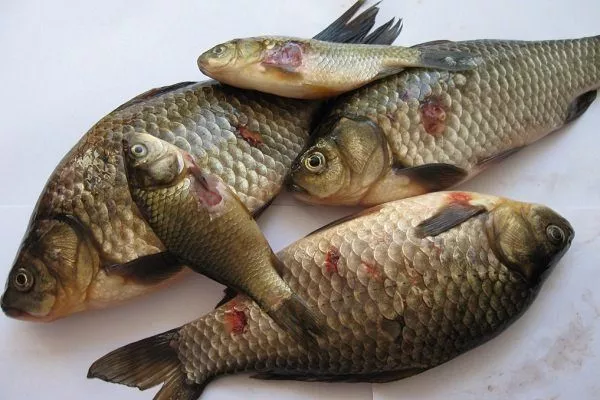
Aeromonas infections peak in the spring and summer months. In the fall, the disease subsides, becoming chronic. Fish that have recovered from the disease develop relative immunity to abdominal dropsy.
In addition to carp and grass carp (yearlings, two-year-olds, three-year-olds, and breeders), other pond inhabitants are also at risk of contracting aeromonosis:
- silver crucian carp;
- tench;
- white amur;
- bream;
- roach.
Pathogen
The causative agent of the disease is Aeromonas hydrophila, a bacterium. It is a short, coccoid, Gram-negative rod with rounded ends.
Once Aeromonas hydrophila enters the fish's body, it spreads through the bloodstream, eventually infecting all organs and tissues.
When a bacterial infection occurs in a sick individual, the blood vessel walls, cells, and tissues are damaged by biotoxins. This can lead to the following consequences:
- inflammation of the skin, which is serous-hemorrhagic in nature;
- accumulation of fluid in the abdominal cavity;
- dystrophic and necrobiotic changes in internal organs.
Methods of distribution
The main source of infection in a freshwater reservoir is its sick inhabitants and so-called microbe-carriers.
The appearance of Aeromonas hydrophila bacteria in the aquatic environment is caused by many factors:
- introduction of the pathogen through water or birds that feed on fish;
- introducing sick carp into a reservoir;
- use of infected fishing gear, equipment, and special clothing.
Freshwater fish become infected through skin lesions. The pathogenic bacteria can also enter the fish's body through their gills. Fish can also become infected with aeromonas by contact with leeches or argulus crustaceans.
In which bodies of water do fish get sick most often?
An outbreak of aeromonosis primarily threatens a body of water densely populated with fish. Ray-finned fish in heavily overgrown and dirty ponds, lakes, reservoirs, or small, slow-moving rivers are particularly susceptible to rubella.
Symptoms of the disease
Close observation of pond inhabitants allows for the diagnosis of aeromonosis. Symptoms of this bacterial infection are divided into three groups:
- external, concerning changes in the appearance of the sick fish;
- behavioral - changes in behavior in infected inhabitants of the reservoir;
- internal - pathological changes in the internal organs of the infected individual.
The clinical picture is determined by the severity of the disease. It can be:
- Spicy. The duration of the acute stage varies from 14 to 28 days.
- Subacute. Duration: from 45 to 90 days.
- Chronic. Duration: from 45 to 75 days.
External signs
The list of symptoms of acute aeromoniasis that are visible to the eye includes:
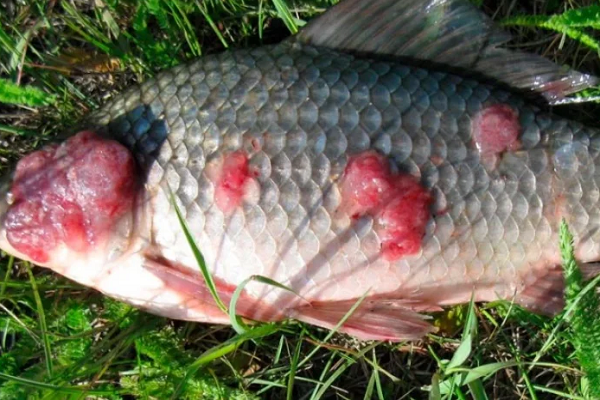
- inflamed skin (areas or the whole) of the hemorrhagic type;
- abdominal or general dropsy;
- bulging eyes;
- raising of scales;
- formation of ulcers with a bright red border;
- redness of the anus (opening).
In subacute cases, sick fish also exhibit dropsy, ruffled scales, and bulging eyes. Numerous ulcers with white borders are also present on the skin of infected fish. These ulcers sometimes develop pus.
In the chronic form of the disease, ulcers cover not only the fish's skin but also its fins. Rough, purple-colored scars are also present. These are healed ulcers.
- ✓ Presence of rough purple scars on the skin and fins.
- ✓ Absence of pronounced internal pathological changes.
Fish behavior
The behavior of sick fish differs from that of healthy fish. It varies slightly for different forms of the disease:
- For acute course Aeromonas is characterized by sedentary behavior. The fish stay near the shore, floating on the surface of the water. They react poorly to external stimuli or do not react at all. In advanced stages, the disease leads to impaired motor coordination.
- For slow flow The disease is characterized by decreased mobility. The fish moves toward fresh water, lying on its side. The prognosis is unfavorable: the sick fish die.
- For chronic course Aeromonosis is characterized by decreased activity in fish. Sick individuals usually recover.
Pathological changes
Pathological changes in the body of a sick fish depend on the nature of the disease.
The acute form of aeromoniasis causes the following complications:
- swelling;
- waxy necrotic process affecting skeletal muscles;
- encephalitis;
- hyperemia of internal organs and abdominal cavity.
The intestines of the infected individual exhibit catarrhal or hemorrhagic inflammation. The liver is flabby and dark gray or green. The gallbladder exhibits excess bile. The spleen is enlarged and dark cherry-colored.
Subacute bacterial infection is characterized by similar internal changes in the fish's body. However, they are not as pronounced. Chronic aeromonosis does not exhibit such changes.
Treatment of aeromoniasis
Treatment for this disease gives a positive result only when the sick individual does not have such external signs as:
- dropsy;
- ruffled scales.
Treatment of aeromoniasis involves the use of medications in the form of medicinal baths:
- antibiotics - Levomycetin, Syntomycin;
- antiseptic - methylene blue.
Medications are also added to the dough-like feed intended for sick fish. It is enriched with antibacterial agents:
- Biomycin;
- Levomycetin;
- Synthomycin;
- Furazolidone;
- Nifulin;
- Furadonin.
The duration of therapy is 10 days. For the first 5 days, feed the fish medicated food. Then take a 2-day break, during which feed the pond inhabitants Eat a normal diet. Continue antibiotic treatment for another 5 days. Repeat the course several times during the summer.
Biomycin can be administered orally to a sick animal. In this case, mix the medication with a starch suspension (3%). For therapeutic purposes, administer the antibiotic orally 3-4 times. Leave an interval of 16-18 hours between doses.
Treatment of the disease also includes intraperitoneal injections of the following antibiotics:
- Dibiomycin with Ecmolin;
- Levomycetin.

Those who breed carp and grass carp need to pay special attention to preventative measures:
- Provide preventative feeding of medicated fish food in the spring, when the water temperature rises to 14°C. Repeat this treatment in courses from mid-summer (July) to the end of September, with a 14-20 day break between antibiotic treatments.
- Carry out veterinary, sanitary, and fisheries improvement measures in a timely manner. This primarily includes preventative disinfection and disinfestation of the pond, veterinary monitoring of its ray-finned inhabitants, and quarantine of newly acquired specimens.
- Regularly carried out vaccinations help to avoid rubella. pond summering.
The danger of the disease
Aeromonas is a highly dangerous disease that causes significant damage to fisheries. Failure to promptly treat it leads to significant financial losses.
For fish
Aeromonas is contagious to freshwater ray-finned fish, both juvenile and adult. Without timely and adequate treatment, the disease can lead to death.
For a person
The pathogen that causes the disease in carp fish poses no danger to humans or carnivorous animals. Fish infected with aeromonosis, but still marketable and palatable, are safe for human consumption if cooked.
Sick individuals that have not undergone heat treatment are fed with food intended for:
- farm animals;
- poultry;
- fur-bearing animal.
Boiled diseased fish are processed into fishmeal. This is done with the permission of a specialist.
Aeromonosis is an infectious fish disease caused by pathogenic strains of bacteria belonging to the genus Aeromonas. The outdated name "rubella" describes the main symptom complex. The disease causes significant damage to fish farms. An acute outbreak can result in the death of up to 60% of fish.