
During the colder months, crayfish behave differently than during the warmer months. These behavioral changes require adjustments to their winter conditions during commercial farming. The right method for catching crustaceans during the cold winter months also requires careful selection.
Crayfish behavior in winter
In winter, the crayfish lives in the same body of water as in summer. When cold weather arrives, it sinks to the bottom and hides in a burrow.
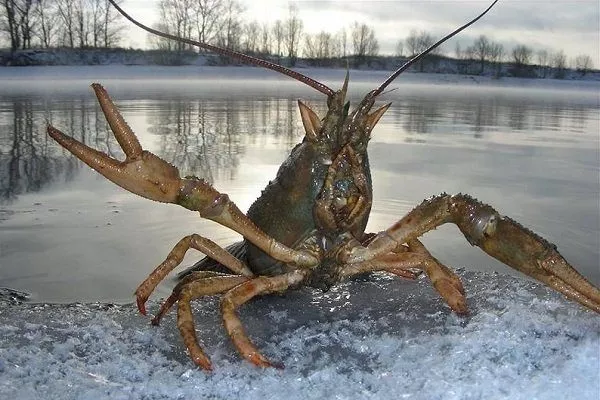
In winter, the arthropod is sedentary but does not hibernate. At night, it leaves its shelter for a few hours in search of food. The rest of the time, the crayfish sleeps in its burrow. This behavior is typical of males.
Females are more active during the winter months. They are busy incubating the eggs laid in October. This is a lengthy process, taking at least eight months. The females keep the eggs clean and "walk" them to ensure the offspring receive sufficient oxygen.
- ✓ Female crayfish demonstrate increased activity in cleaning eggs from fungi and parasites, which is not typical for males.
- ✓ They often leave their shelters for 'walks' with eggs, especially during periods of thaw.
Females spend the winter alone in burrows. Males tend to gather in groups and burrow into the mud.
Features of winter crayfish keeping
Crayfish farmed for commercial purposes are wintered in special ponds with natural and artificial bottom shelters. In addition to favorable conditions, these spineless creatures require a well-balanced diet during the winter.
Requirements for a reservoir for wintering crustaceans
A pond designed to contain arthropods during the cold months of the year has the following characteristics:
- area - 0.3 hectares;
- the presence of a source in the form of a stream or artesian well;
- water hardness - 8-12 °dKH;
- The pH of the aquatic environment is 6.5-7.5 (in water with an acidic reaction, arthropods suffer from a lack of calcium, the building material for the shell).
To successfully overwinter, this spineless creature requires clean, oxygenated water and a silt-free clay bottom. During the winter months, the crayfish lives at the bottom of the pond, where the water is warmer than above. It burrows into the clay sediments at the bottom, hiding from the cold.
To improve winter conditions for the crayfish, the pond bottom is lined with at least a 30-cm layer of clay, a clay pipe is placed there (it serves as a shelter for the crayfish), and crushed stone is added in places. Natural shelters are created in the water near the shore using:
- large branches;
- felled trees.
When ice forms on the surface of a pond, holes are made in it. This measure improves the oxygen supply to the pond's inhabitants during the winter.
Winter diet of arthropods
Crayfish are omnivorous. They can consume any food that does not contain artificial, synthetic, or chemical additives.
The winter diet of crayfish living in their natural habitat, unlike their summer diet, which consists of 90% aquatic plants, is dominated by fallen leaves. It also includes food of animal origin (dead and living pond inhabitants).
When breeding arthropods, they diet in winter they enrich:
- raw and boiled minced meat;
- bakery products;
- cereal porridges;
- vegetables (carrots, turnips);
- earthworms;
- special compound feed.
A crustacean kept in artificial conditions is fed moderately. The amount of food given is controlled. The crayfish is required to eat all the food. Otherwise, the pond will become contaminated with food waste.
Food is scattered over the pond's surface or placed in feeding troughs. The latter option is preferable. It allows you to monitor whether all the food provided to the crayfish has been consumed.
Features of winter crayfish fishing
During the cold season, crayfish are caught primarily with special traps. The traps are set at a location in deep water, where the water is warmer. Unlike in the summer, crayfish do not venture out onto the shallows at night in winter, but hide in the clay at the bottom.
The trap is placed in a deep ledge during the colder months of the year because such areas are preferred by schools of fish for wintering. Dead fish are food for crayfish.
The mouth of a clean stream or spring is considered a good place for winter fishing for arthropods. Crayfish tend to stay close to water sources with high oxygen content.
Choosing the optimal time
An experienced crayfisherman knows how to accurately determine the best time to catch crustaceans. During the cold season, crayfish go hunting at night. These spineless freshwater inhabitants are most active between 10:00 PM and 3:00 AM.
Night is the optimal time to catch them from a body of water. The catch will be more meager during the day. In winter, crayfish traps are set at night. They are checked in the morning and the catch is collected.
Bait
To lure a crayfish into a trap, use bait:
- Fish. The arthropod is most often caught using raw fish (bream, roach), cut into several pieces. The crayfish is attracted to this fish by its distinctive smell.
- Meat. Fresh chicken is suitable. Rotten chicken is not suitable for catching crustaceans. The meat is cut into small pieces and generously placed in the trap.
- Bread. Crayfish are easily caught on a piece of fresh rye bread rubbed with garlic. Make a hole in the bread crumb and stuff it with the garlic paste. To prevent the bread slice from getting soggy in the water, wrap it in nylon fabric.
- Check the integrity of the traps and replace damaged parts if necessary.
- Treat traps with a saline solution to disinfect before use.
- Place the bait in the center of the trap for maximum attraction to crayfish.
In winter, experienced crustacean fishermen also use other products as bait:
- canned green peas with chopped dill;
- sunflower cake;
- canned fish and meat;
- leftovers from home cooking;
- grasshoppers purchased at a pet store.
Methods
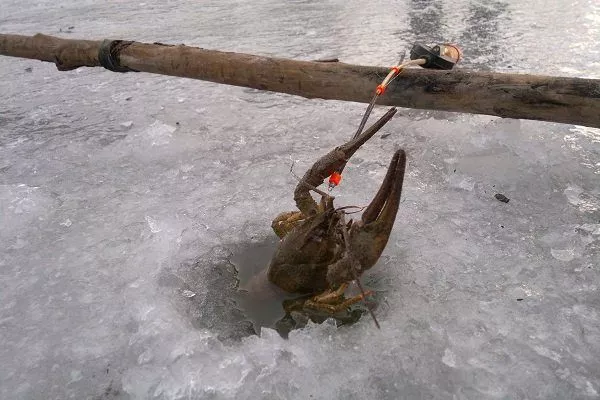
Winter crayfish fishing is not much different from summer fishing. The only difference is the need to cut holes in the pond ice to set the traps.
To catch arthropods from a reservoir in winter, the following gear is used:
- Crayfish trap. The trap is homemade from a wooden frame and metal mesh. Bait is placed in the trap, which is lowered to the bottom and tied to a stake with a rope. Every 60 minutes, the trap is raised to check for a catch.
- Scraper. This trap is simple in design, resembling a large net. It is dropped into an ice-free body of water and dragged along the bottom through crayfish habitats.
- Twist. The tackle is made from wire, with a hook on one end and a hook on the other. — A twist for rotation. The twist is dipped into the hole with the hook end, 10 turns are made, and the trap is pulled out of the water along with the crayfish entangled in the algae.
- Fishing rod. It's a wooden stick, sharpened at one end. A fishing line is tied above the tip, to which a bait wrapped in nylon or mesh is attached. The pointed end of the stick is stuck into the bottom of the pond, and the fisherman waits for the bait to bite.
- Seine (fine-mesh net). A group of three people fishes at night. Two use a seine to comb the bottom, while the third uses a flashlight from land to illuminate the area. In the darkness, the crayfish move toward the light and are caught in the net.
Winter cold spells alter crustacean behavior. These changes, along with changing weather conditions, are taken into account in commercial arthropod farming. Crayfish fishermen also pay attention to crayfish behavioral patterns in winter when choosing the location, time, and method of fishing.