
These small relatives of lobsters are representatives of the ancient world, having appeared as early as the Jurassic period. As their name suggests, they inhabit rivers and streams. They are also found in lakes, streams, ponds, estuaries, and even swamps.
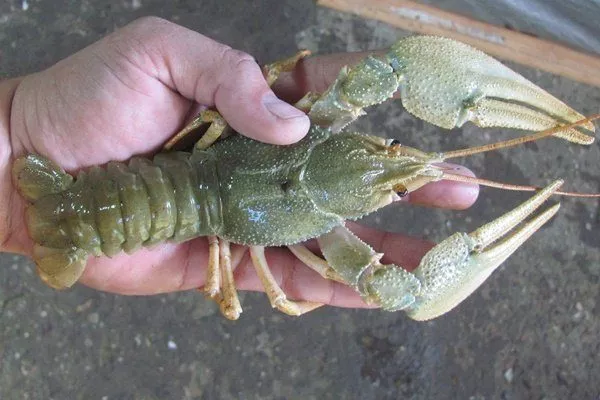
Appearance
The crayfish is a higher crustacean, a member of the order Decapoda, which includes the highly organized crayfish, as well as crabs and shrimp. All members of this order have a body consisting of a constant number of segments: four head segments, eight thoracic segments, and six abdominal segments.
If you examine a crayfish, you'll easily notice that its body is divided into two parts: the cephalothorax (which consists of the fused head and thoracic segments, the fusion seam clearly visible from the back) and the segmented abdomen, ending in a wide tail. The cephalothorax is hidden beneath a hard shell made of chitin, a polysaccharide, and is also coated with calcium carbonate, which increases its strength.
The shell is the crustacean's skeleton. It serves a protective function, safely concealing the crab's internal organs and also serves as an attachment point for the arthropod's muscles. On its head are two pairs of antennae, or barbels, covered in bristles and very long, making the term "antennae" more appropriate. They function as olfactory and tactile organs, making them essential for crabs. Furthermore, the balance organs are located at their base. The second pair of barbels is shorter than the first and is used solely for touch.
On the front of the cephalothorax is a sharp spine, with black, bulging eyes nestled in recesses on either side. These eyes are located on long, flexible stalks, allowing the crayfish to rotate them in all directions. This allows the animal to clearly see its surroundings. The eye has a complex compound structure, meaning it consists of a large number of small ocelli (up to 3,000).
Attached to his chest are claws—their forelimbs. He uses them to defend himself from enemies, catch and hold prey, and also uses them during the female's fertilization period to restrain her and flip her over. This makes it clear that crayfish are not fond of romance in intersexual relationships.
To move, the animal uses four pairs of long, walking legs. It also has small legs located on the inner surface of the abdomen, called abdominal legs. These legs serve a vital function, helping the crayfish breathe. They pump oxygen-rich water toward the gills. These legs are covered by a thin membrane and located under the cephalothoracic shield, which creates a cavity for them.
Crayfish must constantly work their legs to pump fresh water through their cavity. Female crayfish also have a pair of tiny, two-branched legs on which they support the eggs containing the developing crustaceans.
The last pair of limbs are plate-like tailed legs. Together with the thickened telson (the final segment of the abdomen), they play a significant role in swimming, enabling the crayfish to quickly move its "legs" backward. When startled, the crayfish instantly flees the danger zone, making sharp vertical movements with its tail, sweeping it under itself.
The arthropod's oral cavity is no less complex. It has three pairs of jaws. Each has a specific function: one grinds food, while the other two act as sorting stations. They sort food particles and transport them to the mouth.
Sexual dimorphism, that is, the anatomical difference between female and male individuals of the same biological species, is present in these arthropods, although it is not clearly expressed.
Female and male - who is in front of us?
The female crayfish is significantly smaller than the male, being more petite and graceful. The same can be said about the size of her claws—they are more modest. Her abdomen is noticeably wider than the first part of her body—the cephalothorax—while in the male it is narrower. Another distinctive feature is the condition of the two pairs of abdominal legs. In females, they are underdeveloped, while in males, they are well developed.
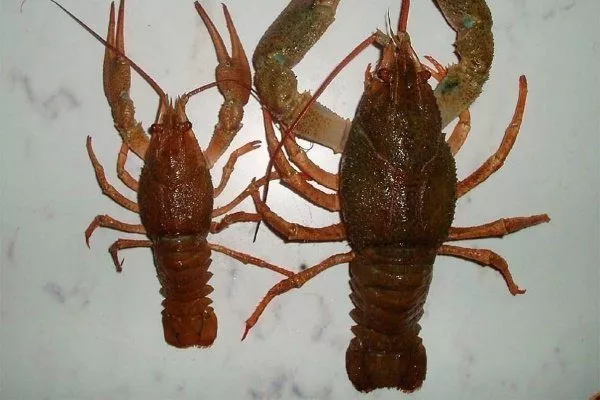
Their coloration depends on their habitat and water composition. Crayfish blend in with the bottom of the reservoir, "dissolving" among rocks and driftwood. Therefore, they are usually brown, brown with a greenish or bluish tint.
They grow to 6-30 cm in length. However, there's still no definitive answer to how long they live. Experts are unsure about their lifespan. Some believe they live up to 10 years, while others estimate a much longer lifespan, claiming a lifespan of 20 years.
Habitat
Some crayfish prefer freshwater, while others thrive in brackish water. Many of these crustaceans thrive in crystal-clear water. Therefore, if crayfish are found in a body of water, it's safe to assume the local environment is healthy. However, the narrow-clawed species, which is less sensitive to pollution than its relatives, sometimes inhabits waters of poor quality, which can be misleading.
Crayfish require sufficient oxygen and lime in the water. They die if they lack oxygen, and their growth slows if there's not enough lime. They prefer a bottom that's either muddy or has a low silt content.
Water temperature affects their vital activity, which is understandable: the warmer the water, the less dissolved oxygen it can hold, and therefore the gas concentration decreases.
They settle at depths of 1.5–3 meters, near the shoreline, where they dig burrows. A body of water usually contains only one species of crayfish, but exceptions are rare, and several species coexist in the same lake.
Types
| Name | Body length | Shell color | Resistance to pollution |
|---|---|---|---|
| Thick-clawed crayfish | 10 cm | Brownish green | Low |
| Broad-clawed crayfish | 20 cm | Olive-brown or brown with a bluish tint | Low |
| Narrow-clawed crayfish | 16-18 cm | Brown from light to dark tone | High |
| American signal crayfish | 6-9 cm | Brown with a red or blue tint | High |
There are 4 types of crayfish:
- An endangered species - the thick-clawed crayfishIts population is so small that it is currently on the verge of extinction. They live in the adjacent areas of the Black, Caspian, and Azov Seas in clean, brackish water. They cannot tolerate sudden increases in water temperature, which should not rise above 22-26°C. They grow up to 10 cm in length. Their body is brownish-green. Their claws are blunt and slightly forked.
A characteristic feature of the thick-clawed crayfish is a sharp notch on the fixed part of the claw, which is bordered by cone-shaped tubercles. It does not inhabit polluted areas. - Broad-toed species The scaly-sided ...
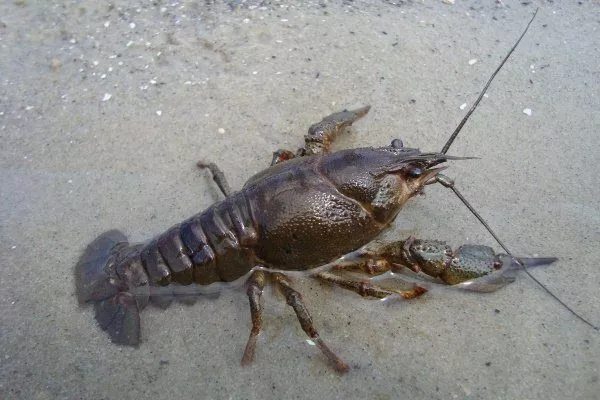
- Narrow-clawed crayfish The rhinoceros thrives in fresh and brackish water, inhabiting the Black and Caspian Seas, slow-moving rivers, and low-lying bodies of water. Its body length reaches 16-18 cm, with specimens up to 30 cm (12 in) sometimes caught. Its chitinous shell is light to dark brown. Its claws are elongated, narrow, and long. It is more resistant to pollution, so it can inhabit polluted waters.
- American signal crayfish It has spread to many European water bodies, displacing other species. It was introduced to European countries after the decline of native crayfish populations due to a "crayfish plague." In Russia, its appearance has only been recorded in the Kaliningrad region.
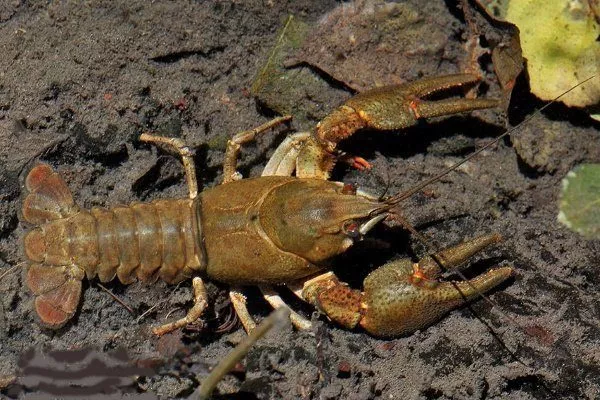
Thick-clawed crayfish
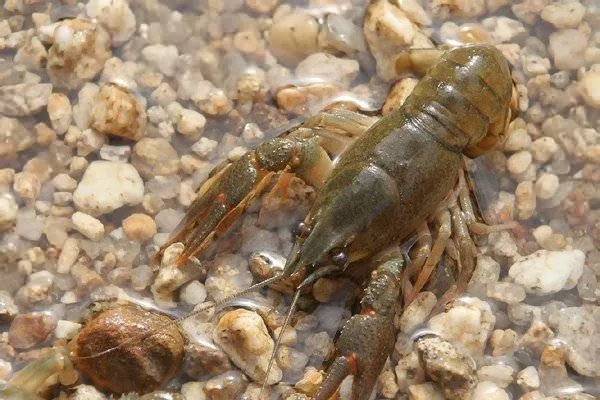
Broad-clawed crayfish
Narrow-clawed crayfish
American signal crayfish
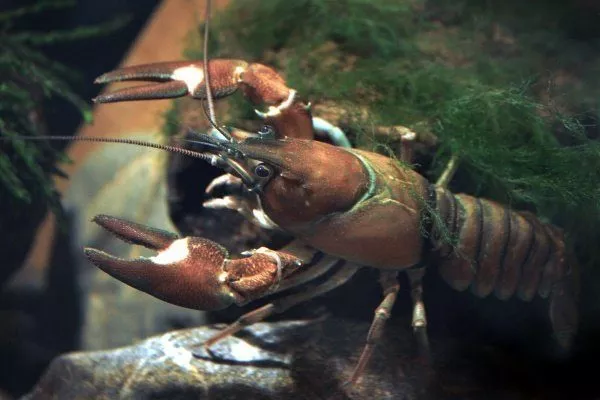
In appearance, the "American" crayfish resembles a broad-clawed crustacean. Its distinguishing feature is a white or blue-green spot located on the claw joint. It reaches 6-9 cm in length, although some individuals can grow up to 18 cm. Its coloration is brown with a red or blue tint. It is resistant to crayfish plague, a fungal disease that kills crayfish en masse, but it is a carrier of the infection.
Nutrition
Freshwater crayfish are omnivores, with a varied diet that includes both plants and animals. For most of the season, their diet is predominantly plant-based. Among plants, they enjoy algae and the stems of water lilies, horsetails, pondweed, elodea, and water buckwheat. In winter, they nibble on fallen leaves.
But for normal development, they require food of animal origin. They enjoy feasting on snails, worms, plankton, larvae, and water fleas. They also enjoy carrion, scavenging dead birds and animals on the bottom of the pond, and hunting sick fish—in other words, they act as cleaners for the aquatic ecosystem.
Crayfish don't kill their prey or inject it with venom to paralyze it. Like true hunters, they lie in wait and instantly seize their unsuspecting prey with their claws. Holding it tightly, they gradually take small bites, so their meal lasts a long time. Experts have observed cases of cannibalism in crayfish when there's a food shortage or overcrowding.
After hibernation, mating, and molting, crayfish prefer animal-based foods; the rest of the time, they feed on vegetation. Feeding aquarium and pond crayfish is discussed in this article.
Lifestyle
Crayfish are usually active at night or at dawn, but they also emerge from their burrows in cloudy weather. They are hermits. Each arthropod lives in its own burrow, dug to suit its size. This helps prevent intruders from invading their home, as well as the intrusion of a relative or enemy.
During the day, they spend all their time in their burrows, covering the entrance with their claws. When threatened, the crayfish retreat and retreat deeper into their burrows, some up to 1.5 meters long. When searching for food, they don't stray far from their home, moving slowly along the bottom with their claws extended. If prey comes within reach, they act with lightning speed. They react just as quickly in times of danger.
In summer, crayfish typically live in shallow waters, and with the onset of cold weather, they retreat to deeper waters. Females overwinter separately from males, as they brood their eggs and hide in burrows during this time. Male crayfish "clusters," gathering together in groups of several dozen individuals, overwintering in pits or burrowing into the mud.
Reproduction
Males are ready to reproduce at 3 years of age, while females reach sexual maturity a year later. By this time, the crayfish have grown to 8 cm in length. Among sexually mature individuals, males always outnumber females by 2-3 to 1.
Mating occurs during the cold season, between October and November. The timing may shift due to weather or climate conditions. A male can only fertilize three to four females. While in most animals this process is usually consensual, in the case of arthropods, mating resembles an act of violence.
As early as September, males become noticeably more active and aggressive toward individuals swimming past them. Upon spotting a female nearby, a male begins to pursue her and attempts to grab her with his claws. This is why male crayfish are significantly larger than females, as she can easily dislodge a frail male.
If the male manages to catch the female, he flips her over onto her back and transfers his spermatophores to her abdomen. This forced fertilization sometimes results in the death of the female, along with the fertilized eggs. On the other hand, the male expends a great deal of energy chasing her and practically does not eat during this period; he often simply eats the last female he catches to bolster his own strength.
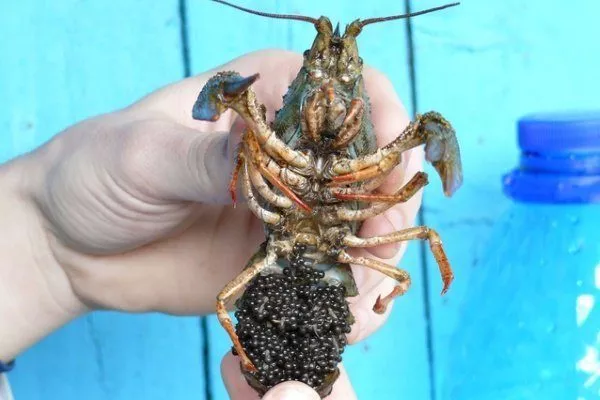
After two weeks, the fertilized female lays eggs, which attach to her abdominal legs. She faces a difficult time during this time—she protects the future offspring from enemies, provides the eggs with oxygen, and cleans them of silt, algae, and mold. Most of the clutch dies during this process; the female typically preserves about 60 eggs. Seven months later, in June-July, the crustaceans hatch from the eggs, measuring just 2 mm in size, and remain on the mother's abdomen for 10-12 days. The crustaceans then begin to swim freely, dispersing throughout the reservoir. By this time, they reach a length of 10 mm and weigh about 24 g.
Molting
As mentioned above, the crayfish's strong chitinous shell reliably protects it from its enemy's sharp teeth, but on the other hand, it also hinders its growth. However, nature has provided a solution to this problem, and it has the ability to periodically shed its old shell entirely. This shedding process not only renews the crayfish's chitinous covering, but also the upper layer of its retina, gills, and part of its digestive tract.
Young crustaceans shed their shells up to seven times during their first summer. As they age, the number of molts decreases, and adults typically shed only once per season. Shell shedding occurs only in the summer, when the water in the lake or river warms up.
Don't think this "rebirth" process is quick and easy. It can last anywhere from a few minutes to a day. The arthropod struggles to free its claws first, then its remaining legs. Often, during molting, the limbs or antennae break off, and the crayfish survives without them for a time. Over time, the lost parts grow back, but they have a different appearance. Therefore, crayfish fishermen often catch animals with claws of varying sizes, one of which may be malformed or underdeveloped.
A new soft covering has already formed beneath the old "skin" before molting. This takes about a month, sometimes longer, until the covering hardens. The arthropod grows in length and becomes ideal food for predatory fish and larger members of its species. Since it molts in the open rather than in a shelter, it must reach its habitat unharmed, where it remains without food for up to two weeks, waiting for its covering to become more or less keratinized.
Crayfish fishing and hunting
Crayfish are caught year-round, but they are generally avoided during the molting season, as the meat's flavor deteriorates. However, this rule applies only to regions where the fish are fairly common.
In some areas where arthropod populations are critically endangered, fishing is completely prohibited, such as in the Moscow region, or permitted only during certain periods, such as in the Kursk region. Crayfish harvesting is generally prohibited during the fertilization and egg-laying periods.
When going fishing, it's important to know the size and quantity of crayfish you can catch. Catching smaller crayfish may result in an administrative fine. Each region sets its own marketable size for crayfish, but it's typically 9-10 cm.
Each country and region may have its own regulations regarding the legal catch of crayfish. Research the legality of this issue before you go crayfishing!
How to catch?
There are 3 main and permitted methods of catching crayfish:
- On the shoeThis method was invented quite a while ago, but it's less effective. An old shoe, preferably a large one, is filled with bait and dropped to the bottom. It's checked periodically.
- On a crayfish hookThe crayfish fishing rod is simple. A fishing line is tied to a stick with a pointed end, which is stuck into the ground, and bait is attached to the end. Fresh fish or a small frog is used as bait. The bait is placed in a nylon stocking and a pinch of bloodworm is added. To enhance the scent, the fish should be spread out. Once the crayfish has latched onto the "victim," it can be seen by the movement of the stick or line, or felt by the twitching of the rod, and is carefully pulled out. However, the catch can be lost at any moment.
- Using a crayfish trapCrayfish traps come in various designs, including open and closed, allowing you to catch several crayfish at a time. They are filled with bait and lowered to the bottom of the pond. Every 20 minutes, they are lifted and checked, and after the catch is removed, the trap is returned to the bottom. Closed traps are more practical, as they make it difficult for the crayfish to escape.
It is permitted to use up to 3 crayfish traps per person, with a mesh size of less than 22 mm and a device diameter of over 80 cm.
Catching crayfish by hand, diving (with or without scuba gear), or using a spear is prohibited by law.
When to fish?
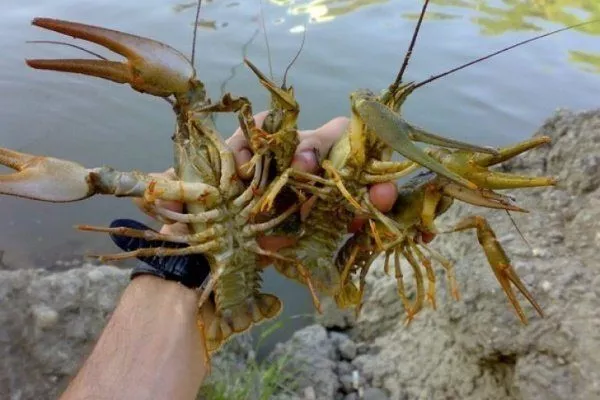
Crayfish are best caught in the fall, when the water cools and the days shorten, increasing the time available for hunting, as they are caught in the dark or early at dawn. Flowing bodies of water with clay or rocky bottoms, lined with reeds, cattails, or rushes, are preferred.
How and when to catch crayfish is described in this article.
The chemical composition of cancer
Crayfish are caught for their tasty, healthy, and tender meat. Protein accounts for the lion's share—82%, fat—12%, and carbohydrates—6%. 100 grams of the edible portion contains only 76 kcal.
Meat contains a wide variety of vitamins: virtually all of the B vitamins, fat-soluble vitamins A and E, and niacin and ascorbic acid. Its mineral composition is also diverse, including potassium, phosphorus, sodium, sulfur, calcium, magnesium, iodine, and iron.
The health benefits of crayfish stem from its balanced vitamin and mineral content. Its low calorie content and high content of easily digestible protein make it an indispensable part of a diet. Experts also recommend it for people with cardiovascular and liver diseases, as well as nervous system and circulatory disorders. However, crayfish is a strong allergen, so if you have an intolerance, avoid it immediately.
Culinary uses
Chefs couldn't ignore the tender and nutritious meat of crayfish. Although 1 kg of crayfish yields only 150 grams of meat, the number of exquisite recipes using it is enormous. They are added to salads and soups, stewed, boiled, baked with Parmesan cheese, and fried simply in butter. The meat is used in seafood side dishes and in jellied meat.
The importance of crayfish to the environment
The benefits of crayfish to the ecosystem cannot be overstated. They prevent carrion and organic matter from decomposing on the seabed, thereby inhibiting the development of pathogenic microorganisms. On the other hand, some experts believe that by feeding on fish eggs, they have a negative impact on the fish population, although this has not been proven and is largely speculation.
Breeding
Crayfish farming is widely practiced worldwide. Each country has its own technology for cultivating these arthropods, but they all follow the same rules:
- the bottom of reservoirs with a small amount of silt;
- the presence of clean, fresh water rich in oxygen is essential;
- maintaining temperature conditions;
- compliance with water composition.
- ✓ Availability of clean water with high oxygen content.
- ✓ The bottom of the pond should have a small amount of silt, preferably clayey or rocky.
- ✓ The water temperature must meet the requirements of the crayfish species.
One of the most cost-effective methods of breeding is considered to be pond farming. This involves setting up several ponds (usually three to four) in which the crustaceans are raised.
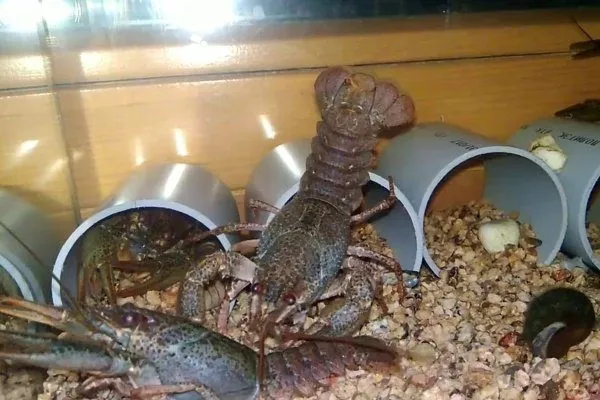
If you're really determined, you can raise crayfish at home in an aquarium. The key is to find females with eggs attached to their abdomens. They're released into the water, where the eggs are incubated. It's important to monitor water circulation and aeration.
- Preparation of the reservoir: cleaning the bottom, providing access to clean water.
- Purchase of females with eggs or young crayfish.
- Regular monitoring of water quality and temperature.
- Feeding crayfish according to their needs.
It's important to prepare a food supply in advance. When the water temperature rises above 7°C, the crustaceans are fed with cooked or fresh food, placed in special trays.
Small crustaceans that have molted for the second time are transferred to the breeding pond and then transferred to a new pond or left in the same pond, provided it is suitable for overwintering. One-year-old crustaceans are released into the nursery pond, where the stocking density should be reduced. They reach marketable size in their second or third year.
Crayfish protection
In the wild, their numbers are declining annually due to environmental degradation, widespread water pollution, and unrestricted fishing. Among crayfish, the thick-clawed species is on the verge of extinction, and the population of the broad-clawed species is also "striving" for the same. They are listed in the Red Data Books of Ukraine and Belarus, and fishing for them is strictly prohibited.
Interesting facts
There are some interesting facts about crayfish that you should know:
- crayfish have blue blood;
- in the true recipe for Olivier salad, one of the ingredients was boiled crayfish, in the amount of 25 pieces;
- Jews are forbidden to eat crayfish because they are considered "non-kosher" food;
- When cooked, all the pigments responsible for the color of the crayfish disintegrate, except for carotenoids, which is why it turns red after heat treatment;
- Previously, it was believed that these arthropods were insensitive to pain, but experts have proven that this is not true; by boiling crayfish alive, people condemn them to a painful death;
- The largest river crayfish is caught on the island of Tasmania, its length is 60 cm.
Finally, it's worth noting that crayfish meat is rich in microelements that have a beneficial effect on the human body overall. It's not only healthy, but also delicious. This is why crayfish is one of the most popular arthropods.
"It's impossible to point out the benefits of crayfish to the ecosystem" - why is that impossible?
If you can't, then don't mark it. Better yet, study Russian. Google and Wikipedia are our enemies' programs. To produce illiterate "writers" like... well, you get the idea.
Oh, how ugly. We see the speck in someone else's eye... Olga wrote such a brilliant article, and you, noticing a small typo (logically understandable), started lecturing her instead of tactfully asking for a correction.
I'd argue that crayfish are scavengers. I've been catching crayfish all my life, and they rarely go into traps if the fish (used as bait) has been frozen for more than six months, and they'll even avoid rotten fish! Besides, unless they're in a feeding frenzy, they prefer carp to hybrids.