
Crayfish farming is a relatively new but profitable industry. You can start it on your own farm, having completed all the necessary paperwork. Among the advantages of this type of business are low competition and high demand.
General characteristics of the business
Crayfish farming is a profitable business that can generate a stable income year-round. This is because Russia only imports crustaceans in small quantities, and there are only a few suppliers. The Krasnodar and Altai Krais supply the shellfish and crustacean market, while Ukraine and Kazakhstan supply crayfish from abroad.
The low level of supply and market saturation is due to the fact that crayfish grow slowly in natural conditions: they only reach marketable weight after 4-5 years of life.
This is why an entrepreneur who decides to engage in industrial crustacean farming in indoor ponds and reservoirs can begin to make a profit within a year and a half, when each individual specimen has grown to a weight of 300 g.
The advantages of cultivating crayfish for subsequent sale include the following:
- low level of competition and high demand;
- minimal labor costs in the process of caring for crustaceans;
- no problems with product sales;
- prospects for further expansion of activities.
The disadvantages of this type of activity are:
- seasonality of product sales (from May to October), which is relevant for the conditions under which crayfish are grown in open water bodies;
- the payback period of the business, which can extend up to 3-4 years;
- large financial investments for organizing a business.
The legal side of the issue
Breeding crustaceans for sale and profit is considered farming. To start such a business, you must register as a sole proprietor.
Farming crustaceans in artificial ponds is considered an agricultural activity. The taxation method used is the Unified Agricultural Tax.
Business plan: required investments, payback and profitability
Before you begin breeding crayfish for commercial sale, you need to develop a detailed business plan. It's worth considering the following points:
- the most suitable method for growing crayfish;
- farm creation plan;
- expense items;
- product distribution channels.
The estimate for organizing a crayfish farming business includes the following cost items:
- organization and equipment of reservoirs – about 300,000 rubles;
- equipment and components for reservoirs – from 100,000 to 2,500,000 rubles (depending on the scale of the business);
- acquisition of a land plot, if you don’t have your own – about 60,000 rubles;
- food and additives for crayfish – 100,000 rubles;
- other expenses (transportation, veterinary, electricity) – 100,000 rubles.
Although indoor crayfish farming requires significant initial investment, it can generate profits within two years of launch. The return on investment for this type of business is 300%.
Options for setting up a pond for breeding crayfish
When developing a business plan, it's important to consider the best way to develop the pond. Depending on this, the following main methods of crayfish farming are distinguished:
- FactoryIn this case, breeding takes place indoors, in special large aquariums. The advantage of this method is that it provides the conditions necessary for rapid growth of the crayfish. This is because the artificially created conditions prevent the crayfish from hibernating. If crayfish are raised in aquariums, the rooms they are kept in should be warm and well-lit.
- HomeThis method involves breeding crustaceans in special crayfish pits, artificial ponds, and basements. This method requires significant investment to install and organize a high-quality water circulation system.
- Natural, or breeding crayfish in a natural pondThe advantage of this method is that it provides the crayfish with natural food (algae, mud). However, with natural breeding, it's important to remember that the water quality may be poor, and crayfish are very demanding. Therefore, it's important to regularly clean the bottom and monitor the water's composition.
The pond must be equipped in accordance with the following recommendations:
- the bottom must be level;
- the shape of the pond must be strictly rectangular;
- the depth of the reservoir must be at least 2 m;
- The side walls of the pond must be smooth, at an angle of 90 degrees relative to the bottom.
Polypropylene sheets are recommended for pond lining, as they protect the water from contamination, unlike wood or reinforced concrete. The sheet thickness should be at least 8 mm.
| Type of reservoir | Payback period | Temperature conditions | Stocking density (individuals/m²) |
|---|---|---|---|
| Factory (RAS) | 2-3 years | 20-24°C all year round | 50-80 |
| Home (basement) | 3-4 years | 16-22°C with seasonal fluctuations | 30-50 |
| Natural pond | 4-5 years | Natural vibrations | 5-10 |
On the plot of land allocated for a crayfish farm, it is recommended to build 10 indoor ponds and the same number of open ones.
Indoor ponds are essential for intensive crayfish farming: the water in them will not freeze even in freezing temperatures, preventing the crayfish from hibernating and allowing them to continually gain weight. Open ponds are used for natural crayfish breeding.
Necessary equipment
For a fully functioning crayfish farm, the following equipment will be required:
- air compressor (aerator);
- an oxidizer that saturates water with oxygen;
- filtration system;
- Measuring instruments for determining the properties and composition of water (conductometer, oximeter, salinometer).
The pond must be equipped with a drainage system with a strong fine mesh pipe that will prevent the crayfish from leaving the pond.
The bottom of artificially created reservoirs must contain clay, stones and river sand.
To grow crayfish in a limited space at home, you can build a RAS (recirculating aquaculture system):
The nuances of breeding crustaceans on a home farm
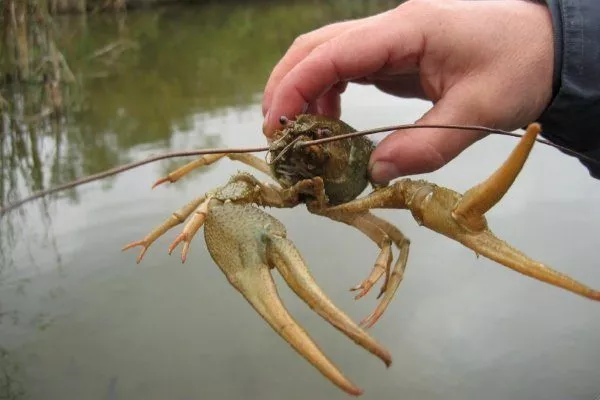
When purchasing crayfish for breeding, you should choose an equal number of females and males. Long-clawed crayfish are the most prolific and undemanding in terms of care. They gain weight much faster than broad-clawed crayfish.
The required number of crayfish should be calculated based on the pond's area. Six individuals are required per square meter, two of which are males.
The water in which crayfish live and breed should be clean, with a small amount of minerals. Add 0.3-0.5 g of sea salt per liter of artesian water.
In the wild, crayfish spawn in October and November, when water temperatures are between 4 and 6 degrees Celsius. Spawning begins in late spring, when the water warms to 15 degrees Celsius. In artificial ponds, crayfish mate in early spring.
In addition to long-clawed crayfish, the following crayfish species can be bred in artificial conditions:
- Cuban blueRepresentatives of this species reach significant sizes within six months, but at the same time, they require high water temperatures (22-26 degrees Celsius) and low stocking densities: at least 20 liters per individual.
- Australian redclawThese crayfish grow quickly and have a large amount of meat. They are also heat-loving, so they require a suitable water temperature of about 23-28 degrees Celsius.
When intensively raising crayfish for commercial use, proper feeding is essential. Feed composition depends on the age of the crayfish. Mixture recipes may include the following components:
- wheat;
- barley;
- wheat bran;
- vegetable oil;
- dry milk;
- soybean and sunflower meal;
- meat and bone meal;
- fish meal.
Vitamin supplements are also periodically added to the feed. The crayfish are fed at the same time, morning and evening.
Annual work schedule
- January-February: Temperature control in wintering ponds (not below 7°C)
- March: Preparation of rearing ponds, 30% water change
- April: Start of intensive feeding (5% of body weight)
- May-June: Sorting juveniles into size groups
- July-August: Catching commercial specimens (50-60 g)
It is necessary to ensure that large amounts of food remains in the water - as they decompose, they release toxins that can cause the death of crayfish.
Sales of products
After receiving the first batch of crayfish, it's important to utilize all available distribution channels. Wholesale customers include restaurants and cafes, pubs, and supermarkets. Specialty fish and seafood stores will certainly be interested in this type of product.
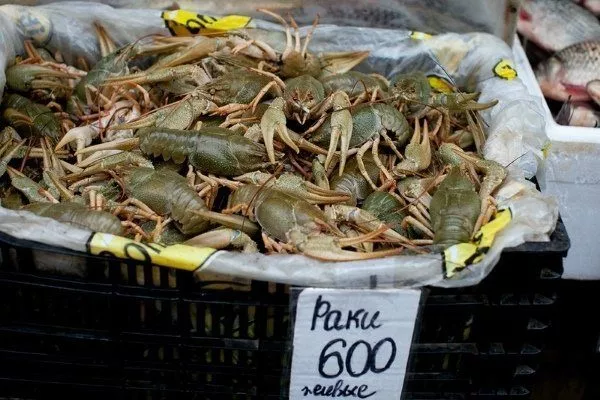
You can also find customers who will buy crayfish retail. Initially, potential buyers may include neighbors and acquaintances who will spread the word about the product to their friends and acquaintances.
To successfully sell your products, you can consider setting up your own retail outlet at the market.
Crayfish can be sold in various forms. Customers may be interested in live, cooked, or frozen-boiled crayfish. When selling cooked crayfish, they must first be packaged in plastic containers filled with brine.
It is important to remember that the sale of crayfish requires the following documents:
- certificate of conformity (GOST);
- sanitary passport for transport for transportation of products;
- veterinary certificate;
- declaration of quality conformity.
- ✓ Documentation: Veterinary certificate form No. 2
- ✓ Packaging: Perforated polypropylene boxes (no more than 3 layers)
- ✓ Transportation: Temperature 10-12°C with humidity 85-90%
- ✓ Marketing: Photo reports of the growing process for restaurants
- ✓ Logistics: Maximum delivery time is 12 hours
Crayfish farming is a promising business. Crayfish products are in demand, and demand currently exceeds supply. Crayfish farming in artificial ponds allows for their continuous growth without hibernation.