
The Australian red-claw crayfish was previously known in Russia only to aquarium enthusiasts. Today, this arthropod is successfully farmed on an industrial scale. We'll learn how to breed this exotic crayfish, what to feed it, and how to create optimal living conditions.
Description of the species
Thanks to its distinctive appearance, the Australian crayfish has become a regular in decorative aquariums, and its tender flesh and rapid growth make it a profitable breeding target. Let's find out what this inhabitant of southern waters looks like and what its characteristics are.
Appearance
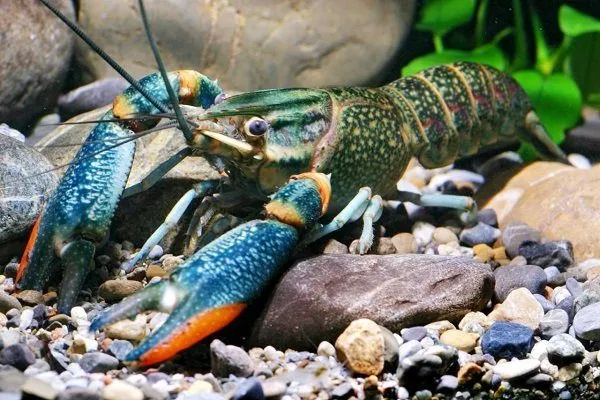
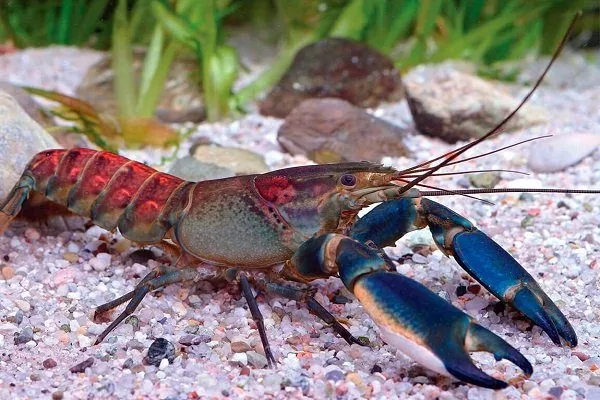
The red-clawed crayfish is also known as the Yabby Red Claw. However, the primary color of this crayfish is blue. Predominant shades include green, brown, light blue, orange, and red. The carapace has yellow specks.
The vibrancy of the Australian crayfish's coloration is directly related to water hardness. The higher the water hardness, the brighter the crayfish's shell. In soft water, the crayfish's shell becomes paler.
Characteristics of Australian crayfish:
- length – up to 20 cm
- weight – up to 0.4-0.5 kg;
- lifespan – 5 years.
Character and behavior
Australian crayfish are non-aggressive. However, their behavior is significantly influenced by their environment. Under certain circumstances, these arthropods can become hostile.
Behavioral features of red-claw crayfish:
- get along well with all types of fish and agree to share their homes with them;
- often conflict with each other;
- Cannibalism is possible.
In the wild, red-claw crayfish dig burrows with their claws for shelter. They also hide under snags and among the roots of coastal plants. They hunt at night and prefer to sleep during the day. If crayfish venture out during the day, it means they are molting.
In nature, the Australian crayfish eats:
- detritus;
- worms;
- snails;
- small fish.
Detritus is dead organic matter consisting of the remains of invertebrates and temporarily excluded from the cycle of biological nutrients.
Sexual characteristics
Males' readiness to mate is indicated by a flattened swelling on the outer surface of their claws. This swelling can be white, pink, or most commonly red. These markings, known as "claws," from which the Australian crayfish gets its second name, make it easy to distinguish males from females.
Females have neat, unprotruding claws. Males are slightly larger than females.
Reproduction
During breeding, the male-to-female ratio ranges from 1:1 to 1:4. Water temperature influences sexual activity, the duration of the incubation period, and the growth rate of the juveniles. The optimal temperature for spawning and egg development is 25 to 28°C.
The recommended ratio of dark to light is 12/12 or 10/14 hours. Ponds are used for breeding, as they allow easy management of the broodstock. The crayfish density is 1,500 per hectare.
- ✓ The presence of a pronounced red claw in males, which indicates their sexual maturity.
- ✓ Absence of damage on the shell and active behavior as a criterion of health.
The largest and strongest individuals are selected for breeding. A single female weighing 100 g can produce 1,000 crayfish. Optimal parameters for a brood pond:
- area – 1,000 sq. m;
- depth – 1.2-2.5 m;
- The bottom profile is V-shaped.
The gestation period for eggs and larvae in female Australian crayfish is 8-9 weeks.
Meat yield
Australian crayfish are raised for meat. The business is profitable due to the low investment and rapid growth of the arthropods. Biological and fish farming indicators:
- the commercial weight of one item is 200-400 g;
- weight gain – 50-60 g in six months;
- the amount of meat in the tail is 30% (in other crayfish – no more than 20%).
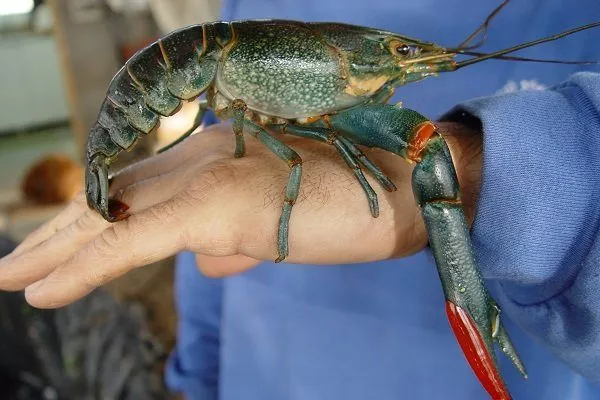
Industrial red-claw crayfish farming in southern Russia produces individuals weighing 200 g or more in just four months. Common crayfish reach a weight of 100-120 g within 10 years.
The taste of meat
Australian crayfish have a distinctly different flavor from their domestic river counterparts. Their meat has a unique texture; it's more tender, with coarse fibers. Experts say the texture of red-claw crayfish resembles lobster and the flavor of crab.
Australian crayfish pairs harmoniously with a variety of ingredients. Restaurants typically serve it with various river delicacies or sauces that enhance the flavor of the meat, which is prepared using the same technique as lobster.
Red-claw crayfish meat is dietary and is recommended for people with vascular disease and circulatory problems. 100 g of meat contains 80 kcal.
Natural habitats
The red-clawed crayfish is native to standing waters in the Australian region. This arthropod is found on the Australian continent and in New Guinea.
Crayfish prefer to live in bodies of water where there is no current, or minimal current. Habitat:
- ponds;
- shallow rivers;
- lakes;
- streams.
It is precisely their habitation in stagnant water that allows Australian crayfish to be kept in closed ponds and aquariums.
Crayfish breeding
Today, the Australian crayfish is becoming a promising candidate for industrial farming. The growth parameters and other characteristics of red-claw crayfish make it possible to create a profitable business out of their cultivation.
Where are crayfish grown?
For crayfish breeding A system of shallow ponds is created—for incubation, breeding, nursery, and fattening. Some of the ponds are covered with polycarbonate. The temperature in these ponds does not drop below 7°C during the winter, so that the crayfish do not hibernate, but rather feed and gain weight.
The broodstock females are kept in broodstock ponds. Nursery ponds are shallow—0.5-1.5 m deep, with an area of 0.1-0.5 hectares. It's best to have a drainage hole—a crayfish collector is installed in one.
Features of setting up a pond for growing crayfish:
- the pond is filled with water a couple of weeks before planting the crayfish;
- the walls in such reservoirs are made vertical;
- the bottom is lined with polypropylene - it does not rot, helping to keep the water clean;
- Crushed stone, broken brick, and ceramic waste are placed on the polypropylene in a 20 cm layer, and on top of that – a 10 cm thick layer of sand.
Crayfish are also grown in closed aquaculture systems, which include:
- crayfish pools;
- water purification unit;
- bio-filter;
- water treatment unit.
The water temperature in the pools is maintained by split systems.
Artificial burrows made of plastic pipes are installed in crayfish tanks. These shelters help prevent cannibalism.
Neighbors and vegetation
Red-claw crayfish can coexist with a variety of fish species, so small non-predatory species can be added to ponds. Crayfish leave behind a large amount of food scraps, and the small fish that eat them help keep the water clean.
Large and predatory fish should not be bred in ponds with crayfish, as they can eat small crustaceans.
The pond flora is standard. Crayfish love plant food. The more plants in the pond, the better. Moreover, these arthropods not only eat leaves but also damage roots when they dig them up.
Requirements for the reservoir
Australian crayfish are undemanding when it comes to water quality, so there are no particular problems when creating crayfish ponds.
Optimal conditions:
- active reaction – in the pH range of 6.5-8.5;
- hardness – from 5 to 20;
- temperature – +20….+28 °С;
- minimum / maximum permissible temperature -10 / 36 °C.
Unlike shrimp, crayfish can survive in the most unfavorable conditions—low oxygen levels and high nitrate concentrations. Copper ions are especially dangerous to crayfish.
Feeding regimen and diet
In the wild, crayfish eat whatever they come across. When bred, their diet must be varied, complete, and rich in protein. Combined feed can help solve this nutritional problem. Feeding the crayfish 2-3 times a day.
Combined feed, chalk, protein supplements, bloodworms, and earthworms are added to the regular food. Before adding a new portion of food, check to see if the feeders are empty.
The diet of young animals should include:
- snails;
- larvae;
- daphnia;
- Cyclopes;
- aquatic worms;
- fish fry.
Young crayfish readily eat ground meat. As they develop, their diet becomes more varied. To prevent the crayfish from eating each other, their diet includes meat, fish, vegetables, bread, oilcake, and even frogs.
The daily feed requirement is 2% of the arthropod’s body weight, for egg-laying females – 4%.
For crayfish to thrive, their feed must contain a variety of plant and animal components, minerals, and vitamins. Foreign-made shrimp feeds are now helping to solve this nutritional problem.
The optimal composition of branded food for crayfish:
- proteins – 43%;
- fats – 8%;
- fiber – 4%.
Industrial granulated feeds of imported production, intended for aquatic organisms (fish, mollusks, crustaceans, etc.), are also suitable for crayfish.
Optimal food ratio:
- vegetable – 70%;
- animal – 30%.
It is recommended to add dried leaves, ground stems, and reeds to their diet. Beech or oak leaves are a must in Australian crayfish's diet. This food is not only a delicacy for these red-clawed arthropods, but also an antiseptic essential for their immune system.
What should you not feed?
Although red-claw crayfish are considered omnivorous, there are some foods that are best avoided:
- banana peel;
- grated beets, carrots, potatoes - they spoil the water;
- Crayfish don't eat apples.
It is not recommended to pollute crayfish breeding pools with minced meat, eggs, cottage cheese, or food scraps unless the water is cleaned and filtered.
Breeding procedures on farms
Setting up a mini-farm for breeding crayfish requires only a small plot of land and minimal investment. Crayfish production for sale takes about a year to a year and a half. The investment pays for itself within a year.
The procedure for artificial breeding:
- In October-November, the females are transferred to a brood tank. In June, the newborn crustaceans hatch and are kept in incubation tanks.
- To ensure the safety of the larvae, the eggs are collected and hatched in May using a Weiss apparatus. One 8-liter incubator holds up to 15,000 eggs.
- After the second molt, the crayfish are transferred to nursery ponds, where they are raised at +22…+24 °C up to 8 cm in length and up to a weight of 15-18 g.
- The yearlings are transferred to fattening ponds, where they gain weight of 40-60 g.
Mass production of crayfish requires considerable investment. A complete system of tanks or reservoirs, climate control, and water supply are required.
Crayfish breeding tanks must be large enough. If the crayfish are overcrowded, they will eat each other. Separate tanks should be provided for the young, otherwise they will also be eaten.
You can also learn about the experience of breeding Australian crayfish in the following video:
Compared to many other aquatic organisms, these arthropods are unpretentious, grow very quickly, and produce a large yield of valuable meat. These characteristics of Australian red-claw crayfish make them a highly attractive target for industrial farming.