
Dill is an annual herbaceous plant that is easy to care for and frost-resistant. These characteristics make it easy to grow outdoors. However, even when growing such an undemanding plant, it's important to follow proper agricultural guidelines.

Optimal conditions for growing dill
Before sowing dill, you need to pay attention to the following conditions:
- Neighborhood with other crops on the siteDill coexists well with almost all vegetables, but it's important to remember not to plant the greens too close to their stems, otherwise the dill will drain all the moisture and nutrients.
Any crop, with the exception of celery, can be used as a precursor to this green. If dill is planted, including for seed production, fennel should not be planted nearby: these crops readily cross-pollinate.
- TemperatureAlthough dill seeds germinate at temperatures of 3-5 degrees Celsius, it is recommended to plant them when the air warms up to 16-18 degrees Celsius.
- Suitable soilTo get a bountiful harvest of dill, plant it in well-moistened, deeply dug, loose, neutral soil. Soil pH is also important: dill will germinate poorly if it's below 6.3. Soils containing dolomite or lime are not suitable for this crop.
- IlluminationWhen choosing a site for planting dill, choose sunny beds, although the plant can also thrive in partial shade.
- ✓ The optimal depth of soil digging in autumn should be at least 25 cm to ensure good aeration.
- ✓ The soil pH level should be strictly within 6.3-7.0, the use of a pH meter is mandatory for accurate determination.
The advantages of growing dill in open ground include:
- ease of maintenance and harvesting;
- unlimited space;
- the plant receives more vitamins and nutrients.
Avoid planting early, fast-maturing dill varieties in late spring or early summer. This is because the plant will immediately produce flower stalks with 15 hours of daylight.
Planting dates
Dill produces several harvests during a single season, so it can be planted from spring to late fall. The timing of planting depends on the gardener's goals: if you want aromatic greens, plant in spring and fall, while if you want to harvest seed-bearing umbels, plant in summer.
Since dill seeds tolerate frost well, they can be planted outdoors immediately after the snow melts, when the air temperature is above 5 degrees Celsius. Planting can begin in late April and be completed in mid-May. This can be done at any time during the summer.
In autumn, dill seeds are planted from October to November, before frost, so that they do not have time to germinate. Dill is planted before winter in order to get the first greenery as early as possible in the spring.
Overseeding can be done throughout the season.
Soil preparation
Preparing the soil for planting dill seeds requires several stages:
- In the fall Dig the soil deeply and add fertilizer (humus, cow manure, or bird droppings at a rate of half a bucket per square meter). For mineral fertilizers, use superphosphate or potassium salt (200 g and 150 g per square meter, respectively).
- In the spring Loosen the beds thoroughly to allow liquid and air to reach the seeds freely.
- A couple of days before planting the seeds water the beds into the soil.
- 2 weeks before planting, add compost at a rate of 5 kg per 1 sq. m.
- A month after germination, feed the plants with a urea solution (10 g per 10 l of water).
After the preparatory activities, you can begin planting dill seeds of the selected variety.
Selecting a variety
When choosing a dill variety for planting, carefully examine its characteristics. Some varieties produce abundant foliage, while others form flower stalks and are intended for seed collection. These varieties are differentiated not only by their intended use, bush height, and flower shape, but also by ripening time.
Early ripening varieties
| Name | Ripening period | Yield (kg/m2) | Bush height (cm) |
|---|---|---|---|
| Gribovsky | 30-45 days | 1 | 25 |
| Further | 38-40 days | 2-2.5 | 30 |
| Redoubt | 1.5 months | 1.3 | 35 |
These include the following:
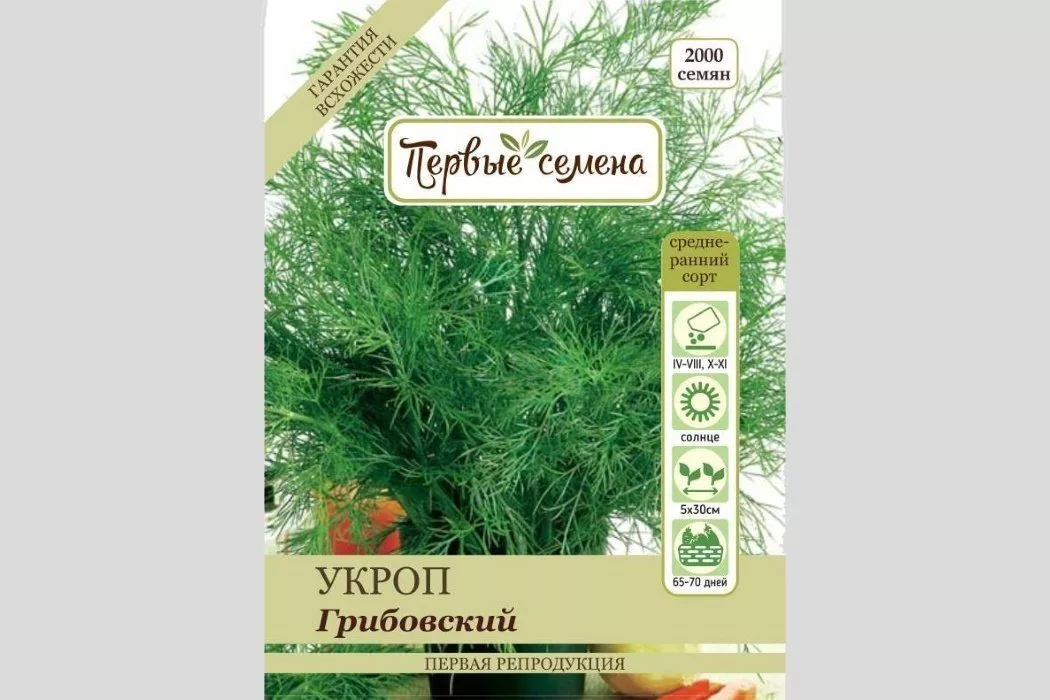
- Gribovsky (It takes 30-45 days from germination to the first leaf harvest). This plant is undemanding to weather conditions: even in cold summers, the bushes produce abundant, high-quality foliage. Seeds of this variety can be planted several times, starting in April and ending in July. The rosette height of Gribovsky dill reaches 25 cm. The foliage weight of a single plant can reach 1 kg. The variety is resistant to many diseases and pests.

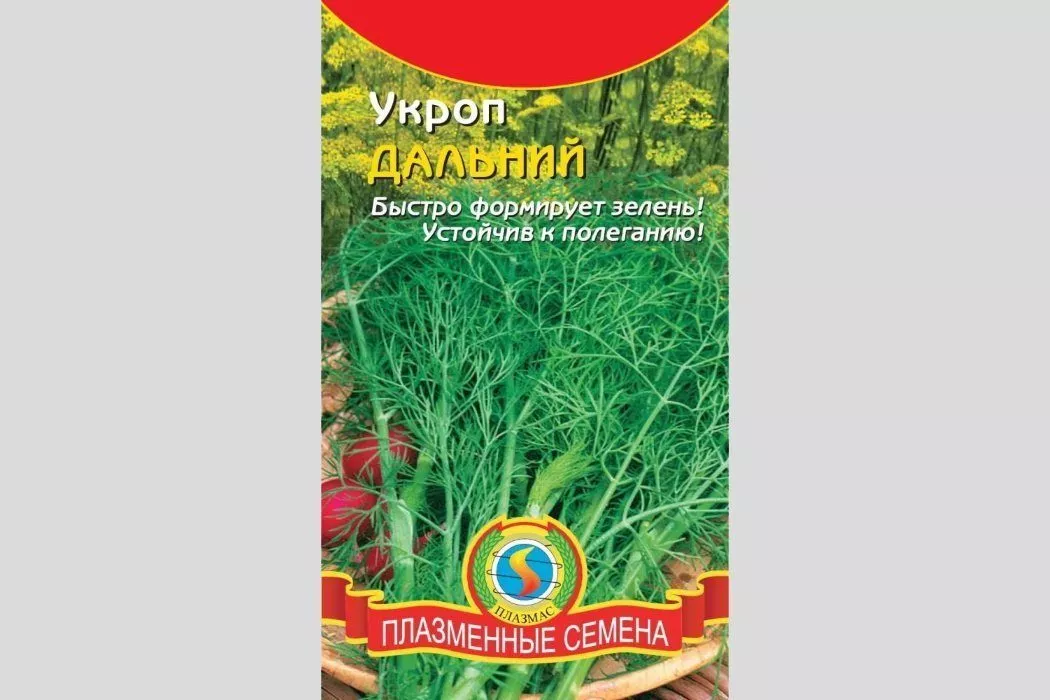
- Further (from germination to harvest – 38-40 days). This is a high-yielding variety: 2-2.5 kg of green foliage is harvested per square meter. Dalniy dill is grown commercially. A distinctive feature of this variety is the waxy coating on the leaves. Dalniy is resistant to pathogens and tolerates heavy rainfall without lodging.
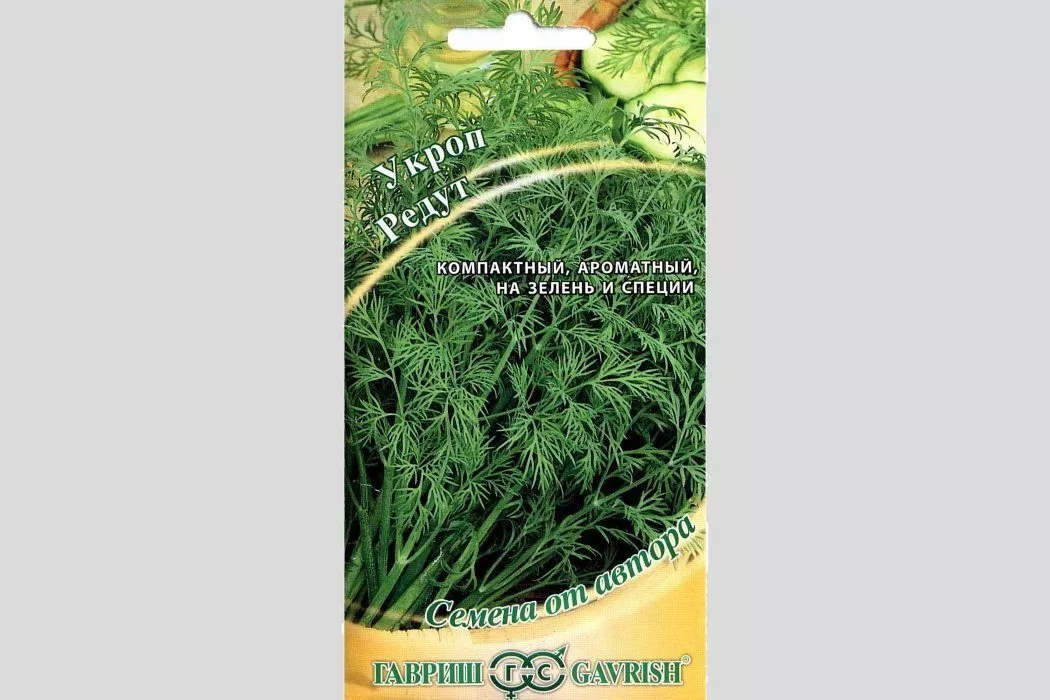
- Redoubt (The first harvest is 1.5 months after seed germination). Over the course of the season, 1.3 kg of leaves are harvested per square meter.
Early-ripening varieties quickly form umbel-shaped inflorescences: they form faster than the leaves mature. This is why they cannot produce large quantities of greens.
Mid-season varieties
| Name | Ripening period | Yield (kg/m2) | Bush height (cm) |
|---|---|---|---|
| Amazon | 1.5 months | 2.5 | 40 |
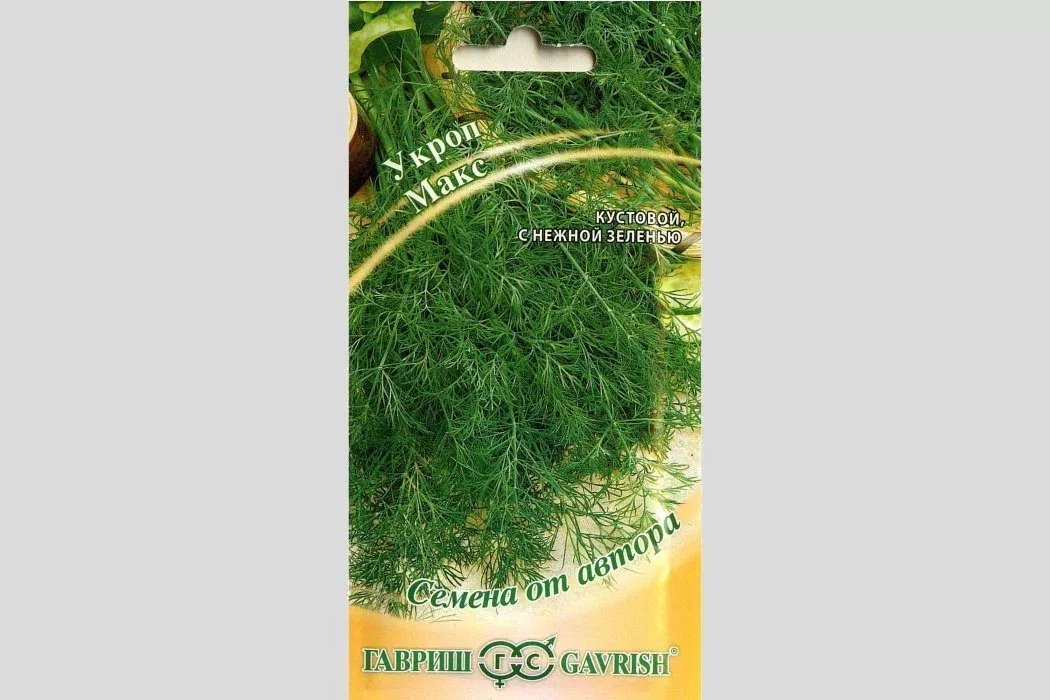
| Max | 1.5 months | 4 | 45 |
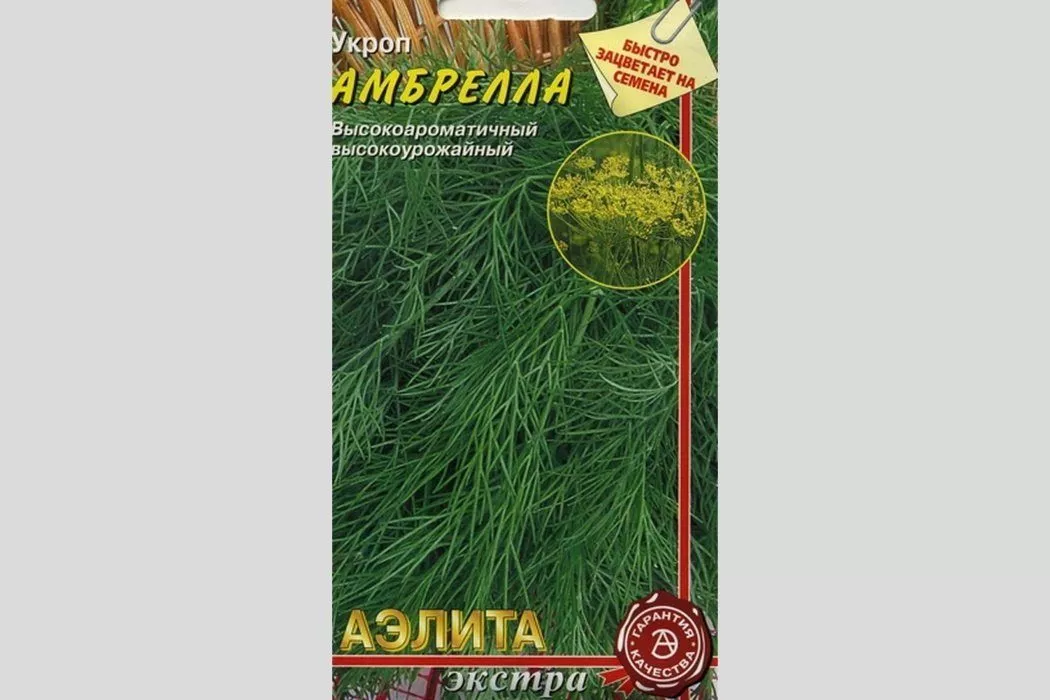
| Umbrella | 40-48 days | 2 | 50 |
Popular representatives of this group are:
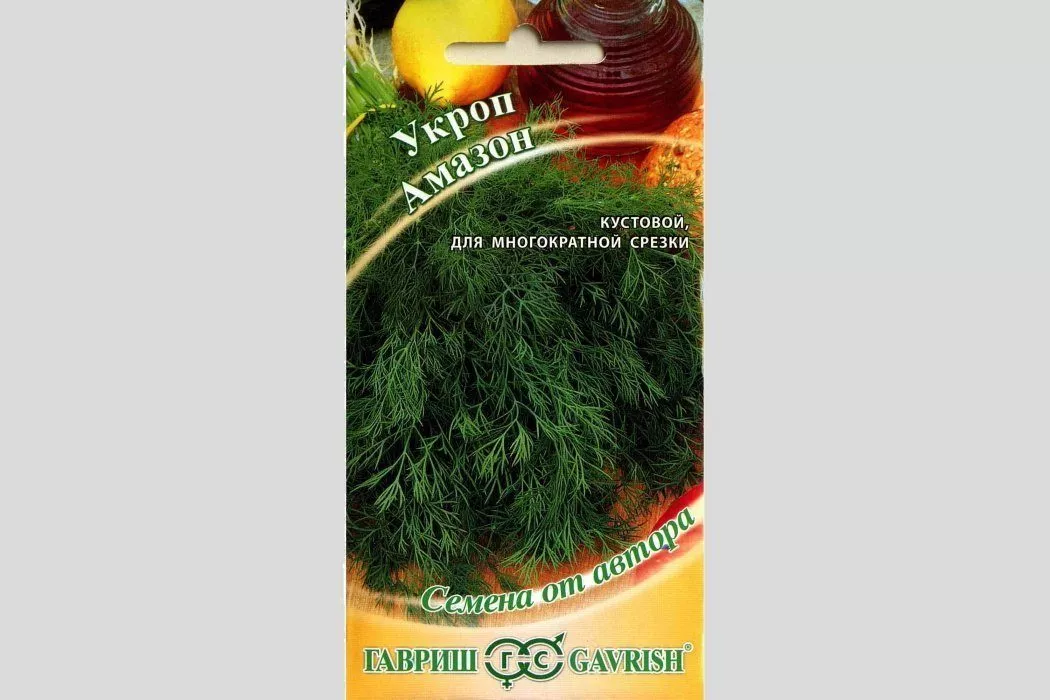
- AmazonIt is recommended to sow the crop in late April or early May. The first harvest of greens occurs approximately 1.5 months after germination. Over the course of the season, 2.5 kg of leaves can be harvested from 1 square meter.
- MaxThe seeds of this variety are planted in the soil after the temperature has warmed to 8 degrees Celsius or more. The leaves can be harvested 1.5 months after germination. The total foliage weight is up to 4 kg per square meter.
- UmbrellaA hybrid variety distinguished by its rich green leaves and deeply dissected blades. The crop reaches commercial maturity 40-48 days after germination. Approximately 2 kg of greens are harvested per square meter per season.
Mid-late varieties
| Name | Ripening period | Yield (kg/m2) | Bush height (cm) |
|---|---|---|---|
| Frost | 45-57 days | 2.7 | 170 |
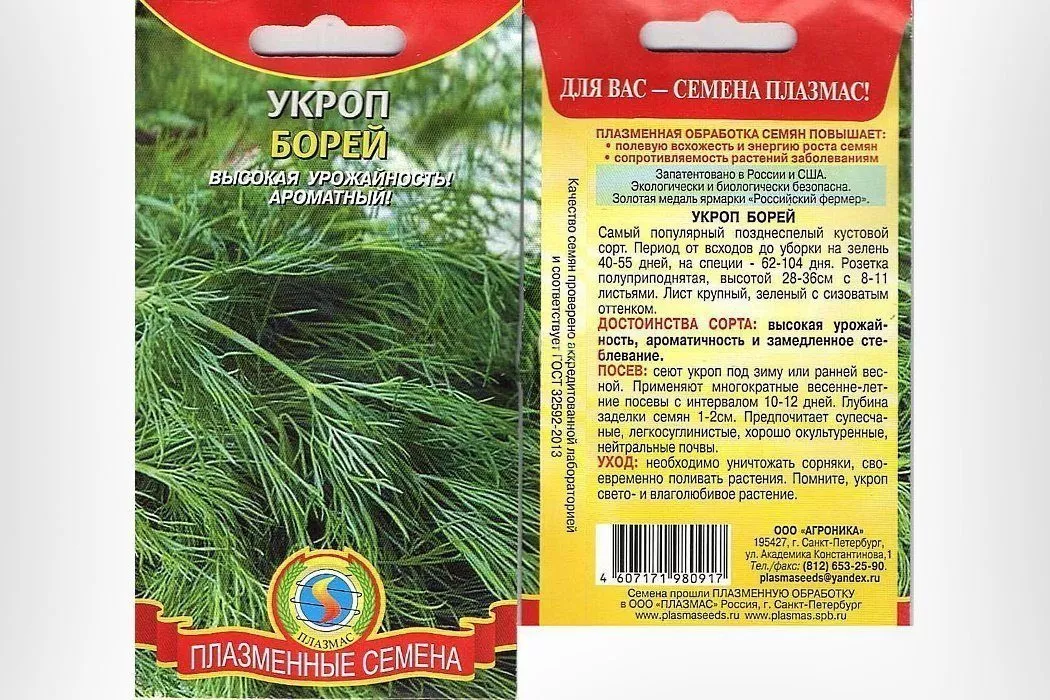
| Borey | 39-55 days | 4.2 | 120-130 |
These crops mature slowly, taking approximately 45-57 days. Popular varieties include:
- FrostThis variety grows to a height of 1.7 m and produces large, convex umbels. Approximately 2.7 kg of greens are harvested per square meter per season.
- BoreyThe greens are harvested 39-55 days after seed germination. The stems reach 1.2-1.3 m in height. The variety's advantage is its disease resistance. Up to 4.2 kg can be harvested per square meter during the season.
There are approximately 70 known varieties of dill. To ensure a succulent supply of fresh herbs all season long, gardeners recommend planting several varieties with different ripening periods.
Landing
Dill can be planted using seeds and seedlings.
Growing from seeds
Since dill is an unpretentious crop, its seeds will yield a harvest even without preliminary soaking, but its quality and quantity will directly depend on the preparation of the seed material.
To speed up seed germination, do the following before planting them in the ground:
- Place the material in a cloth bag and place it in water at 50 degrees.
- The water needs to be changed every 4-5 hours.
- The next day the seeds are ready for planting in open ground.
To clean the material from possible pests, you need to place it in a solution of potassium permanganate and keep it for 2 hours.
Before planting, prepare not only the seeds but also the soil: make furrows in the selected area and water them with a weak solution of potassium permanganate for disinfection.
Dill can be sown densely, without dividing the plot into beds, or using the row method. In the latter case, the plant is planted in rows, with a distance of 20 cm between each row. The seeds themselves are sown densely, 5 cm apart.
The seeds should be planted no more than 2-3 cm deep into the soil, even if they are planted in winter.
Growing from seedlings
If you plan to plant dill seedlings outdoors, use early bush varieties. Their seeds are first sown in pots or a box (on a windowsill or in a greenhouse). Dill should be transplanted outdoors when the seedlings reach a height of 3-4 cm.
For growing dill using seedlings, we recommend using the Almaz variety. Seeds should be sown approximately a month before planting (early to mid-April).
To germinate seedlings, make furrows no more than 1 cm deep in the soil and space the seeds 0.5-1 cm apart. Leave 1.5-2 cm between each row.
After planting, water the seeds, cover the container or pot with plastic wrap, and leave in a warm place. The recommended temperature is 20-25 degrees Celsius.
For information on how and when to sow dill, watch the following video:
Caring for dill in open ground
Dill doesn't require much effort or time, but if you follow proper agricultural guidelines, this crop will surely reward the gardener with a juicy and bountiful harvest.
Watering
It's recommended to water dill plants frequently and thoroughly, as without moisture, the leaves will slow down and the plants will sprout. Avoid overwatering the beds so much that they become waterlogged, as this will result in less flavor.
The recommended volume of liquid is 20-30 liters per 1 sq. m.
Watering is recommended in the evening or in cool cloudy weather.
Top dressing
No fertilizer is applied during the growing season. All fertilizers are added to the soil before planting the dill seeds or seedlings.
Fertilizing during the growing season is only necessary if the plant is growing slowly. Under these conditions, a light application of fertilizer is sufficient. If the plant turns yellow, it's due to a nitrogen deficiency.
Weeding and loosening
The first weeding should be done after the bush has established itself well. While it's still weak, weeding should be done regularly. Subsequently, this can be done every two weeks.
Loosening is carried out to a depth of 5 cm after the plant has taken root. If the soil is already loose, no additional tilling is necessary.
Shelter in the heat
On extremely hot days, dill can wilt. To prevent this, you can create a shelter-like structure over your herb beds.
Pest and disease control
Most often, the crop is affected by fungal diseases:
- powdery mildew;
- Cercospora leaf spot;
- blackleg.
Their development is associated with poor soil composition, excessive moisture, and poor crop rotation practices. To combat rotting, a Fundazol solution is recommended.
To prevent the occurrence of diseases and pests The soil must be treated with biofungicides before planting.
There are no pests that specifically attack dill bushes. They are attacked by insects that parasitize nearby crops. This is why it's important to plan your planting areas in advance.
Harvesting and storage
Greens should be harvested from bushes that have not yet produced their umbels, meaning while the plant is young. In this case, the leaves are compactly clustered and have a pleasant green color. After the umbels emerge, they become coarser and lose both their appearance and flavor.
Rules for collecting dill:
- First, you need to thin out the beds with young shoots;
- First, cut off the greenery from the lower tier of the bush, then the side shoots, and then everything else;
- If seeds are needed, the bush with formed umbrellas is cut off at the root using scissors or pulled out of the soil.
Fresh dill leaves don't keep for long: they quickly lose their firmness and turn yellow. Bunches of the herb will keep for no longer than a week in the refrigerator, and about two days at room temperature.
If you plan to store dill for a long time, freeze the harvested greens after washing, drying, and finely chopping them. Then, divide them into bags and place them in the freezer.
Dill can also be dried. It's recommended to do this in partial shade, spreading it out on a cloth. After the leaves have wilted, finish drying them in the oven at a low temperature (40-50 degrees Celsius). Dried dill should be stored in glass jars with tightly sealed lids.
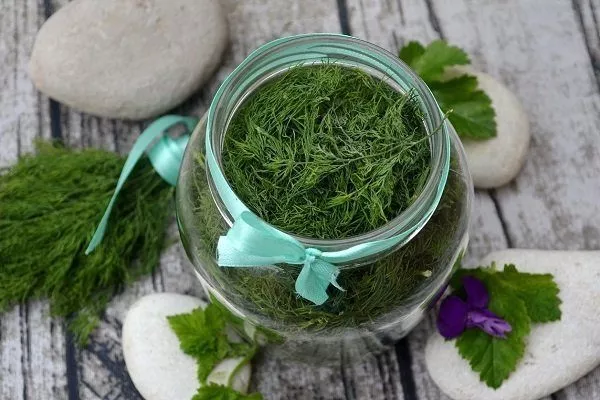
Dried and frozen herbs can be stored for up to a year. Seeds collected from the umbels can be stored for up to 2-3 years.
Dill will produce a large amount of greenery if properly cared for in open ground. When choosing a variety, pay attention to the ripening period. Also, keep in mind that some dill varieties form flowers quickly and are therefore only suitable for seed collection.