
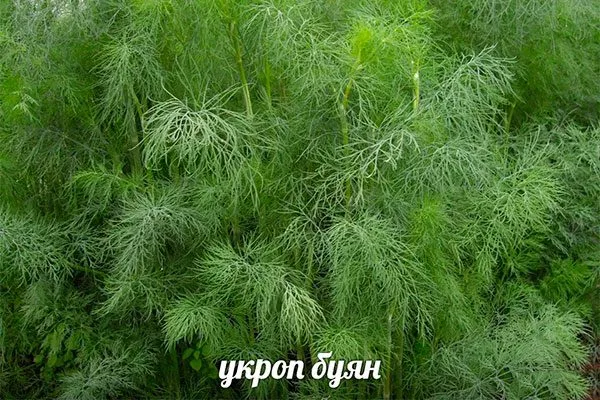
Buyan dill is a Russian-bred bush variety with a powerful dill aroma. It produces vigorous plants with large leaves that not only look great but also have a certain decorative appeal.
Description of dill Buyan
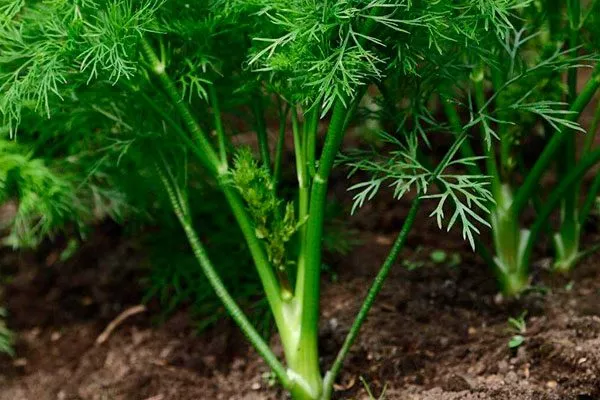
Dill 'Buyan' has large, dark green, deeply dissected leaves covered in a waxy coating. This dill produces a raised rosette containing approximately 25-30 leaves. Each rosette weighs 230-250 g. The height of the bush is 45-55 cm.
Characteristics of the variety
The Buyan variety was developed by breeders from Hardwick LLC (St. Petersburg) in 1998. This dill is permitted for cultivation throughout Russia.
This dill is versatile and can be grown in a wide range of climates and is suitable for any type of soil.
It has excellent agrotechnical characteristics:
- Ripening periods. Buyan dill is a mid-late variety, with a harvest time of approximately 60-70 days from emergence. Harvesting occurs from May to September, depending on sowing time.
- Productivity. Buyan dill is a high-yielding variety. Its average yield is 4.8-5.4 kg/sq.m. indoors and 5.2-6.5 kg/sq.m. outdoors.
- Cold resistance. The Buyan variety has standard frost resistance for the crop. Dill seedlings can withstand short-term frosts down to -5°C. Furthermore, this variety generally tolerates cold weather well.
- Drought resistance. The Buyan variety tolerates moisture deficits quite well. It's important to maintain a balanced supply of moisture—it requires moderate but regular watering, avoiding stagnant water.
Taste and application
Buyan dill has a rich, slightly tart, spicy-sweet flavor. This variety is ideal for salads and is widely used in cooking, including first and second courses, and for canning.
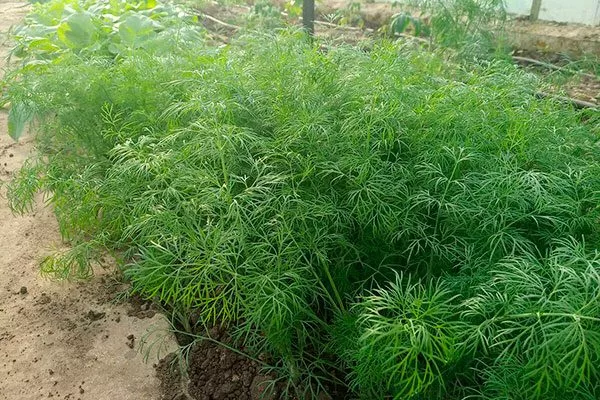
Buyan dill, compared to other varieties, has a more intense aroma. The greens can be chopped into salads and soups, used as a seasoning and pickling spice, and also dried and pickled in jars.
Pros and cons
Buyan dill is quite popular among gardeners and summer residents, as it has many advantages that allow it to be successfully cultivated in almost all regions of the country.
Landing
To get a good harvest of herbs, it's important to plant dill correctly, choosing the right location and time for sowing. It's also important to adhere to the sowing schedule, as this affects the quality of the herbs and the overall yield.
How to prepare seeds?
To ensure high germination rates, seeds must be tested for quality by placing them in a salt solution. Seeds that float to the top are discarded as non-viable.
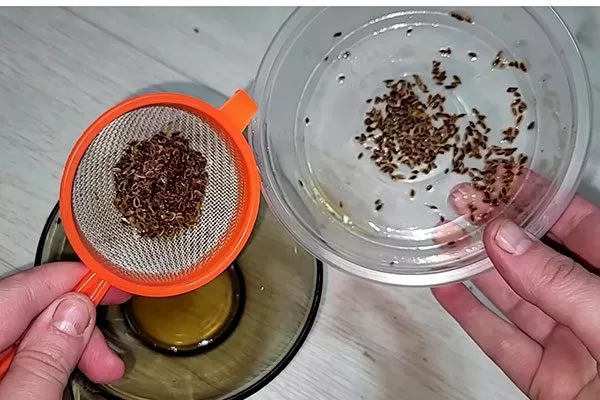
To speed up germination and sprouting, soak the seeds in damp cheesecloth for several hours.
It is also recommended to disinfect the seeds, for example, in a solution of potassium permanganate (1 g per 1 liter of water). Disinfection time is 20-30 minutes. Treated seeds are thoroughly rinsed with warm water.
To improve viability and germination, it is recommended to treat dill seeds with a growth stimulant. Suitable options include "Epin" or "Zircon," in which the seeds are soaked for 4-6 hours and 8-16 hours, respectively.
Selecting a site
Buyan dill is planted in well-lit areas or in partial shade. It should not be planted in full shade, as insufficient light will cause the dill bushes to grow weak and pale. A minimum of 16 hours of daylight is recommended.
The soil in the area should be loose and light, moderately moist, and free of waterlogging. A neutral pH is preferable.
Dill grows well alongside various crops, but it is not recommended to plant it after celery or next to berry bushes, which tend to deplete the soil.
How to prepare the soil?
Dill planting areas begin to be prepared in the fall. A second treatment is carried out in the spring, 2-3 weeks before planting.
Features of soil preparation for planting dill Buyan:
- The area is cleared of plant debris and weeds, and then dug to the depth of a shovel blade.
- When digging, add organic fertilizer—compost or humus—at a rate of 5 kg per square meter. If the soil is low in fertility, it is also recommended to add mineral fertilizers—superphosphate and potassium salt—at a rate of 25-30 g and 15-20 g per square meter, respectively.
- In fertile soils, only phosphorus-potassium fertilizers are applied, as dill actively accumulates nitrates.
Dill reacts extremely poorly to stagnant water, so on clay soils, an additional drainage layer of fine gravel and sand is installed. The layer thickness should be 5-7 cm.
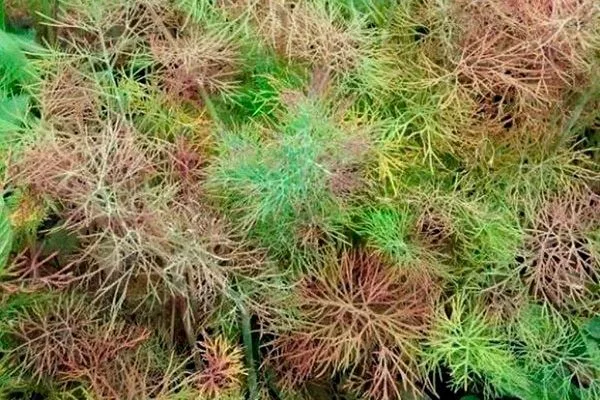
When preparing the soil for dill, avoid adding lime and wood ash. The plant reacts poorly to their presence. Instead of bright green, dill leaves turn yellow or even reddish, and the greens are scanty and tasteless.
Sowing scheme
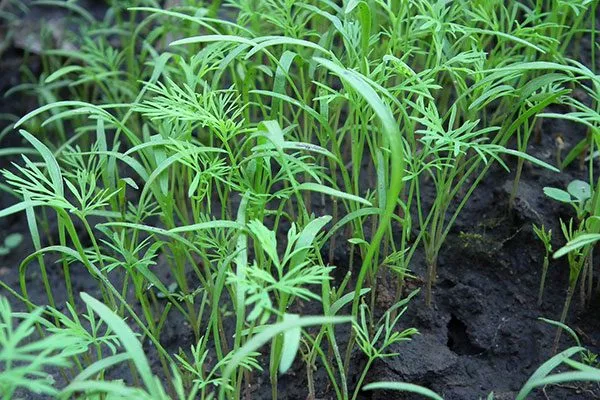
The dill sowing depth is 2-3 cm in light soils and 1.5-2 cm in medium and heavy soils. The optimal sowing pattern for Buyan dill is 25 x 25 cm. However, other options are also possible.
How to sow dill Buyan:
- In rows. Leave 30 cm between them, and 3-4 cm between neighboring plants.
- RibbonsThe distance between them is 40-50 cm, and between the lines in the tape is 20-30 cm.
- Furrows. A 5 cm wide board is pressed into the watered and leveled area. The gaps between adjacent furrows are 10 cm. Seeds are scattered along the furrows and covered with humus or ordinary soil.
Buyan dill can be sown from April to July. Up to 6 sowings are carried out per season at intervals of 2-3 weeks (you can use the following as a guide dill germination period, to calculate the sowing time).
Growing dill using seedlings
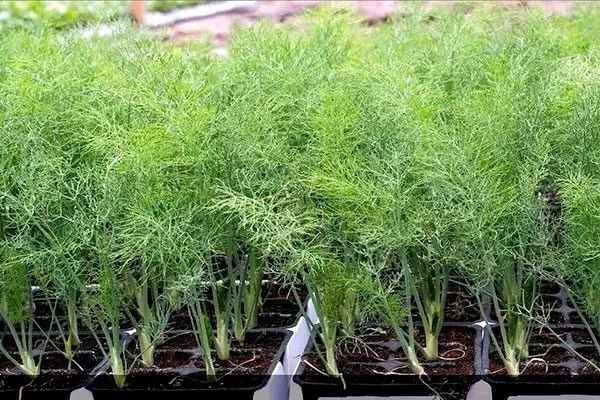
Buyan dill can be grown using seedlings. This method is most often used when growing indoors. Seedlings grow in approximately 40 days.
Features of growing dill seedlings Buyan:
- Sowing takes place from the beginning to the end of March, depending on climatic conditions.
- Dill is sown in boxes or cassettes filled with nutrient substrate.
- The optimal room temperature is +20…+25 °C.
- Once the seedlings emerge, the containers are moved to a cooler location for 2-3 days. The temperature there is maintained at 10 to 12°C. Then, it is raised again to 18 to 20°C.
- When the first true leaf appears, the plants are picked.
- Dill seedlings should be watered regularly, but sparingly, as stagnant moisture can cause root rot. Use only warm, settled water.
- The room where the seedlings are growing is kept lit for 12 hours a day. If the light is insufficient, grow lights are turned on.
When the seedlings reach the stage of 7-10 leaves and a height of 15-18 cm, they are transplanted into the ground (a cover or film shelter).
Care
To ensure high-quality greens and a high yield, it's important to regularly tend to your dill beds—watering, fertilizing, weeding, etc.
Watering
Dill is watered twice a week. The watering rate is 7 liters per 1 square meter. In dry weather, it is recommended to water in the evenings - often and abundantly.
Top dressing
To promote vigorous growth, bush dill is recommended to be watered weekly with a urea solution (30 g per 10 liters of water). However, fertilizing is generally only necessary in poor and unfertilized soils.
If all the necessary fertilizers were added to the soil in autumn and spring, then dill will be added additionally feed not required.
Loosening
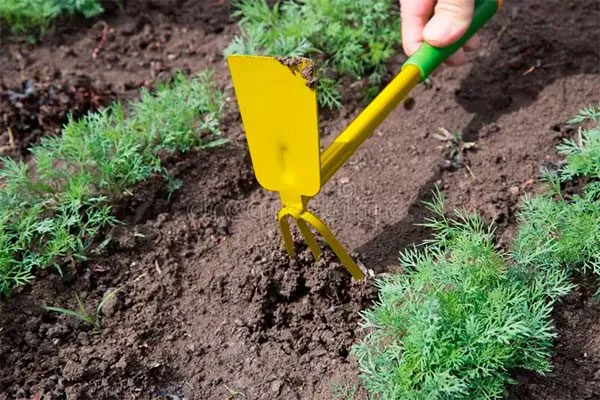
It's best to loosen the soil in the beds every two weeks. When the seedlings are establishing roots, loosen the soil to a depth of 5 cm; later, loosen to a depth of 10 cm. Loosening ensures oxygen supply to the roots, ensuring proper rooting and plant growth.
Prevention of diseases and pests
Dill Buyan has excellent immunity and is rarely affected diseasesUnder a combination of unfavorable factors, dill can become susceptible to powdery mildew or verticillium wilt, an incurable viral disease. Seedlings can also be affected by blackleg if overwatered.
For severe infestations, use fungicides based on Bordeaux mixture and copper sulfate. Leafy greens affected by powdery mildew can be treated with, for example, Fitosporin or Pseudobacterin. For Fusarium wilt, it's best to treat the beds with Fitolavin.
Among the pests, various types of aphids, such as carrot and melon aphids, pose the greatest threat to dill. These can be controlled with insecticides, but this is a poor option for dill, as the greens grow quickly and are immediately eaten. Therefore, insects are repelled with folk remedies such as onion, tobacco, or chamomile infusions.
Harvesting
The harvest begins before the flowers appear, while the dill leaves are tender and fragrant. Cutting begins with the lower tier, then moves on to the side shoots. The rosette is cut off completely, leaving only the growing point, from which new shoots soon emerge.
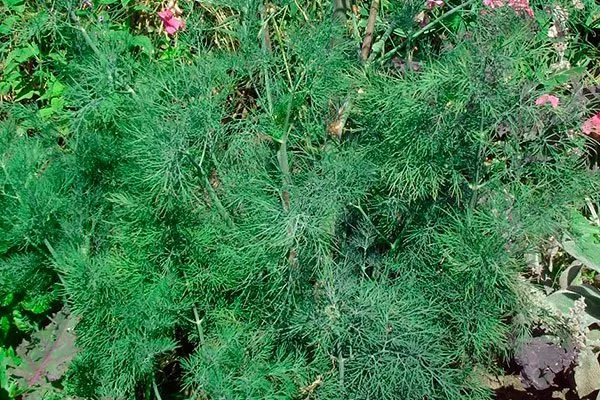
Usually, it takes about 60-70 days from the moment the seedlings appear until the first harvest of greens.
Reviews
The Buyan variety is a delicious and beautiful dill, a wonderful choice for any garden. This Russian variety is productive and versatile, suitable for edible, canning, and commercial use.