
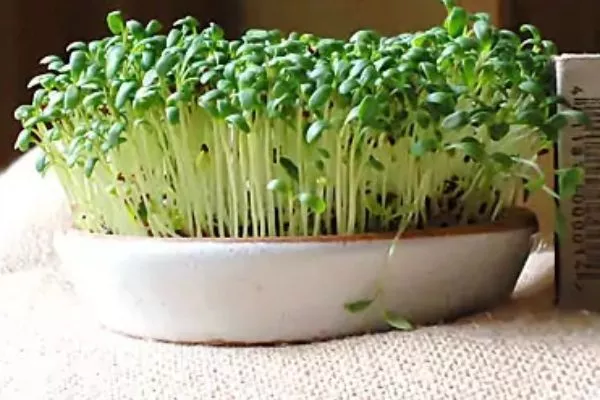
This spring variety of leaf lettuce is distinguished by its ability to grow year-round, whether in an open garden, protected conditions, or simply in a container on a windowsill or balcony. This watercress is characterized by its rapid growth and tolerance to low temperatures.
Introduction to the variety
The Spring cress variety was developed in 2001 by a team from Russian Seeds JSC and the N. I. Vavilov All-Russian Institute of Plant Genetic Resources, including Z. S. Vinogradov, O. A. Zvereva, and L. M. Kushch.
Special characteristics of the variety:
- Spring is rich in vitamins and microelements, which makes it a valuable dietary supplement during winter and early spring.
- This variety is undemanding to conditions and can be grown on balconies and windowsills, provided there is sufficient lighting.
- It is used as an independent crop or as an additional component for soil compaction.
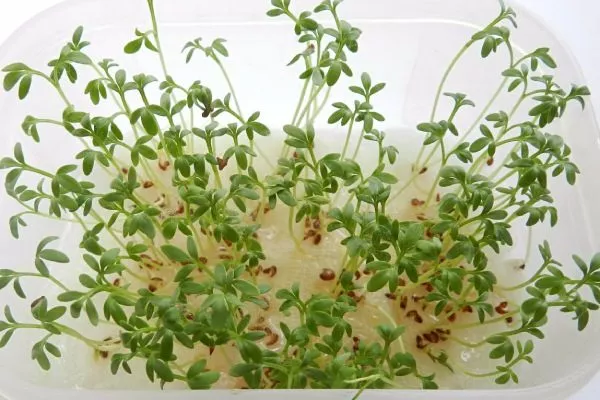
- The seeds germinate within 2-5 days, and the average yield is 400-500 g per 1 sq. m.
- The leaves of this variety can be used fresh, as well as for making creamy soups, salads and side dishes.
Watercress contains mineral salts of calcium, iron, iodine, carotene, rutin, as well as vitamins B, C, and P, making it beneficial for digestion, stabilizing blood pressure, and removing toxins from the body. Watercress also has antimicrobial properties.
Description of appearance
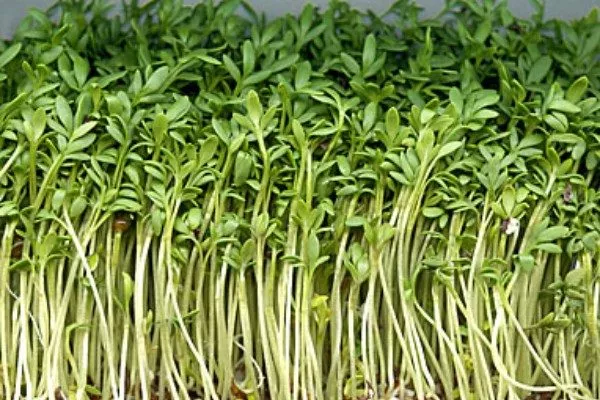
This lettuce is distinguished by its small size: its length ranges from 8-10 cm, and its diameter is between 15 and 22 cm. Other varietal characteristics:
- The rosette of leaves is slightly raised;
- the leaf blades are large, oval-shaped with slightly wavy edges and a slightly bubbly texture;
- the subtle light green shade of the bush contrasts with the rounded shape of the “crown”;
- the compact structure gives the leaves a crispy texture;
- The taste of this variety is characterized by lightness and a mustard flavor.
How to grow correctly?
This plant does not require special conditions for sowing and subsequent care, but systematic moisture promotes its rapid development and preservation.
- ✓ Maintain soil moisture at 70-80% to prevent drying out.
- ✓ Provide lighting for at least 12 hours a day, using phytolamps in conditions of insufficient natural light.
Despite the standard rules, note the following for this watercress:
- You can plant seeds for seedlings in any month of the year, starting from January and ending in December.
- In order for the crop to develop well, it is necessary to maintain the temperature in the range of 18-21°C after transplanting the seedlings to a permanent location.
- Between April and September, the plant can be sown directly into open ground, where it will grow best in soft sunlight.
Reviews
The leafy variety of Spring lettuce has a number of positive characteristics, making it so popular among consumers, large farmers, and ordinary summer residents, as well as residents of apartment buildings.