
Asparagus lettuce isn't often found in Russian gardens, as it's still considered a relatively new crop. However, experienced gardeners try to grow this type of lettuce themselves. And for good reason – it has a wealth of beneficial properties, can be used to prepare a variety of dishes, and is relatively easy to care for.
Asparagus salad – features
Asparagus lettuce also has other names: wo-chu, uysun, and stem lettuce. It can be annual or perennial, and belongs to the Asteraceae family. It was bred from celery and common lettuce, and can have purple, red, or green leaves that can be curly, dissected, or wrinkled.
Botanical description
The plant's origins are Chinese plantations, and it's also common in Japan, India, Mongolia, Kyrgyzstan, Tajikistan, and Kazakhstan. However, it's a relatively recent arrival in Russia. In our latitudes, green-leafed plants are most common.
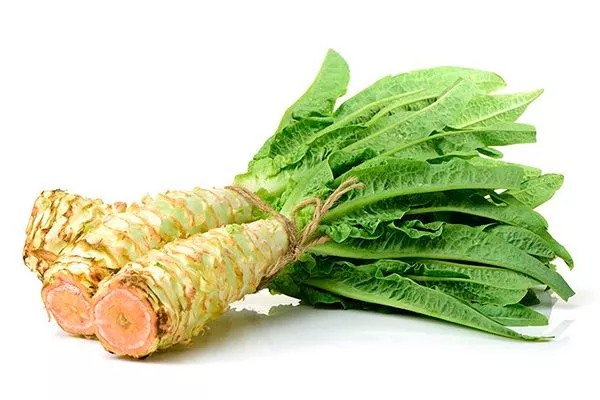
Appearance and structure of asparagus salad:
- Root system. Rod-shaped and cone-shaped, with numerous lateral branches. Not very deep.
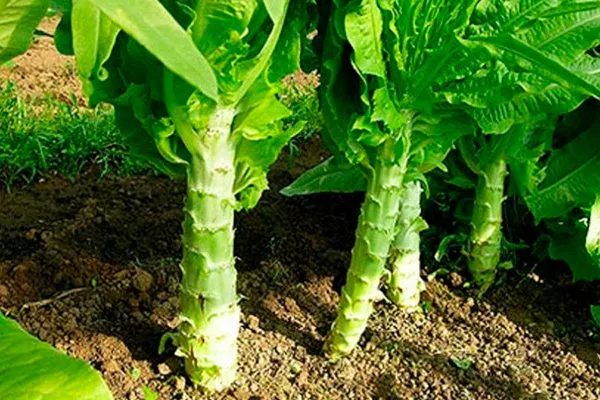
- Stem. An upright, fairly robust plant. Its diameter ranges from 4 to 10 cm and it is characterized by exceptional juiciness. It reaches a height of up to 80 cm, but specimens can reach even taller—around 130 cm. Its color is usually light green.
The best part of the stem to eat is from the base to 30 cm up—this is the crispiest and tastiest part. The main stem emerges from the root, while the lateral stems form from the leaf axils above. - Taste. Pleasantly herbaceous, but has a slight bitterness.
- Leaves. Sessile stems can be elongated-oval (in which case the stem is shortened), elongated-narrow (in which case the stem is long and slender), or dissected (this type is almost never seen in our region). Color ranges from light green to red and purple.
The surface of the leaves can be wrinkled, bubbly or completely smooth. - Peduncles. They are located on flowering stems that branch upward. These form inflorescences in the form of heads, each containing 10-25 flowers.
- Flowers. Typically white, greenish, or yellowish in color, they consist of a corolla and unilocular inferior ovaries. They are small and bisexual. They open early in the morning but close within a couple of hours.
- Fruits and seeds. The fruits are achenes, containing a pole and a beak. They can be easily separated when cleaning the planting material. The seeds are quite small, can be flattened, round, or oblong, and have 5 to 7 longitudinal ribs.
The planting material comes in white, yellow, black, dark brown, or white-silver. Its thickness ranges from 0.3 to 0.5 mm, with an average width of 9 mm and a length of 4 mm.
The crop tolerates drought well, has excellent transportability and can be stored for a long time (4 months).
Popular varieties
| Name | Ripening period | Leaf color | Bush height | Bush weight |
|---|---|---|---|---|
| Dungan salad | 75 days | grayish-green | 40-50 cm | 450 g |
| Early lettuce | early maturing | light green | 85 cm | 200 g |
| Late lettuce | late | light green | 120 cm | 200-500 g |
| Svetlana | 100 days | light green | 85 cm | 300-500 g |
There are many varieties of asparagus salad, but in our country the following are considered the most popular and widespread:
- Dungan salad. It's considered mid-season—it takes about 75 days from sprouting to technical maturity. The color is grayish-green, each bush weighs 450 g, the leaves are elongated, and the rosette is 40-50 cm in diameter.
- Early lettuce. It is an early-ripening variety with a rosette diameter of 35-40 cm. The color is light green, the bush weight is 200 g, the bush height is 85 cm.
- Late lettuce. The plant is quite tall, reaching up to 120 cm. Its color is light green, and its weight varies from 200 to 500 g.
- Svetlana. This is a mid-season variety, ripening in 100 days. The bush grows to 85 cm in height and weighs between 300 and 500 g.
The benefits and harms of asparagus salad
Asparagus salad is considered a very healthy food, so it's often used during diets and other health issues. It's rich in various vitamins and microelements, making it useful for:
- weight loss;
- removal of toxins and toxic compounds from the body;
- strengthening the immune system;
- improving visual acuity;
- restoration of the epidermis;
- acceleration of metabolism;
- normalization of the functionality of the digestive system;
- strengthening of joints and bones, connective tissues;
- diuretic action;
- elimination of inflammatory processes of any etiology, including infectious ones.
Asparagus salad is recommended for pregnant women as it supports fetal development, prevents various birth defects, and promotes normal heart function in the unborn baby. Furthermore, it provides the body with all the necessary nutrients and prevents excessive weight gain, which is especially important during pregnancy.
Asparagus salad also has contraindications:
- individual intolerance to vegetables;
- cystitis and the like;
- stomach ulcer;
- acute gastritis.
You should not abuse the product, otherwise problems with the urinary system and stomach may occur.
Time to collect seeds
Seeds are usually harvested as the seed pods ripen. August is considered the start of harvest, but much depends on the technical maturity date. For early-ripening varieties, this is 100 days, for mid-season varieties, 130 days, and for late-ripening varieties, 160 days.
The planting material begins to ripen 13-15 days after budding, but the plant has a prolonged flowering period, so the seeds on a single plant ripen at different times. Seeds on a single plant always vary in quality, so it's important to know the best source for them:
- the central axes are the highest quality seeds, which ripen first;
- medium shoots from 1 to 4 order – good quality;
- lower orders of shoots - seeds are unsuitable for sowing.
Planting material is collected in warm, sunny weather. If the region is characterized by frequent and strong winds, there is a risk of seed shattering, so two options are available:
- wrap each seed pod with gauze;
- Collect all the seeds at once and let them ripen indoors or in the sun.
Growing technology
Asparagus lettuce is easy to plant and care for, following the standard requirements and care for salad crops. However, there are some special considerations to be aware of.
Lighting and humidity
Asparagus salads are best planted in areas with full sun before midday and partial shade afterward. The best exposures are south and southeast. If planting seedlings, grow lights should be installed indoors.
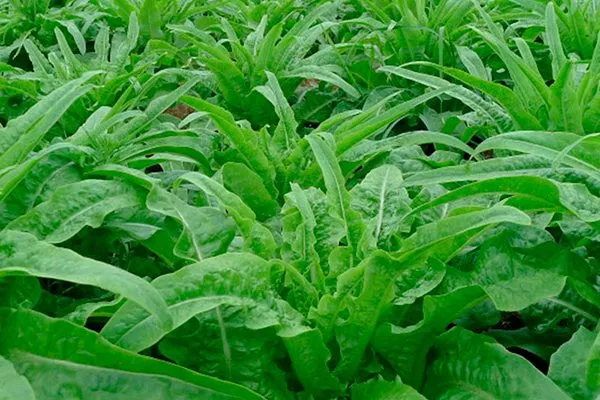
The plant prefers medium-to-high humidity—from 50 to 70%. This is due to its moisture-loving nature and the ability of its leaves to evaporate large amounts of moisture. The same humidity parameters apply to the soil.
Temperature
Uysun is considered a cold-hardy crop, so the seeds germinate easily even at soil temperatures of 12-14 degrees Celsius. The air temperature during seedling formation can be as low as 1 degree Celsius, ensuring normal seedling development over a long period.
Optimal air temperature conditions during different stages of development:
- for sowing - within 5-8 degrees;
- before budding – from +17 to +20 degrees;
- during flowering – during the day from +20 to +25 degrees, at night from +18 to +20 degrees.
Soil
Asparagus lettuce requires fertile soil with a neutral pH level—between 6.1 and 6.6. Any type of soil is suitable—clay, sand, sandy loam, loam, and even peat. It must contain vermicompost, and the soil must be loose and well-drained.
- ✓ The pH level should be strictly within 6.1-6.6, deviations can lead to poor absorption of nutrients.
- ✓ Mandatory presence of vermicompost in the soil to ensure the necessary microflora.
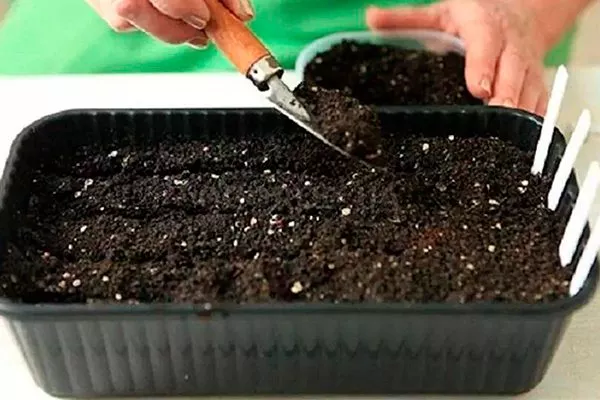
For growing, you can prepare soil from the following components:
- leaf soil;
- wood ash;
- peat;
- coarse sand;
- dolomite flour.
Sowing stages
Asparagus lettuce seeds can be sown directly into open ground or grown indoors for seedlings. The first step is to prepare the seeds:
- select all the hollow ones and throw them away - to do this, fill the planting material with water and remove all the floating grains;
- disinfect – soak for 2-3 hours in a light pink solution of potassium permanganate.
The seeds can be pre-soaked in cheesecloth and a saucer using the standard sprouting method, but this procedure is not considered necessary for asparagus salad.
When sowing directly into the beds, do the following:
- Prepare the beds once the desired temperature has stabilized – remove any debris, grass clippings, branches, and leaves. Dig and rake the soil.
- Make shallow grooves (about 1 cm).
- Moisten slightly with warm water.
- Space the seeds 25-50 cm apart, depending on the desired plant size. Leave 60-70 cm between rows.
- Sprinkle with substrate and water lightly again.
If frost is expected, cover the seeds with plastic wrap. Seedlings should appear in about 2 weeks.
When planting using the seedling method, do the following:
- Around April (depending on the region), prepare the container and disinfect it.
- Fill it with a universal substrate or one you make yourself (you can use sand with peat).
- Wet the surface with a spray bottle.
- Make furrows at a distance of 7-10 cm from each other.
- Sow the seeds in a solid line.
- Sprinkle with soil mixture and moisten.
- Cover with glass or plastic wrap.
- Move it to a sunny windowsill (it needs plenty of light).
- For 10-12 days, open the cover every day for ventilation and water periodically. During this time, the first shoots will appear.
- When 1-2 true leaves appear, thin out the seedlings, leaving about 5 cm between them. Immediately after this, feed the seedlings: 4 g of potassium salt, 12 g of superphosphate, and 10 g of urea (per 1 sq. m).
- When 3-4 leaves have formed, apply the same fertilizer again.
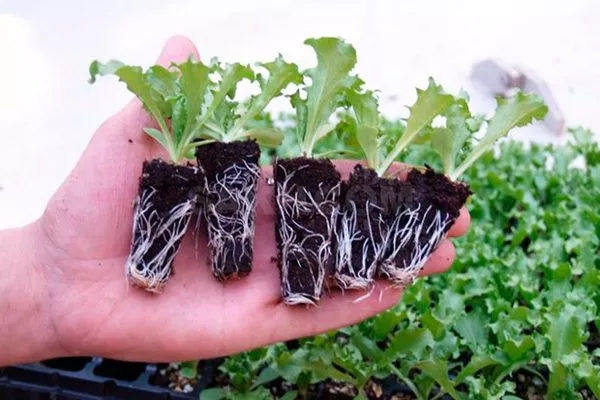
- When 4-5 leaves appear, transplant the seedlings into separate cups and grow them in them until the bushes become stronger.
When growing seedlings, pay attention to the thermometer readings at different times:
- before the formation of sprouts - from +20 to +25 degrees;
- 5 days after emergence - in the sun 17 degrees during the day and 11 degrees at night, in cloudy weather 15 degrees during the day is enough, 9 degrees at night.
Be sure to moisten the substrate every day and then lightly loosen it.
Stages of transplantation
Transplant the seedlings into the beds after approximately 30-40 days. The recommended method is transshipment with a root ball. Here are step-by-step instructions for proper transplanting:
- Remove all debris from the area, dig it up and dismantle it, adding sand, manure, and dolomite flour (it can be replaced with slaked lime).
- Make holes 5-7 cm deep. Maintain the same distance as when planting seeds in open ground.
- Water the holes with warm, settled water.
- Remove the seedlings from the cups along with the soil.
- Place the bushes in the holes and sprinkle with substrate as when hilling.
- Moisten slightly.
- Carry out the next watering no earlier than in 3 days.
Care instructions
Maintenance procedures include just two steps: watering and fertilizing. However, don't forget to remove weeds and loosen the root zone after rain or moisture. This will allow the roots to receive the necessary oxygen.
Watering
Since asparagus lettuce's root system doesn't extend deep, the plant should be watered frequently but in small amounts. The key is to prevent stagnant water and the formation of a dry crust on the soil surface. Water in the morning or evening.
- First feeding: 10 days after germination or transplantation, use nitrogen-phosphorus fertilizers.
- Second feeding: during the period of stem formation, increase the proportion of phosphorus.
- Third feeding: when the leaves begin to grow, you can repeat the composition of the first feeding.
Fertilizers
Asparagus lettuce thrives in fertile soil, but an excess of minerals can be harmful. Therefore, two or three applications of fertilizer are sufficient throughout the growing season. These periods are 10 days after sprouting or transplanting, during stem formation, and during leaf growth.
Lettuce needs nitrogen and phosphorus most, while potassium plays a secondary role. Therefore, it's important to choose appropriate mineral supplements.
Harvesting
Fresh asparagus lettuce leaves should be harvested when small buds appear at the top of the plant. During and after the active flowering period, the stems become stiff and lose their flavor. Harvesting is usually done at intervals, as the flowers don't all appear at once. The interval between harvests is about 5-6 days.
A sharp knife or pruning shears are used for this procedure, as the stems and leaves must be cut off, not torn off. This is especially important for perennial varieties to avoid damaging the root system.
Major pests and diseases
Unlike other herbaceous plants, asparagus lettuce rarely gets sick—only when proper cultivation practices are not followed. However, powdery mildew, rust, gray mold, and root rot can occur. The main cause of fungal infections is excess moisture.
The most common pests include spider mites, aphids, mealybugs, and scale insects. Fungicides and insecticides are used to prevent and treat diseases and pests.
What to cook?
Asparagus salad is eaten in a variety of ways – raw, boiled, stewed, fried, baked, pureed, made into soup, cocktails, etc. We offer a brief overview of the most popular and simple recipes.
Warm asparagus salad
This is a delicious and filling baked dish. How to prepare:
- Peel and wash the stems.
- Cut into large cubes.
- Simmer for 10 minutes in salted water.
- Once the stems have softened, drain the water and place the salad on a baking sheet.
- Add chopped onions, herbs, and asparagus leaves.
- Mix everything thoroughly and sprinkle generously with cheese.
- Bake for 15 minutes at 180-200 degrees.
Stew with asparagus salad
This dish is not vegetarian, as meat is added to the stew. Lamb or goat are best. Preparation:
- Marinate the meat and then cut into cubes.
- Place in a saucepan. Add the diced vegetables—onion and carrots—to the pan.
- Pour in water and simmer for about 15 minutes.
- Now add the raw potatoes and return to the stove. Simmer for 20 minutes.
- Add bell pepper, white cabbage, stems and leaves of asparagus salad.
- Season with tomato juice, salt, ground pepper, basil and rosemary.
- Cook until done.
Mashed potatoes with asparagus salad
This dish adds a twist to the flavor of regular mashed potatoes. How to prepare:
- Peel the potatoes and lettuce stems.
- Cut as desired, but the stems should be larger in size.
- Boil until done (together).
- Drain the water and transfer the vegetables to a blender.
- Add butter, salt, and pepper. Nutmeg pairs perfectly with the puree, adding a special flavor.
- Grind it.
Asparagus Spear Soup
This first course can be prepared using any meat broth. Cooking instructions:
- Boil the broth and remove the meat.
- Cut it into small cubes and return it to the pan.
- Add potatoes and lettuce stems to the broth.
- Boil until half cooked, then add onions, bell peppers, champignons or other mushrooms and carrots (optional).
- Cook until done, but add grated processed cheese 5 minutes before.
- Decorate the plates with herbs.
Asparagus lettuce is a versatile, tasty, and healthy herbaceous vegetable that accumulates virtually no nitrates or other harmful substances. Asparagus lettuce requires little care when growing and planting, but the key is to avoid overwatering or drying out the soil.