
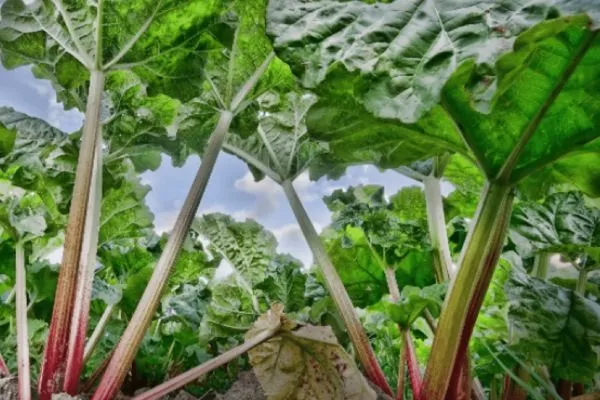
Moscow rhubarb, labeled No. 42, is a perennial herbaceous plant intended for open-ground cultivation. It has an impressive lifespan of 10 to 15 years, depending on growing conditions. It belongs to the wavy variety, whose stems are broken rather than cut.
Origin
The Moskovsky 42 rhubarb variety was developed by specialists from the Moscow branch of the All-Russian Research Institute for Plant Growing (MOVIR). In 1968, it was officially approved for cultivation throughout Russia.
Description of the plant
The bush is medium-compact, characterized by a weak ability to form shoots and resistance to flowering. Other varietal characteristics:
- the height of the plant varies from 100 to 120 cm, but there are also longer stems – up to 200 cm;
- the leaves are wide, ovoid, dark green in color, with a bubbly surface and slightly wavy edges;
- the leaf blades reach 40-43 cm in length and about 35-37 cm in width;
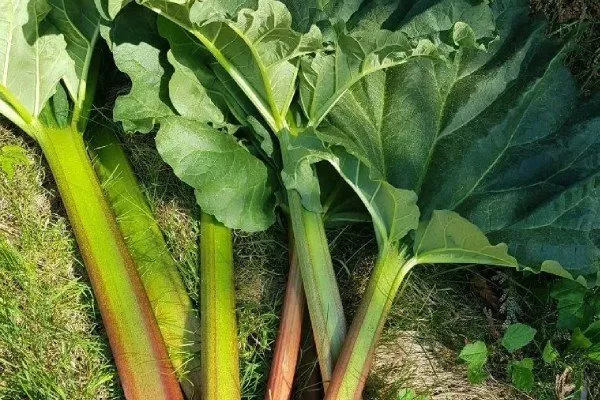
- the petioles have a lighter green hue with a raspberry tint at the base and a slightly ribbed structure, about 47-50 cm in length, 20-22 mm in width;
- the aroma is pronounced, as is the taste;
- the pulp is considered tender and juicy;
- half vertical socket;
- The weight of the petiole is significant – minimum 100 g, maximum 150 g.
Ripening time and yield
The first harvest is three years after planting, but three harvests are made per season. Technical maturity is reached in 40-45 days. The yield of early-ripening rhubarb depends on climate conditions and the precise adherence to agricultural practices. Approximately 2 kg of edible plant material can be harvested from 1 square meter, while under more favorable conditions, a single bush can yield up to 5-6 kg.
Application
The Moskovsky 42 variety has a universal purpose: the greens are used for preparing fresh salads (at a young age), as well as for canning, freezing, and heat treatment during cooking.
Features of cultivation
To plant rhubarb seedlings, dig holes approximately 50-80 cm deep and wide. The distance between plants should be at least 70-100 cm. When planting from seeds, the planting depth should not exceed 2-2.5 cm. Add mineral fertilizers, compost or humus, a little slaked lime, and wood ash to each hole to normalize the soil's acidity.
- ✓ The optimal soil pH should be in the range of 5.5-6.5. Outside this range, the plant absorbs nutrients poorly.
- ✓ The soil must be well-drained to avoid waterlogging, which leads to root rot.
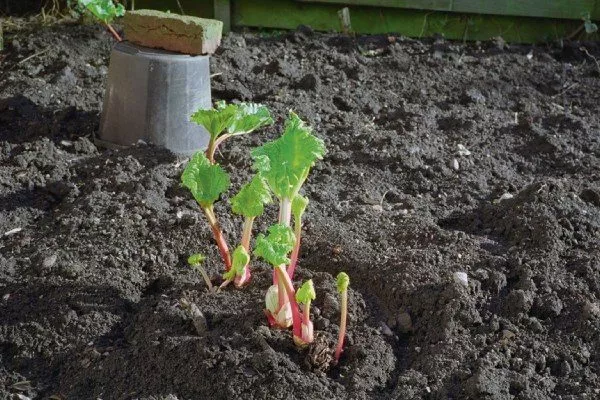
Rhubarb care begins immediately after planting:
- It is necessary to carefully loosen the soil between the bushes, weeding and removing all weeds is mandatory.
- During the summer, it's recommended to water the plants 3-4 times, simultaneously applying liquid fertilizer to the underside of the bushes. Fertilize with a solution of bird droppings or cow manure, adding 500 ml of liquid at a time.
This solution is also useful: dissolve 15 g each of urea and ammonium nitrate in 5 liters of water. This amount is sufficient to feed 2-3 plants. - In the fall, remove dead leaves. In September, add wood ash and a special garden mix containing vermicompost and mineral fertilizers. Before wintering, protect rhubarb with humus, manure, or peat, which not only enriches the soil but also prevents freezing during severe frosts.
- In the spring, gardeners should inspect the bushes for damage and remove dead parts. Manure, potassium chloride, and ammonium nitrate should be evenly spread over the area around the trunk.
- In spring, before the growing season begins, apply a complex mineral fertilizer with a predominance of nitrogen to stimulate leaf growth.
- In summer, during the period of active growth, feed the plant with a solution of mullein or bird droppings to maintain the nutritional value of the soil.
- In the fall, after harvesting, apply potassium-phosphorus fertilizers to prepare the plant for winter.
It is recommended to store petioles in the refrigerator, basement or other cool places.
How does it reproduce?
The crop can be propagated by two main methods: through seeds, which requires considerable labor and time, or by dividing rhizomes. The latter method, although faster, can lead to the loss of unique varietal characteristics, especially in the case of hybrids.
The most commonly used method is division, which has the following features:
- To divide rhizomes, it is necessary to select healthy plants aged 3-5 years.
- The rhizome is dug up and divided into several large sections, each of which should include at least 2 powerful root branches and well-developed buds.
- Root cuts should be treated with crushed activated charcoal or ash to prevent rot. Afterwards, the rhizome pieces should be dried in the shade for several hours.
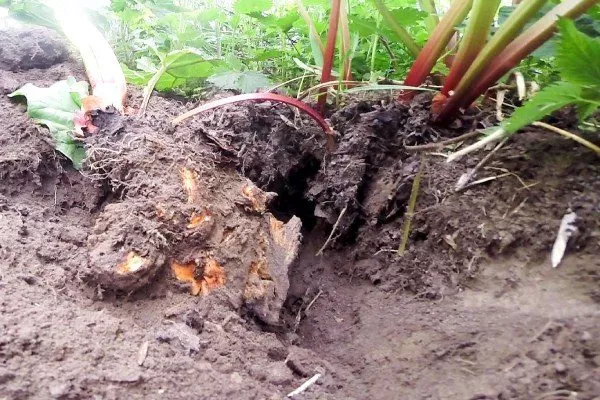
It is recommended to plant rhubarb divisions in April or May, so that the plants have time to take root before the onset of cold weather, or in early September, so that they can gain strength for spring growth.
Reviews
Moskovsky 42 rhubarb has been popular in Russia for over 50 years. This variety has earned a reputation among consumers thanks to its excellent flavor and aroma. However, if you ignore proper agricultural practices, yields will decline significantly, so strictly follow all expert recommendations.