
The quality of sunflower seeds depends largely on the timeliness and correctness of their harvesting. Various agricultural factors and storage conditions influence the properties of the seeds and the oil extracted from them.
When to harvest sunflowers?
There are no exact calendar dates for sunflower harvesting. The warmer the climate, the earlier harvesting should begin. deadlines depend on the degree of ripening of the seeds, features varieties and weather conditions.
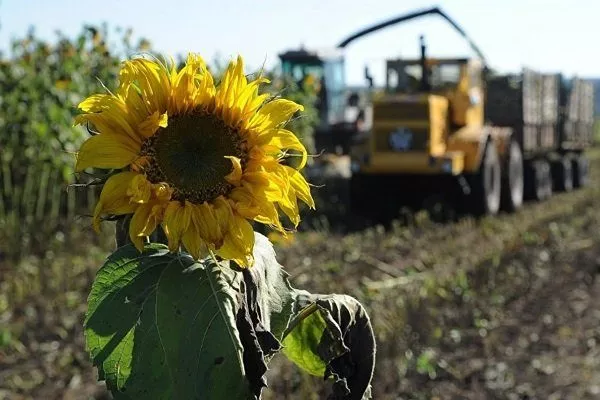
Throughout the country, the optimal period for harvesting sunflowers begins in mid-August and lasts until the end of September.
The cleaning time is chosen based on the following factors:
- 80% of the plantings have reached the final stage of ripening, and the moisture content of the seeds is no more than 10-11%.
- If it's hot, harvesting begins earlier to avoid losses in productivity and yield.
- If the field is overgrown with weeds or infected with fungal infections, desiccation must be carried out.
- If the farmer has a drying machine, harvesting can begin earlier, at 20% humidity.
It is important to determine not only the start but also the end date of harvesting - this allows you to avoid losses caused by seed shedding.
How to determine whether the seeds are ripe or not?
When determining the timing of sunflower harvesting, farmers consider the degree of seed ripeness. When the crop is ripe, harvesting can begin (weather permitting). Specialists also consider certain technical parameters when determining sunflower readiness for harvesting.
Signs of ripe seeds:
- The plant is not green, but completely dried out and yellowed.
- Sunflower with ripe seeds has no smell.
- The seed baskets droop downwards.
- All the petals around the perimeter of the basket turn brown, there are practically no yellow ones.
- The seeds in mature baskets have not yet fallen off, but are fully ripe and significantly thickened.
- The color is black, sometimes with a grayish tint or whitish stripes, which are characteristics of the variety.
Sunflower seeds begin to ripen on the 40th day after flowering, when physiological maturity occurs. As the crop matures, nutrient accumulation ceases, and moisture content drops to 20%—this is the stage of economic maturity.
Seed maturity levels
Before harvesting, farmers pay attention to the degree of seed ripeness, which is determined by the moisture content of the seeds and heads.
Maturity phases:
- Yellow. The green heads acquire a lemon-yellow color on the reverse side, and their moisture content is 85-88%. The seeds in the yellow phase are well developed and have a moisture content of 30-40%.
- Brown. At this stage, the baskets become brown, their moisture content is 40-50%, and the seeds’ moisture content is 10-12%.
- Full ripening. The crop dries completely. The moisture content of the heads is 18-20%, and that of the seeds is 7-10%.
Harvesting begins when most of the plants (80%) are in the brown phase. If the seeds are to be stored for a long time, their optimal moisture content is 9-10%.
Delaying harvesting results in a 5-8% yield loss. Dried seeds quickly fall off. Birds, rodents, and various pests further increase losses.
In northern regions, the main problem during sunflower harvesting is excessive moisture. Seed moisture content is 12-14%, but due to weather conditions, harvesting typically begins at 18-22% moisture.
Desiccation effect
Desiccation is the dehydration of plant tissues using chemicals to speed up ripening and facilitate mechanical harvesting. This agricultural practice is performed 5-15 days before harvest.
Desiccation is used on sunflowers in the ripening phase. The key is to apply the treatment promptly, as applying it too early significantly reduces yield, while late desiccation will render its effectiveness null and void.
When to use sunflower desiccation:
- To remove excess moisture from seeds in fields where plants have seeds at different stages of maturity.
- In case of severe weed infestation, which adds dirt and moisture to the crop during harvesting.
- If the seeds have normal moisture content, but the plants themselves, their stems and caps, contain too much moisture, this will negatively affect the quality of the product.
- If it is necessary to speed up the sunflower harvest, for example, to sow another crop.
Processing effect:
- simultaneous maturation of plants;
- bringing the cleaning dates closer by about a week;
- increase in crop yield;
- reducing harm from diseases;
- higher oil yield per hectare;
- increasing the productivity of agricultural machinery and reducing fuel costs.
Conditions for desiccation:
- The flower heads have turned brown. Time until harvest: 1.5 weeks.
- The crop humidity is 25-30%.
- Field cultivation in the morning, in dry and sunny weather.
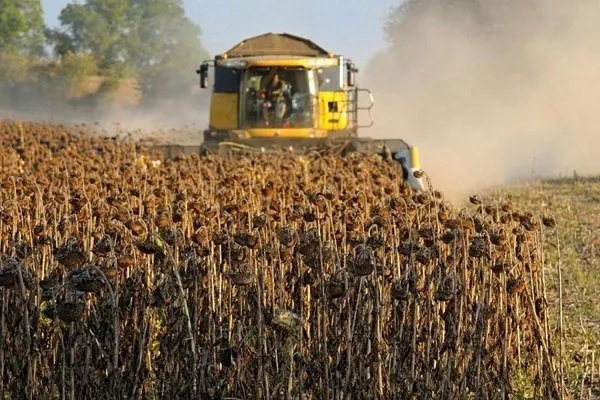
Recommended products include Edil, Reglon, Magnesium Chlorate, and Glyphosate. They are typically applied 2-4 weeks before harvest.
How to harvest?
The harvest is collected using combines such as the Don-1500, Neva, and others. They are equipped with headers adapted for cutting heads located at different heights, including on lodged plants.
A reaper is an agricultural device that expands the capabilities of combines and increases their efficiency.
Recommended technical parameters:
- stubble height after harvesting - no more than 20 cm;
- percentage of yield loss - 2.5%;
- crushing of seeds - up to 1%.
What types of reapers are there:
- Mounted. This is professional sunflower harvesting equipment. Universal models are suitable for any combine harvester, while specialized models are designed for specific combine brands.
- Cereals. A traditional header is not suitable for sunflower harvesting, as the reel's inappropriate size causes significant yield losses. To avoid losses, special attachments called lifters are installed.
What to look for when purchasing a sunflower harvester:
- When choosing an attachment, consider the dimensions of the combine harvester. Equipment of the required size can be purchased or ordered directly from the manufacturer. The minimum header width is 4 m.
- The equipment is attached to the combine harvester using special flanges. Beforehand, ensure that they fit the combine harvester body.
- It's recommended to use headers with hydraulic lifting and lowering systems. This system is adjustable from the combine and significantly simplifies the harvesting process, saving time. The downside is increased energy costs.
- It is advisable that the header be equipped with a tray - this reduces crop losses.
- ✓ Make sure the header is compatible with your combine in terms of mounting type and dimensions.
- ✓ Check for hydraulic lifting and lowering system for easy adjustment.
- ✓ Please note the presence of a pallet to reduce crop losses.
The technology for harvesting sunflower is similar to harvesting grain crops (wheat, barley, etc.):
- The field is mown and divided into rows. This work is done 2-3 days before the combines arrive.
- Access roads for equipment will be organized.
- Sunflowers are mown using a mounted harvester.
- They burn the stubble.
If sunflower crops are small—like those found in a garden or a small vegetable patch—hand-held harvesting tools are necessary. They all operate on the same principle: knocking the seeds out of the sunflower by striking the head.
Manual device options:
- Skewers. Suitable for farmers growing sunflowers on a large scale for oil production. A spit is typically used on plots of 10-20 acres. It is made from a 200-liter metal drum. Welding rods inside the drum allows the sunflowers to catch on the drum as the spit rotates.
Holes are made in the sides of the barrel to allow the seeds to fall out. The baskets are placed inside and the threshing begins. The device is effective for threshing dry grain with a moisture content of 6%. Raw grain is extremely difficult to thresh. A heating element can be placed under the barrel to dry or roast the seeds. - Leg from a stool. This tool is sufficient for processing a harvest from several beds. The stool leg is ideal in weight and shape for the job. To knock out the seeds, place a bag over the sunflower heads and hit them with a hammer.
10-15 blows are enough to knock all the seeds into a bag. Another method is to gather all the caps into a pile and knock the seeds out while sitting. - Bag. The sunflower heads are trimmed and placed in a plastic bag. The bag is beaten for at least five minutes with a stick, such as a shovel handle. The bag is then untied and the emptied heads are removed. A fan is installed in front of the raw material to remove debris.
- Polyethylene. This is an old-fashioned method that requires a stick and some oilcloth, which is spread along both sides of the bed. Walking along the rows, the gardener knocks the seeds out of their heads with the stick.
Delays in harvesting work
Delaying sunflower harvesting is unacceptable, as it leads to significant losses. Considering how many nutrients sunflowers extract from the soil, they must be grown for maximum benefit—harvest losses are unacceptable.
Consequences of late cleaning:
- Seeds, which have a genetically loose structure, spill out of the heads. The risk of seed shattering increases in windy weather, when the heads collide with each other.
- Plants fall over, and stems break, as they become brittle as they dry out. Sunflowers are damaged by mice, seeds are pecked by birds, and stems are trampled by wild boars.
- As the heads dry out, they begin to actively become diseased. This leads to their partial or complete detachment from the stem. Diseases affecting sunflower heads negatively impact the quality of the seeds, reducing their oil content, the weight of 1,000 kernels, and increasing acidity.
Within 5 days, seed losses increase by 50-100%. After 2 weeks, losses increase by an order of magnitude—by 10-12 times. If sunflowers remain idle in the field, the moisture content of the above-ground parts of the plants, including the heads, increases, causing the seeds to actively shed.
Harvesting must be done as quickly as possible; the longer it takes, the greater the losses caused by natural threshing. The drier the seeds, the greater the losses.
How to store sunflower seeds properly?
Sunflower seeds require special storage conditions. The main problem and danger to the harvest is high humidity. At this humidity, the seeds heat up, allowing microbes to develop extremely quickly.
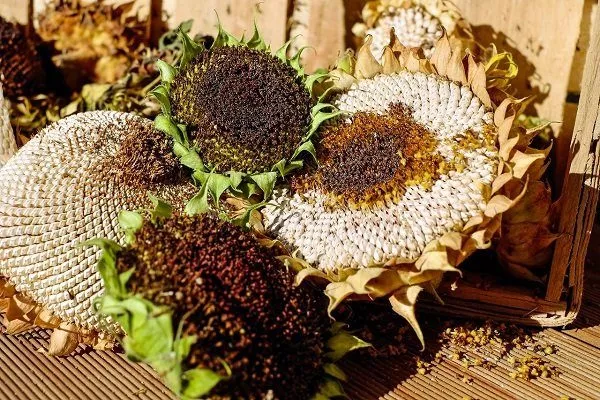
The shelf life of seeds largely depends on:
- Integrity of the shells. Specimens with damaged coating are left unprotected from microbes.
- Garbage. It has increased hygroscopicity, helping to increase the moisture content of raw materials. The maximum permissible contamination level is 2%.
To ensure proper storage, sunflower seeds require not only favorable storage conditions but also proper preparation. They are pre-dried and cooled to a temperature no higher than 10°C. The maximum shelf life of sunflower seeds is six months.
Stages of sunflower seed preparation:
- Screening. Hollow specimens, debris and parts of weeds are removed from the mass collected in the field.
- Calibration. Seeds are divided into two groups: for seeds and for processing.
- Drying. It prevents rotting of raw materials and increases the shelf life of sunflower seeds.
ZAV-20 systems or other similar units are used to clean raw materials. They are also cleaned using SVU-5 or SM-4 secondary and final cleaning systems. They are calibrated using PSS-2.5 and BPSU-3 pneumatic sorting tables.
Optimal conditions:
- purification degree - 99%;
- humidity - 60%;
- temperature - minus 25°C;
- raw material humidity - 7%;
- constant ventilation of the room;
- the optimal temperature range is +7…+10 °C.
Storage methods:
- in mounds up to 1 m high with seed moisture content of 7-8%;
- in bags - up to six tiers, with 10% humidity;
- in ventilated barns.
Timely and proper sunflower harvesting significantly increases yields and reduces unnecessary seed loss. Adherence to harvesting timing, technology, and storage conditions helps prevent spoilage and deterioration of the raw material.