
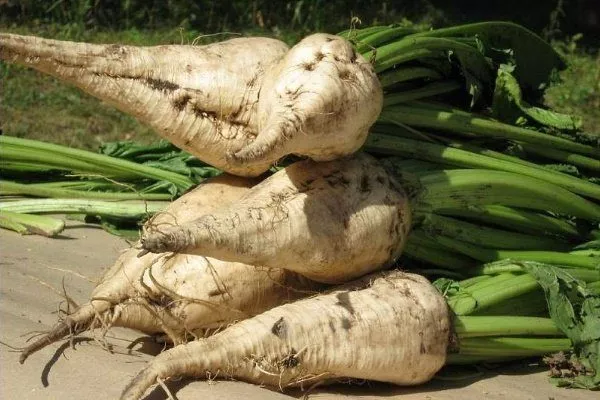
Sugar beet is a variety of the common root beet, but it is highly productive because each tuber contains a large amount of sucrose. Because of this, it is classified as an industrial crop and is grown primarily for sugar production, and less commonly for animal feed.
History of appearance
In 1747, the German chemist Andreas Marggraf discovered that beets also contain sugar, which had previously been extracted only from sugarcane. This knowledge was put to good use by plant breeders decades later, when his student Franz Karl Achard established the first sugar beet plant in Lower Silesia (present-day Poland) in 1801.
Since then, a group of breeders has been actively developing new beet varieties with higher sugar content. As a result of numerous studies, in just under two centuries, scientists have been able to increase the sugar content in various beet varieties from 1.3% to 20%.
Description of characteristics
Sugar beet comes in a variety of varieties and hybrids, but they all share common characteristics, which can be found in the table:
| Criterion | Description |
| Plant species | Sugar beet is a biennial root crop. During its first year of growth, it develops a fleshy, elongated root with firm white flesh and a rosette of basal leaves. |
| Sugar content of root vegetables | More than 16% or 69-72% of the dry matter mass. |
| Purity of cell sap | In the unrefined plant it is 87-89%, and in the refined plant it is 92-93%. |
| Sugar yield | Reaches up to 0.8 t/ha. |
| Time to sow seeds | Carry out sowing work in the 2nd-3rd ten days of April. |
| Harvest time | Harvest root crops in the 1st-2nd decade of October. |
| Plant density | It amounts to 80-100 thousand pieces/ha. |
| Growing conditions requirements | Sugar beets thrive on warmth, moisture, and light, so the richest yields are found in irrigated areas in the black soil zone. Among the world's leading sugar beet growers are Ukraine, Georgia, Kyrgyzstan, Russia, and Belarus. They are also cultivated in many countries of the European Union, Central America, and North America. |
Composition of sugar beet
Sugar beet is a healthy food rich in vitamins and microelements. It has a low calorie content per 100 g—approximately 39.9-45 kcal, including:
- proteins – 1.5 g;
- fats – 0.1 g;
- carbohydrates – 8.8 g;
- fiber – 2 g;
- dietary fiber – 2.5 g;
- water – 86 g;
- ash – 1 g.
The energy ratio of proteins, fats and carbohydrates is 13%:2%:80%, respectively.
It's important to note that sugar beets contain only mono- and disaccharides (8.7 g per 100 g of product) of digestible carbohydrates. The root vegetable contains 25% dry matter, and 20% sucrose. Other carbohydrates found in beets include glucose, fructose, galactose, and arabinose.
Sugar beet is rich not only in sugar, but also in vitamins, macro- and microelements, as can be seen from the following table:
| Substance | Concentration per 100 g of product |
| Vitamins | |
| A (retinol, beta-carotene) | 0.01 mg |
| B1 (thiamine) | 0.02 mg |
| B2 (riboflavin) | 0.04 mg |
| B3 (nicotinic acid) | 0.1 mg |
| B6 (pyridoxine) | 0.06 mg |
| B9 (folic acid) | 13 mcg |
| C (ascorbic acid) | 10 mg |
| E (tocopherol) | 0.1 mg |
| PP (nicotinic acid) | 0.2 mg |
| Macronutrients | |
| Potassium | 288 mg |
| Calcium | 37 mg |
| Sodium | 46 mg |
| Phosphorus | 43 mg |
| Microelements | |
| Iron | 1.4 mg |
| Iodine | 7 mg |
| Cobalt | 2 mcg |
| Manganese | 660 mcg |
| Copper | 140 mcg |
| Zinc | 450 mcg |
Beneficial properties
Sugar beet and products made from it have the following beneficial properties:
- lower cholesterol levels and increase hemoglobin levels, and also strengthen blood vessels, generally improving the functioning of the cardiovascular system (due to this, white beets are recommended for consumption in cases of atherosclerosis and hypertension);
- increase the number of red blood cells, therefore supporting the condition in blood diseases, including anemia and leukemia;
- help prevent cancer because they contain a large amount of natural antioxidants;
- cleanse the body of waste and toxins, normalize metabolism (due to this, food poisoning can be treated with a freshly prepared decoction using the plant's tops);
- improves thyroid function in hypothyroidism due to the iodine content, which also helps you lose weight and reduce drowsiness;
- strengthens the immune system and speeds up recovery from colds, as it saturates the body with vitamins and other beneficial elements;
- They have a rejuvenating effect, nourish, moisturize and whiten the skin of the face, which is why they are used in cosmetology.
Harm and contraindications
Despite all the benefits, sugar beets can cause harm if consumed in large quantities under the following conditions:
- hypotension – beets help lower blood pressure;
- urolithiasis and kidney stones, gout, rheumatoid arthritis – beets contain oxalic acid, which promotes the formation of salts, which then form oxalate stones;
- chronic diarrhea – beets are a laxative product, so they can cause diarrhea, which is extremely harmful for people suffering from this disease;
- Gastritis with high acidity, acute gastrointestinal diseases, such as stomach ulcers or duodenal ulcers – beets increase acidity, which irritates the mucous membrane and can aggravate these diseases.
In addition, due to the high sucrose content, white beets are strictly contraindicated for obesity of any degree and diabetes.
Application
Sugar beets are an industrial crop used to produce sugar and ethanol, a gasoline that can replace diesel fuel. Remarkably, this plant is processed without any waste, as its residues are no less beneficial than sugar:
- syrup – used in the production of citric acid, alcohol, glycerin, yeast and organic acids;
- pulp – used as nutritious and succulent feed for pigs and cattle;
- defecation – used as a good lime fertilizer.
Table beets are primarily used for food, rather than sugar or fodder beets. However, the roots, which have a high sucrose content, are sometimes ground and used as a substitute for granulated sugar. They are also suitable for making jams, syrups, and compotes. Sugar beets can also be used to produce excellent liqueurs, cordials, and moonshine, due to their high sucrose content.
Sugar beet skins have an unpleasant taste, so before eating they must be thoroughly peeled and the root vegetable itself must be soaked in cold water for 5-7 minutes.
What is the difference between sugar beet and fodder beet?
To accurately identify the characteristics of sugar beet, it is necessary to take into account its differences from forage crops:
- contains significantly more sucrose - up to 20% in dry state versus 5-6% in fodder beet;
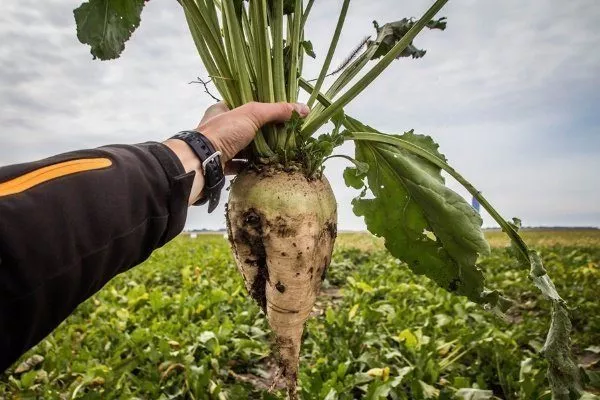
- has an elongated shape, and not cylindrical, round or oval like the stern;
- has white flesh and skin, while fodder beets can be red, pink and even orange;
- It is used mainly for sugar production, and less often for feed, while fodder beet is used mainly for livestock feed.
It should be noted that when sugar beets ripen, only the tops stick out of the ground, while fodder beets, on the contrary, stick out significantly.
Selecting a variety
All varieties and hybrids of sugar beet belong to the same species, have white flesh and skin, but are divided into 3 main groups according to their economic qualities and sugar content:
- fruitful – have medium and low sugar content in root crops (17.9-18.3%);
- high-yielding sugary – are distinguished by an average sugar content in root crops (8.5-18.7%) and high yield;
- sugary – contain the maximum amount of sugar in root crops (18.7-19%), but their yield is somewhat lower in comparison with other groups.
In sugar beet-growing farms with an area of 150 hectares or more, it is recommended to simultaneously sow at least three varieties of sugar beet:
- Z/NZ hybrids are suitable for early harvesting. Their optimal proportion in the crop structure is approximately 40%.
- Universal Z/NZ/N-type hybrids for optimal harvesting and storage. The share of such hybrids should not be less than 55%.
- NE hybrids for late harvesting. Their recommended share is no more than 5% of the total planting area.
To prevent the development of cercospora leaf spot in beets, it is best to sow hybrids tolerant or resistant to this disease on 25-35% of the sown area.
When choosing a variety, you should also consider the following recommendations:
- If intensive sugar beet cultivation is just beginning, varieties bred at the experimental station should be selected for sowing. These include the Belarusian single-seeded variety 69 and the hybrid Nesvizhsky 2. Their yield can reach 40-45 tons/ha.
- If intensive cultivation technology has already been mastered, high-yielding hybrids developed jointly with Western European companies can be selected. Popular varieties include Beldan, Danibel, Manezh, and Kavebel.
- If you plan to harvest early (the third ten days of September), choose sugar-type hybrids such as Silvana, Vegas, Rubin, Kassandra, and Beldan. It's worth keeping in mind that their optimal share in the beet crop structure should be around 25-35%.
Experienced gardeners note that, from an economic point of view, the most profitable for cultivation are hybrids with a high sugar content in root crops: the extraction coefficient is more than 87.5%, the specific consumption of root crops is low - 6.0-6.2 tons per 1 ton of sugar, the yield of purified sugar is 10.4-12.0 tons/ha.
Suitable conditions for growing
To obtain a good harvest of large root crops, it's essential to initially select a site with soil suitable for sugar beets. The most suitable soils are moderately or well-cultivated sod, sod-carbonate, or sod-podzolic soils, which can be loamy or sandy. They should preferably have the following qualities:
- underlain by moraine loam from a depth of 0.5 m;
- have high water-holding capacity;
- have a neutral reaction (pH 6.0-6.5);
- loose and well aerated;
- contain phosphorus and exchangeable potassium - at least 150 mg per 1 kg of soil, boron - at least 0.7 mg per 1 kg of soil, humus - at least 1.8%.
- ✓ Optimum soil acidity: pH 6.0-6.5.
- ✓ Minimum humus content: 1.8%.
- ✓ Required amount of phosphorus and potassium: not less than 150 mg per 1 kg of soil.
- ✓ Boron content: not less than 0.7 mg per 1 kg of soil.
It will be impossible to get a good harvest of sugar root crops on soils that are too light, heavy, peaty or waterlogged.
To ensure sugar beets develop to their full potential, it's crucial to plant them after the right predecessors. For example, beets should not be grown after crops such as:
- perennial legumes;
- cereal grasses;
- corn;
- flax;
- rape;
- grain crops if herbicides based on Chlorsulfuron or Metsulfuron-methyl were used during their cultivation.
Here are some acceptable crop rotation schemes:
- occupied fallow – winter grains – beets;
- peas for grain – winter grains – beets;
- first year clover – winter grains – beets.
Experienced gardeners believe that sugar beets are best grown after winter grains, preceded by legumes or first-year clover. However, the crop can also be grown after spring grains, legumes, and potatoes.
Beets should only be returned to their original growing location after 3-4 years, otherwise the risk of disease, rootworm, and other pests increases significantly. Furthermore, controlling infestations of hard-to-eradicate weeds like pigweed and barnyard grass will be significantly more difficult.
Soil cultivation
Beet soil is cultivated in two stages: in the fall, when the main work is carried out, and in the spring, when pre-planting preparation is carried out. Each stage is crucial for a good harvest, so it's worth paying special attention to them.
Autumn processing
There are two technologies for soil cultivation in autumn:
- TraditionalNo later than 3-5 days after harvesting, the soil is cultivated with specialized tools—stubble cultivators—to a shallow depth (8-10 cm). After stubble removal, in early September, moldboard plowing is performed to a depth of 20-25 cm. Increasing this depth to 30 cm is impractical: this will not increase beet productivity, and energy costs for tillage will increase. Plowing itself is recommended to be carried out with reversible plows after applying potassium and phosphorus fertilizers. In the fall, the field should also be leveled using moldboard ridges and furrows.
- Soil conservationThe soil is loosened to a depth of 20-22 cm using a no-till method, with manure first incorporated using a heavy disc harrow. A layer of mulch is left on the soil surface during loosening. This technique is primarily used on sandy loam soils susceptible to wind or water erosion. In other cases, traditional tillage is preferable, as it does not increase weed infestation and eliminates the need for herbicides.
Regardless of the technology used, green manure can be incorporated into the soil. In this case, soil preparation will look like this:
- Loosen the topsoil in 2-3 passes and chop up the green manure crop. For this, it's best to use a disc harrow, i.e., disk the stubble in 2-3 passes.
- Add mineral fertilizers, except nitrogen ones, and plow the soil.
- Conduct pre-sowing treatment and direct sowing using combined seeders.
Cruciferous green manure is incorporated into the soil during the budding period.
Spring processing
In spring, the soil is cultivated to create a lumpy, loose structure and achieve the following indicators:
- the content of lumps up to 10 mm in size in the loosened layer is not less than 85%;
- ridge size – up to 20 mm;
- soil density – from 1 to 1.3 g per cubic cm.
To achieve these goals, it is necessary to carry out pre-sowing cultivation to a depth of 2-4 cm using a combined unit (AKSh), but not a rotary harrow, cultivator or other soil-cultivating units.
When applying solid and boron fertilizers, as well as soil herbicides, the optimal processing depth on cohesive soils is 2-3 cm, and on light soils – 2-4 cm.
This video explains in detail which herbicides to use for growing sugar beets:
In spring, plowing for sugar beets should not be carried out, as this will lead to a delay in sowing and a decrease in seed germination due to their deep placement in the loose soil layer.
Fertilization
To obtain a full harvest of root crops, it is necessary to properly feed the plant, using both organic and mineral fertilizers.
Organic fertilizers
Organic matter should be applied under the preceding crop or directly under sugar beets in the fall during plowing at a rate of 40-80 t/ha. In the spring, adding fresh, undecomposed manure to the soil is prohibited, as it can promote various diseases, including rootworm, root rot, and scab.
Thus, if necessary, manure can be replaced with chopped straw from various grain precursors or green manure crops such as oilseed radish, lupine, or white mustard. Soil cultivated in this way guarantees uniform germination.
The volume of green mass to be plowed into the soil depends on the yield of the seed material:
| Productivity | Volumes of green manure plowing |
| 350 c/ha | 30 t/ha |
| 300 c/ha | 25 t/ha |
| 250 c/ha | 20 t/ha |
| 200 c/ha | 17 t/ha |
| 150 c/ha | 13 t/ha |
| 100 c/ha | 9 t/ha |
To increase the yield of green mass, up to 90 kg/ha of nitrogen fertilizers should be applied to cruciferous crops, but no nitrogen fertilizers are required for lupines.
If straw is used as organic matter, it should be chopped into pieces up to 5 cm in size, evenly distributed over the area, and plowed in with the green material. If straw is used as the sole organic fertilizer, nitrogen should be added to the soil at a rate of 8-10 kg/ha per ton of straw to accelerate its decomposition by microorganisms.
Mineral fertilizers
Sugar beets are fed with various mineral fertilizers:
- phosphorus – ammoniated granular superphosphate, ammophos, liquid complex fertilizers (LCF);
- potassium – potassium salt, potassium chloride, sylvinite;
- nitrogenous – ammonium sulfate, urea, urea-ammonia mixture (UAM).
The rate of fertilizer application depends on a number of factors – the dose of manure applied, the content of available nutrients in the soil and the planned yield:
| Fertilizers, kg/ha | Content of potassium and phosphorus oxides in soil, mg/kg | Planned yield, c/ha | ||
| 401-500 | 501-600 | 601-700 | ||
| Nitrogen | - | 140-150 | 150 | 150 |
| Phosphorus | 151-200 | 120-130 | 130-140 | 140-150 |
| 201-300 | 110-120 | 120-130 | 130-140 | |
| 301-400 | 90-100 | 100-110 | 110-120 | |
| Potassium | 151-200 | 180-270 | 270-300 | 300-340 |
| 201-300 | 160-250 | 250-290 | 290-320 | |
| 301-400 | 140-180 | 230-270 | 270-300 | |
- Conduct a soil analysis to determine missing elements.
- Apply phosphorus and potassium fertilizers in the fall before plowing.
- Nitrogen fertilizers should be applied in spring during pre-sowing cultivation.
- Apply foliar fertilization with boron during the growing season.
Soils in sugar beet-growing regions are unable to fully compensate for sugar beets' boron requirements, so boron must be added using boric acid, superphosphate, borax, and complex fertilizers. For example, with low boron content (less than 1 mg/kg of soil), the following is recommended:
- In the fall, add boric acid (3 kg/ha) or borax (4 kg/ha) during plowing together with glyphosate-containing herbicides.
- In spring, add boric acid (2 kg/ha) during pre-sowing cultivation together with UAN or soil herbicides.
During the growing season, foliar feeding with boron is also recommended:
- The first one is before the rows close.
- The second one – 25-30 days after the first one.
- The third one is a month before harvesting in case of dry weather or over-liming of the soil.
Each time you apply top dressing, apply 1-2 kg/ha of boric acid. For foliar feeding, you can also use micronutrient compositions "Svekla-1" and "Svekla-2." These include:
- boric acid;
- manganese sulfate salts;
- copper;
- zinc;
- cobalt;
- ammonium molybdate.
Large doses of potassium fertilizers should be applied to sugar beets:
- Potash salt, sylvinite, or sodium chloride (technical salt) compensates for the need for sodium. Apply at a rate of 100-150 kg/ha.
- Ammonium sulfate will saturate the soil with sulfur if applied at a rate of 0.3-0.4 kg/ha. Phosphogypsum can be used for the same purpose at a rate of 1-2 tons/ha.
- Complex fertilizers will ensure the optimal mineral nutritional balance for beets. Apply during pre-sowing cultivation at a rate of 3-4 c/ha or during sowing at a rate of 4-8 c/ha (apply 6-7 cm laterally and 6-7 cm deeper than seed placement).
If the soil wasn't fully saturated with nitrogen before sowing, the plant will need to be fertilized with nitrogen fertilizer. The rate should be up to 120 kg/ha on fertile soils, based on 60-80 t/ha of organic fertilizer.
However, it should be noted that UAN should not be applied as a pre-sowing fertilizer. If the nitrogen rate is higher than 100 kg/ha, UAN should be applied 7-10 days before sowing, along with boric acid. If the fertilizer is used for root feeding, it should be applied to a depth of 2-3 cm using a KMS-5.4-01 cultivator equipped with an OD-650. The optimal time for application is when 1-4 pairs of true leaves appear.
You shouldn't overdo it with nitrogen fertilizers, since root crops tend to accumulate nitrogen in the form of nitrates.
If sugar beets are grown on soils with a pH of less than 6.0, liming will be necessary either before the preceding crop or directly before the beets. Dolomite flour (5 t/ha) or defecate (8 t/ha) can be used for this purpose.
In this video, a specialist will explain what fertilizers were used to grow sugar beets:
Preparing seeds for sowing
For sowing, select only pelleted seeds of 3.75-4.75 mm size, which contain insecticidal and fungicidal seed treatments. Preparing them for sowing involves the following:
- Carry out a rough cleaning of the seeds from dust, small and large impurities so that they retain their sowing qualities for a long time.
- Carry out a basic cleaning of the seeds, removing various impurities, including stems.
- Grind the seeds and combine them according to their diameter – 3.5-4.5 and 4.5-5.5 mm.
- Immediately before sowing, coat the seeds with a nutrient-rich mixture such as humus and molasses. For every 1 kg of seeds, use 2 kg of humus, 300 g of molasses, and 0.7 l of water.
- After pelleting, soak the seeds in warm water (18-25°C) for 24 hours, and only then use them for sowing in the soil.
This type of processing is carried out in industrial settings using specialized equipment. If this isn't possible, pre-treated sugar beet seeds can be purchased from specialized stores.
Sowing seeds
Planting is carried out on a warm, sunny day when the soil warms to 5-6°C and the air temperature reaches 8°C. There should be a short time between pre-sowing soil preparation and the actual sowing. Seed sowing is carried out as quickly as possible, taking into account the following parameters:
- Seed sowing rateDepending on soil and climate conditions, 1.2-1.3 sowing units will be required per hectare of land.
- Seeding depthIt depends on the soil type: on sandy loam and light loamy soils, seeds should be planted at a depth of 30-35 mm, on medium loamy soils – 25-30 mm, and on heavy soils with high moisture – 20-25 mm.
- Width between rowsTo facilitate mechanized crop care, leave 45 cm between main rows and no more than 50 cm between connecting rows.
Seeding is carried out using mechanical or pneumatic precision seeders coupled to tractors such as MTZ-80/82 and MTZ-1221. Their operating speed should not exceed 5 km/h. Headlands 24, 36, or 48 rows wide should be left along the edges of the field.
The seeding unit should be guided along the marker's track using a sighting device, which can be mounted on the tractor hood 100 mm to the right of the centerline. The right marker's reach should be 2875 mm, and the left marker's reach 3075 mm. The optimal tractor track width is 1800 mm. To facilitate beet crop maintenance, it's best to use a tramline.
Caring for seedlings
After sowing, the process of cultivating sugar beets is as follows:
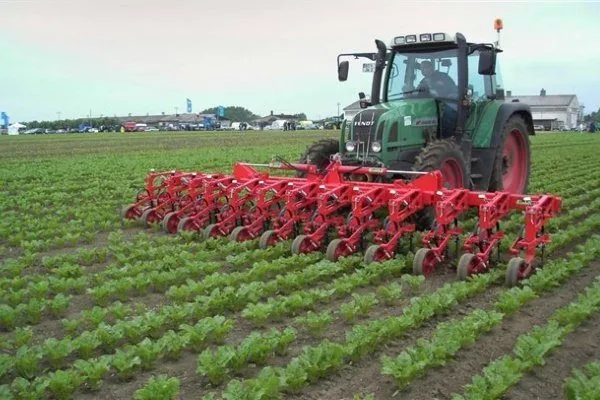
- Four to five days after sowing, perform pre-emergence harrowing of the soil, loosening its surface with harrows or rotary hoes. This agricultural technique helps break up the crust on the soil surface after rain, kill weeds, and increase soil moisture reserves.
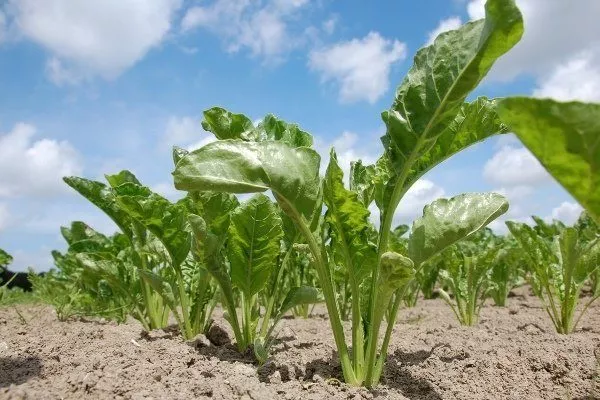
- A few days after the first true leaves appear, perform post-emergence harrowing. Cultivating the soil immediately after emergence is not recommended, as this can damage the seedlings.
- If the soil between rows becomes excessively compacted, perform shallow loosening of the soil between rows of crops to a depth of 6-7 cm. A cultivator with single-sided razors is used for this purpose, but care must be taken to avoid damaging the seedlings.
- When the first shoots appear, bunch or thin the sugar beet rows, leaving bunches of 3-4 strong plants in each row. The first bunching should be done mechanically, and subsequent bunching should be done by hand.
- Provide the plant with timely, abundant watering – up to 25 cubic meters per hectare at the beginning of the growing season and up to 40 cubic meters during the period of intensive foliage development. Starting in July, water the beets up to 3-4 times a month during light rainfall, and in September, watering once before harvesting is sufficient. Watering is not necessary from the second ten days of September.
When caring for seedlings, special attention should be paid to protecting them from potential threats:
- WeedsTo combat them, use specialized herbicides containing glyphosate. Such products must be approved for use and listed in the registry of plant protection products. However, it is important to note that herbicides are not recommended for use during prolonged dry periods.
- Root rot and soil pests (wireworms, sugar beet nematode). Protection against such threats requires proper site selection, crop precursors, cultivars, and tillage methods and quality. Additionally, root crops can be treated with biological preparations (Beta Protect) against rot.
- Soil and foliar pests (flea beetles, beet rot beetles, beet flies, aphids). To protect the crop from them, treat the seeds with insecticides before sowing.
With proper crop care, sugar beet harvesting can begin in mid- to late September.
Harvesting and storage of crops
Just before harvesting, the soil should be watered thoroughly. If beets are grown in large plots, harvesting the roots will require the use of combines, but in smaller farmsteads or garden plots, all the work can be done by hand. This must be done with extreme care to avoid damaging the roots, which will significantly reduce their shelf life.
Dug-up beets should be air-dried and cleared of any remaining soil. Store in a dry place at a cool temperature of 0°C to +2°C. Higher temperatures will reduce the sugar content of the beets. If the room is humid, wrap the beets in parchment paper or layer them with sawdust. They can be stored this way until the next season.
Small quantities of fruit can be stored in the freezer, but before freezing they should be washed, dried, grated or cut into thin strips, and then packed in a plastic bag or container.
Beet tops can be used as organic fertilizer for the next crop after beets. With a root crop yield of 400-500 c/ha, the amount of plowed-in tops will be equivalent to 25-30 t/ha of manure.
Sugar beets are most often grown and cultivated on an industrial scale, but a good harvest of the root crop can also be obtained in garden plots and small farms. The key is to pay due attention to soil and seed cultivation and plant care. If harvested correctly, healthy crops can be stored until the following season.