
Mustard is an annual plant in the cruciferous family. It is grown as a green manure, a honey plant, and as an oilseed crop. In this article, we'll explore its various uses and outline the timing and specifics of mustard sowing.
Why do they sow mustard?
| Name | Flowering period | Frost resistance | Soil requirements |
|---|---|---|---|
| White mustard | 30-40 days | Up to -6 °C | Undemanding |
| Blue mustard | 30-40 days | Up to -6 °C | Undemanding |
| Yellow mustard | 30-40 days | Up to -6 °C | Undemanding |
In agriculture, in vegetable gardens and summer cottages, mustard is most often used as green manure.
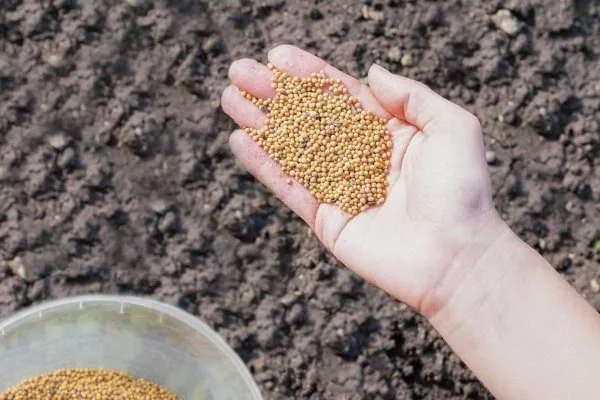
Green manure is a group of plants that are grown for subsequent incorporation into the soil before or at the beginning of their flowering phase.
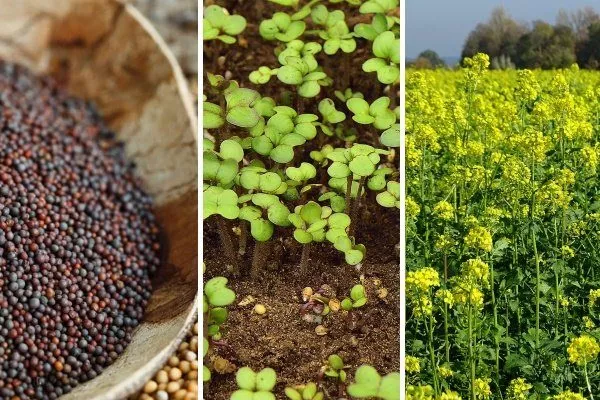
Green manure crops of the cruciferous family include mustard:
- white (English);
- blue-gray (Sarepta);
- yellow.
Let's consider the benefits of mustard seeded in the garden. as green manure:
- enriches the soil with organic matter, nitrogen, and microelements;
- extracts and converts poorly soluble minerals into accessible forms;
- improves the mechanical properties of the soil (the root system loosens clay soils and prevents sandy soils from disintegrating);
- forms compost, protects soil from erosion and leaching of nutrients;
- prevents the growth and development of pathogenic fungi and bacteria (for example, scab);
- inhibits weed growth thanks to a developed root system, which prevents weeds from taking root, and the creation of shade;
- reduces crop rotation, allowing you to sow the same crops in the same place more often;
- mulches the soil and retains snow on it.
Mustard has other uses as well. It is used as:
- Companion plant - is beneficial when planted next to the main crop:
- attracts pollinating insects and thereby increases crop yields;
- repels pests due to the content of essential oils;
- stimulates plant growth through root secretions.
- Honey plant — each flower produces from 0.2 to 0.5 mg of nectar; bees collect 70-100 kg of honey from 1 hectare of crops.
When do they start sowing?
Mustard is sown during the soil's "resting" period (green manure fallow), in row spacing during the main crop's development. Depending on its intended use, mustard is grown in spring, summer, and fall.
In the spring
Early sowing of mustard is justified as:
- "green manure" (green manure);
- companion plants;
- honey plant;
- source of vitamins and microelements in the human diet.
Planting mustard in spring helps reduce the growth and spread of weeds across the area.
Begin sowing the crop in early spring, as soon as the snow melts. Depending on the climate, the time to begin planting mustard seeds varies across Russia:
- for the middle zone - March;
- for southern regions - February 20th;
- For the northern ones - April.
Be guided not only by long-term temperature charts for the region, but also by the weather forecast in case of late spring.
The plant is cold-hardy, withstanding temperatures down to -6°C. Seeds germinate even at +1…+2°C, and at temperatures of 10°C and above, the first shoots will appear within 3-4 days after sowing.
If you are using an annual as a green manure:
- Mow the mustard before or at the initial flowering stage (i.e., 30-40 days after planting). By this time, the plant will have reached its optimal green mass.
- Dig the ground with a shovel.
- Water in dry weather.
Due to the shallow root system, plants are watered generously at all stages of growth.
- Use EM products. These concentrates contain beneficial microorganisms that accelerate the breakdown of plant fibers and promote the rapid formation of humus.
- Plant the main crop no sooner than a week after incorporating the green manure into the soil. Unrotted green material will slow down vegetable growth.
In summer
To restore, improve, and enrich soil, planting mustard in the summer is ideal. During this season, the crop is sown on soils that:
- are removed from crop rotation;
- protect against weeds after harvesting.
When rotating crops, follow these rules:
- To make the most of the fallow land, sow the annual crop twice a season: at the end of May and in mid-July.
- Maintain a 2-week interval between sowings to give soil microorganisms time to process the organic matter.
- Mow and till plants in the flowering stage. If you miss this time, mustard seeds will form and spread throughout the area.
In the fall
To prevent the cleared soil from becoming covered with weeds, sow the empty beds with mustard within 2-3 days after harvesting.
It's especially important not to delay agricultural work in northern regions. Winter sets in early there. If you delay sowing, there's a risk that the mustard won't have time to grow before the frost sets in. In southern Russia, the crop can be planted until late autumn.
In the autumn, it is important to sow mustard as a green manure and to protect the soil from dehydration, freezing, windblown and leaching.
There are two ways to deal with grown mustard:
- Mow when plants have grown to a height of 17-20 cm. Then dig them up or leave them on the surface of the soil until spring (as mulch).
- They are left in the beds if the mustard has not had time to grow, frosts have set in and the soil has frozen.
Peculiarities of mustard sowing
To get the most benefit from a plant, it's important to follow certain agricultural practices when planting it. It's important to prepare the seeds, the site, and plant it correctly.
- ✓ Optimal seeding depth: 1-1.5 cm for light soils, up to 2 cm for heavy soils.
- ✓ Required soil moisture for germination: not less than 60% of the total moisture capacity.
Seed and site preparation
Mustard germinates well without any additional stimulation. However, if you need to speed up seed germination, dilute 0.6 g of heteroauxin in 1 liter of water and soak the seeds for 6 hours.
When it comes to preparing the area for sowing, proceed as follows:
- Clear the soil of weeds and vegetable residues.
- Add organic and mineral fertilizers: ash or dolomite flour and humus at a rate of 1-1.5 buckets per 1 sq. m.
- Dig the soil with a shovel or use a motor cultivator.
- Level the soil with a rake, breaking up large clods of earth.
If you plan to use the plant as edible greens, create raised beds.
How to sow mustard correctly?
The method of sowing an annual plant varies depending on the purpose of its cultivation. The plant, as a green manure crop, planted in a carpet manner:
- Take a handful of seeds and scatter them evenly over the area.
- Stick to the calculation of 1 dessert spoon of planting material (4-5 g) per 1 sq. m.
- Cover the crops with soil or rake them. Uncovered seeds take longer to germinate, are eaten by birds, and are dispersed by the wind.
- Water the area generously with a watering can. Avoid using a hose with high pressure to avoid washing away the seeds.
When growing as a salad crop and microgreens, sow mustard using the row method:
- Prepare the beds. Make furrows 2 cm deep.
- Sow seeds 10 cm apart.
- Maintain a distance of 20 cm between rows.
- Place the seeds into the soil to a depth of no more than 1 cm, otherwise germination will be delayed.
Like a honey plant Mustard is sown in rows, the consumption per 1 ha is 12-16 kg of seeds.
- ✓ Period of maximum nectar secretion: morning hours at a temperature of 18-25°C.
- ✓ Preferred soils: neutral or slightly alkaline with good aeration.
To protect against pests and attract pollinating insects Plants are planted pointwise between rows of main crops.
It's important not to grow mustard in the same bed or after harvesting other cruciferous vegetables such as cabbage, radishes, and radishes. Plants of the same family share common diseases and pests.
In agricultural fields, mustard sowing is mechanized, using:
- coulter for soil-broadcast sowing;
- seeder for continuous row technology.
Watch a video about sowing mustard as a green manure in fields and plots:
By sowing mustard in your garden, you'll enrich the soil, increase your yield, and grow healthy greens. Choosing the right season and mastering simple farming techniques will help you avoid difficulties when sowing mustard and achieve the desired results.